
• Skip to primary navigation
  • Skip to main content
Danny Brown

Danny Brown

podcaster - author - creator

  • About
  • Podcasts
  • Journal

Social Media

Webfluenz Brings Social Media and Influence Analysis to the Masses

When it comes to social media analysis and influence marketing, and the ability to use software to identify and track potential influencers for your brand, one thing that always comes up as a stumbling block is the cost usually associated with it.

Because of the data required to filter and rationalize the findings of platform-specific algorithms, costs usually range from the $700 per month mark to anywhere between $3,000-$5,000 per month. So far, this has meant the benefits of social analysis, as well as true influence marketing, has been limited to mid-to-Enterprise-level businesses and organizations.

One company aiming to change this is Singapore-based Webfluenz.

Addressing the Cost of Social Data

The pricing model makes Webfluenz an attractive solution for businesses of all sizes, but especially smaller-to-medium ones that don’t have the financial muscle a mid-to-large Enterprise-type business has.

Webfluenz pricing

For a solo entrepreneur or professional, the free account is a great starting place, with a lot of features that you’d expect to find in a premium solution: sentiment tagging, demographic locale and ad-hoc filtering.

However, when you move up a scale, either to the $299 per month option or the $499 one, this is where Webfluenz really starts to show its benefits, not to mention advantages over similarly priced competitive solutions.

Meeting Multi-Level Business Needs

Let’s say you run with the $299 per month option – ?this is much lower than industry leaders like Radian6 or Sysomos. Heck, even the $499 per month option is. So what are you getting for that, and are you losing features because of the lower cost? Short answer to the features question – no.
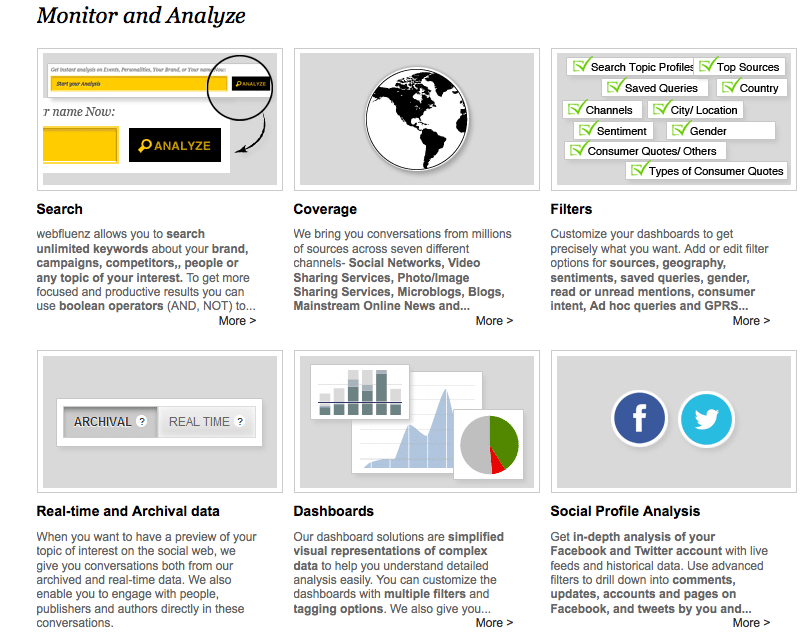
Webfluenz monitor and analyze

Multi-lingual sentiment tagging

Supporting 24 languages of the world’s Internet population, Webfluenz allows you to track around 90% of global languages and allocate sentiment tracking to these conversations. Its proprietary technology breaks common language down into real meaning, as opposed to generic mentions and word definitions.

Qualitative analysis for influencer campaigns

I’m not a fan of judging influence by the amount of amplification an online user can generate. Bots and scripts can inflate numbers. Instead, I’m more impressed by business actions taken based on content shared – sales, leads, downloads, etc. Webfluenz tracks these actions, and the impact on your business, as well as identifies the intent of your target customer (research, compare, buy), enabling a far more effective influencer message can be crafted.

Engagement history

The key to building any kind of business loyalty – online or offline – is the amount you invest in the core relationships that matter. Customer, employee, colleague, stakeholders, etc. Webfluenz tracks all of your enagegements, their levels, frequency, etc., and makes sure you don’t let the most important connections disappear.

Webfluenz Engagement WorkFlow?

Just these three features alone would make an already-attractive price point worthwhile, but the additional features Webfluenz provides takes it up yet another notch.

The Complete Digital Business Suite

One of the biggest complaints around any of the social tools available today is that none of the offer an all-in-one solution.

If you want social monitoring, you need a dedicated monitoring platform. If you want social engagement, you need a good conversation dashboard like a Hootsuite. If you want influence tools, you need ?a Traackr or an InNetwork. If you want a CRM platform, you need a Nimble. And so on.

And this makes sense – it’s rare for any platform to offer an in-depth solution to multiple business needs the way the platforms mentioned above can, in their individual categories.

I’ll give Webfluenz credit here, though – they make a great attempt at answering this criticism.

Competitive analysis

Knowing what works for your competitor, and how they’re driving traffic and sales from their digital efforts, can help you refocus yours and adapt on the fly. Webfluenz shows comparison reports on competitor buzz and growth, while giving you current performance data on your campaigns.

webfluenz - Competitive Benchmarking Analysis? 2013-08-29 15-34-21

Team collaboration and workspaces

Using a simple workflow process, you can assign team roles and duties within the Webfluenz dashboard, as well as follow up on assignments and use this information across internal teams to improve your internal set-ups.

Dashboard reports

If there’s one thing that any business needs, it’s easy-to-understand reports that deliver the kind of data you can act upon. From Deep Dive Reports to Competitive Benchmarking, as well as Comparative Benchmarking and results, Webfluenz has you covered here.

Webfluenz and You

That’s just a sampling of what’s on offer – the full suite of tools, and the ease in which almost any level of user can start diving in, is what helps Webfluenz stand out in an already crowded marketplace.

Add in a detailed user guide, as well as a hands-on support team and account management guide, and you’re going to be pretty hard pushed to find as cohesive a platform at the price Webfluenz is currently being offered for.

If you’re already using a social analysis platform and you’re happy with its performance and features, then you’re probably not going to change anytime soon.?If you’re currently looking for a new suite of tools, though, and you don’t want to break the bank while doing so, I’d definitely recommend checking Webfluenz out.

If they’d create an open API to connect with other tools, it’d be an even better solution that it currently is. The UI could also be a bit slicker when it comes to the engagement dashboard. But?I’ve mostly been impressed so far and, as a demanding grumpy Scotsman, that’s never an easy thing to do.

Nice work, guys.

Edit, August 30: Just heard from Rachana Khanzode, head of social marketing at Webfluenz, and seems the platform does offer an open API, so integration with other platforms should be good to go.

On Standing Up to Cyberbullying

Fighting cyberbullying

Earlier this week, my ArCompany colleague Hessie Jones wrote a damning blog post on the state of social networks and their approaches to cyberbullying.

It’s a powerful read and looks at both sides of the coin – is it merely down to platforms to tackle, or users of the platforms as well, by speaking up when they see something wrong happening?

As someone who’s suffered bullying as a child, it struck home with me, especially now since online personas make it easy to target victim(s) behind a veil of anonymity.

Which is why I’ve started a Clipsi board around the topic of cyberbullying and where social networks fit in. I’ve covered the value of Clipsi as a news resource on this blog previously, so it made perfect sense to use this new platform.

Some statistics around the topic of cyberbullying:

  • Nearly 43% of kids have been bullied online. 1 in 4 has had it happen more than once.
  • Girls are about twice as likely as boys to be victims and perpetrators of cyber bullying.
  • About 58% of kids admit someone has said mean or hurtful things to them online. More than 4 out 10 say it has happened more than once.
  • Bullying victims are 2 to 9 times more likely to consider committing suicide.

That last statistic is tragically pertinent, with recent high visibility news stories highlighting the impact of cyberbullying on teens and what they see as the only way to escape.

Of course, cyberbullying isn’t restricted to teens, with adults coming under unwanted and threatening scrutiny. Clearly there is a major problem with today’s society and easier accessibility to people.

While we can’t stop it overnight, we can continue the process to eradicate it – or, at the very least, make it something that won’t be ignored. This Clipsi board is my way of joining the battle.

If you have any resources you’d like to share, please leave them in the comments below and I’ll add to the board. To follow the board and suggest resources, simply create a Clipsi account for yourself and hit the “Follow” button.

Let’s get started.


image: kid-josh

Social Media Intelligence, The UK / North America Digital Divide, and Social’s Impact on Influence

Social media measurement

Social media and HR

With a long weekend coming up here in this part of Canada, I’m about to take some downtime with my family and switch off for a few days. So, to end the week, I thought instead of a normal post here, I’d point you in the direction of three recent guest posts / Q&A’s elsewhere around the web.

I was grateful to be asked to contribute to three very different blogs in recent weeks – Canyon Communications, Salesforce and The Social Penguin – and the results can be found below. They cover different yet connected topics, so hopefully you’ll find use in at least one of them!

Cheers, and see you next week!

How Social Media Impacts Influencer Marketing

My guest post for the Salesforce.com blog takes a look at how influence is being skewed by the ever-growing noise and ambiguity of the social web.

By creating systems where noise and amplification is rewarded, and social impressions are currencies versus dollar return, are we creating an ecosystem where brands can no longer pinpoint who can help them reach, and meet the needs of, their target customer base?

Read the full article here.

Social Media Intelligence Isn’t Exclusive to Interaction and Participation

Over at Canyon Communications, the topic of discussion is determining business value and the return on investment for your social media efforts.

Often business are out off from entering the social space because of the “engage or die” mindset that often pervades their participation. This fear of scale, interaction, negative feedback, etc., stops many businesses from enjoying social’s benefits across multiple verticals.

This post shares three ways to overcome that fear and use social media intelligently – Social Research, Social Listening, and Social Influence. But more than just marketing examples, it shares how to optimize data insights, company culture, customer retention, crisis communications and much more.

Read the full article here.

Social Media, Digital, and the UK / North America Digital Divide

The last, but not least, post can be found at UK-based The Social Penguin, and is part one of a two-part Q&A.

While many companies are using social media as an integral part of their bigger business strategy, others are lagging behind or struggling to adapt. This can be for many reasons, all of which may have some validity but more often than not are simply used as a fallback.

In part one of the Q&A, I discuss why conflicting information and the fear of selling is social media’s biggest detractor; an example of a great social media campaign that delivered results; the differences between the UK and North America when it comes to digital and social; and why we need to break the silos of PR, social, SEO and content.

Read the full article here.

And with that, I bid you adios!

Why We Need The I Don’t Care Button on Facebook (Infographic)

I don’t normally share infographics here on this blog, as I find most to be a mess of anecdotal data and limited research. However, as someone who’s been going through a culling process on Facebook for many of the reasons listed in this infographic, I thought this was a fun one to share.

Designed by Alessandro Di Ruscio, founder of “infocomics” website The Maple Kind, Why We Need The I Don’t Care Button on Facebook pokes fun at some of the status updates that find their way into our streams every day.

Alessandro’s mission is to make infographics that are funny and waste your time, as opposed to the ones that don’t teach you anything and waste your time. Seems he’s onto something there.

You can check out his other infocomics?here.

Courtesy of: The Maple Kind ? Where infographics meet comics and bullshit!

Why the Best “Social Media Stars Reality Show” is the One That Doesn’t Need Made

Social Media Stars Reality Show Season One

Social Media Stars Reality Show   Season One

Over on Facebook, strategist and author Olivier Blanchard shared this golden nugget of TV brilliance (if brilliance shares the same stage as pointless and lameness): there’s going to be a reality TV show on “social media stars”.

Okaaay…

So sure, social media has embedded itself into the mainstream, with sporting events and news stories relying on live social feeds to add to their coverage. As a driver of social change, it’s an incredibly powerful tool.

For businesses, small or large, social media can also be hugely effective at offering alternative solutions for brand awareness campaigns, hiring new employees, competitive analysis, customer experience and more.

So, there’s no doubt that social media can be, and is, a key part of our everyday lives, personally and professionally.

Yet a reality TV show purporting to showcase “social media stars”? Come on.

Why It’s a Joke to Begin With

When you take a look at the promo page for the show, it greets you with this outstanding sales pitch:

Social Media Stars Reality Show?is looking for YOU! This is your shot at stardom! Live in a Miami Beach Mansion, hang with fellow superstars and engage in social media challenges to show your stuff! From the creators of?Top Recruiter: The Competition, comes Social Media Stars Reality Show.

Are you legendary on LinkedIn, a prodigy on Pinterest, talented on Twitter and fabulous on Facebook? If your friends ask you to ?teach them Twitter? and their jaws drop when you?re done,?we want YOU!

Now, I get that, for the sake of brevity, the pitch may be limiting itself to the platforms mentioned here. Either way, it doesn’t bode well for the show (if anything could – but I digress…)

At best, it’s Social Media 101: “Oh hey, we need to do that social media thing, let’s get on the Twitter and start Pinteresting stuff.” Because at the end of the day, that’s all social’s really about anyway.

Apart from the stereotypical pitch, though, are we really saying there are “social media superstars” that deserve a TV show (even in a medium as tacky as reality TV)?

Then again, when you think of it like that, it does start to make sense.

The Ego Has Landed

One of the things that social media has enabled is the ego to be not only heard, but amplified to the Nth degree. If you thought people buffed up their resumes pre-social to sound interesting, that was nothing compared to the ego-driven narcissism that social media empowers certain folks with.

Now authors can be bestsellers with just over a thousand books sold; social scoring platforms pretend you’re the most influential person on topic X; social media consultants list their physical address as social networking site Empire Avenue (I’m not making this shit up!).

And on, and on, and on…

In that respect, perhaps a reality TV show would be perfect. Now, instead of those in the social media bubble knowing the amount of self-loving assholes that can be found in this space, the wider general public can laugh along too.

It’d be like the Fast Company Influencer Project all over again.

Fast Company  Influence Project Proves Online Influencers Have No Actual Influence   TechCrunch

Then again…

Real Stars Just Get on With the Work

The Social Media Stars reality TV show is simply an evolution of the conversation that’s been happening on social media for a while now – that of building yourself up versus building the success of your clients.

Social media, for some strange reason, seems to continue to reward those that shout the loudest versus those that just get on with the work and deliver results.

To some degree, you can blame social scoring for encouraging an ego-driven points game to see who is the “best”. It’s not just restricted to scoring, though – even respected business network LinkedIn seems to be placing more emphasis on being part of a self-congratulatory Top 1% Users list… wahoo.

We can also blame ourselves. We don’t carry out due diligence on the claims of the social media folks we have placed on some fabled dais, rock gods who can do no wrong and espouse pearls of wisdom that are no deeper than a thin crust pizza with no toppings.

Meanwhile, the real stars, if you like, are just getting on with the job and getting results.

  • Companies like Lebanon Ford, who showed what can be achieved with a solid social team and strategies.
  • Businesses like Canadian Pet Connection, who’ve successfully bridged their offline customer experience into the online field, and are enjoying an increased community and ROI because of it.
  • Organizations like Razoo, who’ve raised more than $160 million for charitable causes.

The list goes on, and on, and on.

These are the stars of social media. These are the folks that are delivering, day in, day out. These are the people that don’t care about some reality TV show where you might get 15 minutes of questionable fame – because the reality is, they’re already famous, but for the right reasons.

I’ll celebrate that kind of fame any day.

Influencer Project image: TechCrunch

  • « Go to Previous Page
  • Page 1
  • Page 2
  • Page 3
  • Page 4
  • Page 5
  • Page 6
  • Interim pages omitted …
  • Page 38
  • Go to Next Page »
© 2026 Danny Brown - Made with ♥ on Genesis