• Skip to primary navigation
  • Skip to main content
Danny Brown

Danny Brown

podcaster - author - creator

  • About
  • Podcasts
  • Journal

Social Media

Three Cool and Inexpensive Tools to Track Twitter Hashtags

Grandiose

Judging by the outcry over Tweetchat having to close, due to Twitter’s new API restructuring, and the interest shown in replacement platforms, it’s fair to say that Twitter chats continue to be popular for both Twitter users and brands alike.

The ease in which topics and conversations can be filtered using the hashtag on Twitter enforces the idea that, when done right, Twitter chats and their attached hashtags are a great way to solicit feedback, user experience, crowdsourcing and more.

To make that ease even more effective, here are three cool hashtag trackers that don’t need a second mortgage to use.

1. Tagboard

The first platform is one I came across just last week, called Tagboard.

Tagboard home

Working out of Redmond, Washington, Tagboard allows you to view hashtags across multiple networks. They currently support Twitter, Instagram, Facebook, App.net, Vine and Google+.

You can either track popular hashtags currently happening across these platforms, or create your own to monitor. Below is an example of the one I created around the Influence Marketing book hashtag.

Tagboard influence marketing

You can either view all conversations across the platforms your hashtag is active on, or use the top navigation to filter out the channel(s) you wish to concentrate on.

If you want to join the conversation, you can reply directly on Twitter via the Tagboard panel, or click the comment/reply option for the likes of Google+ and Facebook and be taken directly to the discussion on that platform.

While fairly simple at the minute, Tagboard offers a clean and uncluttered snapshot at who’s talking about what, and on what platform, when it comes to your chosen topic.

Pros: Free to use (currently), clean, ability to upload logo for some personalization, multiple channels.

Cons: Limited customization, no analytics, no embed feature, no live stream option. (Note – these are available to users that contact Tagboard and request these features turned on, with price to be determined.)

2. Keyhole

Next up is Keyhole, from Waterloo, Ontario in the technology heart of Canada.

Keyhole home

The pet project of technology whiz-kids Saif Ajani and Minaz Abdulla, Keyhole was originally built as a personal solution to the pain that often comes with trying to track Twitter conversations. That solution became Keyhole and is used by several brands today.

What I like about Keyhole is it goes a little bit deeper than standard impressions and reach (although they’re still catered for here). Instead, you can find out more about your demographics and where they’re sharing the conversation.

Keyhole Audi

In the image above, for example, you can see a conversation around car manufacturer Audi. As well as the numbers around tweets, users, reach and impressions, you can see who had the most retweets, what their Klout score is, and top recent tweets around the topic.

When you set up a hashtag to track, you gain access to even more information.

Keyhole Audi extended data

Other useful data provided includes:

  • The Top Sites section allows you to see what domains were mentioned using that hashtag, and what tweets sent traffic there;
  • Share of Voice shows which vehicle is being spoken about the most;
  • Most Influential informs who gets the most retweets, who has the biggest Klout score, and who talks about the brand the most.

Add in Location, Demographics, Topics based on Hashtags or Keywords, and Top Sources for tweets, and Keyhole offers a fairly sturdy platform for solo users and brands alike.

Pros: Lots of useful data, clean layout, three monthly pricing models ($14, $39, $99), downloadable reports, embed options.

Cons: Only for Twitter, no way to respond to a tweet from inline.

3. oneQube SmartStream

Located in New York and built by Internet Media Labs, oneQube and its SmartStream product offers a host of solutions for anyone looking to really dig deep into Twitter chats and their accompanying hashtags.

oneQube? home

While oneQube offers more than just SmartStream, it’s that part of the oneQube jigsaw that offers the most potential for hashtag users and trackers.

By setting a hashtag, you can not only track it, but use the oneQube dashboard as a social dashboard, along the lines of Tweetgrid and Hootsuite. This allows you to seamlessly take part in a conversation you’re tracking, without the need for multiple dashboards.

But that’s bread and butter stuff – the real meat comes from the data you can glean from SmartStream around the hashtag in question.

oneQube?   hashtags 2

Much like Keyhole, you can see the most engaged, the most retweets, and the most “influential” users around a topic. However, where SmartStream really gets interesting is with the extra data they provide around that basic information.

If you look to the right of the image above, you can see a section called Secondary Hashtag Conversations. This allows you to see topics that could be related to the core one you’re discussing, offering an opportunity for brands and Twitter chat moderators to reach a wider audience.

SmartStream also offers a handy hashtag map that lets you see how closely tied these other conversations are to yours – the larger the circle, the bigger the relevance and opportunity.

oneQube hashtag map

On top of that, you also have access to detailed information around not only the standard demographics of your hashtag participants, but additional data-points like the type of profile (Business, Individual, Commercial, etc.), as well as the trending topics around that discussion.

oneQube?   hashtags

This kind of information is useful for brands, obviously, but it also allows Twitter chat moderators to provide extra details about the type of people their chat attracts, which can help them find sponsors to work with. You can find a detailed guide to SmartStream here.

Pros: Currently free in beta mode, detailed anlaytics, hashtag map for connected topics, integrated social dashboard.

Cons: Currently suffering from bugs (the SmartStream fails to load), no threaded conversations option on the dashboard, Twitter only.

  • UPDATE 28 JUNE 2013: oneQube is currently offline as they look to update their servers. The bugs I highlighted in the Cons need to be fixed before the platform is public again.

Your Turn

These are just three platforms that have caught my eye when it comes to hashtag tracking. Each has their Pros and Cons, which I’ve shared here. It must be noted that beta products do tend to suffer their fair share of bugs, so keep that in mind when coming up against any glitches.

How about you – what tools do you currently use for hashtag tracking and Twitter chats, and why these ones? Share in the comments below.

Why Social Software Platforms Fail

Salem crappy product quote

Salem crappy product quote

In my role as Chief Technologist over at ArCompany, and from a love of technology in general, I test, play with, compare and recommend all sorts of different platforms, software technologies and solutions.

There’s just something about the promise and potential of data and technology – when used properly and for the benefit of customers as well as the business – that gets my motor running (sorry, Steppenwolf fans!).

An interesting side effect of this is you get to see firsthand why certain social software technologies succeed while others fail, even though on paper they may look the same.

The ironic thing is, the ones that fail could easily avoid their fate – or at least have a better chance of avoiding it – by simply being better prepared.

They Don’t Understand the Space

One of the biggest mistakes where I see companies tripping over is building a platform for a space they have no experience in. Being a great coder or developer is one thing; being a great developer or coder for a space you don’t understand is another.

With social media offering a real-time and often pervasive invitation to look at how people converse with each other, and what opportunities this offers for brands and organizations, the potential for true customer understanding is huge.

But this level of understanding comes at a price – you need to understand text analytics, ontology, and how these two interconnect when it comes to identifying emotional triggers in a conversation.

Because each social platform has its own little nuances, this task becomes even more convoluted. If you, as a software company, don”t have the personnel that understands these nuances and what that means for data analysis and filtering, your platform will be rendered ineffective.

Too many companies would rather place this important part of the puzzle in the hands of developers only, instead of partnering developers with the kind of data analysts and human language scientists that can turn a so-and-so platform into something so much better at connecting the human dots.

This immediately limits the usefulness of the platform. After all, you wouldn’t ask a learner driver to get behind the wheel of an F1 race car, would you?

They’re In It Just for the Money

Businesses need to make money. That’s a given. As I’ve said several times before when talking about influence marketing and how companies should be using it, I challenge any business to stay afloat on goodwill and social proof alone.

But here’s the thing – when you create something purely with the intent of making a lot of money, and not really caring about the quality of the product or the customers that will be using it, it will more often than not bite you in the ass.

While he receives a lot of criticism about his platform, Facebook CEO Mark Zuckerberg always struck me as having the right mentality when it came to this issue.

We don?t build services to make money; we make money to build better services.

Fourteen words. A simple mission statement in fourteen words. Yet it’s one that has seen Facebook become – arguably – the biggest social software platform in the world.

It’s a mantra the likes of Apple and Google follow. By putting the needs of the user first, and building solutions that will actually benefit them and solve their problems, success is the organic end result.

User experience

The way Apple products seamlessly connect to each other via the iCloud platform; the way Google+ drives every Google product touch-point when it comes to interacting with Google’s customers.

It wasn’t luck or chance that saw these three companies, and others like them, make this focus on the end user the core product feature. Each company knew that by offering something that just works, and isn’t complicated or trying to be something it’s not, money would follow.

Too many social software platforms enter the space thinking that social media is the golden goose for profit. It can be; but not if the sole intent is to make money and to heck with the user experience.

They Don’t Understand Community and Content

For many startups, marketing dollars are a luxury. While some companies are fortunate to have generous investors from day one, the majority of startups, especially in the social space, don’t enjoy that umbrella.

For these companies, content and community are two of the core methodologies for getting people to know about you and/or your product, and why they should use you over your competitors who have been established for a while.

Not only that, but you’re walking the talk as well as just sharing cool soundbites. This is just as true for established companies – the social space is a hive of conversations, groups, communities, chats and more. Get the right people for that part of your company’s growth and you’re giving yourself a fighting chance of success.

Look at companies like Marketwired, with Sheldon Levine; or Salesforce MarketingCloud, with Trish Forant; or InNetwork Inc., with Daniel Hebert and Kelly Jennex. The first two companies are well-established, while InNetwork Inc. has just come onto the scene in the last few months.

All three, though, share the mindset that content and community will help them not only grow awareness of their products and what their company does, but also create a loyal user-base as well as drive innovation through the feedback from their communities, and the content that community leaves points of view on.

Listening to your blog community

Too many social software platforms, unfortunately, see content and community as a burden rather than an opportunity.

So instead of hiring the right people that can truly drive this part of the strategy, they instead do nothing or, perhaps worse, hand over the reins to engineers or developers that – through no fault of their own – are clearly out of their depth.

The three companies mentioned above show what happens when your social footprint strategy is as key as the social software you’re developing.

Wake Up or Break Up

In the last 12-18 months, there’s been a lot of consolidation in the social space. Some of this is through choice; some, through financial needs.

Either way, these companies have continued to evolve and, for the most part, improve. Because they’ve continued to keep the right people; stay on the right path; and concentrating on the user experience as much as the cool development experience.

Newer platforms coming into play continue this mindset. Guys like oneQube, TrendSpottr and SqueezeCMM, for instance, place utility and solutions over features and vapourware.

They understand the marketplace: ?what works, what doesn’t, and – more importantly – why. It’s not rocket science, yet so many social platforms make it look that way.

Then again, they only have themselves to blame. A CEO of a company that’s struggling in the space right now once said to me,

It doesn’t matter what we build. Good marketers can market shit.

While that might be true, it’s also a damning statement on your goals and vision, or lack thereof. While you might be able to sell shit, customers and users that can’t use that shit will soon move elsewhere, where their needs are actually met.

Leaving you to wonder why it’s your company that’s now in the shit…

UX image: headspace

Why Diminishing the Benefits of Slacktivism Isn’t A Great Idea

Over on Facebook, my friend Gini Dietrich posted a question about trying to locate an image, used by a non-profit organization in a new campaign.

The image in question is the one below.

UNICEF Facebook Likes campaign

The messaging behind the campaign is simple – while Liking unicef.se (unicef Sweden) on Facebook is all well and good, and they certainly wouldn’t discourage that, it costs money to actually carry out the work unicef and other non-profits do every day of the week.

That makes sense.

What doesn’t make sense is potentially alienating the very people you’re pseudo-criticizing in a campaign like this, by implying slacktivism doesn’t do any good.

Slacktivism and What Defines Action

A relatively new term, slacktivism is regarded as follows:

Slacktivist activities include signing Internet petitions, joining a community organization without contributing to the organization’s efforts, copying and pasting of social network statuses or messages or altering one’s personal data or avatar on social network services. – Wikipedia

To use the slacktivism definition with regards the unicef.se ad, the suggestion is all the social activity in the world (in this case, Facebook Likes) isn’t going to save lives because it’s not resulting in hard cash.

That view is echoed in a comment on Gini’s Facebook wall around the ad by marketing professional Lisa Byrne:

People think clicking like means they are now supporting in some way cos they’re spreading a message – it’s all too easy a copout. I love what Unicef did – CALL TO ACTION PEOPLE!

This implies that unless hard cash is being donated, or a more substantial action taken other than Liking a status update or Page, then it’s not really action at all. Which, while that viewpoint is understandable, misses the longer tail picture.

The Benefits of Slacktivism

Social Change Anytime EverywhereIn their excellent book Social Change Anytime Everywhere, authors and ?non-profit specialists Allyson Kapin and Amy Sample Ward share case studies, examples and methods on how to support non-profits via social media (as well as through “traditional” methods).

In Chapter 2 of the book, they look at the slacktivism question, and offer a very balanced overview of both pros and cons.

From the book:

Regardless of the era (this isn’t a new phenomena), the emphasis and effort spent on spreading information and raising awareness has always resulted in people doing what organizations ask, even if it’s considered slacktivism.

Liking a Page, liking a post, and all the rest are not the actions and real impact you’re looking for, ultimately, but those actions are important! Why? Because, through them, people are telling you that they will do what you ask to support the cause.

As both Kapin and Ward point out, while the end goal may be financial donations, the path to making those donations happen can come in many forms, and the act of spreading awareness – even through something as simple as a Like – is part of that path.

Taking it further is Steven Edward Streight, a New York-based senior copywriter and trustee for a local non-profit. In Steven’s words:

I am a trustee of a local non-profit. The grant writer told us that Facebook Likes, Comments, and Shares actually do help with getting grants and donors, because social media interactions indicate we are reaching out to the community and the community supports what we do (Peoria Historical Society).?So I believe that the non-profit is wrong.

This endorsement is a perfect example of why slacktivism, even though it may not be a financial action, should not be dismissed as not adding anything to the bottom line.

The ROI Equation

Back in 2009, I founded a social media-led charity project called 12for12k. The goal was to find 12 charities, and support a different one throughout the 12 months of 2009, and hopefully raise $12,000 per charity throughout the year. Hence the name 12for12k.

I was fortunate to be surrounded by some very kind and awesome friends – people like Susan Murphy, Jon Aston, Darin Bernston, Rachel Kay, John Haydon and many, many more who believed in the project and donated their time and expertise for free.

Since the aim from day one was to give 100% of donations to the supported charities, this free expertise was a Godsend.

However, as focused and as determined this original small group was, there’s no way in heck we’d raise $12,000 between 6-8 people every month. And this is where a combination of awesome supporters and slacktivism came into play.

We created avatars that people could display on Twitter and Facebook. We connected with blog partners who would feature each new charity every month. We asked people that couldn’t afford to donate to simply share or blog posts and other content across Facebook and Twitter.

And it worked. I can give you at least fifty or so examples of people struggling financially, but who worked their asses off at getting the charities in front of more fortunate friends (from a financial point of view).

Those passive little 12for12k avatars that started popping up across social networks? People saw them standing out from others, and asked about 12for12k and the charities we were supporting.

12for12k avatar

This led to several mainstream media news stories and features about the project.

The end result? While we didn’t hit the overall goal of $144,000 across 12 charities, we did raise more than $91,000 in 12 months, and a further $9,000 in the first month of 2010.

A Clear Definition of Action?

These examples, and many more like them, highlight a simple fact – while unicef’s ad may be technically correct, it doesn’t start and end there.

No-one is denying that non-profits need donations to carry out the awesome and often-hard and unrecognized work that they do. It’s why between 30,000 and 60,000 non-profits are believed to close each year – and that’s just in the U.S.

The truth of the matter is, we need to support non-profits financially, and ensure the causes most at supported by non-profits can actually be helped. But to suggest that slacktivism isn’t helping is doing a huge disservice to those folks that can’t afford to help financially, but want to help in any other way they can.

This is where social media-led action – or slacktivism, if you like – can raise awareness and put a charity in front of the very people that can not only donate at that time, but become involved more deeply with the charity and support for years to come.

Turn these people away, and the next non-profit to “fail” could be one that doesn’t see value in all forms of support beyond financial.

And one final piece of irony, that made me smile wryly when I saw the unicef ad – UNICEF USA approached 12for12k early in 2009 to partner with them, and that partnership happened in June 2009.

I guess a project that uses slacktivism as a key component can offer benefits…

Social Media Doesn’t Create a Crisis – Companies Do

If you type the term “social media crisis” into Google, you’ll receive about 1.7 million results. Remove the quotation marks, and you’ll get almost 700 million results.

Social media consultants will point to the likes of Motrin, Chick-Fil-A, Applebee’s, Kenneth Cole, United Airlines and others like them as examples of a social media crisis, where a business has come under heavy fire online on their own social channels, as well as blog posts and social updates elsewhere.

While it’s true that social media amplifies a crisis when it happens, it doesn’t actually create the crisis – the company does.

Social Media Crisis or a Crisis on Social Media?

Over the last few days, two more companies have found themselves the target of online unrest and extremely vocal criticism of their business practices.

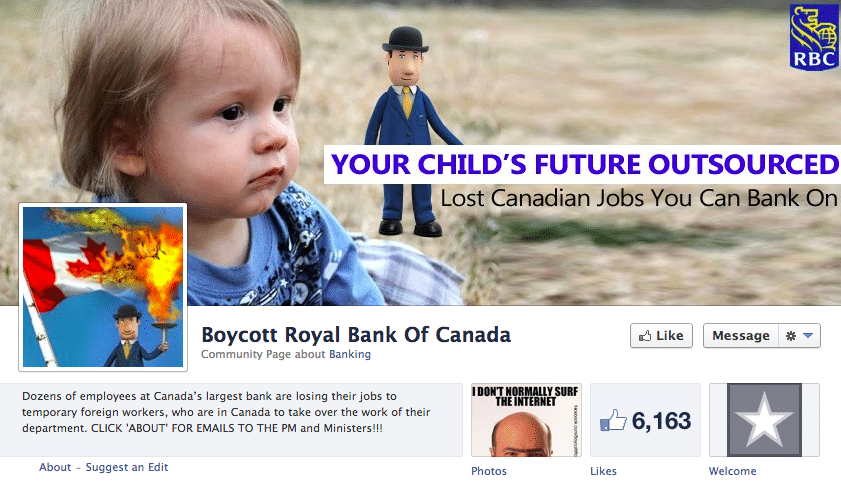
The Royal Bank of Canada – RBC – is currently facing a firestorm of vitriol surrounding media reports that they’re laying off full-time employed Canadian workers and replacing them with temporary workers from abroad.

This is counter to a Canadian government Temporary Foreign Worker Program that only allows such workers to be used if there are no suitable Canadians. As someone who kind of went through this process when I moved to Canada, I understand why they have it in place.

According to the media reports, RBC is bypassing this program by using an outsourced company based in the U.S. to hire temporary workers, and then have the current full-time workers train the temporary staff to replace them.

The response on social media has been swift and forceful.

Boycott Royal Bank Of Canada

On Facebook, a “Boycott Royal Bank of Canada” page went up and has (at the time of writing) garnered more than 6,000 likes in less than 24 hours.

The page shares links to articles on how this situation arose, other related content in the provincial government’s part, and stories from current customers looking to close their accounts.

RBC, for their part, issued a statement on their Facebook page, but unfortunately that fuelled the flames even more (click to expand).

RBC Facebook page

It’s not just RBC that’s under fire today. Fellow Canadian company Hootsuite, developers of one of the leading social dashboard’s, is facing criticism for using unpaid interns.

In a recent “job listing” on their careers page, Hootsuite offered the following:

Note this position is a three month internship at present with a commitment of Monday to Friday with core hours of 9 a.m. -5 p.m. and that the role is unpaid.

The word “internship” divides a lot of business owners, as well as potential interns. In the past, internships were mostly unpaid – the applicant would normally be a college student looking for work experience, and for that experience they would provide free labour to the business that “employed” them.

However, in recent years, unpaid internships have become a hot topic of debate, with calls for them to be abolished and students paid accordingly.

In Hootsuite’s case, where the main outcry has gained even more steam is that it’s illegal in the Canadian province where Hootsuite are based to not pay for the work the interns would be doing.

The British Columbia Employment Standards Act states:

…employees must be paid at least the minimum wage (currently $10.25 per hour), and an intern performing duties and responsibilities that would normally be assigned to an employee must be paid the same wages and benefits that an employee would collect.

The key point from that statement is “…performing duties and responsibilities that would normally be assigned to an employee…”.

Since the original internship ad was for positions covering “affiliate marketing”, “strategic accounts analyst” and “social media coach”, it’s a pretty safe bet to assume these would normally be handled by full-time employees.

While Hootsuite has since removed the ad, and their CEO responded to the criticism that the process is “under review”, their social channels are pretty quiet, particularly Facebook where questions are being asked.

Hootsuite Facebook criticism 1


Hootsuite Facebook criticism 2

It’s not that these questions have simply been missed – Hootsuite is still answering questions on Facebook, but they’re just skewed towards non-negative ones.

Hootsuite Facebook positive response

The two examples above, and the ones from the introduction of this post, are core reasons why it’s not social media that causes a crisis, but the actions of a business.

Business Practices Are What Cause Outrage

While social media is the perfect channel for amplification of criticism and the kind of outcry we’re seeing here, it’s not the instigating channel.

Instead, that lay with the executive decision at RBC and the hiring policy of Hootsuite. Both of these decisions are made offline.

The fact they’ve now made their way online and are evoking such vocal condemnation – more so with RBC – is a perfect example of how social communications may have changed the way we do business, but the underlying business practice is the one that still defines a company’s perception.

My friend, and super smart communications professional, Ann Marie van den Hurk offers some insightful thoughts. Ann Marie is Principal of Mind the Gap Public Relations, as well as author of upcoming book?Social Media Crisis Communications: Preparing for, Preventing, and Surviving a Public Relations #FAIL.

Business practices are what cause outrage against companies. Outrage is outrage, regardless of where it starts. It could start online or offline and then move to social media and spread. It doesn?t matter. It is real either way. It is the business practices and then their response to customers’ concerns and anger. Or, in this case, lack of response to the outrage.

As shown by the lack of response (so far) on both RBC and Hootsuite’s Facebook pages, silence from a brand can do more damage than interaction. The ease of social media in enabling people to vent their frustrations – and vent even more if/when these frustrations are unanswered – can make life pretty uncomfortable for brands caught in this kind of crossfire.

Social media is a perfect tool for outrage exasperation. It is a better tool than any other channels for spreading outrage. People are more linked. The cost of access is very low. People who were angry at an organization or a situation before social media had limited options. Instead of shrugging it off and throwing up their hands, the outraged can now use those same hands to take to social media, expressing themselves and organize with like-minded individuals.

This is the new battlefield brands continue to find themselves in today. Some are better prepared for it; others, less so.

While both RBC and Hootsuite have posted official “responses” on either their own Facebook pages or to specific media channels, the bigger bulk of the questions being asked – from individuals – are being left unanswered.

In Hootsuite’s case, answering “positive” questions while bypassing critical ones during the same time phase could be seen as avoiding the issue, despite the communication from Hootsuite elsewhere.

Organizations are slowly getting more sensitive to outrage and are putting a higher priority on dealing with it; however organizations aren?t moving that the same speed as those outraged. The open, interactive attitudes of social media and the traditional business culture aren?t exactly well matched. Most organization?s management teams have not been able to keep pace with the explosion of social media usage and are ill equipped to manage community outrage.

As Ann Marie points out so eloquently in all three quotes above, social media is a challenging space when it comes to crisis communications.

It can be a very fine line to tread – when do we respond, who do we respond to, and should we respond or will be be flaming the fire even more?

In some cases, there really is no victory to be had by the brand, regardless of how well they respond, which doesn’t help matters.

One thing we can learn, though, is social media will continue to be the torch bearer to hold companies to task. Perhaps the lesson is to look internally first and improve the business practice (perceived or real), before the external voices react to the internal actions.

Time will tell.

Note – my sincere thanks to Ann Marie for her time and sharing her expertise.

Using the Google Analytics Trackbacks Feature to Create a Content Strategy

Trackbacks chart

This morning, I noticed Google Analytics had added a Trackbacks section to their Social Analytics data. This, to me, is very big news.

While bloggers will know all about Trackbacks and why it’s nice to get them, businesses may not be aware of their importance. Yet as the social web in particular continues to be graded, Trackbacks could become even more important, especially in the eyes of Google, as they look to rank the Authority of content and that content’s creators.

So why is this new Trackbacks edition to Google Analytics important and, more importantly, how can you use them to build your content strategy?

The Validation Factor of Trackbacks

For anyone who doesn’t know what a Trackback is, its definition is:

TrackBack is a type of?peer-to-peer?communication system that was designed to send notification of updates between two?Web sites?via a Trackback Ping.?Ping?in reference to TrackBack refers to a small message sent from one?Web server?to another. TrackBacks are useful for informing a Web site that you have referenced its Web site within your own Web site, and is popular with?bloggers.?TrackBack was first released as an open specification in August 2002. – Webopedia.

So, if I write a post and reference content elsewhere, that’s me providing a Trackback to the article. The reason bloggers like Trackbacks is simple – it offers validation that your content is seen as informative enough that someone else wants to share with their readers too (click image to expand).

Trackbacks  Links

The potential results of that share, or Trackback, are numerous.

  • New readers or subscribers;
  • New potential customers;
  • Growth of influence;
  • Identified as a thought leader in your industry;
  • Search engine optimization (SEO) benefits.

These are just some of the immediate effects; however, by understanding what Trackbacks are and the potential they offer, you can begin to identify opportunities for your business to use this new feature in your content strategy.

Using Trackbacks in Your Content Strategy

As brands begin to understand the importance of content as part of their marketing strategy, using every tool in your toolbox becomes key when it comes to standing above your competitors and attracting eyeballs to your content.

There are a host of ways to do this currently. For example, being part of Google+ Communities or Linkedin Groups, where you can share your content with regards a topic of discussion (in a non-spammy, relevant way, of course).

You can also encourage social sharing via the likes of Twitter, Facebook, employee accounts, etc, or you could join a blog aggregator service like Triberr to increase your content’s visibility.

However, with the new data on Trackbacks available in your Google Analytics dashboard, you can use this additional information to build a content strategy into the bigger picture.

  • Head on over to the blog or article in question, and thank the author, giving you more visibility to their audience, and showing you appreciate these referrals. It gives a good impression of how you do business.
  • Identify the most popular content when it comes to Trackbacks, and use that data to build a series (or series of series’) around these topics.
  • Identify the type of blogs that are sending readers your way, and determine if there’s any kind of partnership opportunity.
  • Identify blogs that send a lot of new traffic via Trackbacks, and begin to link to them as opposed to their competitors, building a relationship that could turn into future business.
  • Offer a value-added service to clients by filtering where they could improve their content and what type of information they could start to produce.

Again, these are quick, simple changes you can make now to start improving your own content strategy (and that of your clients). As the new Trackbacks service solidifies, expect more examples to become clear.

And when you tie that into the information available from the Data Activity Hub (click image to expand), that shows where your content is creating conversations elsewhere across the web, you can see the advantages your brand could begin to exert over your competitors.

Data Activity hub

As I’ve written many times before on this blog, understanding your traffic and how you can utilize that is key, for bloggers and brands equally. Google understands this, and is giving you all the tools you need to make better judgement calls as well as strategic decisions.

Are you taking advantage of these tools enough?

  • « Go to Previous Page
  • Page 1
  • Interim pages omitted …
  • Page 3
  • Page 4
  • Page 5
  • Page 6
  • Page 7
  • Interim pages omitted …
  • Page 38
  • Go to Next Page »
© 2026 Danny Brown - Made with ♥ on Genesis