• Skip to primary navigation
  • Skip to main content
Danny Brown

Danny Brown

podcaster - author - creator

  • About
  • Podcasts
  • Journal

Social Media

Social Media Doesn’t Have to Be This Way

Get your marketing right

Six years ago, I began a love affair with the potential that social media could offer.

While I’d been online for much longer, meandering from blogging to forums and gaming, it was only when I started really getting into what MySpace, Facebook and Twitter offered that I saw something bigger than just talking about random stuff.

I saw the opportunity for everyone to truly have a platform to share from. I saw the opportunity for business to both understand and connect better with their audience.

But most of all, I saw a medium that would finally negate the crappy jobs that people and businesses were doing when it came to being honest and transparent, because now there was a viable way to cross-check the shit and converge on the real.

Yet for all that potential, here we are, six years later, and that potential seems to be fighting a losing battle in the war of attrition for eyeballs and attention.

Social Media Used to Be More Than This

Recently, I posted two articles that looked at the BS metric of standalone reach, as well as (the lack of) transparency in social media.?These posts had been brewing on my mind for a little while, as more and more examples of crappy methods and the people behind them come to the fore.

I thought they may have been isolated examples, but as comments on the posts as well as discussions elsewhere proved, there’s a growing malaise forming in social media circles. People are getting tired of BS, and finding more instances of this numbing state of affairs now that the rose-coloured blinkers have come off.

  • Margie Clayman wrote about her new awareness of questionable practices by some of social media’s early adopters;
  • Pam Moore talked of well-known “community leaders” being as fake as Hollywood boobs (that last part may have been my takeaway);
  • My friend Hessie Jones sent me a link to an article on Social Media Today that talks about “socializing your business” but instead is simply another article on creating, managing and measuring a social media marketing campaign (big difference in the two terminologies);
  • Jamie Notter shared his frustration about bandwagon jumping on humanizing your business.

These are just some of the examples in recent weeks – if you go back a few months, there are more to be found where the wheels seem to be coming off the potential of social media, and are being replaced by retreaded tires masquerading as profound content and authenticity.

Why? Why are we throwing away such an opportunity for true change and growth? Is it really in exchange for easy eyeballs and links to our content? Does “success in social media” truly equate to numbers of followers, fans, subscribers and having a higher social score than others in your niche?

Social Media Doesn’t Need to Be This Way

As we see more examples of questionable practices coming to the fore, the net effect is that they’re essentially saying it’s okay to be false. If you want to be someone, or a successful business, be either an ass or a fake.

Which is sad, since social media can be so much more.

  • It can be the focal point to raise almost $140 million for charitable causes;
  • It can be responsible for inspiring case studies;
  • It can help complement the biggest sales day in a company’s history;
  • It can be the fastest way to head off a potential brand reputation crisis;
  • It can simply be a way to tell a wonderful story.

As these examples above and many more like them show, success can come without faking it. Success can come by being real. Success can come by building small armies to do great things.

Simply put, success can come without the need to link bait for traffic, buffer numbers, bandwagon jump and similar.

If you’re still not sure about the dilution process that social media is going through at the moment, ask yourself this question:

When someone asks you what you do, or you’re attempting to convince a new client or business the value of social media. do you get a questioning stare and a smile that says, “Yeah, right”?

My guess is you do. Many times.

Until we counter this crap that seems to be pervading social at the minute with real work; real results; real numbers; and real honest-to-goodness quality, that look and smile will continue.

And no-one likes to be questioned and laughed at for too long. Do they?

Beyond Contests: How Facebook Apps Can Boost Your Brand’s Visibility

Grow your blog

Facebook fact checking

This is a guest post by Jim Belosic.

Facebook contests, especially giveaways and sweepstakes, are popular on Facebook for a good reason: if the prize is right, the contest generates buzz and motivates people to spread the word about the contest and the brand that?s hosting it.

We?ve seen ShortStack users install a contest app and gain of thousands of Likes within a few days in response to a well-run contest.

A contest or giveaway isn?t the only way to increase engagement, though. In fact, there are lots of fun ways you can use Facebook apps to increase interaction with your followers month after month, allowing you to use contests sparingly so they?re something they look forward to.

Since contests generally last about 30 days, and it would be difficult to run one month after month, it?s important to think about other ways you can boost visibility day in and day out.

Here are a few ideas:

1.? Use a Fan Reveal App to Get Users Excited About New Features

Ask your customers/users to Like your Page and in exchange reveal new products/features or make product-release announcements. Fans of your brand want to know what they can expect next from you, and whether you own a bakery or a manufacturing company, people who use your products want to know what you?ve got in the pipeline.

A Facebook app is a great way to let them know. A few movie and video game companies have teased their fans with snippets of trailers from upcoming releases — the caveat is that the trailer is only revealed with new Likes so existing fans are motivated to ask their friends to Like the page.

2. Inform Your Customers With a Newsletter App

Adding a newsletter signup app to your page is an easy way to increase your business? visibility. You can even ask people to like your Page in order to reveal the newsletter signup form. That way you have an additional way to communicate with your users.

You can use status updates to tease newsletter content and then direct your fans to the app where they can sign up to receive the newsletter.

3. Let Your Customers Request Reservations With an Appointment App

Any small business owner who wears many hats should try using an app that allows his or her clients/customers to request or even book appointments or reservations via Facebook.

You can ask for name, telephone number and times that a customer wants to come and then call them to book or confirm an appointment. You can also iFrame in a more sophisticated reservation system that will actually make the reservation for your customers, something like OpenTable.

4. Add Another Communication Channel With a Request for More Information App

A small staff can be overwhelmed by phone calls and email requests for more information about your company?s products. Using a ?request? app gives prospective customers access to the information they seek, such as lists of products or services, or even cost estimates.

And if you?re collecting data via a form, take the opportunity to sign your customers up for a newsletter, to gauge their interest in a new product or service you?re thinking about adding to your line-up or ask for their location or age.

5. Increase Efficiency Even More With a Contact Us/Customer Support App

The easier you make it for people to get in touch with you, the better. Using a ?contact us? app allows your fans/customers to send an email to specific departments within your company.

For example, you can send them straight to whomever handles sales, customer support, press inquiries, etc. streamlining the contact process. You also link to this type of app whenever someone comments on a post or or asks for more information, keeping them inside your Facebook ?property.?

6. Collect Feedback With a Testimonials App

At ShortStack we have an app we call ?Make us Better? where customers can leave us feedback about our service. It?s a great way for us to learn what we?re doing right and what our users would like us to do differently.

As tempting as it may be, avoid posting only glowing reviews of your business — prospective customers might not believe what they read because, well, no one is perfect!

7. Do Some Good With a Donation App

You can use an app to let your friends and followers make donations — or match your company?s donations — to charities. Various apps have different features, but donation apps typically show your giving history, let your followers know which charities you?ve donated to, and give them an opportunity to share donation messages.

8. Reduce the Risk of Investing in Unwanted New Products or Services With a Voting or Survey App

People like to participate in surveys. As a business, using a survey or voting app is a great way to learn what kinds of service your customers wish you would provide, or even what color coffee cup they?d be most likely to buy.

Using a voting or survey app can ultimately reduce the risk of investing in new products or services only to have them bomb.

For example, if you own a bakery and results from a survey include tons of requests for gluten-free desserts, you might consider adding equipment to your kitchen that would allow this.

If you own a hair salon and a ?What new service are you most likely to use? poll suggests that you?d do a booming business in massage, you? might decide to invest in a massage table and hire a massage therapist.

Gut feeling is good, but data that backs it up is even better.

9. Connect With Other Services

Using apps to connect with other platforms and services that you use allows your users to have a seamless social media experience with your company, using Facebook as the hub.

For instance, you can install apps that allow you to display videos from YouTube or Vimeo on your Page, display photo sets from Flickr, display Tweets or share podcasts, songs or any other recording you made on SoundCloud.

These are just a sampling of ways that you can use apps to build your presence on Facebook without hosting a contest. Have you experimented with non-contest apps? Which ones? do you find the most useful for building engagement?

Jim Belosic ShortStackAbout the author: Jim Belosic is the CEO of ShortStack, a self-service custom app design tool used to create apps for Facebook Pages, websites and mobile web browsing. ShortStack provides the tools for small businesses, graphic designers, agencies and corporations to create apps with contests and forms, fan gates, product lines and more. Connect with Jim on Twitter.

We Need Better Insights, Not More Data

A little while back, I wrote about the difference between analytics and insights. My key point was while we may have awesome data at our fingertips, not knowing what to do with that data renders it obsolete and ineffective.

A new survey, with responses from attendees of the recent DMA2012 conference, as well as the recent Forrester Research conference Seizing Opportunity From Digital Disruption, seems to back up that insights versus analytics post.

Filtering The Noise Chamber

Today’s connected consumer has access to an insane amount of information, all at their fingertips, thanks to the ubiquity of smartphone access to the web.

From checking restaurant reviews and stock prices, to taking pictures of a new pair of jeans and asking the opinion of friends on Facebook, today’s consumer is no longer restricted to choosing a brand through a push marketing approach.

This change of direction in the purchase cycle has resulted in brands playing catch up in trying to make sense of this new paradigm.

Instead of buying a media spend and determining results based on increased foot traffic to a storefront, marketers and analysts now have to understand what tipped a consumer from intent to buy to an actual purchase, and what external factors can impact that decision in the first place.

To enable this, technologies and companies have sprung up to allow marketers all the data they need, and more. However, this now presents a new and far more dangerous problem, from the perspective of the marketer:

How can the right data be filtered when there is so much of it? Failure to extrapolate the right data will only make the job tougher for any brand looking to truly understand their customer’s mindset.

Failure to understand your customer equals failure to grow and remain afloat. The scary thing is, though, it’s clear that many marketers just aren’t getting to grips with this new analytical methodology, as the report shows.

The Problem with Data – Lack of Insight

Some of the key findings from the attendees include:

  • 45% said the analysis and application of data is the biggest challenge;
  • 39% are not using demographic information or customer behaviour patterns when creating marketing strategies;
  • 44% don’t envision hiring new employees to oversee this data;
  • 83% plan to start considering using real-time data.

There are other worrying statistics from the results, but I picked out these four because they highlight perfectly the challenges to today’s marketer, as well as the failings of many businesses looking to operate in the space.

If more than a third don’t take something as basic and yet hugely important like demographics and customer behaviour into the equation, and almost half think they’re qualified to oversee this core business component themselves, that’s a problem.

Even more disconcerting is the percentage that don’t use real-time data – 83%.

Eighty three percent.

That’s more than three quarters of the businesses asked not utilizing something as simple as Twitter Search to get the lowdown on what’s being said about their brand or product at any given time, and being able to react to it.

It’s almost like we’re trapped in 2006. If businesses today aren’t utilizing the technology out there to make their business smarter and more effective, then it’s no wonder so many fail when it comes to using social as a complementary component to their other marketing efforts.

It’s not data that’s the problem – it’s the lack of insight into how that data can be mined, analyzed and acted upon. And there’s no need for this to be the case.

Smarter Thinking, Better Execution

Just looking at some of the key points I pulled from the report, there are simple solutions to every one of them.

If analysis and application are the biggest challenges, identify the people who understand this new research opportunity to provide the analysis that’s most important to you – lead generation results, customer service satisfaction, brand perception, competitor activity, etc. (This also addresses the 44% of businesses who don’t foresee employing people to oversee the data).

Additionally, identify the analysis that’s most important to you – lead generation results, customer service satisfaction, brand perception, competitor activity, etc. If you have no-one internally that can address this need, look to the kind of people your competitors have in this key role and act accordingly to, at the very least, match that investment.

Use technology like Quantcast to identify the demographics and behaviour of your web traffic. Cross measure this with tools like Traackr and Nimble, that can identify the key people talking about your brand and then filter them into groups and level of relevance and/or importance when it comes to contact.

Change the mindset of considering real-time intelligence and start making it a key part of your brand’s customer experience reporting. Hell, you don’t even have to be on a platform to set up alerts on the information that matters, and then allocating the right person to deal with that opportunity/situation.

Unless, of course, you’re the type of business that would have the chance to speak with your customer in your shop about how their visit was, and instead advise them you’d rather be in the office drinking coffee and playing Angry Birds.

Data doesn’t have to be scary – you don’t need to be mining every single piece of information out there about your brand. You do, however, need to be mining for the right data that’s important to you at that given time, and act on that.

Reduce the data. Increase the insights. Be a smarter business. You owe it to yourself, and your customers deserve better.

You can get a free copy of the full report here.

Data rich and insight poor

Why Storify Misses the Point on Protecting Privacy

Facebook groups privacy

Facebook groups privacy

When is a private thought not a private thought? When online curation tool Storify decides to bypass privacy wishes and share that thought publicly.

Over at AGBeat, there’s an interesting (and alarming) story about how Storify can be used to post private updates on Facebook publicly. By using their curation tool, someone in a private or secret Facebook group (where only members can view content) can share something meant for a limited audience for the whole web to view.

Storify co-founder Burt Herman seems to think this is okay, and the perfect example of why you should be careful in who you trust online.

But he’s missing a very key point.

People Can Make Mistakes – Technology Should Be Smarter

In a post on the Storify site addressing the AGBeat article, Herman suggests that curating private posts into a public stream is no different from taking a screenshot of a private update and posting that too.

While technically that may be true, in reality there’s a big difference between the two methods. Founder of business network pioneer Adholes, Marc Lefton, succinctly sums up the issue:

Screenshots are malicious. This [a Storify share] can happen by accident. That’s the difference.

Because Storify makes it simple for people to be browsing a site or network and share something that catches their eye, users (rightly or wrongly) will not always consider the limited audience the original update was meant for.

That’s the equal beauty and fallacy of human nature – excitement about content that grabs attention can result in the emotion of finding that content override the logic of respecting the audience limitation.

Technology like Storify, however, isn’t built on an emotional reaction – it’s bits and bytes taking a logical approach to enabling you to share emotionally-rich content.

Or at least it should be – but as the AGBeat article and Storify co-founder Herman’s shifting of blame to the user proves, the technology only works logically if the developers build it to do so.

Herman’s logic – that you should trust who you share content with not to reshare it if it’s meant to be private – would carry more weight if his platform was consistent in that mindset across all networks. But it isn’t.

If you try and share content via Storify from a protected Twitter account, the privacy settings from the micro-blogging platform prevent Storify from being able to quote the tweet. So it’s clear that Storify’s technology can be stopped by a network’s API.

Which suggests both Facebook and Storify are at fault here – Facebook for not preventing sharing the way Twitter does, and Storify for not recognizing a private group or community’s restricted access settings. Unfortunately, Storify doesn’t really see it this way.

It’s Your Fault

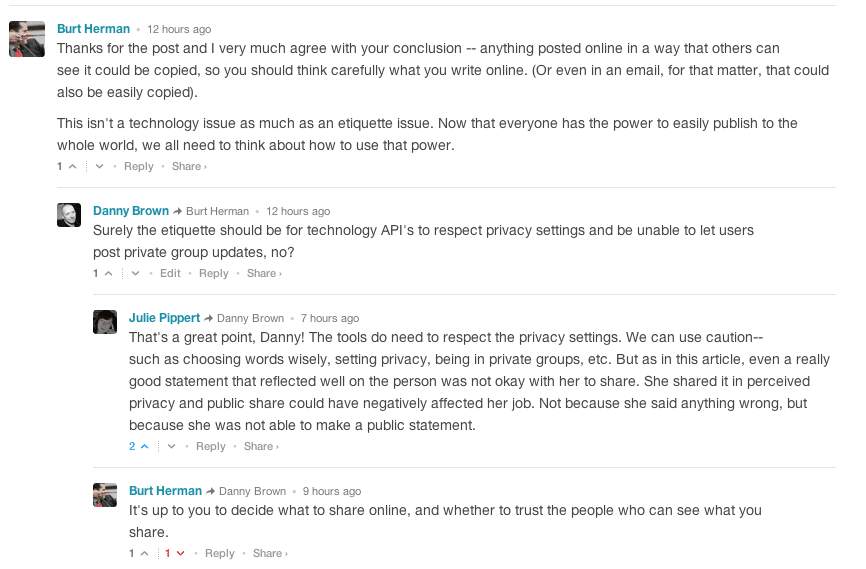
In the comments section of the AGBeat article, I questioned Herman’s stance on user blame after he stated it wasn’t a technology issue, but one of etiquette.

Danny AGBeat

Herman’s answer, ironically, highlights Storify’s failing – the “power” effected by being able to share easily needs to be countered by the ability to identify whether that content should be shared.

Herman’s logic suggests if a private update is shared, it’s your fault for trusting the wrong friends to begin with. But that’s simply absolving responsibility from the platform that offers the public sharing of a private update. Former journalist, and General Manager of Social Media at New York-based technology startup Internet Media Labs, Amy Vernon identifies the flaw in this logic perfectly:

This is the difference:?

You protect your tweets, Storify won’t allow people who are allowed to see your tweets to Storify them. You protect your Facebook posts, Storify will allow people who are allowed to see those posts to Storify them.

Plain and simple.?

Is it, at its root, a human problem? Sure. But all this is changing faster than the average person can keep up. That doesn’t absolve tools and platforms from trying to abide by privacy levels.

Instead of blaming the user, why doesn’t Storify take the higher road and have a filter/blocker in place (similar to the Twitter scenario) where a message pops up prior to the sharing that asks the simple question: “This content is from a restricted source – are you sure you wish to share?” Or, better still, simply change the way Storify scrapes network API’s and only allow sharing of clearly publicly available content.

Of course, to do this would mean admitting Storify (and, by association, Facebook) have a problem. And no-one likes to admit they have a weakness…

image: AGBeat

Being Smarter with the Long Tail of Social Monitoring and Influence

digitalcity_0

When social media first began gaining popularity with brands, the first thing they wanted to know was, “What are people saying about us?”

It’s understandable – whereas before brands would only get to find out what the public’s perception of them was when the cash registers slowed down, now they could get insights on what was being said before it became a problem, and the perception of their response to that conversation (positive or negative).

This led to a booming market in social monitoring platforms. Companies sprung up with technologies that could monitor millions of conversations, send alerts to brand managers, and define the changing sentiment around a brand and the subsequent buzz that went with it.

All for a very nice premium, too, with licenses running into thousands of dollars per month for just a single license.

But the truth of the matter is social monitoring is flawed, and will continue to be flawed, while we still think in bits and bytes when it comes to human behaviour.

We Are Not Machines

The basic premise of a social monitoring platform is simple:

  • Choose your industry;
  • Choose keywords to monitor (brand, product, person);
  • Set up your alerts;
  • Define your goals (buzz, sentiment, volume, leads);
  • Gather data, report, refine, rinse and repeat.

Sure, there are other areas of data that brands may set up, depending on their goals – competitor intelligence, for example. But even this basic set-up of goals and tactics highlights the flaw in social monitoring – we’re hoping humans behave like machines to tell us what we want to know.

For most social monitoring platforms, the technology is still fairly basic in that all it does is monitor online conversations for certain keywords (much like Google scans the web for your search terms and then gives you a series of results).

The problem with this approach is it requires linear thinking on behalf of the target. Instead of true natural conversations like the ones you have with friends on Facebook, monitoring tools are often looking for non-connected scripts. Take the following example.

I’m in my house, freezing my butt off in a typical Canadian winter. I go online to moan, and say something as simple as “Being cold sucks.” There’s nothing really there for monitoring software to pick up. Or is there?

If the software was advanced enough, there are multiple reasons for me being cold. Is there a hole in my window? Is my roof insulation not working properly? Is my furnace broken? Am I struggling to pay heating bills?

Immediately, there are now four opportunities for four vendors to take an interest in me – glazier, roof insulators, HVAC companies and maybe even my bank, to see if they can help financially.

All from three little words, instead of a monitoring solution looking for me going online and asking “Know any good HVAC companies in Southern Ontario?”

You can see why we still have a way to go when it comes to monitoring. But that’s just a part of it.

Social Monitoring and the Influence Effect

Let’s take monitoring one step further, when it’s being used as part of an influencer outreach campaign.

When brands use influencers, they need to know who’s making the buzz happen and who’s creating action from intent. Otherwise, they’re just shooting in the dark while paying thousands of dollars to social scoring sites for putting them in touch with the influencers in the first place.

So, as a campaign unfolds, brands use monitoring platforms to see where the conversation is stemming from (influence solution partners can offer this information but you should be monitoring for your own needs as well). They track the times an influencer speaks, and whether this causes a trickle or ripple effect.

And this sets up another problem with monitoring at that high level – it doesn’t take into effect all the disruptive factors that help a decision be made, positive or negative.

Influencer disruptor paths

For example, I see an influencer talk about the new Ford F-150. I trust the influencer (he or she’s a car geek, just like me), and I like the mix of fuel economy and torque that the F-150 offers. I’m sold, and I mention as such to the influencer on their blog, so that goes down as a positive net.

But I’m not the decision maker when it comes to finances – my wife is.

So, as much as I love the truck and as much as I give off the vibe that I’m moving beyond intent to buy to actually buying, based on an influencer’s write-up, I don’t buy, because my wife has rightly said we need to go on vacation this year to unwind, and the money needs to go to that.

The effect of that decision isn’t felt, because the monitoring only stayed with me until I was a positive result for the brand and influencer. Had the monitoring or influencer program stuck with me for a week or two, they would have seen me jump online to say, “Vacation this year, truck next year.”

Instead, the brand wonders why there was a positive effect that didn’t correlate into a sale; the influence program is questioned for effectiveness; and the monitoring solution fails to follow up on my secondary conversation.

Take it one step further – let’s say the software really digs into who I’m talking with and can filter them into relevancy, as well as alerts if there’s a follow-up to our original conversation online. They would have picked up my wife speaking with her friends online and saying, “Danny wanted a truck, but we really need a vacation this year, so we’re doing that instead.”

The result would be immediate – the influencer program clearly worked, it’s just priorities that take precedence and, in this case, a vacation was a higher priority. But the message about the F-150 came through loud and clear and, had the vacation not been the disruptor in this case, the sale would have been completed.

We Need to Be Smarter with the Long Tail

Now, these are hypothetical examples, and there are companies that are trying to identify not just the main conversations, but the secondary and tertiary ones too. In our book, we highlight the ones we feel are making great inroads, and dedicate a chapter into using these platforms for your influence campaigns.

But as hypothetical as they are, they also clearly illustrate where we need to go, and that’s into the Long Tail of monitoring and/or influence. We can’t just stop at the result – we need to understand what made that result happen:

  • What diverted an action (my wife being the logic to my emotional decision);
  • Where the follow-up should be (in this case, reminders that I’m in the market for a truck in 12 months time);
  • What language tipped the emotional purchase (prior to the vacation becoming a disruptor);
  • Where the true result came from (in this case, a few weeks after the perceived success).

We’re not there yet, and while social scoring continues to be the lead when it comes to measuring influence online, we won’t get there anytime soon. The good news is, companies are moving away from scoring and really digging into all the data that’s available to us.

When monitoring catches up and combines its resources with the knowledge we get from identifying true influence, business will never be the same again.

Ready to start the next wave?

  • « Go to Previous Page
  • Page 1
  • Interim pages omitted …
  • Page 4
  • Page 5
  • Page 6
  • Page 7
  • Page 8
  • Interim pages omitted …
  • Page 38
  • Go to Next Page »
© 2026 Danny Brown - Made with ♥ on Genesis