• Skip to primary navigation
  • Skip to main content
Danny Brown

Danny Brown

podcaster - author - creator

  • About
  • Podcasts
  • Journal

Social Media

Facebook for Android and Why Zuckerberg Now Owns Your Ass

A little while back, I wrote about my concerns with the Facebook Messenger app, and the Permissions it needed demanded to function. It was these Permissions that saw me uninstall Messenger and ultimately close down my Facebook profile.

I’ve since activated a very stripped down Facebook profile, where I share a lot less than before and have it locked down to a very small number of family and friends – a very different experience from my “pretty much share everything” use on the deleted account.

Since I commute a lot, I installed the full Facebook for Android app. Usually, I have my apps to manually update, but because I had been testing the beta version of the new Android app before switching back to the “official” one, I’d neglected to change my app update settings.

This let Facebook download the latest update yesterday. And, originally, I was impressed – the new UI was slick and the experience far superior. So impressed, I shared a couple of screen grabs of the new interface.

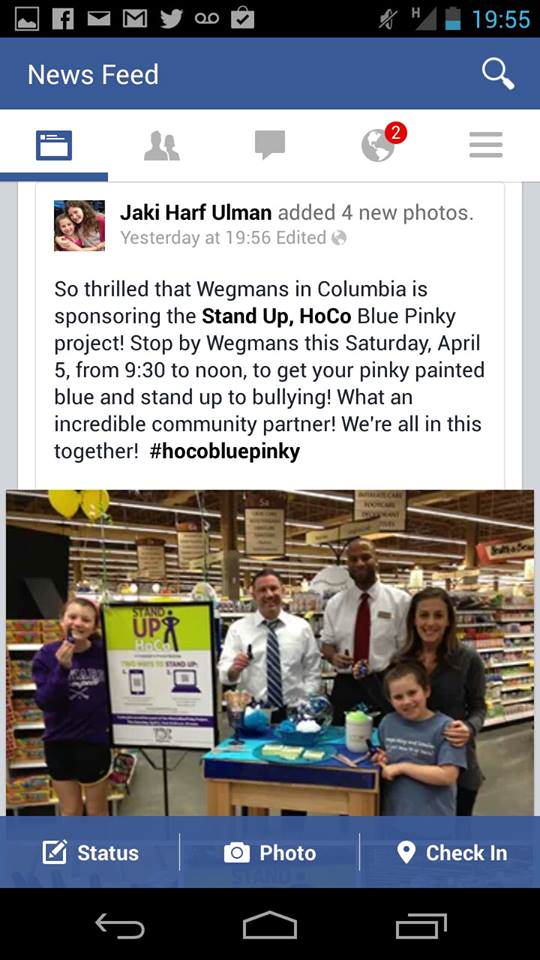
Facebook for Android profile Facebook for Android newsfeed

As you can see, it’s a clean, easy-to-navigate experience. Finally, Android users had the app they deserved, right? Not quite.

The Devil Gives Better Choices than Facebook

You’ve probably heard the term “making a pact with the Devil”. Essentially, it allows you to have anything you want, in exchange for your soul being the property of the Devil when you die.

Facebook’s new Permissions kinda reminded me of this, given that they’re forcing you to give up any semblance of privacy you may have thought you still had left.

When I shared the pictures on Google+, Al Spaulding made me immediately regret the fact I was on auto-update. From his comment on the post:

It looks great. However I refuse to download it and am still using the older version from 2 mth ago. Why? Because the new one says pretty clearly that they can access your phone for anything. They can read your texts – take them off your phone and upload them to their server, place phone calls on your behalf, and even disclose your location without you wanting them to.

While I’m used to Facebook’s Draconian privacy settings, the part about accessing my SMS and MMS messages caught my attention. I don’t recall this being as explicit before (although it may have been), so I uninstalled the app and set about re-installing to check the Permissions out fully.

The results were a mix of scary and extreme.

Facebook SMS

Facebook contactsFacebook calendar Facebook call numbersThe Calendar I’d seen on previous Permissions, and the Calls (while annoying) I’m pretty sure had been there too. But check out the exact wording of the SMS/MMS Permission, and that of the Contacts one.

Doesn’t that alarm you as a user? Read that wording again, especially this statement:

This allows the app to read all SMS messages, regardless of content or confidentiality.

Wow. Just… wow. Not even my wife gets access to my SMS messages (and no, Jacki, I have nothing to hide!). What honest and useful reason can Facebook have to get access to my texts? Seemingly they’re running with the “It will help us target better” message.

I call bullshit.

Target Publicly and Respect Privacy

I’m a marketer. I get that data helps us target campaigns better, and (in an ideal world) meet the needs of our customers and audience by that very targeting. Yet as I say time and time again, this has to be opt-in, and publicly available data.

The moment you track data beyond public access, you’re moving into both immoral and – you’d like to believe – questionably legal areas.

Facebook requiring access to my SMS messages, as well as the friends I speak with privately on the phone, sets off major alarm bells, and this from someone that benefits from the amount of data publicly available.

I’m not naive enough to think anything we put on the web is private. And, since the NSA-Snowden affair, I’m even less naive to think that we don’t face the prospect of being snooped on by our respective security forces.

But it could be argued it’s in the interests of public safety for this level of monitoring (though some of the arguments are very tenuous). Facebook doesn’t protect us, nor does it seem to have our interests at heart. All it wants are numbers, pure and simple, and the data that comes with these numbers to sell to the highest bidder.

These Permissions for their Android app merely confirm that, and is why my use of Facebook will now be restricted to the web version.

Your privacy, and how you place it in the Facebook ecosystem, is something Facebook is counting on you to ignore. The choice is yours.


The Three Metrics Your Business Needs to Answer on Social Media

Metrics

If you Google the question, ?Where do I start on social media?? you?ll be greeted with approximately 1.4 billion results.?1.4 billion.

While many of these results will be duplicate versions, it?s clear that getting started on social media is a question many people are looking for an answer to. Add the word ?business,? and run a similar search, and you?ll find around 1.2 billion results.

Blog posts, news articles, corporate videos and more?again, everyone is looking to find out the right way to do social media.

The secret, if it can be called that, is simple: You need to start out right and, much like everything else you do in business, have a plan with measurable milestones and results.

Step One: ?Why Do We Want to Be Here??

From monitoring conversations online to discussing with clients, the overarching theme that prevents successful business use of social media is a lack of understanding of why they want to be on social media.

Typical responses include, ?Our competitors are on there,? ?Because everyone?s doing it,? and ?We don?t want to be left behind.? The problem with these answers is they don?t dig deep enough into the bigger questions that you need to answer:

  • What are your competitors doing on social media, and are they doing it well?
  • Are you able to identify your competitor?s brand impact?share of voice, awareness, leads, etc.?from their participation on social media?
  • Does your core demographic match the core demographic of those social media users your competitor?s are trying to connect with?

These are the three basic questions that need to be asked if you?re using the competitor comparison as a reason to be on social media. Having the answers to those questions will allow you to move to the next stage.

Step Two: ?Where Do We Need to Be??

Once you?ve analyzed and answered the ?why? behind the decision to be on social media, the next stage is the one that will more often than not determine how successful you are?where you need to be.

There are literally hundreds of social networks online, and these are the platforms that are actually recognized as bonafide social networks, along the lines of power hitters Facebook, Twitter, Google+, etc. Add in forums, niche networks, community blog networks and more, and it’s no wonder so many businesses have trouble finding the right path.

This is where smart passive use of social media is needed.

  • Prior to becoming actively involved in social media, use a passive approach with tools, keywords and data mining.
  • Use simple searches with the likes of?Social Searcher,?Social Mention?or?Trackur?to find out if your target audience is actually using social media and, if they are, on what platforms they’re on.
  • Compare the amount of chatter and, more importantly, the level of opportunity for your brand to be active on each channel.
  • Identify two or three channels that have active participation, with a good level of questions your brand can answer, and use them as your starting point for actual social media participation.

By starting out slowly, based on analytical evidence on why you should be on your chosen platforms, you set yourself up for a far better chance of success than jumping in blindly. This allows you to create the third stage.

Step Three: Map Out Goals and Success Metrics

Of course, this entire preliminary work means nothing if you?re not going to set goals and success metrics to measure your social media use. Every brand has different needs and requirements. Here are a few to consider:

  • Brand awareness;
  • Share of voice;
  • Market perception;
  • Customer experience;
  • Lead generation and customer acquisition;
  • Loyalty and advocacy.

Social media is a fantastic resource for truly connecting your brand to your customers, both existing and potential. But it also takes a lot of time, experimentation and investment to pay off?so you need to make sure you have certain metrics in place to measure how you?re doing.

  • Set up a calendar and break it down into your usual results pattern?monthly, quarterly, biannually, annually, etc.
  • Highlight goals for each milestone?percentage shift in brand awareness, impact on competitors, website traffic, social network growth, inquiries to your sales team, customer satisfaction, etc.
  • Determine acceptable growth vs. ideal growth, and compare how the former is trending to the latter.
  • Analyze the cost of implementation (manpower, hours, technical resources) to the investment return (market share, brand perception, increased customer loyalty, word of mouth marketing, sales and reduced churn).

The ability to measure how you?re doing is crucial when it comes to buy-in across the company. Having a clearly structured plan to measure success will help pave the way for further investment.

To compare milestones, technologies like?Pulse Analytics?can help you identify your successes, your weaker areas, and which customers/advocates are driving the most interaction and profit.

As you can see, it?s not a quick or simple jump to make, contrary to popular advice. But by being smart when it comes to why you should be on social media and, more importantly, how you measure your effectiveness, you?re setting yourself up for success rather than failure.

image: Steve Garfield

Can We Say Goodbye to These Social Media Buzzwords in 2014?

sticky content

When it comes to social media, 2013 was a pretty watershed year for brands and platforms alike.

Oreo won widespread praise for the way it took advantage of the power outage at the Super Bowl with its?“You can still dunk in the dark” tweet; Google’s nascent Google+ platform?broke the 500 million user barrier; and social channels continued to play key roles in political uprisings, as?witnessed in Brazil this past summer.

However, with all the positive steps of a maturing social media comes an inevitable byproduct: overhyped buzzwords. From prefixing (and suffixing) the word?marketing, to feel-good soundbites that had little real-business benefits behind them, 2013 will be remembered as the year that social media became home to some of the most annoying and overhyped buzzwords online.

Here are the top five as crowdsourced from across the Web.

1. ‘Lessons Learned From’ Blog Posts

Whenever there’s a crisis on social media channels?or an offline crisis that’s amplified via social media?you can pretty much guarantee that within 24 hours there will be a batch of blog posts published with titles such as, “What Crisis X Can Teach Us About Business” or “Lessons Learned from the Brand X Social Media Crisis.”

While some of these posts may offer value, many are simply jumping on the bandwagon to drive traffic to their blogs, without actually offering any deep or insightful lessons. This has led to a strong feeling of apathy and sarcasm directed toward the authors of these posts.

“Everything is not a lesson, especially natural disasters, terrorist threats, and anything that happens to a bunch of people at once. Stop exploiting tragedy for profit.”?Tinu Abayomi-Paul, chief visibility officer at?Leveraged Promotion

2. Everything Is Dead!

You’ve probably heard the conversations online: SEO is dead. Print is dead. Advertising is dead. PR is dead. Email is dead. And so on. It’s almost impossible to browse your Twitter feed or Google+ stream and not come across a blog post or update with one of these statements being made.

And yet, here we are. SEO is still here; print still has its audience; advertising continues to profit; PR is still a core part of any brand’s strategy; and email continues to lead the way as the preferred communication channel for business. Despite the naysayers?or perhaps, in spite of them?it would appear the demise they write of hasn’t quite happened.

“We need to stop implying that a certain practice is dead. Nothing really dies, it either adapts or recycles. The adoption curve goes from innovators to laggards and all need something at different stages.” ?Ann Marie van den Hurk, principal at?Mind the Gap PR

3. Go Viral

Perhaps it’s no surprise that brands want a viral hit, whether that’s a YouTube video that gets millions of views, or a piece of content that gets shared across every channel. After all, if you can come up with the next Old Spice Guy sensation, everyone can retire.

The problem is, the allure of viral?mass uptake by your target audience and those not yet aware of your brand?is the very thing that’s made viral overhyped, and hurts your chances for success.

“The allure of going viral is ultimately a distraction for brands because it focuses on marketing to the crowd. When you chase an elusive crowd you have no connection to in the hope of going viral, you’re setting your business up for failure. Viral campaigns tend to be one-offs with limited shelf life, and quickly fizzle out.” ?Allyson Kapin, founding partner at?RAD Campaign

4. Social Business

One of the most overhyped and overused social media buzzwords in 2013 was the term “social business.” A complete industry seemed to appear overnight, with agencies and consultants offering multiple definitions?a business that places equal value on employees as it does stakeholders; the culture, connections and participation of a brand; and being part of a “collaborative economy.”

However, this merely diluted the definition of?what it means to be a true social business?one that is created and designed to address a societal problem, and is a non-dividend company where profits are reinvested in the business or used to start another one with the aim of increasing social impact. That’s a far cry from the corporate definition being touted in 2013.

“A hijacked phrase, and nobody can agree on the definition of the new version.” ?Doug Haslam, senior account director at Scratch Marketing

5. Brand Storytelling

People like stories. From early cavemen sitting around a fire to the likes of Hans Christian Andersen, stories have the power to captivate audiences and keep them lost in that moment. It’s into this arena that brands have started to promote their own history and goals through the medium of storytelling. At least that’s their attempted goal.

The problem is, storytelling needs that emotional impact to truly connect. And many brands who are now telling their stories miss that key tenet, and instead of captivating an audience, drive it away through clearly forced and weak attempts to connect.

“Storytelling is a true art, an essence that’s hard to capture. You can’t expect others to see it or feel it unless you deliver it properly. When we try to market through storytelling, I don’t think many know what that really means?storytelling is not interchangeable with copywriting.” ??Julie Pippert, founder and director at?Artful Media Group

Saturation Before Maturation?

When polling for this article, there were many other popular phrases that people consider overhyped: Web 3.0, content marketing, influence marketing?pretty much anything marketing that wasn’t simply marketing?big data and more.

While social media matures as a business solution as well as a societal one, it continues to go through growing pains. Overcoming overhyped buzzwords is clearly going to be one of those pains.

How about you – what buzzwords got your gander in 2013? Share them below!

A version of this post originally appeared on OPENForum.

Beautiful Content Curation with TwineSocial Social Hub

TwineSocial Social Media Content Curation

As content continues to lead the digital marketing charge for brands and content creators alike, one of the “side effects”, if you like, is the evolution in how content is being presented.

While blogging in text form remains popular, content creators are looking for newer, more impacting solutions. One such solution enjoying increased popularity are the rich media curation platforms. You just need to look at the success of Pinterest to see how collective images can tell a far richer story than any written word.

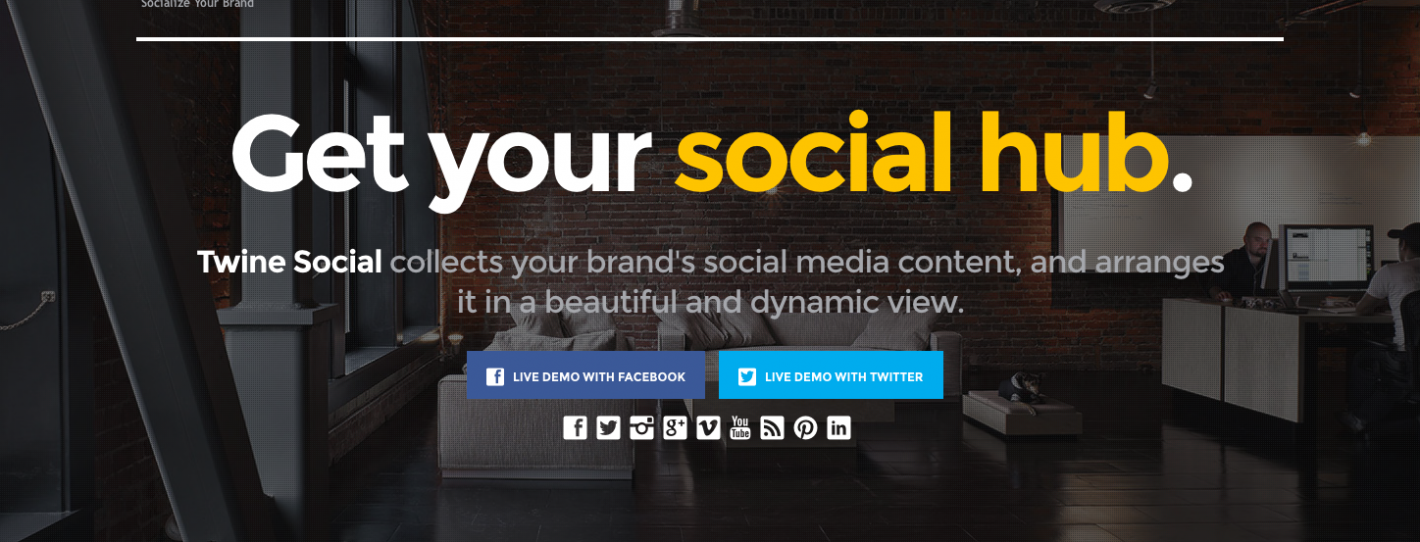
Taking Pinterest one step further and offering a true social hub, and hoping to become a standard for brands and content creators alike, is TwineSocial.

TwineSocial and Rich (Social) Media

Anyone can create a social hub. There have been countless examples already – some excellent (RebelMouse and Keyhole, which I’ll be looking at soon), some not so much. However, RebelMouse is more geared towards personal content curation?- TwineSocial, on the other hand, is about the integrated experience.

Connecting Your Social Graph

When you first create your TwineSocial account, the first thing you’ll need to do is connect your various social accounts. However, instead of simply connecting your Facebook, Twitter and other standard accounts, you can also select hashtags and search terms around your brand.

Twine Social Threads

As well as the usual suspects, TwineSocial also supports Vine, Vimeo, Flickr and other networks that usually get bypassed by many other curation solutions.

The ability to include hashtags as well as multiple accounts and RSS feeds enables you to create the complete picture around you or your business. Not only that, but peers and colleagues/internal teams can be integrated as well.

The TwineSocial Brand Ecosystem

For example, in my account settings, I have my own standard inclusions – my Twitter account, Facebook, Google+, etc. I also have the #influencemktg hashtag, which my Influence Marketing book co-author Sam Fiorella and I use to continue the influence discussion outlined in the book.

Speaking of Sam, I can feature his account as one of interest, via the TwineSocial Connections feature. This essentially allows the curator to highlight social accounts, people, brands or topics they feel would be interesting to their own social graph.

TwineSocial Connections

This Connection feature is available across your chosen social accounts, so if your business has multiple sales teams based on demographic and locale, or your company blog is broken into various sub-sections for your company’s products, you can highlight these different channels as part of your bigger corporate picture.

Or, as a content creator, blogger, podcaster or otherwise, you can bring any other content you own into the fold as recommended channel partners. Or feature the accounts of your podcast guests, etc.

Highlighting Your Key Content

Depending on the size of your business, or how much content you create (or contribute to) as part of your content strategy, your latest stories or updates could potentially be lost soon after they’re published.

To counter that, TwineSocial offers a Pin option. Much like its almost-namesake, this enables a Pinterest-like feature that allows you to keep the most important content front and centre at all times.

Not only that, but when a visitor to your hub selects a particular piece to dig deeper into, it expands into a feature area, while still keeping your live feed behind it.

Twine Social Danny Brown

This offers two benefits – you can choose which content is the one driving the most interest, based on your goals for that period, and you can cross-promote not only your own content, but channel partners for joint promotions.

For example, your content could be the lead hub, your channel partners could be the related products or services surrounding the lead hub. This kind of flexibility could be key in differentiating your product offering in a more visually appealing way than your competitors.

Twine Social – The Verdict

I’ll be the first to admit, I love the direction TwineSocial is taking. The user interface is clean, uncluttered and very easy to navigate – something some of the other hubs have struggled to accomplish.

Additionally, TwineSocial is placing emphasis on the visual appeal of all your content, not just the rich media that you use for an article, blog post or video. The layout of the hub is slick, and the bold images and typography catches the eye of visitors to the hub.

I can see this being used by all kinds of content creators. Brands are obvious, as are producers of multiple content – text bloggers that also use video, for example, or graphic-heavy content (designers, for example).

The cost is attractive too, with plans for all pockets and budgets.

TwineSocial Pricing

The free version is a great starting point for anyone looking to try the product, while the full-on Enterprise solution offers the promotion of other accounts, white labeled / no TwineSocial branding, custom CSS to replicate your own brand identity, and more. For $399 per month, it could be a great way to collate a brand’s social activity and use to entice new employees, clients, partners and more.

It’s not perfect, though.

On Making Twine Social Even Better

At the moment, it doesn’t offer any analytics around the effectiveness of the hub. For example, it’d be great to see which areas of the hub are garnering the most eyeballs or clicks; it’d also be great to see which parts of the hub drove traffic to a landing page, or which one was shared the most. This would allow you to tailor the hub content more efficiently.

Additionally, it’d be great for visitors to be able to visit a hub and embed a specific section.

So, let’s say I’m writing a piece on social analytics software. I could go to a hub for something like Pulse Analytics, grab a section that compares solutions and their impact on ROI, and embed that directly to my post. If anyone clicked on the embed in my post, it would take them to the Pulse Analytics hub, and all the data the visitor is clearly interested in.

It also uses Klout scores as a measurement of who your most influential followers are – the less said about that, the better..! 😉

There are also some bugs in the current build. For example, I had issues trying to grab the embed code for my hub to embed it in a page on this blog, to show you what it looks like when integrated with your other content. Additionally, when you add new social accounts, it pulls all of that content to the top of the hub, as opposed to dropping it in by date of the content itself.

However, analytics is on the way, and the embed option is something Aaron Fessler, CEO of TwineSocial, agreed could be a cool feature addition in future iterations when I spoke with him recently about the product. And bugs are always to be expected on beta products (as long as they’re ironed out in future updates).

In the meantime, as I mentioned I am liking the direction and simple approach TwineSocial is taking. As content continues to be an important part of the marketing landscape moving forward, the more your content stands out, the more opportunities should come your brand’s way.

TwineSocial offers that stand out effect in spades.

Disclosure – I was given full access to the Enterprise solution in order to evaluate TwineSocial’s feature set. However, all opinions are mine. You can check out TwineSocial for yourself here.

The Battle for Social Ad Revenue – The Potential Winners and Losers

Social ads battle

Social ads battle

As the dust settles from Twitter’s recent IPO, one of the surprising outcomes was the news the microblogging platform is on track to post?global ad revenue figures of $1 billion by the end of this year.

In the U.S. alone, Twitter’s ad revenue showed an increase of 93 percent over the same period the previous year, with?$277 million posted for the first three quarters in 2013.

With mobile becoming ever more pervasive as the browser of choice for Twitter users, and mobile ads growing less intrusive and more natural, it’s clear that Twitter has moved from the social network that has a “monetization problem” to one that’s set to give the likes of Facebook and LinkedIn a run for their revenue money.

But will it be the “winner” in the upcoming social ads battle?

Why Social Ads Are Big News

With social media finally becoming a staple in the marketing and advertising departments at businesses, reliance on traditional advertising has begun to swing to digital channels.

While media buy and print/television/radio advertising remains important,?budgets are increasingly being allocated to digital spend.

As these budgets shift and consumers turn to social media to not only research products and brands, but either buy directly from a social media-led offer or click through to a landing page, the networks are looking at ways to take advantage of this shift and be the go-to ad partner for businesses and marketers.

Social ad budgets in the US

It’s not surprising that the bean counters over at Facebook, Google, Twitter and the rest are so keen to attract advertisers to their platforms?by 2017, it’s predicted that social media ad spend worldwide will exceed $10 billion.

Add in mobile spend and it’s a piece of the pie that will literally cost the networks millions if they’re not part of it.

Social Ad Spend And Revenue By Network

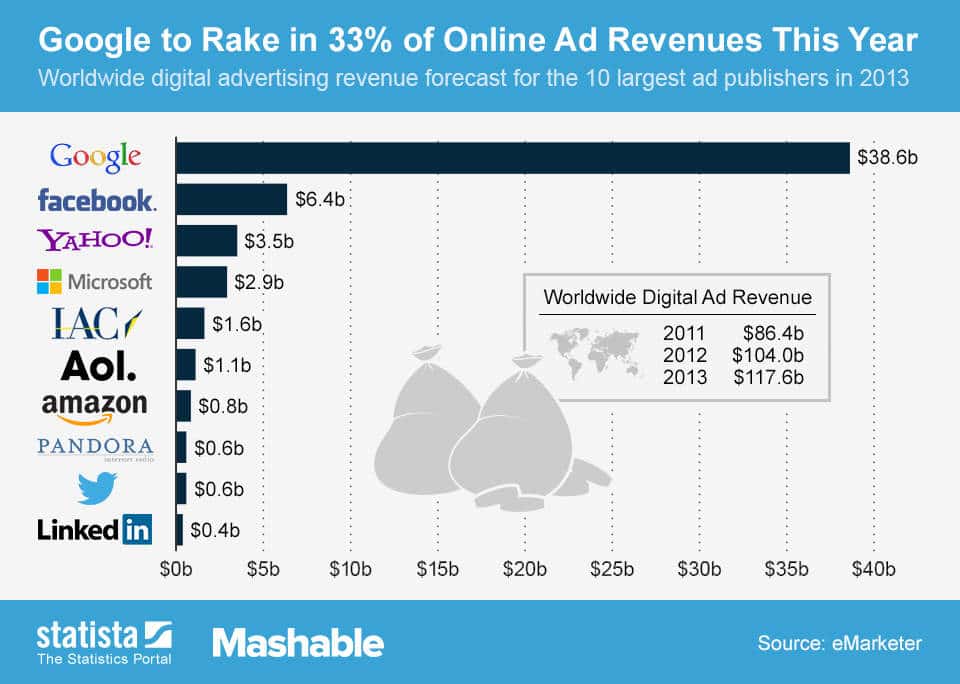
If you look back at how the networks fared in 2013, there’s one clear winner and that’s Google. A study by eMarketer at the beginning of this year predicts Google to account for a third of all online advertising, easily outstripping its nearest competitor, Facebook.

Digital ad revenue

While Facebook shows a strong second with almost $6.5 billion in online ad revenue, both Twitter and LinkedIn trail with a distant $0.6 billion and $0.4 billion respectively. Yet that doesn’t really tell the full story.

Google’s online ad revenue is made up of multiple factors and platforms. For example, while the majority of its revenue still comes from AdWords and AdSense, there’s also the revenue from advertisers on its YouTube property.

Speaking of YouTube,?Google launched a Paid Channel option?for any user with over 10,000 subscribers, where channel owners could charge subscribers $0.99 or more per month for access. Google is reported to receive around 45 percent of channel subscription costs, adding to its online revenue stream.

Compare the “Big Four” social networks?Twitter, Facebook, LinkedIn and Google+? and Google has a clear advantage by the number of revenue streams it earns from. Add in the recent +Post Ads announcement that meshes Google+ content with Google’s ad network, and it would seem they have the social ad market sewn up.

However, the others are starting to make inroads into this advantage, certainly by number of additional revenue streams if not quite actual revenue yet.

Twitter?Revenue Potential

As mentioned earlier, the microblogging platform has (perhaps) surprised many, by sharing some?excellent revenue figures. Advertising revenue has increased 124 percent on a year-over-year basis; advertising revenue makes up 91 percent of total revenue, an increase of 4 percent; and gross margins increased.

While operating losses increased and data licensing revenue decreased, Twitter is still in good shape to make a healthy profit in 2014 and beyond from social ads, especially given its acquisitions of companies like Bluefin Labs and Trendrr, with the potential of social ads making their way into TV engagement via Twitter.

Facebook Revenue Potential

The first major network to successfully transition to an IPO, Facebook has used both the money from that as well as increasing focus on its developer labs to continuously introduce new social ad revenue.

While the company has received criticism over its mobile experience versus the desktop one,?Facebook has still made great strides in revenue?from this part of its social monetization strategy.

While it’s still a ways behind Google?but then again, who isn’t??Facebook’s mobile ad revenue has tripled in the last year, making it the most impressive when it comes to growth in this vertical.

Additionally, with news that ads from Instagram (Facebook’s first major acquisition)?aren’t being received as negatively as Facebook may have feared, the potential for revenue from this channel is something to keep an eye on.

LinkedIn Revenue Potential

While Facebook, Twitter and Google are natural fits for social ads with their consumer-led audience, LinkedIn has always stood apart as a professional business network.

As such, it’s been one of the bigger success stories for social media/network revenue, although its?most recent financial reports?show one of its first declines in year-on-year reporting.

However, LinkedIn knows it needs to expand beyond premium accounts and services for recruiters for its monetization and has begun to implement a series of changes to focus on that. Its new focus on content is a clear shift in how it wants to double its ad revenue in the next two years.

Additionally, the introduction of a LinkedIn Advertising API will make it easier for brands and agencies to advertise on the network. That’s not even taking into account its mobile plans, with an aggressive update of its app to make the mobile experience as seamless as the desktop one.

Who Will The Social Ad Winners Be?

Just looking at the (current) top four?Twitter, Google+, Facebook and LinkedIn?and the smart money would be on both Twitter and Facebook to make the most progress.

Acquisitions and channel partners, as well as their plans for mobile advertising to continue to add to the revenue stream, should see Twitter and Facebook eat further into Google’s current dominance.

While there’s no doubt that Google+ is increasing in user numbers, how social ads will play into the experience remains to be seen. LinkedIn, meanwhile, still needs to make the experience sticky enough to keep users engaged.

And what about other platforms?

Pandora, for example,?continues to see growth in its ad revenue?and with other networks globally enjoying large, engaged user bases expanding their geographic audience, it can’t be too long before the current top four look very different.

Thoughts?

A version of this post originally appeared on OPENForum.

image: LaDonna Coy
image: Business Insider
image: eMarketer/Mashable

  • « Go to Previous Page
  • Page 1
  • Page 2
  • Page 3
  • Page 4
  • Interim pages omitted …
  • Page 38
  • Go to Next Page »
© 2026 Danny Brown - Made with ♥ on Genesis