• Skip to primary navigation
  • Skip to main content
Danny Brown

Danny Brown

podcaster - author - creator

  • About
  • Podcasts
  • Journal

Insights

Today?s Marketer and the Changing Face of Purchase Decisions

social business

social business

As digital and mobile channels continue to pervade ever deeper into today?s business landscape, the challenges facing organizations and their key personnel grows with it.

Whereas before, we could create a message and hammer it home to our audiences until it was accepted, now there are multiple channels, factors, disruptors and more that make marketing your brand much more scientific than before.

Think of all the facets of marketing today:

  • Social media marketing
  • Mobile marketing
  • Influence marketing
  • Digital marketing
  • Search engine marketing
  • Email marketing
  • Pay Per Click marketing
  • Banner display marketing
  • Digital signage marketing
  • Traditional marketing

And on and on and on. Still marketing, but now truly multi-faceted.

Now, into that mix, introduce demographics, locale, purchase history, brand loyalty, financial, emotional and situational factors, and?creating a successful marketing template becomes much more strategic than ever before.

Which is why a new guide from?Worldcom Public Relations Group?is a timely release. The world?s leading partnership of global public relations brands, Worldcom provides analysis and understanding of the various cultural nuances in different marketplaces.

Their?Global & Local Marketing Guide for CMOs?highlights the growing shifts and trends in these different markets, and offers insights from 40 Worldcom partners across more than 15 countries.

These insights help CMOs understand the marketing and PR landscape when it comes to multicultural audiences, locales and industries, and is geared to help organizations and marketing consultants/agencies be more effective in these areas.

Below are some of the key takeaways from the report.

Today?s Marketer Needs to Understand Local as Well as Global

Savvy marketers have always known that true success comes from understanding your customer and meeting their needs and demands.

From type of message to channel of promotion, and language of the message, if you don?t meet your customer on their terms ? or at least be fluid enough to adapt to their known terms ? then you?re already on shaky ground when it comes to getting your brand message out there.

For example, in Argentina, South America:

?60% of opinions about a product are shared in face-to-face conversations, and people are more eager to exchange opinions with friends (45.5%), family (20%) and colleagues (30%). 92% of the comments within these conversations tend to be positive over negative.

In Arizona, United States:

Small businesses are a major contributor to Arizona?s economy, representing 97% of businesses in the state. 78% of Arizona companies rely on word-of-mouth when purchasing a new product or service.

In Hong Kong, China:

Hong Kong is seeing a growing market for group purchases. In January 2012, Groupon had 360,000 fans of their Facebook page, 10% of the total amount of Facebook accounts in China. [Note: I’ve never been sold on fans in relation to business metrics, but the percentages and use of Groupon was interesting – Danny.]

These are just three snippets that highlight very different cultural takes on how we do business today. The report itself delves into many more countries and offers some fascinating insights into why the future of marketing is local, and then beyond.

Interestingly, many of the findings tie perfectly into the research and methodologies that make up?Influence Marketing, and how dyadic (groups of two) relationships drive influence marketing success when it comes to the customer solution.

If marketers can change their mindsets on placing the customer first and then meeting track back from there to meet the customer?s needs, their goals will be more manageable and measurable.

Channels and Content Are Key

For ArCompany, the best marketing and PR is when you?re not even aware you?re being marketed to. The nature of the promotion, the conversations around it, the minute details that are researched before a campaign?s implementation ? all are geared towards making marketing as non-invasive as possible.

Research

Sure, the in-your-face way works, especially in certain industries. But more often than not, the campaigns that resonate the most are the ones that see your customers continue to talk long after the initial ad hits your stream.

To this end, the channels your business uses for its campaigns, along with the content and how it?s shared, plays a significant part in an increasingly connected consumer-led marketplace.

For businesses, 88% prefer email?as the lead communication channel.

For consumers, 34% prefer social media,?although email is a close second with 27%.

76% say that social media [influencer] outreach?is a top priority for clients.

85% cite LinkedIn?as their preferred channel.

49% claim social posts?are too promotional.

46% said the communication?was too frequent.

In addition to these numbers, the breakdown between B2B (business to business) and B2C (business to consumer) content and strategies offers a clear difference in strategy and approach.

B2C content?should be educational; stimulating; entertaining; non-commercial; objective; focused on engagement and two-way communication.

B2B content?should present ROI in a clear, understandable and measurable manner; be solution-driven; have an integrated media approach; include infographics, videos and social media content alongside traditional media.

While the lines between consumer and business marketing are beginning to blur more, as corporations adopt more social media and influencer campaign models traditionally associated with consumer campaigns, the differences are still large enough to warrant specific strategies and tactics for each.

The Landscape is Shifting

It?s not just social media that?s leading the charge in the way we do business ? mobile is dramatically shifting not only the way we consume media, but also the way we shop and make purchase decisions.

More traditional verticals like Financial Services, as well as more forward-thinking ones like Retail, are seeing seismic shifts in how customers of these industries use mobile phones to gather information and quantify their decisions.

In the Financial Services sector?in the U.S., mobile banking is the #1 activity bank customers expect to be able to carry out with their chosen bank.

In the Retail sector, mobile shopping will represent 62% of digital consumers by the end of 2013.

In addition to these numbers, the Hungarian Advertising Association showed mobile marketing grow 12% in 2012, accounting for just under 20% of the complete advertising budget for the European country. This trend is visible elsewhere, as the full report shows.

Where Does This Leave You?

As the examples here and in the full report show, today?s CMO needs to be multi-talented.

As well as being responsible for product development, market research, sales management and advertising, they need to be up-to-date on the trends that matter for their customers as well as their business and stakeholders.

As a CMO in today?s marketplace, you need to:

Know who you?re speaking to, and understand their habits and behaviours of your key customers.

Know what, how and when to share your message.

Understand measurement and where you?re succeeding, where you?re struggling, where you need to pivot and where you need to acquiesce.

Plan for sustainability, move away from the campaign mindset and be strategic in building long-term loyalty and advocacy through delivering on your promise and continuing the after-service long after the sale.

The simple fact of the matter is, mobile and digital marketing is only going to become ever more pervasive, and require more hats to be worn across the board. The marketing hat starts with the CMO ? make sure you?re wearing it well. Need help? Let’s talk.

The full Global & Local Marketing Guide for CMOs 2013 can be downloaded?. This post originally appeared on the ArCompany corporate blog.

Why Social Software Platforms Fail

Salem crappy product quote

Salem crappy product quote

In my role as Chief Technologist over at ArCompany, and from a love of technology in general, I test, play with, compare and recommend all sorts of different platforms, software technologies and solutions.

There’s just something about the promise and potential of data and technology – when used properly and for the benefit of customers as well as the business – that gets my motor running (sorry, Steppenwolf fans!).

An interesting side effect of this is you get to see firsthand why certain social software technologies succeed while others fail, even though on paper they may look the same.

The ironic thing is, the ones that fail could easily avoid their fate – or at least have a better chance of avoiding it – by simply being better prepared.

They Don’t Understand the Space

One of the biggest mistakes where I see companies tripping over is building a platform for a space they have no experience in. Being a great coder or developer is one thing; being a great developer or coder for a space you don’t understand is another.

With social media offering a real-time and often pervasive invitation to look at how people converse with each other, and what opportunities this offers for brands and organizations, the potential for true customer understanding is huge.

But this level of understanding comes at a price – you need to understand text analytics, ontology, and how these two interconnect when it comes to identifying emotional triggers in a conversation.

Because each social platform has its own little nuances, this task becomes even more convoluted. If you, as a software company, don”t have the personnel that understands these nuances and what that means for data analysis and filtering, your platform will be rendered ineffective.

Too many companies would rather place this important part of the puzzle in the hands of developers only, instead of partnering developers with the kind of data analysts and human language scientists that can turn a so-and-so platform into something so much better at connecting the human dots.

This immediately limits the usefulness of the platform. After all, you wouldn’t ask a learner driver to get behind the wheel of an F1 race car, would you?

They’re In It Just for the Money

Businesses need to make money. That’s a given. As I’ve said several times before when talking about influence marketing and how companies should be using it, I challenge any business to stay afloat on goodwill and social proof alone.

But here’s the thing – when you create something purely with the intent of making a lot of money, and not really caring about the quality of the product or the customers that will be using it, it will more often than not bite you in the ass.

While he receives a lot of criticism about his platform, Facebook CEO Mark Zuckerberg always struck me as having the right mentality when it came to this issue.

We don?t build services to make money; we make money to build better services.

Fourteen words. A simple mission statement in fourteen words. Yet it’s one that has seen Facebook become – arguably – the biggest social software platform in the world.

It’s a mantra the likes of Apple and Google follow. By putting the needs of the user first, and building solutions that will actually benefit them and solve their problems, success is the organic end result.

User experience

The way Apple products seamlessly connect to each other via the iCloud platform; the way Google+ drives every Google product touch-point when it comes to interacting with Google’s customers.

It wasn’t luck or chance that saw these three companies, and others like them, make this focus on the end user the core product feature. Each company knew that by offering something that just works, and isn’t complicated or trying to be something it’s not, money would follow.

Too many social software platforms enter the space thinking that social media is the golden goose for profit. It can be; but not if the sole intent is to make money and to heck with the user experience.

They Don’t Understand Community and Content

For many startups, marketing dollars are a luxury. While some companies are fortunate to have generous investors from day one, the majority of startups, especially in the social space, don’t enjoy that umbrella.

For these companies, content and community are two of the core methodologies for getting people to know about you and/or your product, and why they should use you over your competitors who have been established for a while.

Not only that, but you’re walking the talk as well as just sharing cool soundbites. This is just as true for established companies – the social space is a hive of conversations, groups, communities, chats and more. Get the right people for that part of your company’s growth and you’re giving yourself a fighting chance of success.

Look at companies like Marketwired, with Sheldon Levine; or Salesforce MarketingCloud, with Trish Forant; or InNetwork Inc., with Daniel Hebert and Kelly Jennex. The first two companies are well-established, while InNetwork Inc. has just come onto the scene in the last few months.

All three, though, share the mindset that content and community will help them not only grow awareness of their products and what their company does, but also create a loyal user-base as well as drive innovation through the feedback from their communities, and the content that community leaves points of view on.

Listening to your blog community

Too many social software platforms, unfortunately, see content and community as a burden rather than an opportunity.

So instead of hiring the right people that can truly drive this part of the strategy, they instead do nothing or, perhaps worse, hand over the reins to engineers or developers that – through no fault of their own – are clearly out of their depth.

The three companies mentioned above show what happens when your social footprint strategy is as key as the social software you’re developing.

Wake Up or Break Up

In the last 12-18 months, there’s been a lot of consolidation in the social space. Some of this is through choice; some, through financial needs.

Either way, these companies have continued to evolve and, for the most part, improve. Because they’ve continued to keep the right people; stay on the right path; and concentrating on the user experience as much as the cool development experience.

Newer platforms coming into play continue this mindset. Guys like oneQube, TrendSpottr and SqueezeCMM, for instance, place utility and solutions over features and vapourware.

They understand the marketplace: ?what works, what doesn’t, and – more importantly – why. It’s not rocket science, yet so many social platforms make it look that way.

Then again, they only have themselves to blame. A CEO of a company that’s struggling in the space right now once said to me,

It doesn’t matter what we build. Good marketers can market shit.

While that might be true, it’s also a damning statement on your goals and vision, or lack thereof. While you might be able to sell shit, customers and users that can’t use that shit will soon move elsewhere, where their needs are actually met.

Leaving you to wonder why it’s your company that’s now in the shit…

UX image: headspace

Why Diminishing the Benefits of Slacktivism Isn’t A Great Idea

Over on Facebook, my friend Gini Dietrich posted a question about trying to locate an image, used by a non-profit organization in a new campaign.

The image in question is the one below.

UNICEF Facebook Likes campaign

The messaging behind the campaign is simple – while Liking unicef.se (unicef Sweden) on Facebook is all well and good, and they certainly wouldn’t discourage that, it costs money to actually carry out the work unicef and other non-profits do every day of the week.

That makes sense.

What doesn’t make sense is potentially alienating the very people you’re pseudo-criticizing in a campaign like this, by implying slacktivism doesn’t do any good.

Slacktivism and What Defines Action

A relatively new term, slacktivism is regarded as follows:

Slacktivist activities include signing Internet petitions, joining a community organization without contributing to the organization’s efforts, copying and pasting of social network statuses or messages or altering one’s personal data or avatar on social network services. – Wikipedia

To use the slacktivism definition with regards the unicef.se ad, the suggestion is all the social activity in the world (in this case, Facebook Likes) isn’t going to save lives because it’s not resulting in hard cash.

That view is echoed in a comment on Gini’s Facebook wall around the ad by marketing professional Lisa Byrne:

People think clicking like means they are now supporting in some way cos they’re spreading a message – it’s all too easy a copout. I love what Unicef did – CALL TO ACTION PEOPLE!

This implies that unless hard cash is being donated, or a more substantial action taken other than Liking a status update or Page, then it’s not really action at all. Which, while that viewpoint is understandable, misses the longer tail picture.

The Benefits of Slacktivism

Social Change Anytime EverywhereIn their excellent book Social Change Anytime Everywhere, authors and ?non-profit specialists Allyson Kapin and Amy Sample Ward share case studies, examples and methods on how to support non-profits via social media (as well as through “traditional” methods).

In Chapter 2 of the book, they look at the slacktivism question, and offer a very balanced overview of both pros and cons.

From the book:

Regardless of the era (this isn’t a new phenomena), the emphasis and effort spent on spreading information and raising awareness has always resulted in people doing what organizations ask, even if it’s considered slacktivism.

Liking a Page, liking a post, and all the rest are not the actions and real impact you’re looking for, ultimately, but those actions are important! Why? Because, through them, people are telling you that they will do what you ask to support the cause.

As both Kapin and Ward point out, while the end goal may be financial donations, the path to making those donations happen can come in many forms, and the act of spreading awareness – even through something as simple as a Like – is part of that path.

Taking it further is Steven Edward Streight, a New York-based senior copywriter and trustee for a local non-profit. In Steven’s words:

I am a trustee of a local non-profit. The grant writer told us that Facebook Likes, Comments, and Shares actually do help with getting grants and donors, because social media interactions indicate we are reaching out to the community and the community supports what we do (Peoria Historical Society).?So I believe that the non-profit is wrong.

This endorsement is a perfect example of why slacktivism, even though it may not be a financial action, should not be dismissed as not adding anything to the bottom line.

The ROI Equation

Back in 2009, I founded a social media-led charity project called 12for12k. The goal was to find 12 charities, and support a different one throughout the 12 months of 2009, and hopefully raise $12,000 per charity throughout the year. Hence the name 12for12k.

I was fortunate to be surrounded by some very kind and awesome friends – people like Susan Murphy, Jon Aston, Darin Bernston, Rachel Kay, John Haydon and many, many more who believed in the project and donated their time and expertise for free.

Since the aim from day one was to give 100% of donations to the supported charities, this free expertise was a Godsend.

However, as focused and as determined this original small group was, there’s no way in heck we’d raise $12,000 between 6-8 people every month. And this is where a combination of awesome supporters and slacktivism came into play.

We created avatars that people could display on Twitter and Facebook. We connected with blog partners who would feature each new charity every month. We asked people that couldn’t afford to donate to simply share or blog posts and other content across Facebook and Twitter.

And it worked. I can give you at least fifty or so examples of people struggling financially, but who worked their asses off at getting the charities in front of more fortunate friends (from a financial point of view).

Those passive little 12for12k avatars that started popping up across social networks? People saw them standing out from others, and asked about 12for12k and the charities we were supporting.

12for12k avatar

This led to several mainstream media news stories and features about the project.

The end result? While we didn’t hit the overall goal of $144,000 across 12 charities, we did raise more than $91,000 in 12 months, and a further $9,000 in the first month of 2010.

A Clear Definition of Action?

These examples, and many more like them, highlight a simple fact – while unicef’s ad may be technically correct, it doesn’t start and end there.

No-one is denying that non-profits need donations to carry out the awesome and often-hard and unrecognized work that they do. It’s why between 30,000 and 60,000 non-profits are believed to close each year – and that’s just in the U.S.

The truth of the matter is, we need to support non-profits financially, and ensure the causes most at supported by non-profits can actually be helped. But to suggest that slacktivism isn’t helping is doing a huge disservice to those folks that can’t afford to help financially, but want to help in any other way they can.

This is where social media-led action – or slacktivism, if you like – can raise awareness and put a charity in front of the very people that can not only donate at that time, but become involved more deeply with the charity and support for years to come.

Turn these people away, and the next non-profit to “fail” could be one that doesn’t see value in all forms of support beyond financial.

And one final piece of irony, that made me smile wryly when I saw the unicef ad – UNICEF USA approached 12for12k early in 2009 to partner with them, and that partnership happened in June 2009.

I guess a project that uses slacktivism as a key component can offer benefits…

Empathy is a Social Currency

Empathy in the organization

Empathy in the organization

In their excellent book Humanize, authors Maddie Grant and Jamie Notter share their insights into why a truly successful business needs to take the reasons social media has enjoyed exponential growth as a business imprint, and implement it across the organization.

It takes more than simply activating staff on social media and being more “approachable” as a business on the social web – it’s a complete mindset and culture change, for which many organizations today are still not ready for.

It’s probably one of the best business books on this topic today, and is highly recommended.

But as well as offering a roadmap into why organizations need to adapt the social mindset to succeed in today’s business landscape, Humanize – and the underlying concepts within it – raises another, much more important factor: that of empathy as a social currency.

There’s More to Being Human Than Simply Being a People Business

Leading website Ragan.com, a destination for communications and PR professionals globally, published an article detailing the case of a waitress that worked at pub restaurant chain Hooters.

In the article, Sandra?Lupo shares how she had to undergo surgery to remove a brain tumour. As a result of the surgery, she was left bald and sporting a scar from where the surgery left its mark.

Upon returning to Hooters, she was advised by her boss – via the Regional Manager for that particular locale – that she would have to wear a wig to hide her baldness.

Lupo couldn’t afford to pay for the wig; the manager of the restaurant wouldn’t cover the cost. ?Lupo wore a borrowed one which caused scalp irritation so she stopped wearing it, her hours were cut as a result, and because of this chain of events Lupo quit.

She’s now suing the restaurant from a disability angle, which the restaurant is contesting.

Lupo’s case, and the article at Ragan.com, raises a key point that many organizations are failing to address today, when looking to turn their business into not only a social business, but one where the culture throughout is pervasive with the right mindset to begin with, from the top down.

We’ve spoken with, and helped, several organizations that have implemented cultural shifts. Shifts that:

  • Have enabled employees to become social ambassadors;
  • Have identified weak processes and pivoted where needed;
  • Have empowered people of all levels to help drive decisions because they’re the most suitable to do so, even if – by rank and seniority at the organization – they’re more junior.

And while this shift is important and offers validation of where we believe business needs to be moving, there are still many organizations that employ this approach and yet forget the core tenet of being human, or a social business, or a people-led organization.

And that tenet is empathy.

Empathy is a Social Currency

The greatest customer service assistant – whether in a retail environment or on the other end of a phone line in a call centre environment – knows that when a customer complains, it’s almost universally never directed at them in person.

Rather, it’s the brand that’s coming under fire. ?With that knowledge, the CSA can adopt two approaches:

  • Tow the company line no matter what claims the customer may have that could be counter to the organization’s edict;
  • Apply empathy to the situation, placing themselves in the customer’s shoes, and working together to resolve the matter with no need for an escalation process to be invoked.

The former option may be the company’s preferred method, when working to the letter of the law, but it’s the latter that will leave a far more satisfactory outcome and potentially set that customer on the path to becoming a true brand advocate.

This approach has been taken with the more successful companies on social media; accepting that there will always be instances where a message was lost, a promotion was poorly timed, or a response took longer than normal.

Trackur-Talking-About-You

As social media opens up multiple channels for the connected consumer to air grievances on, so the need grows for organizations to move away from just being a people business when it comes to customers, and adopt to being a provider in the empathy business as well.

But this should absolutely not be restricted to the customer on an external basis only – it should also be extended to the internal customer as well.

The Culture of Empathy for the Internal Customer

Smart organizations know that employees are also customers. They may not always buy the company product – that purchase still needs to earned by delivering on the sales promise – but they do help shape the purchase decisions of their family, friends and social connections.

Even away from the immediate connections, your employees – and their passion for the organization – are core to how your bottom line is affected.

When potential customers contact a business with regards a product, they don’t care about the sales team now. They’ve already researched the product online and through trusted peers, with 71% of consumers making a purchase based on social media referrals and 74% of consumers preferring social network peer connections to influence the decision-making process.

With the traditional sales team now being bypassed for their recommendations, customers are looking to talk directly with employees immediately attached to the product or service the inquiry is about.

According to Inc., if that employee isn’t up to speed with the product and the company’s support, future plans, comparisons to competitor products, hands-on support and more, that customer becomes a lost opportunity and will move on to your competitor.

As every organizational development trainer knows, the valued employee not only stays with the organization longer; they want to be an embedded part of the organization across multiple areas, and not just where their current position may limit them to.

And the way to value the employee? Empathy.

In the case of Sandra Lupo and Hooters, it could be argued that Hooters did nothing wrong legally. If part of the Hooters “experience” is the physical make-up of the waitresses, then Hooters could have a case that Lupo’s appearance didn’t match the company prerequisite, no matter how questionable we may feel that stance is (if, indeed, that is the company stance when defending the suit).

But the company line isn’t always the best one; nor does it have to be strictly adhered to.

The greatest leaders know that the ability to divert from a course of action, or a path that’s always been trod, is the biggest differentiator between a good company and a great one.

In the case of Hooters, the cost of providing a custom wig for a waitress would allow them to maintain the outward requirements of front-facing waitresses, while understanding and alleviating the pain of someone whose appearance is temporarily “different” through hugely unfortunate circumstances.

Instead of facing a legal case, they have shown belief and support for the people behind their company’s success – the very cultural approach that turns a people business into a human organization.

The Path to Empathy Starts Here

One of the biggest mistakes organizations make is in thinking the only requirement to be successful on social media – or business, in general – is to be human. That is, be your customer’s friend and speak to them as one.

Yet, as Humanize shows, and as many brands have found out, “being human” is not the same as humanizing your organization. Nor is it something your customers truly want.

In a report commissioned by the Corporate Executive Board, one of the key highlights that the report identified is consumers prefer simplicity in the decision-making process, leading to an 86% chance of interest turning into a purchase. Perhaps even more tellingly, only 23% actually cared about a brand relationship (or friendship), which counters the posit you need to be friends with your customers.

CEB report

Instead, the most successful organizations were the ones that were empathetic, in the word’s truest sense:

…the action of understanding, being aware of, being sensitive to, and?vicariously?experiencing the feelings, thoughts, and experience of another of either the past or present without having the feelings, thoughts, and experience fully communicated in an objectively?explicit?manner; – Merriam Webster dictionary.

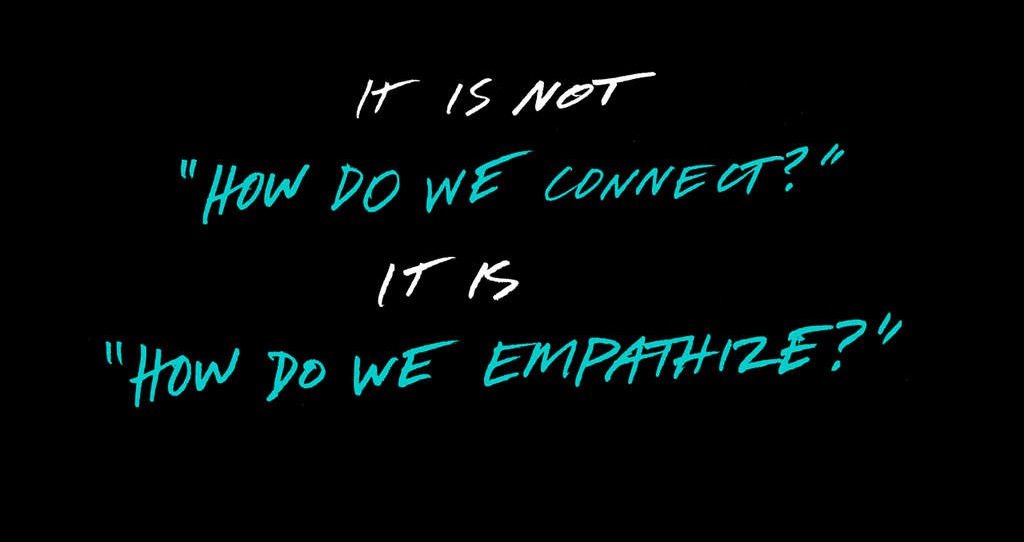
By understanding what it means to empathize, an organization can implement the culture needed to serve both internal and external customers to drive increased loyalty, engagement, advocacy and collaboration through involvement across the board.

Understanding the Mindset of Employees and Customers

Tracking software with advanced text analytics algorithms are beginning to identify true nuances of conversations between people. Nouns, verbs and adjectives can be layered upon the bigger conversation, and detect mood swings, emotional states, hidden messages and more.

Externally, being aware of these states of mind can help organizations prepare a message for individual customers (based on group personas as well as individual ones) that help show empathy to a current situation, and how your brand can help.

Internally, with tools like Yammer being widespread across many organizations, organizations can identify an employee who feels unappreciated or who has a great idea that isn’t being promoted. This clearly needs treading carefully with regards privacy and the employer/employee relationship, but is worth the effort to agree on with all parties.

Experiencing the Feelings of Another

There’s a reasonably popular television show called Undercover Boss, that explores what happens when the CEO of an organization is heavily disguised and placed into the workforce for a week, to see how well the company is run and identify the great people doing great things.

While not every organization’s CEO needs to do the same, remembering what it was that made your company such a great place to work in the first place is something that should be revisited often.

Adopt an open office policy where every employee’s views can be heard without bias or fear of recourse; spend a day on the job of various department workers; visit the facilities provided, like cafeteria and the quality of services provided to employees while in your care. Be an employee again to experience where your organization needs to make changes.

From a customer point of view, follow their footsteps at every touch-point of their connection to your organization. How does customer service handle their call; what does tech support look like; how are your resellers treating them; how are your complaints heard online when voiced? Be the customer again and resolve the issues before your competitors do.

Being a people organization is one thing; being an organization where people are human and empathize with the flaws as well as the strengths of other humans connected to the organization, both internally as well as externally, is where the true people part comes into play.

The challenge is yours to accept.

A version of this post originally appeared on the ArCompany blog.

Global Survey Shows Influence Marketing Seen as Lead Generation Tool, Not a Branding Exercise

Robots replacing humans

Mention “influence marketing” today and it’s a good bet that the majority of people will think of social scoring platforms like Klout, Kred and PeerIndex.

These early movers in the influence space have carved a niche for themselves and the brands they’re looking to work with, by attempting to provide data on who the most influential online users are.

By connecting brands with these online influencers, the hope is that brand’s message will be amplified to the Nth degree and more awareness around the brand will ensue.

However, a new report based on a global survey of 1,3000 marketers, PR professionals and brand managers/agencies highlights brand awareness as being less of a goal when it comes to influence marketing.

Instead, lead generation and customer acquisition are much more important, and where brands are allocating their budgets in the next 12 months and beyond.

The report also shows that social scoring platforms lack trust and authority when it comes to the very people these platforms are looking to work with.

Brand Awareness Alone Doesn’t Pay the Bills

There are a few key insights that the report provides, from how influence marketing is perceived today to how effective those using influence marketing as part of their overall strategy perceive today’s more popular platforms.

However, it’s the fact that influence marketing is seen as a lead generation and customer acquisition tool that stands out.

It also lends weight to why scoring platforms like Klout, etc, come under fire for the lack of results (perceived or actual) when used as the influence marketing tool of choice.

influence leads

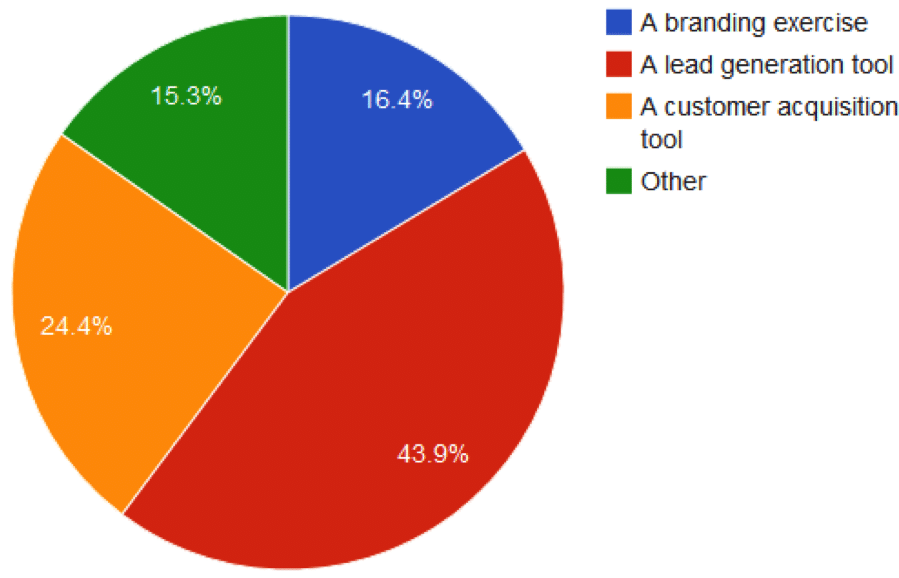
As shown by the image above, almost 44% of respondents see influence marketing as a lead generation tool, with almost 25% seeing it as a customer acquisition tool. Just over 16% see it as a branding exercise.

With social scoring platforms like Klout (currently) not sharing the kind of measurement that shows what leads and customer acquisition their client promotions have resulted in, it leads to another concern for marketers – how effective are these platforms?

influence effect

This is reflected in the survey responses, with more than half feeling today’s scoring platforms aren’t effective at identification of the type of influencers that can drive leads and customer acquisition goals.

Additionally, more than one fifth felt the results were too varied, with only 5% of respondents believing today’s scoring approach to influence were effective for their goals when starting a campaign.

While not every influence marketing campaign needs to drive sales all the time, the fact of the matter is brand awareness doesn’t pay the bills nor drive profit.

Blog posts and social shares are nice to have for social proof, but businesses are placing success metrics on the financial and customer return influence marketing campaigns drive, not X amount of social network updates.

Social Scoring May Be Waning But True Influence Marketing is Just Beginning

While the report shows there’s a clear gap between what PR/marketers see as the strategy and the results generated by scoring tools, it also shows that they clearly differentiate between “social scoring influence” and “influence marketing”.

influence difference

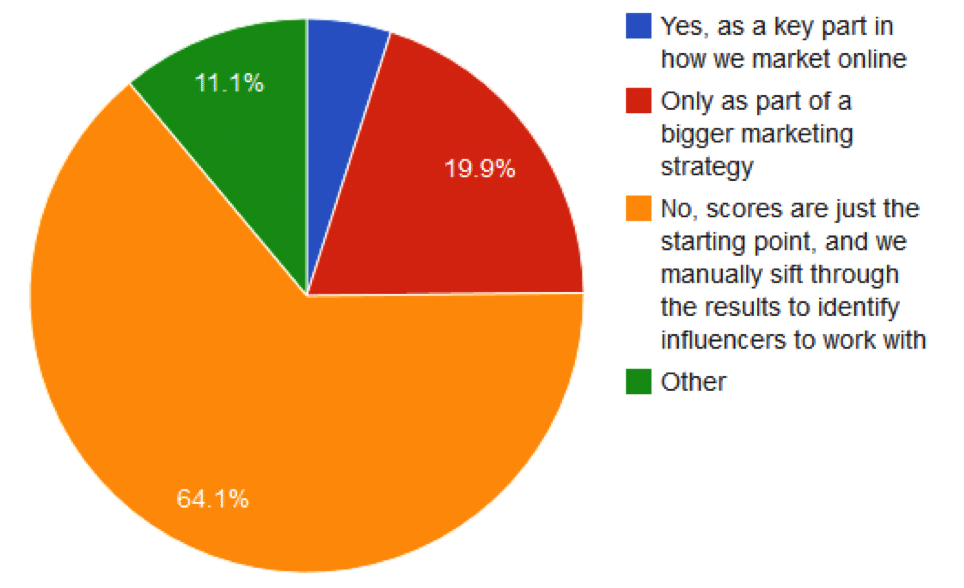
As the above figure shows, almost 2/3 of all respondents identify social scores as simply a starting point in their campaign – they still see the need to filter through the results manually and filter the most relevant influencers.

Additionally, almost 20% use scoring as part of a bigger marketing strategy and not as a standalone tool. Less than 5% use scoring as a key part of their overall strategies and tactics.

This ties in perfectly to further data from the report, when discussing how whether they’ll be using influence marketing, and how much of their marketing budgets are being allocated for the next 12 months and beyond.

influence marketing allocation

According to the report, almost half – 44.1% – will be creating an influence marketing campaign in the next 12 months, with just over 30% indicating the likelihood of using influence marketing as part of an integrated strategy.

When it comes to actual budgets, however, there’s a clear gap between how much will be allocated to “social scoring” and how much will be allocated to actual “influence marketing”.

influence scoring use

The figure above represents how many respondents will use social scoring as part of their influencer outreach. Almost two thirds say it’s unlikely, as the methodology is not seen as a valid identification/measurement tool.

Just over one fifth will use scoring, but only as part of a bigger strategy, while less than 9% are sold on scoring as a key part in the influence marketing arsenal.

The Future of Influence Marketing

The full report makes for some pretty interesting reading overall, but it’s the takeaways shared in this post that I find to be particularly illuminating.

While I’ve personally questioned the value of social scoring when it comes to true influence versus online popularity and amplification, it’s been seen from a biased bubble, if you like.

The survey carried out by Sensei Inc. and ArCompany was open to anyone to complete, although they had to be representative of marketing, PR and communications disciplines.

Over 1,300 respondents from across the globe represented a good mix of professions and business functions. In fact, business-to-business (B2B) was serviced just as much as business-to-consumer (B2C) markets – another interesting statistic, given social media’s penchant to be more acceptable in the B2C market.

Because of this mix, the results took me completely by surprise when it came to how scoring was perceived by the very professionals and verticals these platforms are hoping to sell their services too.

Yet perhaps I shouldn’t have been as surprised.

As both Sam Fiorella and I have found, in numerous interviews and research for our imminent Influence Marketing book, we’re moving beyond today’s approach of amplified distribution when it comes to influence, and into true, measurable and actionable data, metrics and identification of true influence.

While scoring may continue to be popular when it comes to consumer awareness and where people stand with their score on these platforms, the business decision-makers are looking for more tangible results.

That bodes well for the future of influence, and for businesses working in this space.

Here’s to the next wave.

You can access the full report here.

  • « Go to Previous Page
  • Page 1
  • Interim pages omitted …
  • Page 33
  • Page 34
  • Page 35
  • Page 36
  • Page 37
  • Interim pages omitted …
  • Page 174
  • Go to Next Page »
© 2026 Danny Brown - Made with ♥ on Genesis