• Skip to primary navigation
  • Skip to main content
Danny Brown

Danny Brown

podcaster - author - creator

  • About
  • Podcasts
  • Journal

Insights

The Changing Face of Social Media for Business in the B2C and B2B Space

Changing face of social media

Changing face of social media

With the shorter buy-in cycle of consumer customers versus business clients, and the natural usage of social media by “everyday consumers”, the ratio of B2C (business-to-consumer) versus B2B (business-to-business) has traditionally been in B2C’s favour when it came to how companies could benefit from social media as part of their business arsenal. Not any more.

Two recent surveys not only highlight the diminishing notion that social media is better suited to B2C companies, but also how well B2B companies are adapting and competing with their B2C counterparts.

The B2B Integration of Digital and Traditional

The first report is from New York-based abm, or the Association of Business Information and Media Companies. The report – a whopping 425 pages long – was carried out between March and April of this year, with more than 6,600 respondents covering 11 markets, including agriculture, marketing, engineering, healthcare and more.

The goal of the report was simple – to identify what resources B2B companies use to identify/encourage buying signals in their market. The three main questions of the report were:

  1. Marketers, advertisers and sellers: How well do trade media help you reach customers?

  2. Users, readers, media consumers and event attendees: How much do trade media influence your buying decisions?

  3. B2B media professionals: How effective are you at bringing buyers and sellers together?

The results were illuminating. While traditional methods like print magazines, product info from the manufacturer and print newsletters were still leading the way, digital resources were equally important.
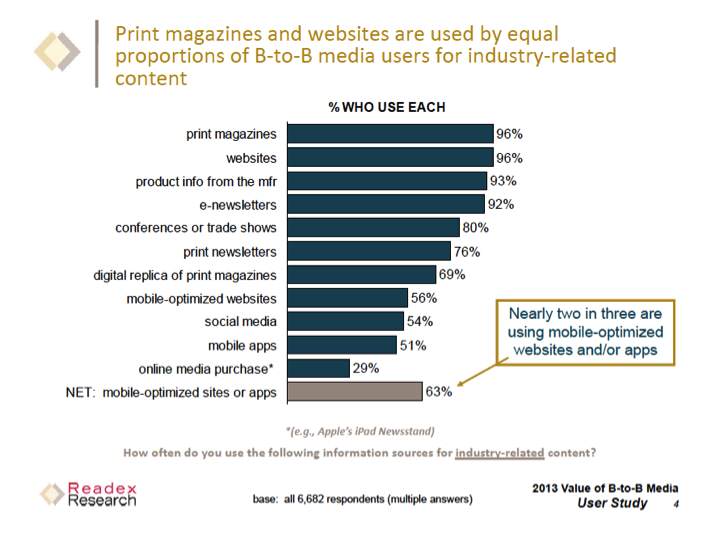
B2B resources for media

While websites play a huge role, and are equal in usage to the more traditional print magazine approach, it’s the implementation of digital or social media-led resources that catch the eye.

  • Digital magazines – 69%;
  • Mobile-optimized websites – 56%;
  • Social media – 54%;
  • Mobile apps – 51%.

For consultants and agencies pushing the line “social media doesn’t work in the B2B space”, this should act as a bit of a wake-up call.

Not only that, but when you look beyond just the current business use of social media and dig into how B2B sees resource use in the next 3-4 years, the picture becomes even clearer with regards the changing landscape.

Future of B2B media resources

The difference in where the B2B industry sees the market going from where it currently is now is striking.

  • Only 39% see print magazine usage as important, compared to today’s 96%;
  • Just 61% rate product information from the manufacturer, compared to 93% today;
  • Conferences and trade shows drop to 46%, compared to 80% today.

Meanwhile, social media, mobile-optimized websites and mobile apps remain steady in their importance. It’s a clear signal that the B2B space is moving beyond traditional thinking and into more integrated and agile solutions.

However, if the B2B space is showing an interesting trend upward, the B2C space is starting to show some serious wear and tear.

Senior B2C Marketers Know Less Than They Did Before

Marketing used to be so easy. Create a campaign, allocate a budget, blast a message out, (hopefully) see some traction, call it a success, rinse and repeat.

Deeper strategies and tactics weren’t needed, because the channels to view marketing messages were limited – print, TV, radio, billboards, and maybe some emails and telephone calls.

Of course, today it’s completely different. Not only do you still have all these channels, but now you have social networks, review sites, forums, game sites and more competing for your customer’s attention. Combine that with the reduced attention span of today’s connected consumer and the need for much better targeted marketing “just got real”.

The problem is, it doesn’t appear that marketers are keeping up, according to a new study from Yesmail Interactive and Gleanster. Also carried out between March and April this year, the two companies surveyed 100 senior B2C marketers representing brands with revenue between $10 million and $1 billion.

The results were just a little bit scary, although not too surprising.

B2C effective use of data

The main takeaways from the image show that while marketers believe they’re doing a good job of understanding their customers, the reality is a little further from the truth.

  • Marketers are still using reactive data to define customer knowledge – purchase history (67%), customer feedback (59%), and transactional/campaign response data (56% and 54% respectively);

  • Proactive data, such as likelihood to purchase (41%), online behaviour patterns (41%), social data (38%) and customer value scores (36%) is being severely underutilized, despite the fact it paints a far deeper picture of a brand’s customer base, existing and potentional.

By not using this data, the results are two-fold: the false belief that the business is meeting its customers’ needs, and resources being allocated to projects, products and services that are more likely to fail, due to non-relevance and non-market need.

Dig further into the report, and you can see this disparity become even more transparent.

B2C disparity of audience

As per the previous image, the senior marketers surveyed believe they’re doing a great job at understanding their customers based on historic purchases and interactions with the brand.

The problem is, this is just a small part of the bigger B2C picture, and that picture shows a much smaller understanding of the customer than the marketer believes.

  • Transactional data is still viewed as key, despite offering limited and dated insights;
  • A customer’s preferred channels to interact on are unknown;
  • There is no underlying understanding of when a customer is ready to buy;
  • The customer’s use of social media for decisions and actions is unknown;
  • How profitable offline customers are compared to offline ones.

These are just the basics – important basics, but basics nonetheless. If marketers are getting these wrong, then it’s disconcerting to picture what else they’re missing out on.

The blame for this lack of understanding? ?Limitations in marketing tools, poor data quality, and fragmented marketing systems. Sorry, but that’s bullshit.

No-One Said Success Was Easy

These excuses are the same ones that marketers used 10, 20, 50 years ago and more.

“We only have radio to market with”, “we only have TV and radio to market with”, “we don’t have audience insights from TV viewers”, “we have audience insights but they just represent a median percentage”.

And on, and on, and on. While there might have been some validation to that argument a few years back, today it’s anything but valid.

Today, technology – or Big Data, if we want to use the current buzz term – allows us to understand the minutest detail about our target audience.

  • We can understand the emotional triggers that make them take a specific action;
  • We can understand the emotions they feel when viewing a certain product;
  • We can target geolocated offers based on propensity to buy when in a certain neighbourhood;
  • We can identify who influences them to move along the purchase life cycle path at any given time;
  • We can identify cross-cultural opportunities and best practices to implement them;
  • And much, much more.

By using this data and more like it, and having the right people in place to both analyze and deconstruct, we can now target very small and specific buyer communities, allowing for more focused marketing and subsequent performance. This enables a richer understanding of success and failure, and future methods and relationship paths.

Simply put, it’s smarter marketing and where businesses need to start being now, as opposed to 12 months down the line. Does it take a lot of work? Yes, with a capital Y.

It takes employing people that understand the data beyond the data – emotions, human psyches, emotive terminology like sarcasm, and more. It means moving beyond the algorithms and blast radius marketing, and beginning with the customer at the heart of all you do, and working back from there.

It’s not easy, but it does deliver, and much more effectively than current transactional mindsets.

The B2B space is realizing this and catching up on the previously dominant B2C space. Who would have thought..?

The full B2B report from can be downloaded here. A shorter, PDF version can be downloaded here.

The B2C report from Yesmail Interactive and Gleanster can be downloaded here.

image: jbhalper
State of Play for Influence Marketing in 2013 – Infographic

Crossroads of influence marketing

Businesses are now competing with ? and often losing to ? ?the wisdom of crowds? in the branding battle. Identifying individuals who sway online consumer opinion on specific topics and within specific communities has become critically important to marketers and public relations professionals.

A slew of social scoring platforms have emerged with claims that they can identify who influences who online while providing various tools and scoring systems to rank those who are influential and those who are not on a variety of topics.

However, as with most early adopters, their efforts have been widely criticized. Some say they?re just misunderstood and that the technology is just too new.

Either way, there?s one certainty: Marketers and public relations professionals are taking notice.

Earlier this year, ArCompany and Sensei Marketing surveyed marketing professionals around the world in the ongoing effort to better understand this growing industry and where businesses stand on the issue.

  • Can social influence truly be measured?
  • Is anyone using them?
  • What?s the future of influence marketing?

Influence marketing survey key insights

We’ve created the following infographic to highlight some of the key findings:

  • How marketers define Influence Marketing
  • What budgets they?re allocating to Influence Marketing in the next 12 months
  • How do marketers rate various social influence scoring platforms
  • What successes they have had with social influence scoring platforms and if they plan on using them in the future
  • The demographics of audience surveyed

What’s clear is social scoring, while recognized, is being questioned more, with businesses demanding better return for their investment. The technologies that can provide this will be the ones leading the charge in this Third Wave of Influence Marketing.

How about you – how does this data reflect your own personal experiences with influence marketing? I’d love to hear your thoughts in the comments.

Publish the infographic on your site – use the Embed code at the bottom of this page:

IM infographic

Influence Marketing bookBuy the book that offers the methodologies that answer the needs raised in this report: Influence Marketing: How to Create, Manage, and Measure Brand Influencers in Social Media Marketing

Book Authors: Danny Brown & Sam Fiorella
Copyright: ? 2013 by Que Publishing
ISBN-13: 978-0-7897-5104-1
ISBN-10: 0-7897-5104-6

?Survey Sponsored by:

arc-logo
sensei-logo

How Visual Curation Can Help Tell a Brand’s Story

Clipsi Content Fosters Collaboration

Clipsi Content Fosters Collaboration

When it comes to helping define what your brand stands for and, by association, helping potential customers or clients see whether you’re a good fit for each other or not, visual content curation is a hugely effective solution.

While I’m not sold on the current trend that “to be a successful brand, you need to be a storyteller” – both Sam Fiorella and Hessie Jones offer valid opinions as to why this isn’t the case – I won’t dispute how a brand’s story can add to the overall appeal.

Knowing the history of a brand, what made it the success it is today, and how this has defined their culture of success, can tell us a lot about the culture of the organization in question. For some customers, that can be the final persuasive factor in giving that brand their business.

Since humans by nature are very visual creatures, the ability for brands to share their story in a more appealing way than simple news clippings and print publications seems a no-brainer.

Two companies who agree are Vizify and Clipsi.

Vizify – A Life Told in Rich Media

Danny Brown Vizify

In the company’s own words, Portland, Oregon-based Vizify is a “graphical bio” or “visual representation of you”. From their website on why you should use Vizify:

Like it or not, people look you up online before they interview, hire, or date you. Make sure they see your best.

Now while I’m not sure if having a visual representation of yourself for would-be suitors to view you is a great idea, especially in this looks-driven world we live in today, the rest of Vizify’s premise makes perfect business sense.

For job-seekers, it’s a great way to present yourself and your social footprint to potential future employees. By the same token, it’s a great way for headhunters and recruiters to see if a potential candidate is right for the client they represent.

Going a little deeper, and brands can use Vizify to showcase not only their mantra, but how they uphold that online.

While the format is a little more suited to a more visual presentation of a resume, the same features that make up Vizify from a personal angle can also be utilized for a business or brand.

  • Multiple Twitter accounts can show the diversity of your company’s approach to social, from customer service to support to FAQs and more.
  • Images can share corporate events, team building, awards, employee news and milestones, as well as customer satisfaction stories.
  • Videos can highlight the topics you discuss online as well as the people who influence your brand, to show if there’s a correlation for a potential customer.

In addition to these, there’s a nifty Words feature that shows the words you use the most, which gives a great indication of whether your brand’s expertise or areas of interest tie in with those of your customers. As you can see by the image below, if anyone’s interested in talking influence with their mates, I might be your guy!

Danny Brown Vizify words

Additionally, for any customer looking to do some more digging on your brand, Vizify offers a handy Links feature that connects the dots to your online footprints.

Throw in the ability to customize to your brand’s design and some basic analytics behind how your content is being viewed, and Vizify offers a clean and simply way to showcase what your brand’s about when it comes to social.

Clipsi – The New Corporate Media Room

There have been numerous ways to create an online news room that highlights your company’s most important news, milestones and achievements, but recently released Clipsi offers a slick take on it.

By grabbing text or images – or clippings, for the old school amongst us, including me – from either public web pages, or documents from your Dropbox account, Clipsi then lets you arrange them to present an informative and interactive newsroom.

As you can see by the embedded example below, which Neicole Crepeau – the driving force behind Clipsi – kindly put together for me around the topic of the Influence Marketing book.

By collating quotes from blogs, interviews as well as directly from the book, and the research that took place around the case studies and technology vendors in the influence marketing space, this particular Clipsi offers a pretty good feel for the direction the book takes.

However, as cool as the newsroom offering is, it’s where Clipsi is taking steps beyond just offering a public-facing news curation area, and looking to make the platform a true team tool for cross-collaboration, that things get really interesting.

Say you want to create a report or marketing strategy based on what you know about today’s marketplace and where your brand fits in. With Clipsi, you could create a team research board, invite colleagues from relevant departments, and collectively collate any data you feel offers insights into the topic at hand.

With instant visual reference points, as well as clickable links to take you directly to the source, Clipsi moves from being an effective newsroom into a research-driven strategic solution. The example board below, “Social Media is Crack”, is a great example of this approach.

Statistics, research links, authority reports and sources ensure the most up-to-date analysis for your team, which in turn means the most up-to-date reports for your company’s leadership team.

Described by Neicole as “Pinterest for business”, the analogy is apt – yet, for me, Clipsi offers much more of a business solution than the popular image curation board it’s compared to.

Clipsi is currently in beta – you can find more details here.

The Media is the Message

There’s no doubt that businesses are using visuals more in their content creation. Twitter’s introduction of Cards, and the redesigned Google+ and Facebook interface that favours rich media, shows this trend is only going to continue.

As brands look to compete in an ever-noisy space, the ability to show and tell versus just tell is a key ally. Vizify and Clipsi understand this and are helping redefine how we both represent and consume information.

While blogs and social accounts will continue to help these brands position themselves to their would-be customers or future employees, the ability to go a little deeper from a central point makes that positioning a little more attractive on both sides.

Where the media truly is the message, ?don’t let your brand miss out on sharing its version.

Why We Need More Partnerships Like the @Traackr and @Nimble One

The middle of May saw a pretty big announcement in the influence marketing and social business space.

Influence platform Traackr and Social CRM platform Nimble announced a partnership that would see seamless integration of the two solutions, and allow much more effective management of influencer outreach programs.

From Traackr:

As of today, our users can connect their Nimble accounts to their Traackr projects and centrally manage influencer outreach efforts. It?s a huge step forward in closing the loop on influencer marketing.?What makes the Nimble-Traackr duo worth considering is that now you have Traackr?s contextual influencer identification and content tracking coupled with relationship management tools that enable you to create a plan, implement that plan, document the results, and even follow-up periodically with a complete interaction history.

From Nimble:

Up until now, companies that have invested in influencer marketing have faced the challenge of reconciling siloed solutions to manage their marketing programs with discovery, research, engagement and management happening in different places, making it difficult to truly nurture relationships. Using Traackr and Nimble together provide users the ability to perform influencer discovery and tracking, relationship building and nurturing, as well as activating and measuring results.

When I heard about this partnership, I was ecstatic. From a personal point of view, it was validation for the methodologies Sam Fiorella and I talk about in the Influence Marketing book, and what the future of that vertical looks like (integration between complementary platforms).

From a business and marketing point of view, it’s the kind of common sense partnership we see too little off, and yet one that reaps dividends for all involved – the two partners, their clients, and anyone looking to effectively use social media to drive leads, sales, customer service and more.

While this particular partnership is built around influence marketing, it offers a path that other businesses could [should] take when it comes to their own customers and the solutions they offer.

Social Behaviours and Decision Making

For any business, one of the primary goals – if not the main one – is understanding its customers better. These could be existing or potential, as well as stakeholders or employees.

Take it beyond customers, and switch the wording a little, and you get the same thing – donors, political party supporters, activists, etc.

If we, as businesses, can understand what makes our customers tick, and offer them solutions based on their freely submitted data and information, we can identify certain behavioural aspects and provide a message or solution accordingly.

Tie that into their social behaviours online, and then use complementary software that monitors, analyzes, segments and recommends, and we’re moving into an area where we can truly be smarter about how we meet the needs of our customers.

Not only that, but we understand what makes potential clients or strategic partners tick.

Whereas before it could take months or even years to gain enough knowledge to turn a cold call into a warmer introduction, using Traackr’s identifying process along with Nimble’s project management tools gives us data we can really use to break the proverbial ice.

  • New contract details;
  • Personal and professional milestones;
  • RFP timescales;
  • Deciding factors;
  • Competitive influencers;
  • Peer connections.

Information in business is king – analytical information even more so. The Traackr/Nimble partnership brings this information to us in a more cohesive manner than before.

Collaborative Consumption is the Way Forward

Apart from the obvious business solutions the partnership brings, it also enables both companies to fine-tune their own offerings based on how their clients are using the new combination.

For instance, while Traackr has an excellent influence marketing solution, especially when it comes to identifying who influences the influencers, they don’t go quite as deep on the measurement path when keeping track of where someone is in the purchase life cycle.

For a sales team, this information is more key than knowing who the influencers are in a particular vertical – that would fall more to the marketing team to handle.

With Nimble’s integration, a sales VP could allocate team members different leads, at different stages, and base success criteria on how well that sales person moves the potential client into the next stage of the decision-making process.

Each time the lead is moved into a new section – from awareness to research, for example, or research to intent to buy – a new set of influencers could be identified by Traackr. The warmth of that lead would then either increase or decrease based on what needs to happen next.

Alerts are set up to monitor sudden spikes in activity, or mention of certain keywords that would suggest the intention to buy soon.

Now, instead of influence being used for promotion and social share of voice, it’s a true, lead generation tracking tool. All because two companies decided to partner as opposed to leaving clients to figure out how to connect all the dots themselves.

The Possibilities Are Limited Only By You

It’s this kind of forward movement that today’s technologies allow and, for the smarter companies out there, actively encourage.

Developers that build their solutions with Open APIs in mind – the ability for different technologies to connect to each other reasonably easily – are the ones that will be positioned to lead the marketplace.

It’s one of the reasons ArCompany doesn’t tie itself to specific vendors. We may announce strategic partnerships but we’ll still present the most relevant solution(s) based on a client’s specific needs.

At this moment, we’re working with a technology vendor in Toronto to provide the next level of content analysis for both brands and bloggers, and how that solution can tie into other technologies based on verticals and goals.

While we may not be technical engineers, we know what our colleagues in this space are asking for, so it makes sense for us to partner with a vendor that can deliver on these needs, while looking ahead to see how much further we can take the basic premise.

As the conversation around social media and business matures from “oh, nice to have” into an actual business conversation, partnerships like the Traackr and Nimble one will become ever more prevalent.

It’s about time.

image: Nimble.com

The Sunday Share ? 25 Mind Blowing Email Marketing Stats

email-1As a business resource,?Slideshare?stands pretty much head and shoulders above most other content platforms.

From presentations to educational content and more, you can find information and curated media on pretty much any topic you have an interest in.

As a research solution, Slideshare offers analysis from some of the smartest minds on the web across all verticals.

These include standard presentations, videos, multimedia and more.

Which brings us to this week?s Sunday Share.

Every week, I?ll be sharing a presentation that catches my eye and where I feel you might be interested in the information inside. These will range from business to content to social media to marketing and more.

This week, an informative presentation from leading enterprise cloud solutions provider Salesforce.

According to a study by ExactTarget, 77% of consumers prefer to receive permission-based marketing communications through email. ?As many brands and consultants try to tell us email is dead and social is the way forward, this is a good reminder of how powerful email still is.

Enjoy.

  • « Go to Previous Page
  • Page 1
  • Interim pages omitted …
  • Page 31
  • Page 32
  • Page 33
  • Page 34
  • Page 35
  • Interim pages omitted …
  • Page 174
  • Go to Next Page »
© 2026 Danny Brown - Made with ♥ on Genesis