• Skip to primary navigation
  • Skip to main content
Danny Brown

Danny Brown

podcaster - author - creator

  • About
  • Podcasts
  • Journal

Insights

Turning Fans Into Performers ? Dan Deacon and the Power of Youtility

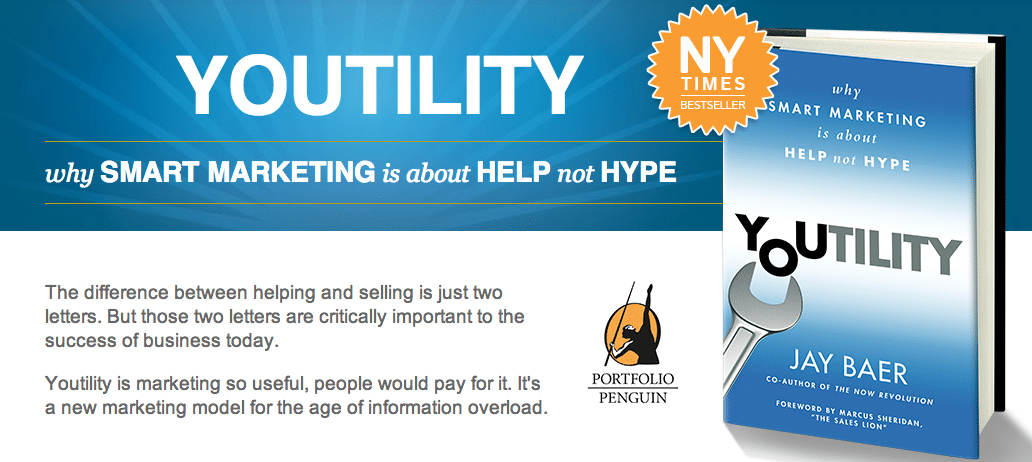
Youtility Why Smart Marketing Is About Help Not Hype

Youtility  Why Smart Marketing Is About Help Not Hype

This is a guest post from Jay Baer.

Today?s consumers are staring at an invitation avalanche, with every company asking for likes, follows, clicks and attention. This is on top of all the legacy advertising that envelops us like a straightjacket.

Lots of books have been written that tell you the way to break through is just to be an ?amazing? company. Pretty much all of them say you can win hearts and minds by doing things differently, providing knock-your-socks-off customer service, or fundamentally changing your corporate culture.

But your company probably isn?t amazing. And becoming amazing is incredibly difficult, and doesn?t produce reliable, linear results. So instead of betting all your money on amazing, what if you just focused on being useful? What if you decided to inform, rather than promote?

If you sell something, you make a customer today; if you help someone, you can create a customer for life.

Marketing Sideways

I call this Youtility. Not utility because a utility is a faceless commodity. Youtility is marketing upside down.

Instead of marketing that?s needed by companies, Youtility is marketing that?s wanted by customers. Youtility is massively useful information, provided for free, that creates long-term trust and kinship between your company and your customers.

Youtility In Your Pocket

But Youtility isn?t all business, and Dan Deacon is proving it every night.

“For the first time, having your phone out at a concert is not a jerk move,” says the description of the official app for Dan Deacon, a Baltimore-based electronic musician known for his engaging live performances. The app turns concert-goers’ phones into a synchronized light show and even an extra instrument that Deacon can “play” from the stage. A short YouTube video demonstrates the app in action.

[youtube]http://youtu.be/R8UlLBuzy6Q[/youtube]

With the app installed and running on a smartphone, Deacon can control the devices en mass by playing audio tones that “instruct” the phones to flash, change color, make sounds and more. It’s quite a spectacle, and a surprise even to fans who have downloaded the app and ostensibly have an idea of what to expect.

“It’s a really cool moment when Dan first plays the tone and then all of the phones change color,” app co-creator Keith Lea says. “Usually people are a little shocked. They’re not really ready for it to work. People are used to their phones being magic, but this registers as a different sort of magic.”

The app has created significant industry chatter for Deacon and Lea, with articles in Rolling Stone, Billboard, SPIN, CMJ and more.

The technology and story behind the genesis of this example of situational Youtility is remarkable.

An Obvious Answer

Says co-creator Lea, “Me and Dan and Alan Reznick, who is also involved with the app, we were all on a bus together. I was running tech and they were both performing on this little tour around the East Coast….I guess Dan had seen the Beijing Olympics Opening Ceremonies and he saw that they handed out LED bracelets and had them sync up. Dan’s idea was why did they bother going through the effort of handing out all of these little LEDs when everybody has, essentially, a little light in their pocket.”

Lea recalls that, as Deacon’s “nerdiest friends,” he and Reznick were asked about the feasibility of using smartphones in this way, which instigated weekly meetings to work on the project, which was more difficult than initially imagined.

“You’d think getting a bunch of pretty sophisticated little mini computers to do something all at once would be easy,? Lea said. ?We first thought the obvious thing was to use WiFi…but we called a couple of networking contractors and just none of them had any ideas because of the need to get 500 to 1,000 people on a wireless network that needs to be torn down and put up every night.”

Simple Solution, Big Outcome

After abandoning WiFi as the syncing technology, the team considered using existing 3G and 4G cellular networks as a connection point but realized that access wasn’t universally strong at all show locations, and music festivals often feature overloaded cellular networks.

Digging deeper, they took an inventory of all the sensor arrays present across all smartphones and realized, “Oh, well every phone obviously has a microphone and a speaker,” remembers Lea, who used the neo-lithic days of dial-up Internet connections as inspiration. “Back in the 90’s we all got on the Internet through a phone connection, and it’s just audio that’s being used to transmit data.”

Deacon and team have no plans to charge for the application, and, while licensing the technology to other artists is certainly a possibility, this is one instance where Youtility isn’t about marketing and brand-building.

“Maybe this is a little trite, but it is pretty cool that a couple artists and a programmer got together, and for a really tiny budget came up with something that is transforming the way people look at their cell phones in this performance context,” Lea says.

Excerpted from the New York Times best sellerYoutility: Why Smart Marketing is About Help not Hype by Jay Baer. See YoutilityBook.com for other resources.

Youtility Excerpt:

Youtility: Why Smart Marketing is About Help not Hype – Exclusive Free Excerpt from Jay Baer

Jay Baer Marketing Keynote SpeakerAbout the author:?Jay Baer is a hype-free social media and content strategist & speaker, and author of the New York Times best selling business book?Youtility: Why Smart Marketing is About Help not Hype. Jay is the founder of http://convinceandconvert.com and host of the Social Pros podcast.

Why The Conversation Prism Misses the Boat on Influence

Conversation Prism

Conversation Prism

Recently, Altimeter analyst Brian Solis released the fourth iteration of the Conversation Prism, a visual representation of where the social web stands today.

As part of this update the prism included influence, in a nod to how key this area of social media has become for today’s businesses, in both goals and tactics. Unfortunately, like many other examples, the influence part of the prism misses an opportunity to move beyond the obvious and really discuss where influence is going.

By primarily highlighting social scoring platforms like Klout and Kred, the prism talks less about influence and more about amplification, popularity and ego-centric versus customer-centric platforms (thanks for that last phrase, Chris Heuer!).

For me, this misses the much bigger influence picture, so I reached out to Brian on the original LinkedIn post, and discussed the inclusion of scoring and the exclusion of better solutions.

On Moving the Influence Conversation Forward (Or Not)

DB:?What stands out is the Influence line. Same old platforms, either based around scores or single networks. Where’s the innovation? Where are the new leaders that are really pushing the influence discussion forward? Companies like Traackr, Appinions, InNetwork Inc., Tellagence, Measurely, etc? With their exclusion and your focus on the technologies that are questionable when it comes to measuring influence, it dilutes this data and leaves it looking a bit outdated even as it’s just published.

BS:?Those companies are indeed leaders in the field. In fact, I’ve written about Digital Influence going back to the late 90s. However, their place is not on this version of the prism as the majority of them are services rather than networks. So, it’s more focused and therefore allows it to be iterative in a systematic fashion.

DB: Klout isn’t a network. Kred isn’t a network. PeerIndex isn’t a network. There is no networking to be had on these sites. Indeed, PeerIndex’s own chief data scientist sees them as the type of company that provides data and consultancy services to their clients. Even taking that aside, though, these companies aren’t really measuring influence – they need you to add your other networks for them to successfully “measure” you.

By that definition, they’re saying you’re only influential based on your public Twitter presence (since that’s all they effectively measure without your strict permissions and connecting of other accounts). It’s why their inclusion on a line of “influence” is skewing the data and reducing any validation of the prism itself.

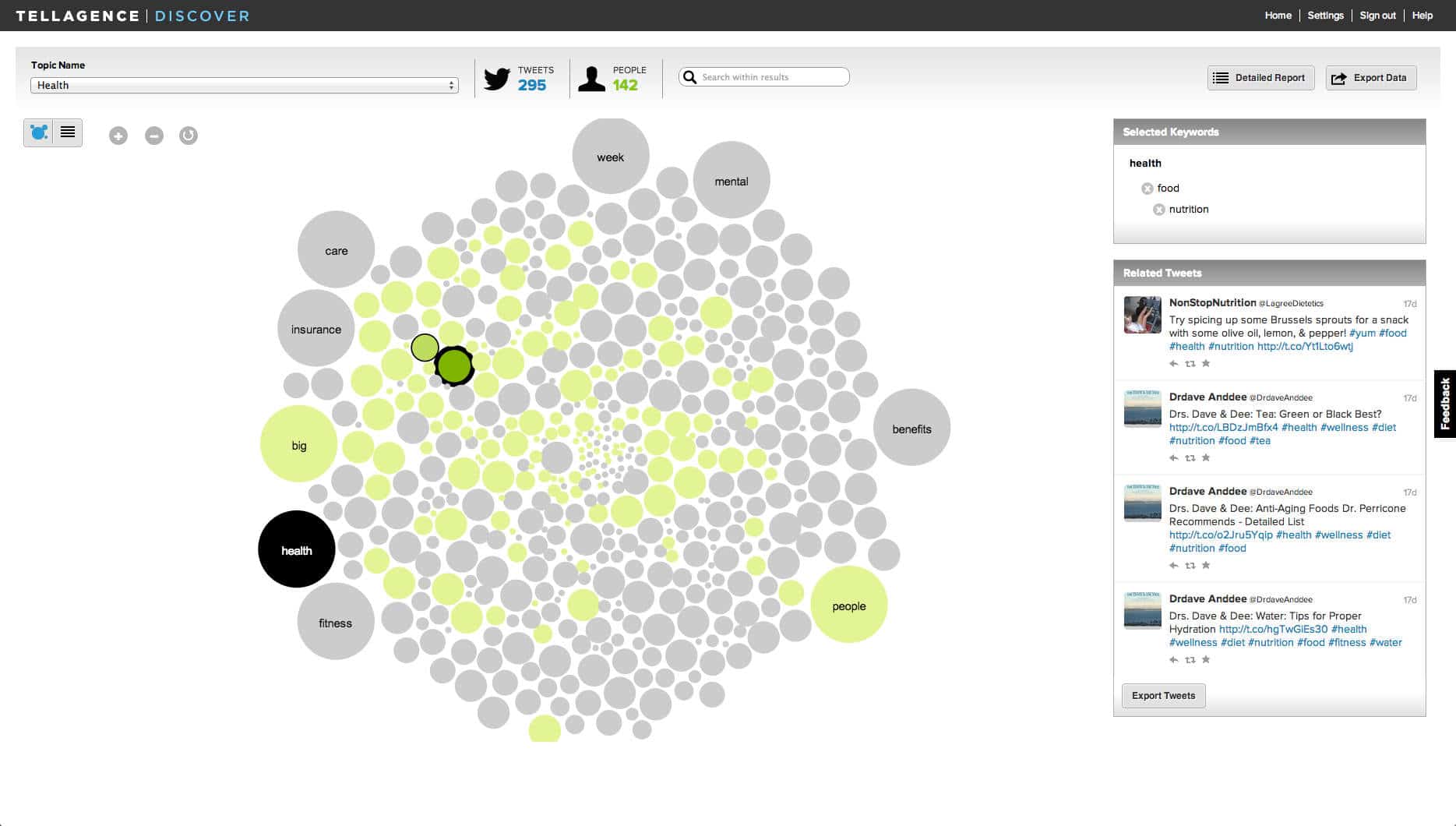
If you want to highlight true influence, look at how Tellagence tracks the ebbs and flows of influential communities and how that changes; or Traackr’s INA solution of who influences the influencers; or Appinions and their use of offline data and reactions to flesh out online influence; or Measurely and their parent company, Lymbix, and how they can successfully identify the emotion an update or content instills in you, making it easier to identify what type of media, content, etc., to use when looking to attract that audience. *That’s* influence – scoring isn’t.

Tellagence Discover Visualization

BS: I tend to disagree…they are networks. And, if you read my report, you will see how I trash the “idea” of scores. Might help to read first. Saves time when you see we are in agreement.

DB: I read that report when it came out, and questioned it at time of publication. It proposes that scoring platforms track more than they do; they don’t. The majority of information they use is from the Twitter firehose, regardless of what they would have you believe (why do you think Kred is so worried about the legal case with Twitter?).

But you have to be consistent as well; in one breath, you say they’re influence platforms (your prism) and then in the other you say they don’t measure influence, but the potential (something we do agree on, though probably not to the same level). And I stand by the definition they are not networks – unless you call a +K a true interaction along the lines of a Twitter interaction or a G+ conversation. They are data repositories – nothing more, nothing less.

BS:?No…no the report doesn’t draw that conclusion at all…in fact, it’s quite the opposite. And in terms of consistency…I’ve 10 years of research, development and experimentation in digital influence. My published work speaks for itself. In regards to an infographic that has “influence” as a category and not as a validation of the social networks that purport influence as a standard, that’s between you and those developers…

I merely created a sliver because the traction of some of those networks has the notable attention and budget of some of the biggest brands in the world. The center of the graphic is there for a reason. So, you can either try to pick a debate that at its root is out of context or you can focus your time on teaching other people about the merits of the services that help brands do a better job i.e. Traackr, eCairn, and the like.

And don’t forget, I co-founded and sold Buzzgain, which was an early player in this arena. If you step back from a ping pong game in the comments, you’ll probably find that I support your message and mission.

At this point I decided to not reengage as the conversation seemed to turn from a discussion about influence into a promo for accomplishments over questions about the inclusion of certain platforms when others would appear more suited to be there.

However, there were some valid points made, and some less valid ones, that deserve addressing, so let’s dig in some more here.

The Idea of Influence Platforms as Networks

Solis’s main reasoning for the inclusion of Klout, Kred, etc., versus more relevant platforms when it comes to actual influence, is that the former are networks while the latter are more service-led.

Yet within these platforms, there is absolutely zero networking opportunities or functions by today’s definition of a social network (unless the awarding of Kred or Klout points via a simple button click is classed as networking). Additionally, if they are networks, then shouldn’t they have been placed in the Network area of the prism?

However, moving beyond that simple overview, even the platforms included see themselves as services. Kred’s business model is to provide the data they gather to their clients, and act as a consultancy on how best to use them.

Kred for Brands

The closest influence platforms – public scoring or otherwise – come to “networking” is within the InNetwork model, where brands and influencers can connect directly within the portal and agree on project deliverables, compensation, etc. Even that, though, is limited to two parties, which makes it a more gated community/network versus a truly public one.

The Potential for Influence versus Actual Influence

In the report that Solis refers to, he speaks of social scoring platforms offering the “potential for influence” and this is where we definitely agree.

During research for our book, Sam Fiorella interviewed PeerIndex founder Azeem Azhar, who shared this interesting and definitive statement on where social scoring stands in the influence sphere:

There’s no real way for companies today, at a large scale, to identify who are the nodes that are more likely to spread messages around given categories. If you’re looking for the 7 people most important to me right now, PeerIndex isn’t for you. If you’re looking for the top 70,000, look to us. That’s where PeerIndex is and where we’re going.

There are two key parts to Azhar’s quote: influence can’t be built at generic scale, which is what scoring platforms profess to offer, and real influence comes from much smaller communities and interaction.

It’s why the platforms I suggested should be in the influence sector of the prism make much more sense than the current scoring-led inclusions – they’re measuring real influence and what that means for a business, versus those that may or may not be influential and lack relevance because of that.

The Social Bubble Needs Popping

I’ll freely admit I’m more than a bit biased when it comes to discussing influence and where it stands today, as far as the social web is concerned.

For the last three to four years, I’ve been a vocal critic of the data and identification methods that scoring platforms use when it comes to determining influence. They’re built for generic metrics, that agencies and brands can use to start the real legwork.

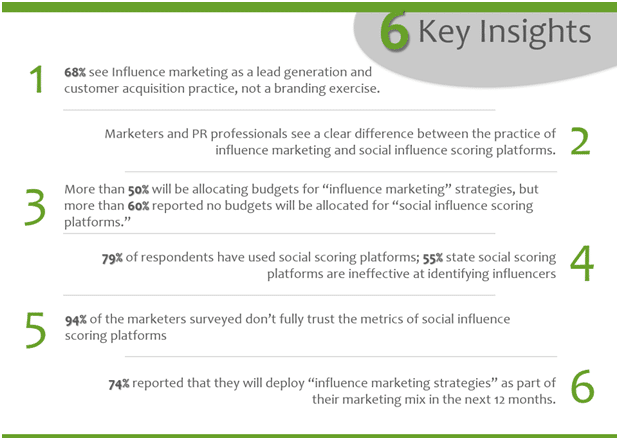
Indeed, in a recent survey of more than 1,300 marketers, brands and agencies commissioned by ArCompany and Sensei Marketing, 94% said “they didn’t fully trust the metrics provide by scoring platforms”, with 55% stating that “scoring platforms were ineffective at identifying influencers.”

influence marketing survey

These are the very companies, brands and professionals that the Conversation Prism is geared towards, and highlights why the continued inclusion of scoring platforms is in danger of diluting the authority of the prism itself.

If we’re to truly move beyond the social media bubble that seems to regurgitate the same names and platforms year in, year out, we need to offer real answers and solutions versus those that have bigger awareness but less relevance.

Once we do that, everyone benefits, because only the best and most relevant information is being offered. And isn’t that where we all aim to be anyway?

image: ConversationPrism.com

You can download the full Conversation Prism here.

The Sunday Share ? Less: What Your Customers Really Want

europe-crisis

As a business resource,?Slideshare?stands pretty much head and shoulders above most other content platforms.

From presentations to educational content and more, you can find information and curated media on pretty much any topic you have an interest in.

As a research solution, Slideshare offers analysis from some of the smartest minds on the web across all verticals. These include standard presentations, videos, multimedia and more.

Which brings us to this week?s Sunday Share.

Every week, I?ll be sharing a presentation that catches my eye and where I feel you might be interested in the information inside. These will range from business to content to social media to marketing and more.

This week, a short but punchy presentation from speaker and entrepreneur Bruce Kasanoff.

As marketers and brands, we often overpower our customers with the amount of things we not only provide them, but also ask of them. As Bruce succinctly points out, though, in the case of our customers less truly is more.

Enjoy.

The Difference Between Ideas and Doing

All about the ideas

All about the ideas

A few years back, I knew a guy who always had a great idea up his sleeve.

He?d share these ideas with anyone that was in his company, and tell of his grand plans for when his ideas made him rich. They would invariably involve?Salma Hayek, a yacht and six months at sea?

Everyone smiled and asked him not to forget us when he was rich and famous. After all, we were the sounding boards for his ideas and we?d say which ones sounded good, and which ones wouldn?t get him Salma.

Jump forward a few years, and needless to say he?s not dating Salma Hayek for six months of the year. Nor does he have his yacht, or his millions in the bank. The last I heard, he was a baker in a small village just outside of London in the U.K.

Not that there?s anything wrong with that. He?s making an honest living, and keeping a roof over his head. But knowing his mind and ambition, I can?t help but feel he?d be a little disappointed that his grand plans never came to fruition.

And there?s one simple reason.?While he talked a great talk about ideas and plans, he never followed through on them.

Never.

Instead, his great ideas remained just that ? ideas. Pipe dreams that could have been great had he taken just one of them and attempted to do it. But he didn?t. Instead, he chose to live anonymously, if you like, and remain ?that guy with the ideas.?

Again, there?s nothing wrong with that. Nothing at all.

But ask yourself one question, if you?re currently thinking great ideas ? what will you do next?

  • If it?s for a business, there are a ton of resources available for you, both online and offline. Google is your friend online, and your local?Chamber of Commerce?(or equivalent) is your friend offline.
  • If it?s for a product, and you want to test run it first, why not try something like?Etsy?to start with (or the equivalent for your product?s niche)? Again, Google is your friend ? use it to find sites to sell your product with little investment.
  • If you?re looking for feedback?to see if your idea is needed, set up your version of customer satisfaction?listening posts?and see what people are saying. If there are a lot of complaints and not a lot of resolutions, that?s an immediate in.
  • If you want to write a book, there are a host of self-publishing platforms available, like?Blurb?and?Lulu. Better still, write an ebook and sell it through your own blog or website.

The main point is, there are a ton of folks with great ideas. But many never make it past the idea stage.

So, the question remains.

What will?you?do next?

Image:?k-ideas

Why Google is Missing the Point on Sponsored Content

Over at the InNetwork blog this week, I wrote about why influencers deserve to be paid. It essentially looked at why brands should be treating influencers more professionally, and respecting them as a key partner in any marketing mix.

In the comment section after the post, Kari Rippetoe, Content Marketing Manager at Search Mojo, left an interesting statement:

Interesting post – you pulled me in with that title, because I wasn’t quite sure I agreed. I totally get where you’re coming from regarding the time an influencer not only spends in writing a post, but also in cultivating and managing their influence and community. But, from an SEO standpoint (and I work for a search marketing firm, so we’re very sensitive to this), paid posts (if you’re indeed compensating the influencer with money) can be detrimental to SEO. Google doesn’t like paid links, and while its algorithm can’t necessarily detect all paid links, I’m not sure if it’s worth the risk. That’s why we don’t pursue requests from bloggers to write posts for payment – because that’s a risk we can’t take on behalf of our SEO clients.

Kari’s point about paid links, and Google’s view on them, is a pertinent one, since – while there are other search engines around – Google is the search algorithm that most people take notice of and adhere to, rightly or wrongly.

The thing is, for me, Google’s wrong regarding their stance on sponsored content.

Sponsored Content – The Google Take

To get a better idea of what Google’s take is, here’s what’s being said around the web with regards what Google does and doesn’t “allow” when it comes to sponsored [paid] content:

Google made it clear that they do not want sponsored content indexed in Google News, and sites that mix in promotional articles with their regular news content could be excluded from Google News entirely.

To clarify, the second warning refers to advertorials or articles created entirely by or for a sponsor, along the lines of what?BuzzFeed does… Adam Sherk.

So, essentially, Google is trying to avoid clearly advertorial content that offers nothing but promoting a brand’s message or paid media. Fair enough – there’s enough crap online that’s been paid for and bypasses the good content, which gets lost in amongst the paid stuff.

Where it gets a but muddied, though, is in what Google deems acceptable, as highlighted by the opening sentence in the paragraph that follows Adam’s quote above:

It does not apply to instances in which regular editorial content is given a sponsor treatment.

So, for example, a blogger could write a piece about hair gel and have Garnier Fructus sponsor the post. This means the blogger writes and Garnier might offer free samples. The blogger’s words, the brand’s product.

See a flaw there? Yep, it can still be viewed as paid content by the blogger’s readers. Why would Garnier sponsor without something being in it for them? Did the blogger remain unbiased, or were they tempted by bigger partnerships if they slipped in a couple of favourable mentions of Garnier throughout the post?

While there may not have been physical dollars exchanged, the question is still there – “can this opinion be trusted?”

Once that happens, it counters the very reason Google wants to clamp down on sponsored content: false advertising, inferior products, etc., and how they’re displacing quality-led, honest content.

Sponsored Content – The Irony Factor

Which brings us to the point that Kari made in her comment over at the InNetwork post, about Google not liking paid links and how that can impact a brand that uses this marketing method.

As I mentioned earlier, I can understand why Google wants to keep their results quality-driven. It helps the consumer, who uses Google more, who can charge more for ads, and… oh, right. Ads. Otherwise known as paid content.

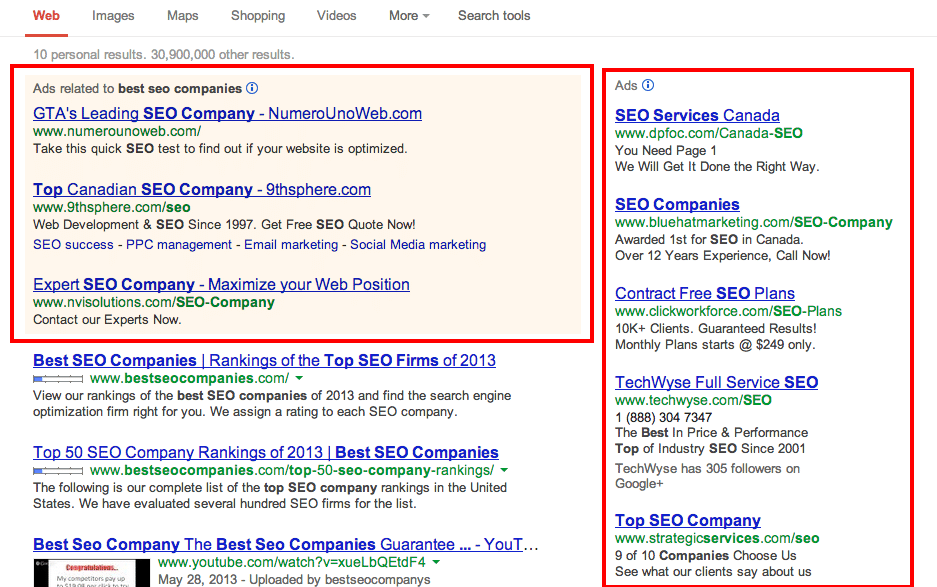
Look at the image below, based around a search for “best SEO companies”.

best seo companies Google Search

There are 11 results visible in the screen shot – essentially, above the fold results (or what people see without needing to scroll down on their screens).

Of these 11 results, only three are organic, and clearly show a solid understanding of SEO by the company involved, which holds the #1 and #2 spot, with #3 being a YouTube video.

Every other result is an ad. Or, for want of a better description, Google accepting paid content to promote a business over another one. Sound familiar?

So it would appear that sponsored/paid content is fine if it’s ads with Google but not if it’s ads appearing within?Google.

This is kind of messed up. Especially since, as I talked about in the post over at InNetwork, trust is the ultimate currency of a blogger, and isn’t something that can be bought at any price.

Sponsored Content – The Trust Factor

Are there bloggers that don’t give a crap and will write any old thing for a brand in exchange for regular sponsored content campaigns? Unfortunately, yes, and these are the ones that Google should quite rightly hammer.

But I’ve tended to find that they’re mostly in the minority.

Instead, what you have are bloggers looking to make a living doing the thing they love – sharing content, making recommendations, helping their community find a solution to help with a certain need.

That love, and that desire to help, allows the blogger to build a loyal and trusted audience – one that they would never deceive or whose trust they’d break, for the sake of a positive review when in fact a product or service was crap.

On the flip side, good brands know that the best way to meet customer needs is to listen to them. Because of the inherent mistrust of brands by consumers, often the only way this listening can happen is by sponsoring a post, allowing a blogger to write about you, offer some trial product, and then monitor the feedback over the coming weeks.

This understanding on both sides sees the blogger write an unbiased view, with the brand allowing that to happen in order to truly understand their target customer’s mindset.

As you can see, it’s a win-win for all involved. Except it’s not – because Google doesn’t really want this type of exchange to happen.

Instead of getting honest and quality content throughout their engine, Google would rather allow other types of paid content – ads – that have no indication of the quality of the company behind them.

At best, this seems a completely flawed approach. At worst, it could ironically enhance the current issue.?After all, if solid content via honest sponsorship and disclosure is being punished and grouped in with the crappy stuff, why even bother…

Thoughts?

  • « Go to Previous Page
  • Page 1
  • Interim pages omitted …
  • Page 32
  • Page 33
  • Page 34
  • Page 35
  • Page 36
  • Interim pages omitted …
  • Page 174
  • Go to Next Page »
© 2026 Danny Brown - Made with ♥ on Genesis