
• Skip to primary navigation
  • Skip to main content
Danny Brown

Danny Brown

podcaster - author - creator

  • About
  • Podcasts
  • Journal

Insights

The Battle for Social Ad Revenue – The Potential Winners and Losers

Social ads battle

Social ads battle

As the dust settles from Twitter’s recent IPO, one of the surprising outcomes was the news the microblogging platform is on track to post?global ad revenue figures of $1 billion by the end of this year.

In the U.S. alone, Twitter’s ad revenue showed an increase of 93 percent over the same period the previous year, with?$277 million posted for the first three quarters in 2013.

With mobile becoming ever more pervasive as the browser of choice for Twitter users, and mobile ads growing less intrusive and more natural, it’s clear that Twitter has moved from the social network that has a “monetization problem” to one that’s set to give the likes of Facebook and LinkedIn a run for their revenue money.

But will it be the “winner” in the upcoming social ads battle?

Why Social Ads Are Big News

With social media finally becoming a staple in the marketing and advertising departments at businesses, reliance on traditional advertising has begun to swing to digital channels.

While media buy and print/television/radio advertising remains important,?budgets are increasingly being allocated to digital spend.

As these budgets shift and consumers turn to social media to not only research products and brands, but either buy directly from a social media-led offer or click through to a landing page, the networks are looking at ways to take advantage of this shift and be the go-to ad partner for businesses and marketers.

Social ad budgets in the US

It’s not surprising that the bean counters over at Facebook, Google, Twitter and the rest are so keen to attract advertisers to their platforms?by 2017, it’s predicted that social media ad spend worldwide will exceed $10 billion.

Add in mobile spend and it’s a piece of the pie that will literally cost the networks millions if they’re not part of it.

Social Ad Spend And Revenue By Network

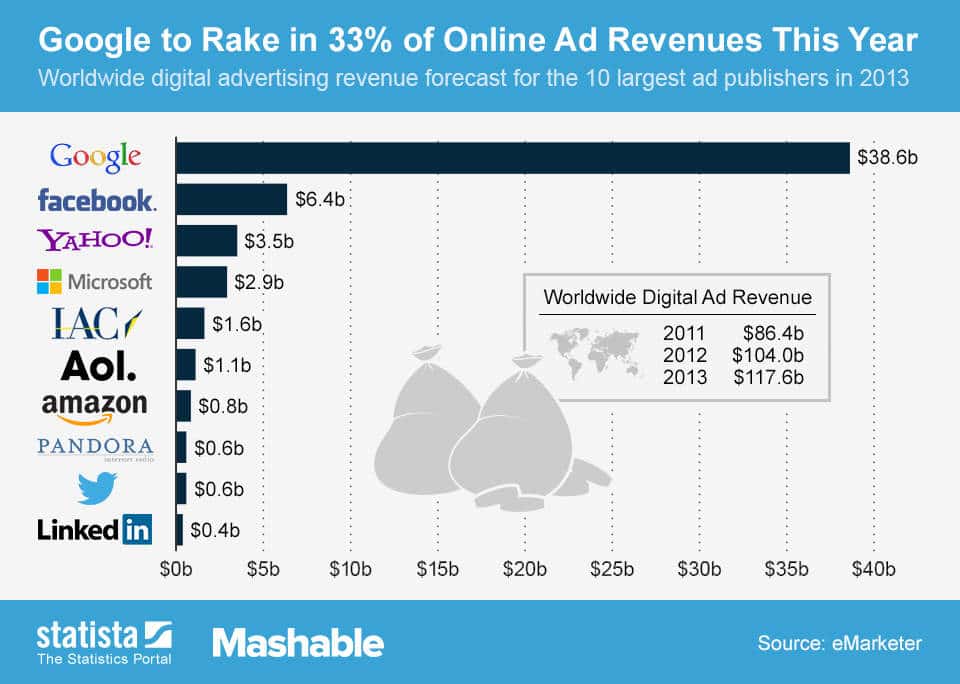
If you look back at how the networks fared in 2013, there’s one clear winner and that’s Google. A study by eMarketer at the beginning of this year predicts Google to account for a third of all online advertising, easily outstripping its nearest competitor, Facebook.
Digital ad revenue

While Facebook shows a strong second with almost $6.5 billion in online ad revenue, both Twitter and LinkedIn trail with a distant $0.6 billion and $0.4 billion respectively. Yet that doesn’t really tell the full story.

Google’s online ad revenue is made up of multiple factors and platforms. For example, while the majority of its revenue still comes from AdWords and AdSense, there’s also the revenue from advertisers on its YouTube property.

Speaking of YouTube,?Google launched a Paid Channel option?for any user with over 10,000 subscribers, where channel owners could charge subscribers $0.99 or more per month for access. Google is reported to receive around 45 percent of channel subscription costs, adding to its online revenue stream.

Compare the “Big Four” social networks?Twitter, Facebook, LinkedIn and Google+? and Google has a clear advantage by the number of revenue streams it earns from. Add in the recent +Post Ads announcement that meshes Google+ content with Google’s ad network, and it would seem they have the social ad market sewn up.

However, the others are starting to make inroads into this advantage, certainly by number of additional revenue streams if not quite actual revenue yet.

Twitter?Revenue Potential

As mentioned earlier, the microblogging platform has (perhaps) surprised many, by sharing some?excellent revenue figures. Advertising revenue has increased 124 percent on a year-over-year basis; advertising revenue makes up 91 percent of total revenue, an increase of 4 percent; and gross margins increased.

While operating losses increased and data licensing revenue decreased, Twitter is still in good shape to make a healthy profit in 2014 and beyond from social ads, especially given its acquisitions of companies like Bluefin Labs and Trendrr, with the potential of social ads making their way into TV engagement via Twitter.

Facebook Revenue Potential

The first major network to successfully transition to an IPO, Facebook has used both the money from that as well as increasing focus on its developer labs to continuously introduce new social ad revenue.

While the company has received criticism over its mobile experience versus the desktop one,?Facebook has still made great strides in revenue?from this part of its social monetization strategy.

While it’s still a ways behind Google?but then again, who isn’t??Facebook’s mobile ad revenue has tripled in the last year, making it the most impressive when it comes to growth in this vertical.

Additionally, with news that ads from Instagram (Facebook’s first major acquisition)?aren’t being received as negatively as Facebook may have feared, the potential for revenue from this channel is something to keep an eye on.

LinkedIn Revenue Potential

While Facebook, Twitter and Google are natural fits for social ads with their consumer-led audience, LinkedIn has always stood apart as a professional business network.

As such, it’s been one of the bigger success stories for social media/network revenue, although its?most recent financial reports?show one of its first declines in year-on-year reporting.

However, LinkedIn knows it needs to expand beyond premium accounts and services for recruiters for its monetization and has begun to implement a series of changes to focus on that. Its new focus on content is a clear shift in how it wants to double its ad revenue in the next two years.

Additionally, the introduction of a LinkedIn Advertising API will make it easier for brands and agencies to advertise on the network. That’s not even taking into account its mobile plans, with an aggressive update of its app to make the mobile experience as seamless as the desktop one.

Who Will The Social Ad Winners Be?

Just looking at the (current) top four?Twitter, Google+, Facebook and LinkedIn?and the smart money would be on both Twitter and Facebook to make the most progress.

Acquisitions and channel partners, as well as their plans for mobile advertising to continue to add to the revenue stream, should see Twitter and Facebook eat further into Google’s current dominance.

While there’s no doubt that Google+ is increasing in user numbers, how social ads will play into the experience remains to be seen. LinkedIn, meanwhile, still needs to make the experience sticky enough to keep users engaged.

And what about other platforms?

Pandora, for example,?continues to see growth in its ad revenue?and with other networks globally enjoying large, engaged user bases expanding their geographic audience, it can’t be too long before the current top four look very different.

Thoughts?

A version of this post originally appeared on OPENForum.

image: LaDonna Coy
image: Business Insider
image: eMarketer/Mashable

Dear Marketers – It’s Not Empathy We Need, It’s Realism

Realism in marketing

As marketers, we like to coin cool new terms to make old tactics seem new and refreshing.

Among these terms is content marketing, influence marketing, relationship marketing, and perhaps the best of all, empathy marketing. This last one has seen some traction lately as marketers and consultants talk about understanding your customer’s needs better through empathizing with them.

Of course, any good marketer would already be understanding customer needs, but that’s another topic, another time.

The problem is, as we create these words and persuade people to adopt them (or, at the very least, create buzz around them), we tend to add to the problem versus creating solutions for it.

Let’s take “empathy marketing” as a case in point.

Unless You’re In Someone’s Shoes, You Can’t Empathize

Brands and marketers would like to think that by empathizing with their customers, they’re more likely to be the solution the customer is looking for.

For example, think of the lifestyle magazines that offer advice to women on regaining their shape after a pregnancy. The marketing spiel might go along the lines of,

We understand. You want your bikini body back, but babies can make that difficult. That’s why our Generic Product X is perfect for you – forget the baby body blues and get that bikini body back now!

This is a particularly lame example although sadly not too far from the truth.

Baby body marketing

Worse still, it’s almost a given that the majority of these marketing promotions are created by men, who somehow think that having a baby is a bad thing when it comes to the female form.

So how can a thirty-something male advertising executive empathize with a new mother on the topic of her body? Simple – he can’t.

Instead of this fuzzy feel-good empathy marketing, we need to look at realism instead.

The Power of Realism

When I was initially drafting this post, I saw an update on Facebook from my friend Helen Androlia that made me stop in my tracks.

While I had an idea on how I wanted this post to read, and what message I wanted to try and get across, Helen’s words summed up the problem of empathy marketing perfectly, and illustrates why we need to inject more realism in our marketing messages.

With Helen’s kind permission, I’ve reposted her Facebook status below.

Sometimes I call myself fat. It’s because I am. I’m not obese. I’m just… fat. I’m tall, too, but I’m also overweight. And this, this isn’t subjective. Being overweight is an objective assessment, untainted by body dysmorphia or whatever.

I have my reasons for gaining weight, and I am working on working out regularly because I want to. It’s not healthy (for me, though I know that there are a lot of healthy overweight people), and it’s not sustainable (for me; that’s important to mention). I already eat well, so I go to the gym as well, and I do what I have to do, but it’s a big task. In the meantime, I am fat. You know, I might go to the gym for years and always remain fat.

Here’s the thing though: people, who are very well-intentioned, always follow this statement up with a reaction, exclaiming that I’m NOT fat, or that I’m beautiful, or that I shouldn’t say things like about myself. I don’t feel like this is about me, really, and that’s why I’m writing this. I know that I’m attractive. I have very healthy self-esteem. I am worthy of being loved, and I know that. My weight doesn’t factor into that, so I don’t need to be told that.

Saying that I’m not fat is like saying I don’t need glasses, or that I don’t have dark hair – it’s objectively untrue, and it actually makes me feel badly about my weight.

Why?

Because when people say that, what they’re saying is that being fat is the opposite of being beautiful, or feeling good about myself. That I shouldn’t call myself fat because that is paramount to saying that I’m ugly, or unfuckable, or a failure. That describing myself accurately is cruel – not because it’s unrealistic, but because fat is a synonym for something much darker.

So friends, I appreciate the sentiment. I do. But remember that ‘fat’ isn’t a death sentence, or a self-inflicted punch to the face. It’s not a four-letter word, and it’s not the antonym to beauty. It’s just another state for our bodies to inhabit, whether we want them to be there or not.

I’m not going to the gym because I’m ugly. I go to the gym because I need to move more and sweat more. And when I call myself fat, it’s because that’s what I am.

I’m okay with it, I promise.

While Helen’s words were for her friends, they’re also a direct challenge to marketers – stop telling us what you feel we want to hear, and start being honest with us instead.

As a marketer, I’m all for that.

Why Realism Works Better Than Empathy

We’ve created this environment where we think we’re doing consumers a favour by “empathizing” with them. The problem is, we’re not really creating solutions when we think empathetically – because unless we’re in that consumer’s shoes, it’s impossible for us to empathize.

Instead of this faux empathy that brands are trying to build, we need to understand, not empathize. And yes, there is a difference.

  • Understand why a product is receiving such crap reviews and, instead of empathizing with your customers on the issues they’re having, fix the problem and understand why it failed, to make it right moving forward.
  • Understand why a campaign that worked in North America probably won’t work in Asia or Eastern Europe, instead of empathizing with these consumers who feel insulted by North American culture in their advertising.
  • Understand why consumers are concerned about your company’s privacy policy, instead of empathizing with their concerns but doing nothing about the policy itself.

But most of all, understand that the best marketing doesn’t come from your supposed customer empathy. Instead, it comes from the understanding of what they really want, and delivering a message that’s based on realism and not marketing spiel.

We can do that, can’t we?

Footnote: Interested in finding out more about Helen? Here you go.

Helen AndroliaHelen Androlia is a highly experienced social media strategist, digital creative and community manager currently working for Draftfcb Toronto.?

With an eclectic background spanning the technology sector to fine arts and culture (and everything in between), Helen creates engaging social media experiences for a number of large brands. ?

A featured speaker at this year’s PodCamp Toronto, Helen was also a keynote speaker at Mesh Marketing 2013. You can find her on Twitter @HelenAndrolia.

image: SamsumgTomorrow

A Conversation About SEO, Social Media and Content Convergence

Convergence

A few months ago, I sat down with Steven Sefton, Digital and Social Media Director for Think Zap, to discuss a variety of topics including the changing face of marketing; where different verticals fit; how the UK and North American markets are different; where influence marketing is heading; and much, much more.

Below, you can find part one of that chat (which originally appeared on The Social Penguin), centred around the shifting face of marketing, and how demographic buyer differences between the UK and North America impact tactics.

I hope you enjoy, and you can find the concluding part here.

————————–

Are companies truly embracing social media (or at least?seriously considering it) or do many still think it?s a fad?

Danny: No, although it?s much better than it was just a year or so ago. The problem?remains poor information and conflicting advice. ?Be everywhere?, ?be focused?,??blog?, ?don?t blog?, ?social media is owned by marketing?, ?social media is?owned by everyone?. And on, and on, and on?

When you have that kind of confusion coming at you from all angles, you can see?why businesses are unsure on what to do next. Combine that with the continued?and very wrong assumption that social media is purely for relationships, and you?can?t ? shouldn?t ? measure ROI on it, and I?m surprised any businesses are even?considering social!

The good thing is, there are some very smart people trying to change the?conversation and move us away from the warm fuzz mindset that so many?consultants are clinging to as their business model. The trick is in getting these?people heard, versus those with the easy soundbites.

What was the last social media campaign that was a success in your eyes?

Danny:?I?m going to cheat a little here, and share the one we used as the case study in the?opening chapter of our book.

MV-1 Canada was trying to launch their dedicated,?as opposed to retro-fitted, mobility vehicle into Canada.?With limited budget and?no market penetration, they used our model of influence marketing, combined?with social campaigns as well as on-foot outreach, and gained a 20% market?share in the first 12 months of sale.

For anyone that says social media doesn?t?equate to real business ROI, I respectfully suggest they think again.

They say social media and digital in the UK are lagging behind our northern?American friends. Do you believe this?

Danny:?I think it depends ? there are some great agencies and consultants in the UK.?People like Shannon Eastman, Paul Sutton, Andrew Burnett and more like them?are paving the way for some really great forward thinking.

And in Canada, I?d say?many businesses are lagging behind their American and UK counterparts, often?because of the longer buy-in cycle that many Canadian businesses have, as well?as the reduced budgets compared to their US counterparts.

It?s like most things?? there are great examples and there are poor examples. I think the greater are?starting to outweigh the poorer, and these countries are getting much closer to?each other.

How does social media and digital work compare in general by brands and?agencies from the UK to Northern America?

Danny:?I find the UK is still very much focused on email as the lead social marketing tool,?versus say an influence campaign or a social marketing one across networks.

This ties into UK social users preferring email as their primary means of?communication from retailers, versus social channels.

Buying signals are also very different. UK consumers are still very much geared?towards connecting with companies for discounts and low-cost goods, whereas?in the NA market, consumers need more data and information before they?commit to offering up their contact details. It?s a very two-way thing.

This means NA marketers need to have a far more tangible offer than a simple?discount or special offer, while UK marketers have a slightly easier buy-in. This?would suggest the loyalty factor would be something that NA brands focus on,?versus the stack-?em-high, sell-?em-cheap UK marketplace.

Many companies are still finding it hard to merge the different departments?within an organisation. How can companies manage the link between PR, Social?and SEO?

Danny:?By understanding they all need each other. There are still too many silos?within businesses of all sizes, not just the bigger organisations. Companies?that understand this and break down these silos are the ones that enjoy bigger?success, because they understand the strengths of a fully integrated approach.

Different consumers use different methods to research, connect, purchase and?review. If you?re still focusing on one core method over another, you?re going to?miss these nuances and then wonder why your conversions sucked.

True influence webinar

Understand that all three disciplines work better when aiming towards a?common goal. Let?s face it, it doesn?t really matter which department you feel?should lead ? every single one?s goal should be both the short and long-term?success of the business. Gelling currently silo?d departments together isn?t just?common sense, it?s business acumen sense.

How do you see SEO, social and content converging in the future?

Danny:?There won?t be any divergence ? there shouldn?t be today. It?s all marketing, pure?and simple.

  • SEO ? traffic to a destination for the goal of conversion (marketing).
  • Social ? building two-way conversation for brand awareness that evolve?into customers (marketing).
  • Content ? thought leadership and advice for the purpose of attracting?readers to your destination to evolve into customers (marketing).

Buzz words like content marketing, social marketing and yes, influence?marketing, are simply soundbites that take away from the simple fact that it?s all?still just marketing. That?s the hub ? everything else is the spoke that?s used as?and when needed.

It’s about how we use social search to define local SEO queries; how paid media drives social activity; how content educates and supports brand acquisition, whether that’s social ads, PPC, SEM, etc. There’s no separation – it’s simply marketing with a common goal.

Realise that, and we don?t have to worry about silos and how?disciplines will converge.

Don’t forget to check out the concluding part of this interview here.

image: Rubin Starset

Social Media, Bullying, and the Growing Lynch Mob Mentality

One of the biggest benefits of social media, whenever you raise the topic of what changes social media has enabled in the bigger picture, is that of freedom of voice for everyone.

No longer are brands the only ones who have a pulpit to spread a message. Now, everyone from non-profits to small businesses to individuals have the ?same opportunities to say something and have that message spread far and wide.

On the one hand, this is a great leveller – if brands are guilty of questionable practices, now they can be held accountable through blog posts, public forums and social communities.

Yet, as much as this is the positive side of social media’s democratization of the web, it also allows anyone with a social account and an axe to grind to wield that axe more powerfully.

Often, they’ll use the argument, “But it’s free speech, I can say what I want.” And, to a degree, that’s true. Yet it’s also not quite as simple as that. Hiding behind free speech won’t stop you from being sued for your opinion; nor will it protect you in court under journalism rules.

However, that kind of free speech is usually used for opinions and counter-opinions.

It’s when that free speech moves from strong opinion into hate, vitriol and bullying that the bigger problem arises. And it’s a problem that seems to be escalating.

The Bear Pit Frenzy of Social Media Mobs

If you’re online in any capacity, you’ve probably heard of the Justine Sacco case. A high-flying executive with a global agency, she was leaving for Africa when she tweeted out the following:

justine-sacco-aids-tweet

While the tweet was offensive and idiotic, and was rightly condemned (Sacco was fired from her position), what followed on social, especially Twitter, was just as offensive.

Instead of criticizing the tweet, and looking at ways to offer perhaps education or counterpoints to the racist overtones, the hate mob descended.

Twitter-DunkDa_G-My-Africans-gonn-rape-u-n-leave-... Twitter-Phislash-Somebody-HIV-must-rape-this-...?Anger at the tweet is understandable, especially if it’s your country that’s been tarnished. Hate and condoning sexual assault, though? Is that even excusable?

Some saw it as an opportunity to get their own racist point of view in.

Twitter-WhiteRightNet-Blacks-are-murdering-white-...

While there were examples of people calling for an end to the vitriol, it continued, and instead of a moment of clarity where we could have discussed racism and using social media to counter it, we were left with a lynch mob that seemed to delight in adding even more to the levels of bullying that were already forming.

Yet perhaps this shouldn’t come as a surprise.

When We Glorify Bullying

In late November, just a few weeks before Sacco tweeted her infamous update, the producer of The Bachelor TV show, Elan Gale, tweeted about his kerfuffle with a fellow airline passenger.

Gale was trying to get home for Thanksgiving and the plane had run into issues on the ground. His following tweets were directed at a passenger named “Diane”, who was agitated about missing the family dinner. Gale thought it was selfish of her when so many others were in the same boat.

What followed was a note exchange between the two, that escalated into insults and then this note by Gale, which he tweeted to his followers:

So a guy has a falling out with someone, a stranger in a public place, and resorts to sexual slurs to antagonize her? Which is then celebrated by over 2,600 people who favourite it. And elicits tweets like this:

Twitter-theyearofelan-My-response-to-Diane-in-7A-... Twitter-KarleeKanz-theyearofelan-Selfish-little-...

Thankfully(?), the exchange between Gale and Diane never happened – Gale later confessed he made it up. However, the perceived bullying via the sexual slur, and the fact so many people celebrated it, perhaps offers an idea as to why social media is fast turning into a megaphone for lynch mobs.

Free Speech Or The Road to Bullying?

As mentioned earlier, social media has been lauded for the way it allows anyone with a social footprint to share their point of view. The trouble with anything that offers this kind of untethered “freedom” is that it often leads to untethered hate.

Instead of needing the bravery (stupidity?) to face someone head on and in person, the web allows the comfort of a screen and being thousands of miles away from the target of their abuse.

Instead of leading to mature discussions around common goals, frustrations and injustices, it’s led to the bear pit mentality that we seem to be seeing more of. Ironically, as social media matures, the audience seems to be going the other way.

This type of “protection” has led to some tragic results.

The well-documented suicides of teens like Rehtaeh Parsons, a Canadian 17-year old who was raped and then mocked mercilessly on social media until she could take no more; or 14-year old Hannah Smith, who took her own life after months of bullying on social network Ask.fm.

It continues. Attacks on people for standing up to sexual inappropriateness; the escalation of?anger into bullying and death threats (much like the Sacco example earlier).

These are just some examples of where social media is being used as a bully pulpit.

Do insensitive and racist/bigoted comments need calling out? Yes. Does that mean any subsequent anger is okay to descend into bullying and mob mentality, though? A resounding no.

While we may feel it’s funny to latch onto a trending topic or viral event, it’s all too easy to forget in the heat of the moment what the eventual outcome may be.

And, as the sad cases of Rehtaeh Parsons and Hannah Smith and others like them shows, this pulpit doesn’t end with emotional upset by the victim…

image:?kid-josh

A version of this post was originally published on the Punk Views on Social Media blog.

Take the Reins (The Fear of Not Being Perfect)

Take the Reins

To be nobody but yourself – in a world which is doing its best, night and day, to make you everybody else – means to fight the hardest battle which any human being can fight; and never stop fighting. – E.E. Cummings

On Christmas Day, 2010, British charity worker Simone Back took her own life. It’s believed Simone had been experiencing relationship troubles and, as a result, felt she could take no more pain.

Gathering together a collection of pills from her medicine cabinet, Simone downed the pills and wrote her suicide note. However, instead of leaving it for those who would find her body, she posted it on Facebook.

The response was tragic.

Instead of concern and help, the majority of messages were of mockery and indifference.

She ODs all the time and she lies.

She does it all the time, takes all of her pills. She’s not a kid anymore.

She has a choice and taking pills over a relationship is not a good enough reason.

These are some of the messages that went back and forth on Simone’s wall as she was at home dying. While some of her Facebook “friends” lived within walking distance of Simone, no-one called or checked on her.

Out of 148 messages left on her wall after Simone posted, just one suggested getting her help.

Her last status update was posted at 10.53pm on Christmas Day. On Boxing Day, her body was found.

The Desolate Human Disconnection

There are over 1 billion users of Facebook. More than half log on every day. Almost half of 18-34 year olds check Facebook when they wake up, and 28% check the site before getting out of bed.

Facebook and other networks have created a cult-like connection to them. We need to be online, checking what’s happening, sharing our lives for all to see, painting a picture of who we want ourselves to be while missing the bigger picture that who we really are is more important.

This need for connection has resulted in the very opposite of what we set out to achieve in the first place. Instead of weighty connections and friendships, often all we’re really creating is an illusion of depth and relationships.

As Simone’s story highlights, the very people we crave connection with can often be the same ones who’re not there when we need them the most. In the meantime, the relationships we foster offline take a backseat and lose importance, as the social networks drag us (not always kicking and screaming) back to their domain.

We never take a break. Or do we?

Taking Back the Reins

A new Kickstarter project looks to change that damning indictment of being always-on but never “there”.

Entitled Take the Reins, and created by Australian actress Emma Barrett, the project aims to hold up a mirror to today’s society while asking the simple question,

The allure of Facebook and social media remains its ability to be social while sparing us all the embarrassing realities of society – but at what cost?

The story of suicide and social media?isn’t a new one?and, tragically, highlights the disparity between the potential of the medium as well as the despair it can foster.

Social media has the potential to be one of the greatest “achievements” in our lives. It’s helping to democratize countries, change the minds of governments, and pull people together for a greater single cause.

Yet it’s also creating this online nation of forced connections and faux friendships, in the search for the person we think we should be more than, even when that person is perfect just the way we are.

Perhaps Take the Reins can be part of the reclamation of our true selves versus the self we feel we need to portray. It’s got to be worth a try, no?

To find out more about the Take the Reins project, please visit its Kickstarter page where you can support and donate to make the documentary happen.

Update December 30 – Emma reached her goal of $15,000 and her project will be funded.

Take the Reins by Emma Barrett ? Kickstarter

[vimeo]http://vimeo.com/81845434[/vimeo]

  • « Go to Previous Page
  • Page 1
  • Interim pages omitted …
  • Page 26
  • Page 27
  • Page 28
  • Page 29
  • Page 30
  • Interim pages omitted …
  • Page 174
  • Go to Next Page »
© 2026 Danny Brown - Made with ♥ on Genesis