• Skip to primary navigation
  • Skip to main content
Danny Brown

Danny Brown

podcaster - author - creator

  • About
  • Podcasts
  • Journal

Insights

Why It’s Important to Support Independent Book Publishers

Metrics

Over the weekend, I saw the following update on Facebook, from independent book publisher Morning Rain Publishing:

Did you know that many bloggers and websites will not allow an author to advertise, or won’t consider giving a review, unless a book already has at least ten 4-star reviews. Your opinion of what you read is so very important to us all.
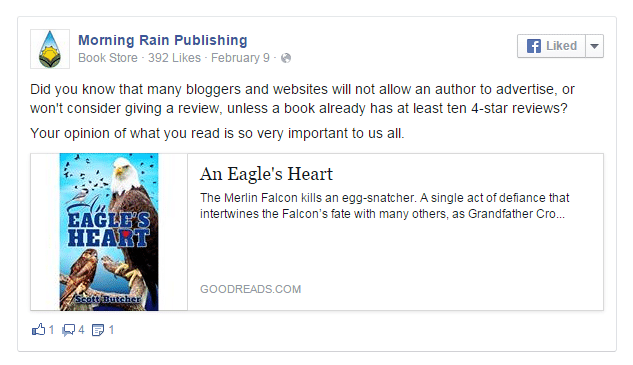
MRP Facebook

It was a stark reminder of how important it is to not only support your favourite authors, but also the publishers behind the books and writers you take to heart. This is particularly true of indie publishers, since they can often be the first step for any aspiring author and their wish to be published.

After all, for many people, publishing a book is high on their bucket lists. I know it was one of the things I wanted to do before I die and, thanks to Katherine Bull and her team at Que Publishing as well as my co-author?Sam Fiorella, I’ve managed to achieve that.

One of the things that became apparent during the writing and promotion process is how much work is involved.

While I was under no illusion that promotion and the right kind of promotion was a key necessity, the difficulty in doing so (without seeming too “in your face”) made me realize why we need to support independent publishers more.

Channels, Conversations and Competition

While many folks may feel a traditional book publisher has a lot of resources at their disposal, there’s a little bit of truth and a little bit of myth in that.

Yes, they do have great partnerships with retail outlets (channels) – or, at least the bookstores that have survived the Amazon onslaught. Depending on the book topic and demographic, these channels can offer a great way for a book to find an instant audience.

On top of that, they can help foster connections for peer reviews (conversations) which is key for any book or author that doesn’t have previous history or works to fall back on. Much like any form of marketing, these word-of-mouth peer reviews can often be the difference between a book launching to a warm market, and a stilted launch that takes time to regain any momentum.

Perhaps the biggest advantage is in the topic (competition) category. Certain publishers excel in specific areas that give them an instant boost over other publishers.

For our book, for example, Que (and its parent Pearson) has always been recognized as a publisher for serious business books, so that allowed both Sam and I to use more technical language for Influence Marketing. This helped separate it from 101-type social media or marketing books, which (I believe) resulted in the critical praise it’s received.

Influence Marketing reviews

These three areas – Channel, Conversation and Competition – offer traditional publishers a little bit more leeway, although they still have to make a profit and this is a risk that’s taken with each book signed up for the publishing process.

This leeway (currently) allows them to still take risks on new authors, although some publishers are moving further away from that and just looking for “names” that can sell books, regardless of quality.

It’s this reason we need to support independent publishers – and self-publishing authors – to ensure quality always overcomes quantity.

Independent Publishing and the Path to New Classics

My wife is a partner in the afore-mentioned Morning Rain Publishing, who are proudly a very?independent Canadian publisher. Along with her two colleagues Jo and Jennifer, their mission is simple. From their website,

The writing world is a crazy, unstable place, but?Morning Rain Publishing?is here to make order out of the chaos. We?re a small press, specializing in e-publishing short stories, novellas, and novels.?Our goal is to discover great Canadian writing to share with readers all over the world.

As part of that goal, the three partners carry out every single part of the process for finding and publishing their next book. This includes (but isn’t limited to):

  • Going through each and every submission;
  • Creating contracts;
  • Proofing, editing, and formatting;
  • Author and book promotion;
  • Creatives, including book covers, swag, and more;
  • Blogger outreach programs.

In addition, they have to create their own Channels and Conversations, in order to stand apart from the Competition. It’s a lot of work, but it’s the last one in particular that had me so galled at the Facebook update shared at the beginning of this post. Here’s a new publisher, trying to break new authors, and certain sites are taking (in my view) an elitist approach to their review process.

Now, I understand that for every great book there can be an equally horrendous book; for every new classic, there can be an equally monotonous tomes (although quality is often in the eye of the beholder).

However, to adopt a policy of a minimum 10 reviews, with four stars being the minimum buy-in, is shortsighted at best, and lacking in editorial sense at least. Here’s why.

You Never Know What You Do Not See

Look back at one of the most successful book series’ in recent years, the Harry Potter saga. Before her work hit the bookstands, author J.K. Rowling was turned down by eight publishers. As history shows, the books went on to sell millions of copies worldwide. You can imagine how these eight publishers must feel today – yet they’re the equivalent of the review sites that sparked this post.

Her books didn’t have a minimum 10 reviews all with four stars or more, since this was before Amazon really came into its own as a publisher and review centre. Going by that background, Harry Potter would also have been turned away by the book review sites highlighted in MRP’s Facebook post.

Then there are the two books published so far by Morning Rain Publishing.

Morning Rain Publishing books

The first, Ryan’s Legend by L.F. Young, has been praised as,

…filled with mystery and likeable characters while being delivered in a fast-paced easy to read style. L.F. Young makes his story compelling in that he gets us straight to the heart of the story.

Their second book, An Eagle’s Heart by Scott Butcher, reached #4 on the Bestsellers List for Amazon UK, and has been equally praised,

In the book An Eagle’s Heart, Scott Butcher has perhaps written the closest thing to Watership Down while still standing on its own.

Neither of these books have a minimum of 10 reviews (so far – the number is growing across the web), yet looking at the reviews that have been published for both, it’s clear they’re perfect for their target audience – a major victory for both author and Morning Rain Publishing.

But the book review sites that have their 10 reviews stipend will never know that, because neither book is deemed “good enough” for them. And that’s a shame – yet it’s also their loss.

The Privilege of Access

You see, being offered a book review is a privilege. It’s a publisher saying,

We value your expertise, your knowledge, and the trusted audience you’ve built up. We feel we have a book you’d really enjoy, and that would be right for your audience too, and we’d love to offer you early access to it, as well as the author for any exclusives for your site.

You’ll notice I used the word “trusted” in the above statement. That trust works both ways. Yes, the reviewer has built trust in their audience, and that should never be taken for granted. Yet now the publisher is putting their trust in you, the reviewer.

By letting you into their world early, they take the risk of their target audience being put off by a bad review before a new book has even had chance to breathe. If early reviews are negative, it can stall sales before the first copy has left the bookshelf, virtual or otherwise.

Essentially, they’re trusting you with the potential future of their company – and you don’t even have the courtesy to see if that company has something worthwhile to share with you.

So, here’s my advice for Morning Rain Publishing, and any other independent author or publisher/self-publisher. If a book review site is so precious it feels it’s above new publications that haven’t had a chance to meet a minimum review criteria like 10 four star-plus reviews, consider striking them off your list – they’re probably not worth your time anyway.

And to these sites where 10 reviews all with a minimum of four stars is the gatekeeper new publishers and authors have to pass, consider this – imagine how difficult it would have been to get to your sacred position had your website not been allowed any visitors until your site had 10 positive reviews on Google (or other search engines).

Access is a privilege, and independent publishers are the ones that pretty much helped get book review sites where they are today – try not to abuse it.

PS – if you want to support independent book publishers, and you love reviewing books, hit up Morning Rain Publishing – they’ll be happy to talk to you.
Turning Prospects Into Customers and 24 Other Tips to Help Grow Your Business

You Don't Need Fans You Need CustomersLately, it seems as if we, as marketers, have gotten lazy. We?ve stopped thinking beyond the easy, Marketing 101 prospecting that we learned when we started our profession, and happily hide behind numbers that don?t mean all that much.

  • Impressions;
  • Social proof;
  • Social shares;
  • Reach;
  • Awareness.

All good numbers, and useful if that?s the goal of your marketing endeavors.

But something that?s primarily missing from these numbers is the main reason we got into marketing in the first place ? customers.

Sure, having a lot of reach can help you get in front of those prospects you want to turn into customers. And yes, without potential customers being aware of your brand, the prospecting factor diminishes immediately.

But we?re so much better than that ? or we should be.

We have the most insane amount of data available to us that it?s almost criminal not to be utilizing that to market smarter. Today?s social web users are freely sharing their Likes, preferences, buying signals and, more importantly, who impacts them to make the decisions that matter ? so why are we not using this data more?

  • Build your archetypal persona based on transactional and archival data, and combine with today?s wealth of information;
  • Identify where they live online. More importantly, identify who they live online with, based on their current needs and situations;
  • Use weighted keywords ? placing more emphasis on the words that matter to your brand and that of your customer;
  • Filter the conversations around these topics and build secondary and tertiary filters around the people in your prospect?s immediate circle for these topics;
  • Drop your prospects into a CRM platform like Nimble, to connect the dots when it comes to the buying cycle and life events that impact their decisions;
  • Monitor, react, be pro-active, offer solutions;
  • Rinse and repeat.

Okay, so that?s a simple overview for brevity ? but as simple as it is, it?s a strong foundation for truly understanding what it takes to move your desired customers from prospects to leads to acquisition.

It takes legwork, but the results are worth it. Unless you prefer to wallow in the lazy marketing pool, of course?.

The above post is my contribution to Craig McBreen’s new eBook, You Don’t Need Fans, You Need Customers. It’s chock full of advice on finding the clients you covet from the likes of Gini Dietrich, Ann Handley, Chris Ducker, Shelly Kramer, Francisco Rosales and more. Best of all, it’s free! My sincere thanks to Craig for the invite – make sure you grab your copy?here.?

The Story of MyWay, YourWay, and BestWay

The way ahead

The way ahead

In a small town not far from here lived three businessmen: MyWay, YourWay, and BestWay.

All three were aware of each other ? it was a smallish town, after all, and all three owned companies that used much of the local workforce for their employment needs ? yet none of them had ever met.

This wasn?t because of conflicting schedules, or location, or any other normal business conflict ? it just seemed that all three were living with a different mindset as to how you did things.

Because of this, all three did their own thing and were quite happy at that. At least, they were until one day when they were forced to meet in person.

The Big Event

One day, a minor catastrophe hit the town where MyWay, YourWay, and BestWay lived. A fire broke out at one of the main factories, and the town?s fire brigade set off in the sole fire engine to deal with it.

Unfortunately, the truck?s engine blew and it left the firefighters stranded miles from the factory.

Knowing that MyWay, YourWay, and BestWay had a lot of workers and access to water pumps ? and, fortuitously, were all close to the burning factory – the Fire Chief called each of the businessmen and asked if they could help until the truck was repaired.

Each one of the businessmen agreed immediately, and made provisions for their workers to get to the fire as soon as possible and begin fighting it.

The Coming Together

First there was MyWay, who immediately got his men to begin spraying water all willy-nilly, safe in the belief that water drowns fire ? you just need enough of it in as many places as possible.

Next to arrive was YourWay, who looked at what MyWay was doing and immediately did the opposite. He concentrated all his water on a window where the biggest flame was leaping out, and left MyWay to his mindless spraying.

Last to arrive was BestWay, who looked at how both MyWay and YourWay were doing things, and then looked at the fire itself. He could see that the source of the fire was an out-building to the right of the factory, and this was feeding the bigger flames on the factory itself. He immediately knew that was the area to start with.

However, he could also see that if the flames all around the building weren?t kept in check, they?d spread fast and make it difficult to reach the outbuilding.

So he introduced himself to MyWay and asked if he could make sure that the spray covered a wide area around the outbuilding, as well as the larger parts of the main building (including the window YourWay was concentrating on). Since that was pretty much what MyWay?s men were doing anyway, MyWay nodded in agreement.

Next, BestWay ran over to YourWay, and asked if he could point all his water at the outbuilding, which would allow BestWay?s team to get inside and fight the fire from within. Since YourWay already thought his concentrated approach was better, he too nodded in agreement and switched his focus onto the outbuilding.

Now that both MyWay and YourWay were concentrating on containing the fire from spreading at its most viral points, BestWay directed his team toward the outbuilding.

Under the cover of the bigger spray from MyWay and the concentrated spray from YourWay, BestWay?s team managed to get inside the building and see that a gas tap had been left on and that had caused the fire.

They managed to turn off the tap, which immediately stopped feeding the flames. They then rushed out and helped the other teams overcome the rest of the fire, and the factory was saved.

Of Realization and Respect

As the embers of the fire smouldered, the three businessmen sat down on the grass opposite the factory and watched as their teams congratulated each other on a job well done.

The now-repaired fire truck drove into the site, parked, and the Fire Chief got out and approached the sitting businessmen. He was smiling warmly and shook each of their hands, thanking them for their bravery and teamwork, and how it was a sign of how three obvious friends could work together because of their understanding of what was needed.

?But we don?t really know each other,? MyWay said. ?It was only today that brought the three of us into the same location.?

?He?s right,? said YourWay. ?Although we know of each other, we?ve never met. To be honest, I?ve never really been inclined to meet with any of them ? I?ve always been happy doing what I do.”

?But how did you manage to coordinate your efforts so well?? asked the Fire Chief. ?It was as if each of you knew exactly what to do.?

BestWay smiled. ?I think we all just realized that, while we can all have different thoughts and opinions on what works best ? my way or your way ? at the end of the day it?s the combination of both, and taking the best parts from the differing opinions, that allows you to work out the best way to move forward. So it was today.?

MyWay and YourWay looked at BestWay, and nodded together.

?So you?re saying it was you that saved the factory?? the Fire Chief asked BestWay.

?Not at all,? was the reply from BestWay. ?I just saw that MyWay could really help by keeping the spray generic but in a different area, and that YourWay could help my team get inside the outbuilding that seemed to be the cause. I couldn?t have done anything without their input ? all I did was take what they were both offering and make it the best for everyone involved.?

?Well, whatever it was, it worked,? said the Fire Chief, ?and I?m sure the Mayor will be letting you all know how grateful he is to you three soon enough.? And with that, he walked back to the fire crew.

The three men stood up, ready to make their way back to their respective businesses. But each of them smiled at each other, and agreed that a new understanding had happened here today.

Sometimes YourWay is right; sometimes MyWay is right. But if you can take the best of MyWay and YourWay, and combine those into how you want to do something, that pretty much results in the BestWay every time.

And you don?t always need a fire to see the sense behind that?

image: jamie Mellor

Beautiful Content Curation with TwineSocial Social Hub

TwineSocial Social Media Content Curation

As content continues to lead the digital marketing charge for brands and content creators alike, one of the “side effects”, if you like, is the evolution in how content is being presented.

While blogging in text form remains popular, content creators are looking for newer, more impacting solutions. One such solution enjoying increased popularity are the rich media curation platforms. You just need to look at the success of Pinterest to see how collective images can tell a far richer story than any written word.

Taking Pinterest one step further and offering a true social hub, and hoping to become a standard for brands and content creators alike, is TwineSocial.

TwineSocial and Rich (Social) Media

Anyone can create a social hub. There have been countless examples already – some excellent (RebelMouse and Keyhole, which I’ll be looking at soon), some not so much. However, RebelMouse is more geared towards personal content curation?- TwineSocial, on the other hand, is about the integrated experience.

Connecting Your Social Graph

When you first create your TwineSocial account, the first thing you’ll need to do is connect your various social accounts. However, instead of simply connecting your Facebook, Twitter and other standard accounts, you can also select hashtags and search terms around your brand.

Twine Social Threads

As well as the usual suspects, TwineSocial also supports Vine, Vimeo, Flickr and other networks that usually get bypassed by many other curation solutions.

The ability to include hashtags as well as multiple accounts and RSS feeds enables you to create the complete picture around you or your business. Not only that, but peers and colleagues/internal teams can be integrated as well.

The TwineSocial Brand Ecosystem

For example, in my account settings, I have my own standard inclusions – my Twitter account, Facebook, Google+, etc. I also have the #influencemktg hashtag, which my Influence Marketing book co-author Sam Fiorella and I use to continue the influence discussion outlined in the book.

Speaking of Sam, I can feature his account as one of interest, via the TwineSocial Connections feature. This essentially allows the curator to highlight social accounts, people, brands or topics they feel would be interesting to their own social graph.

TwineSocial Connections

This Connection feature is available across your chosen social accounts, so if your business has multiple sales teams based on demographic and locale, or your company blog is broken into various sub-sections for your company’s products, you can highlight these different channels as part of your bigger corporate picture.

Or, as a content creator, blogger, podcaster or otherwise, you can bring any other content you own into the fold as recommended channel partners. Or feature the accounts of your podcast guests, etc.

Highlighting Your Key Content

Depending on the size of your business, or how much content you create (or contribute to) as part of your content strategy, your latest stories or updates could potentially be lost soon after they’re published.

To counter that, TwineSocial offers a Pin option. Much like its almost-namesake, this enables a Pinterest-like feature that allows you to keep the most important content front and centre at all times.

Not only that, but when a visitor to your hub selects a particular piece to dig deeper into, it expands into a feature area, while still keeping your live feed behind it.

Twine Social Danny Brown

This offers two benefits – you can choose which content is the one driving the most interest, based on your goals for that period, and you can cross-promote not only your own content, but channel partners for joint promotions.

For example, your content could be the lead hub, your channel partners could be the related products or services surrounding the lead hub. This kind of flexibility could be key in differentiating your product offering in a more visually appealing way than your competitors.

Twine Social – The Verdict

I’ll be the first to admit, I love the direction TwineSocial is taking. The user interface is clean, uncluttered and very easy to navigate – something some of the other hubs have struggled to accomplish.

Additionally, TwineSocial is placing emphasis on the visual appeal of all your content, not just the rich media that you use for an article, blog post or video. The layout of the hub is slick, and the bold images and typography catches the eye of visitors to the hub.

I can see this being used by all kinds of content creators. Brands are obvious, as are producers of multiple content – text bloggers that also use video, for example, or graphic-heavy content (designers, for example).

The cost is attractive too, with plans for all pockets and budgets.

TwineSocial Pricing

The free version is a great starting point for anyone looking to try the product, while the full-on Enterprise solution offers the promotion of other accounts, white labeled / no TwineSocial branding, custom CSS to replicate your own brand identity, and more. For $399 per month, it could be a great way to collate a brand’s social activity and use to entice new employees, clients, partners and more.

It’s not perfect, though.

On Making Twine Social Even Better

At the moment, it doesn’t offer any analytics around the effectiveness of the hub. For example, it’d be great to see which areas of the hub are garnering the most eyeballs or clicks; it’d also be great to see which parts of the hub drove traffic to a landing page, or which one was shared the most. This would allow you to tailor the hub content more efficiently.

Additionally, it’d be great for visitors to be able to visit a hub and embed a specific section.

So, let’s say I’m writing a piece on social analytics software. I could go to a hub for something like Pulse Analytics, grab a section that compares solutions and their impact on ROI, and embed that directly to my post. If anyone clicked on the embed in my post, it would take them to the Pulse Analytics hub, and all the data the visitor is clearly interested in.

It also uses Klout scores as a measurement of who your most influential followers are – the less said about that, the better..! 😉

There are also some bugs in the current build. For example, I had issues trying to grab the embed code for my hub to embed it in a page on this blog, to show you what it looks like when integrated with your other content. Additionally, when you add new social accounts, it pulls all of that content to the top of the hub, as opposed to dropping it in by date of the content itself.

However, analytics is on the way, and the embed option is something Aaron Fessler, CEO of TwineSocial, agreed could be a cool feature addition in future iterations when I spoke with him recently about the product. And bugs are always to be expected on beta products (as long as they’re ironed out in future updates).

In the meantime, as I mentioned I am liking the direction and simple approach TwineSocial is taking. As content continues to be an important part of the marketing landscape moving forward, the more your content stands out, the more opportunities should come your brand’s way.

TwineSocial offers that stand out effect in spades.

Disclosure – I was given full access to the Enterprise solution in order to evaluate TwineSocial’s feature set. However, all opinions are mine. You can check out TwineSocial for yourself here.

The Demand Metric 2014 Outlook Study: Highlights and Horizons

Danny Brown research stations

2014 outlook study from Demand Metric

As a global marketing research and advisory firm with over 38,000 marketing professionals, CEOs and business owners using their services, Demand Metric is perfectly placed to gather the kind of insights and data few advisory firms have access to.

This can range from custom research studies (like the one shared here today), to a repository of business tools, templates and more to help businesses align their goals with the right data, strategy and technology.

It’s from this data that Clare Price, VP of Research at Demand Metric, has collated and released their benchmark 2014 Outlook Study: Highlights and Horizons, which shares insights from 2013 and where that’s taking us in the year ahead.

The Highlights of 2013

If there were two major impacts on the business landscape last year, it was the year that the customer really came to the fore.

Sure, social media has enabled the average consumer a bigger stage on which to better communicate with brands – but now these brands had much stronger tools to analyze and learn from these conversations.

Additionally, it was also the year that saw Marketing consolidate its position at the forefront of revenue production, as well as enabling the customer life cycle to be better understood across all facets of the business.

As a result, some key shifts began to happen.

Quality Lead Generation is Playing a Bigger Role

While a digital strategy is still primarily about growing brand awareness and driving web traffic, lead generation is enjoying increased importance.

Better leads

Not just lead generation, but better quality leads, showing that segmentation and remarketing is being used properly in digital marketing campaigns. Conversion still needs to increase to complement the lead, but as data analytics improves, so should the lead to conversion ratio.

Making Digital an Experience

Because digital marketing has the advantage of being more fluid over more traditional methods, the customer experience is key in relation to revenue and growth.

Better customer experience

Instead of the typical spray and pray approach that marketing and advertising has been known for, now it’s about far more sophisticated data and building an experience around that (think of Canadian beer company Moslon and their beer fridge around the globe for Canadian passport holders).

Get the experience, get the mindset of the customer.

Enabling the Sales Team

Marketing is nothing without sales. We can get all the campaigns right, all the product or service in the right place, all the offers ready – but without a sales team to make it happen, marketing is simply a mindmap waiting to become physical.

Businesses are realizing that enabling the sales team for all possible outcomes (or as good as) offers an immediate advantage.

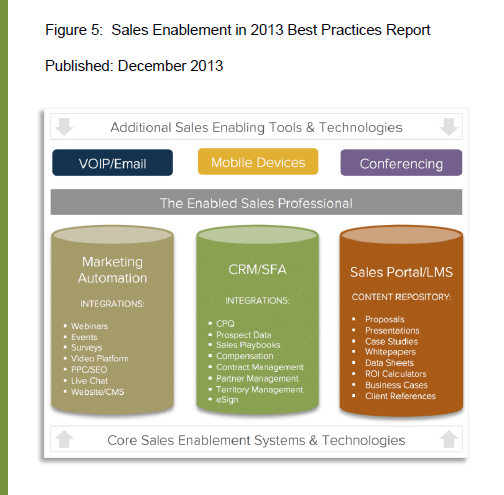
Enable sales team

Customers can take pre-sales research and compound their decision with a savvy sales rep; customized content makes for better presentations at corporate sales meetings; and marketing and sales are far more aligned in goals and what needed to happen, as ooposed to being silo’d.

The Horizon of 2014

So what does this mean for the next 12 months? To find out, Demand Metric took their findings of the past year and combined it with predictions from various stakeholders, clients and analysts/directors at the company.

These predictions include:

We’re moving towards a concept that I like to call ‘slow media’. Slow media compels your customers to want to hear what your brand is saying because you’re creating meaningful media that has context and relevance to your customers. – Jessica Ann, Senior Research Analyst, Demand Metric.

We now have linguistic mapping tools that allow us to… understand what the customer wants, connect archival history with our brand’s core business or competitors, and at what stage of the buying cycle they’re at, so you can prime your message for that exact moment… [allowing us] to truly take advantage of that technology and deliver. – Danny Brown (me!).

The results of predictive analytics, trends and patterns will be questioned when the ‘advice’ of these applications do not match reality. – Christine Crandell, Research Director, Demand Metric.

In 2014, I foresee a more equal share of marketing budget invested in both offline (store) and online (web) with an emphasis on linking the offline audience to online campaigns through smartphones and interactive media. – Han Verbaas, SVP Europe & Middle East, Demand Metric.

These are just some of the predictions (or Horizons) included in the report, and each prediction is combined with what the person saw as a key shift in 2013 and how that plays into the year ahead.

The Demand Metric 2014 Outlook Study offers an interesting look at where we’ve come from, and where we need to go to continue to grow not only the marketing discipline, but the integrated business discipline if businesses want to truly succeed in the ever-changing business landscape we find ourselves operating in.

You can download the full report for free here.

Disclosure: I’m a Research Director at Demand Metric on the topics of digital, social media, and data analytics.

  • « Go to Previous Page
  • Page 1
  • Interim pages omitted …
  • Page 25
  • Page 26
  • Page 27
  • Page 28
  • Page 29
  • Interim pages omitted …
  • Page 174
  • Go to Next Page »
© 2026 Danny Brown - Made with ♥ on Genesis