• Skip to primary navigation
  • Skip to main content
Danny Brown

Danny Brown

podcaster - author - creator

  • About
  • Podcasts
  • Journal

Insights

How the 2014 BDC Young Entrepreneur Award is Helping Canadian Business

2014 BDC Young Entrepreneur Award

This is a sponsored post on behalf of the Business Development Bank of Canada – however, opinions are my own.

Whether you think you can, or you think you can’t, you’re right. – Henry Ford.

They say that if you’re aiming to run your own business, you need to have at least the equivalent of a year’s salary to keep you tided over while you’re building your customer or client base.

For me, even this may not be enough.

It’s tough to be build something sustainable and successful while not bringing in regular income. It’s one of the reasons I’d make for a lousy entrepreneur (at least, nowadays). I’m married with two young kids and a mortgage – I don’t have the luxury of being able to settle for infrequent income while chasing a dream to be my own boss.

If I were younger, and it was just me and my wife, then sure, I could live with the uncertainty factor of wondering where the next meal would come from as I built on my goals.

And perhaps because of that, entrepreneurship is suited to a younger mindset (though there are great examples of new business ventures in later life). Which makes the 2014 Young Entrepreneur Award from the Business Development Bank of Canada (BDC) such an excellent venture.

The Pivotal Moments of Business Growth

For any new business, longevity is tough. There are so many hurdles to overcome – finding customers, competing with competitors, positioning of your product/service, etc – that lasting any length of time is a victory.

Especially when looking at “failure” statistics around Canadian business:

  • 30% of all new businesses will be closed within 5 years;
  • 64% of businesses with revenue of less than $30,000 closed within 5 years;
  • Almost one-third of businesses with less than 5 employees will close within 5 years.

Given that the term “small business” in Canada means 1-99 employees, and the failure rate equates to a lot of people out of work.

Much of the failure can be attributed to mismanagement. This can be weak management in general, poor management of finances, or weaknesses when it comes to marketing the business. In fact, almost half of Canadian business failures is due to internal weakness.

A lot of this weakness happens at key pivotal moments in a fledgling business’s journey:

  • Expansion;
  • New products;
  • Manpower and resources;
  • External advertising channels.

If the wrong decision is made at these key moments, it can mean the difference between a business continuing and one that closes its doors for the final time.

The BDC Young Entrepreneur Award is looking to help a business at that key juncture.

100,000 Reasons to Enter the 2014 BDC Young Entrepreneur Award

Where many new businesses struggle to get things right is in deciding how they should grow as the customer base grows.

  • Do they add staff?
  • Do they take advantage with more marketing?
  • Do they ramp up production?
  • Do they expand territories?
  • Do they open more storefronts?

As these decisions come to the fore, actions more often than not can skew the results. Expanding without research can doom a business to failure, while more marketing dollars without extra production capacity can see overselling and under-providing.

This is where the BDC and the Young Entrepreneur Award helps.

BDC Young Entrepreneur Award testimonials

Offering a grand prize of $100,000, with a second prize of $25,000 in consulting, the BDC aims to help one lucky business make the right decision, and focus on one key area for sustained growth.

This focus will allow the business to concentrate on where it needs to be now to get where it wants to go tomorrow, as opposed to spreading itself too thin and not even being here tomorrow.

In the words of Michel Bergeron, Senior Vice President, Marketing and Public Affairs at BDC, this type of focused approach and partnership with the winner is key.

The contest aims to showcase the vibrancy of Canada?s young entrepreneur community and its importance to the prosperity of our economy. It is an opportunity for entrepreneurs to raise the profile of their business and tap into networks that will ultimately help them keep ahead of competitors and take their business to the next level.

When looking at the percentages of failed businesses due to poor management decisions, this kind of partnership – not to mention a major cash injection of $100,000 – sees the BDC Young Entrepreneur Award as an amazing opportunity for young Canadian entrepreneurs across the country.

People like Joel Pinel, who won the 2013 award.

What a Difference a Year Makes

Joel’s company, WOW Factor Media, is a print media design and marketing company with offices across Canada. His entry was based around his “Equipment Edge” project, that would see WOW manufacturing directional and custom-built signage for new high-rise buildings.

Winning the award allowed Joel to bring that signage manufacturing in-house, and expand operations to offer more services for his clients, existing and potential.

Since winning the 2013 award, WOW has increased its customer base, expanded into new markets, and is ready to grow the workforce, allowing WOW to give back to the community that supported it.

[youtube]http://youtu.be/hPTnLoIbovM[/youtube]

Now It’s Your Turn

While this is a sponsored post on behalf of BDC, I would have happily written about this project anyway. The fact that an organization like the BDC is helping young Canadians succeed is one of the reasons I love this adopted country I call home.

The fact they’re doing it properly, and as a trusted partner for the winner, is simply the icing on the cake. So how do you sign up to be in with a chance of winning the 2014 BDC Young Entrepreneur Award?

  • Be between 18-35 years old;
  • Be a Canadian citizen or permanent resident;
  • Responsible for the day-to-day management of the business for at least two years;
  • Hold at least 20% of the capital stock.

The business itself needs to be registered in Canada, have its head office in Canada, been in operation for at least two years, and be in good financial health.

Non-profits can also enter, as long as their commercial activities are carried out in Canada, and Government support and donations do not exceed 40% of their income.

Entering itself is easy (as long as you meet the criteria above). Simply submit a video pitch along with the application form (which can be found on the BDC Young Entrepreneur Award website) and away you go – hopefully the first step to the next stage in your business’s growth and success.

Even if you don’t win the main prize(s), you’ll connect with great mentors and peers along the way, and receive invaluable advice from those that have traveled the same path you’re on now.

Either way, for young entrepreneurs in Canada, it’s one heck of an opportunity. Good luck!

You can learn more about the BDC on Twitter, Facebook and LinkedIn.

This is a sponsored post on behalf of the Business Development Bank of Canada – however, opinions are my own.


Can We Say Goodbye to These Social Media Buzzwords in 2014?

sticky content

When it comes to social media, 2013 was a pretty watershed year for brands and platforms alike.

Oreo won widespread praise for the way it took advantage of the power outage at the Super Bowl with its?“You can still dunk in the dark” tweet; Google’s nascent Google+ platform?broke the 500 million user barrier; and social channels continued to play key roles in political uprisings, as?witnessed in Brazil this past summer.

However, with all the positive steps of a maturing social media comes an inevitable byproduct: overhyped buzzwords. From prefixing (and suffixing) the word?marketing, to feel-good soundbites that had little real-business benefits behind them, 2013 will be remembered as the year that social media became home to some of the most annoying and overhyped buzzwords online.

Here are the top five as crowdsourced from across the Web.

1. ‘Lessons Learned From’ Blog Posts

Whenever there’s a crisis on social media channels?or an offline crisis that’s amplified via social media?you can pretty much guarantee that within 24 hours there will be a batch of blog posts published with titles such as, “What Crisis X Can Teach Us About Business” or “Lessons Learned from the Brand X Social Media Crisis.”

While some of these posts may offer value, many are simply jumping on the bandwagon to drive traffic to their blogs, without actually offering any deep or insightful lessons. This has led to a strong feeling of apathy and sarcasm directed toward the authors of these posts.

“Everything is not a lesson, especially natural disasters, terrorist threats, and anything that happens to a bunch of people at once. Stop exploiting tragedy for profit.”?Tinu Abayomi-Paul, chief visibility officer at?Leveraged Promotion

2. Everything Is Dead!

You’ve probably heard the conversations online: SEO is dead. Print is dead. Advertising is dead. PR is dead. Email is dead. And so on. It’s almost impossible to browse your Twitter feed or Google+ stream and not come across a blog post or update with one of these statements being made.

And yet, here we are. SEO is still here; print still has its audience; advertising continues to profit; PR is still a core part of any brand’s strategy; and email continues to lead the way as the preferred communication channel for business. Despite the naysayers?or perhaps, in spite of them?it would appear the demise they write of hasn’t quite happened.

“We need to stop implying that a certain practice is dead. Nothing really dies, it either adapts or recycles. The adoption curve goes from innovators to laggards and all need something at different stages.” ?Ann Marie van den Hurk, principal at?Mind the Gap PR

3. Go Viral

Perhaps it’s no surprise that brands want a viral hit, whether that’s a YouTube video that gets millions of views, or a piece of content that gets shared across every channel. After all, if you can come up with the next Old Spice Guy sensation, everyone can retire.

The problem is, the allure of viral?mass uptake by your target audience and those not yet aware of your brand?is the very thing that’s made viral overhyped, and hurts your chances for success.

“The allure of going viral is ultimately a distraction for brands because it focuses on marketing to the crowd. When you chase an elusive crowd you have no connection to in the hope of going viral, you’re setting your business up for failure. Viral campaigns tend to be one-offs with limited shelf life, and quickly fizzle out.” ?Allyson Kapin, founding partner at?RAD Campaign

4. Social Business

One of the most overhyped and overused social media buzzwords in 2013 was the term “social business.” A complete industry seemed to appear overnight, with agencies and consultants offering multiple definitions?a business that places equal value on employees as it does stakeholders; the culture, connections and participation of a brand; and being part of a “collaborative economy.”

However, this merely diluted the definition of?what it means to be a true social business?one that is created and designed to address a societal problem, and is a non-dividend company where profits are reinvested in the business or used to start another one with the aim of increasing social impact. That’s a far cry from the corporate definition being touted in 2013.

“A hijacked phrase, and nobody can agree on the definition of the new version.” ?Doug Haslam, senior account director at Scratch Marketing

5. Brand Storytelling

People like stories. From early cavemen sitting around a fire to the likes of Hans Christian Andersen, stories have the power to captivate audiences and keep them lost in that moment. It’s into this arena that brands have started to promote their own history and goals through the medium of storytelling. At least that’s their attempted goal.

The problem is, storytelling needs that emotional impact to truly connect. And many brands who are now telling their stories miss that key tenet, and instead of captivating an audience, drive it away through clearly forced and weak attempts to connect.

“Storytelling is a true art, an essence that’s hard to capture. You can’t expect others to see it or feel it unless you deliver it properly. When we try to market through storytelling, I don’t think many know what that really means?storytelling is not interchangeable with copywriting.” ??Julie Pippert, founder and director at?Artful Media Group

Saturation Before Maturation?

When polling for this article, there were many other popular phrases that people consider overhyped: Web 3.0, content marketing, influence marketing?pretty much anything marketing that wasn’t simply marketing?big data and more.

While social media matures as a business solution as well as a societal one, it continues to go through growing pains. Overcoming overhyped buzzwords is clearly going to be one of those pains.

How about you – what buzzwords got your gander in 2013? Share them below!

A version of this post originally appeared on OPENForum.

How You Can Use Native Advertising to Complement Content Marketing

For many business owners, online advertising has traditionally meant banner ads and Pay Per Click campaigns with the likes of Google and Yahoo. While the online space was in its infancy for marketers, this approach was successful.

However, in recent years, consumers have become more discerning about how they’re marketed to, and this has resulted in banner ads and PPC campaigns taking a revenue hit. According to?a recent article at Smart Insights, global clickthrough rates continue to show unimpressive interaction, with “banner blindness” a key factor in consumers ignoring straight-up advertising.

Instead, social ads and content marketing have started to drive bigger engagement, with?consumers increasingly acting upon ads within the likes of Twitter and Facebook, as well as sponsored blog posts from bloggers promoting a certain brand or product.

Yet even these methods of advertising are beginning to be less effective, with reports showing consumers tiring of constant blatant promotion by bloggers, and?confusion around disclosure of a paid/sponsored promotion?via these channels.

With consumers looking for a better brand experience that doesn’t necessitate a barrage of ads, one area that’s set to break out in 2014 is that of native advertising.

What Is Native Advertising?

The problem with advertising is it can often seem out of place to the recipient. Mass advertising in particular?print ads or TV ads?is sent out based on attachment to a popular TV show or the reach of a newspaper or magazine. This leads to less relevance for the audience.

Online ads allowed marketers to become more focused, and begin to isolate target audiences based on age, demographic, browsing habits and more. However, this could still lead to irrelevant ads, with ads showing up based on a Web user’s browsing history, versus the ad matching the content being viewed.

This is where native advertising comes into play.

By matching advertorial to content, the hope is the increased relevance to the viewer results in the desired action for that ad. For example, let’s say you’re a fan of Ford vehicles. You visit a site like Jalopnik and, while reading about the new Ford F-150, you see an accompanying ad for tonneau covers, or tire pressure monitoring hardware.

By providing complementary ads to an audience on a relevant site, and providing context for the purchase, the chances of the ad being more successful are higher than an ad for toothpaste, for example.

Mobile native responses

It’s this contextual relevance that’s making native advertising so attractive to marketers, advertisers and business owners of all sizes. So how can your business benefit?

Native Ads As Content Marketing

As consumer behaviour shifts from making a purchase after seeing a brand ad to researching and validating through reading blogs and trusted online media sources, businesses need to think about how they can be a part of that shift.

A particularly effective approach is to partner with bloggers in your industry or niche, and provide relevant advertising opportunities for them where they can also benefit. There are multiple benefits to this method:

  • Both the blogger and his or her audience are relevant to your products or services, offering a warmer lead opportunity.
  • The blogger is respected by their audience and, as such, offers a higher potential for actions taken (downloads, demos, inquiries, etc.).
  • By partnering with a blogger, your business can bypass ineffective ad partners and provide fresh, relevant content direct to the source (blogger and audience).

To help you identify which bloggers are the most relevant to your brand, as opposed to those with a larger audience but less relevance, you can use tools like?InkyBee?and?InNetwork?to help you filter out the best matches.

These companies also offer excellent support in ensuring the bloggers who are the best fit for you are the ones identified by their technology.

Once you identify the bloggers, take the time to review their blogs and how they traditionally partner with third-parties like your brand. Some may display relevant ads next to an editorial, while some may offer sponsored content.

See which works best for the blogger you’re looking to connect with and then reach out with your proposal, identifying your budget and goals to ensure the blogger is the right fit from a financial standpoint.

Native Ads And Mobile

As desktop browsing continues to make way for mobile browsing as the preferred source of content consumption, so marketers and businesses need to adapt their tactics to meet this diversifying audience.

Indeed,?ComScore predicts that mobile browsing will overtake desktop browsing?in the next year.

Mobile versus desktop 2014

This opens up a host of different opportunities for businesses to connect with their customers on their chosen mobile platform.

  • Facebook reports that mobile ads have contributed more than $1.5 billion in revenue, with much of that coming from targeted, native ads in a Facebook user’s stream.
  • Social networks Instagram and Tumblr are enjoying profitable brand partnerships through?in-line native ads?that are part of the user experience.

For businesses already using social media as part of their marketing outreach, the mobile-readiness of these networks make it easy to create in-line ads that will go directly to a targeted customer base (Facebook Ads offer the option to be placed in both desktop and mobile feeds).

Additionally, there are dedicated solutions to help you create a mobile native ad. One such company is?Namo Media, which provides a seamless way for you to include in-line ads on mobile apps. Nano Media’s templates adapt to your brand’s design, keeping ads unobtrusive and a natural part of your customer’s experience.

If your business doesn’t have the scale to build apps, solutions like?Conduit Mobile?enable you to create inexpensive apps with multiple features and promotional solutions.

Whether you’re looking to partner with bloggers and media for native ads through content marketing, or offering a dedicated mobile experience either through existing social networks or a dedicated app, it’s clear that native advertising is growing in popularity and effectiveness for marketers and businesses of all sizes.

With?budgets increasingly being allocated to native advertising, now might be a good time to start considering how you can use it for your business, before your competitors leave you behind.

image: Maureen Flynn-Burhoe

Why The Lithium Deal Highlights Klout’s Failings, But Is Good News for Influence Marketing

In the last couple of days, it was announced that social customer experience company Lithium Technologies would be acquiring social scoring platform Klout for a figure reputed to be around $100 million.

If the deal goes through, it’ll be the close of a five year journey for Klout since its inception – a journey that saw it initially praised as a conduit to determine online influence, and then berated for various missteps that included profiling minors, privacy concerns, and questions around its algorithm and whether it measured influence or simply social signals.

On first look, $100 million looks a great number for Klout, and validation of seeing through the criticism that’s plagued the service, especially in the last 12 months or so.

However, far from being a success story, the sale of Klout highlights its failings, and in more areas than simply the evaluation.

$100 Million Ain’t a Whole Can of Beans

For any start-up looking to be acquired, $100 million probably looks an attractive figure on face value. However, given the financial history of Klout, it’s closer to a loss than a win.

Take a look at their investment history:

  • Initial seed funding in 2009;
  • $ 1.5 million Series A funding in April 2010;
  • $8.5 million Series B funding in January 2011;
  • $30 million Series C funding in January 2012.

Just by these “standard” investment rounds, Klout had received $40 million in funding by the start of 2012, which saw the company valued between $200 – $300 million just a couple of short years ago.

Add to that venture round funding in September 2012 by Microsoft (to utilize Klout’s services in their Bing search engine), along with further venture round funding by Draper Nexus Ventures in August 2013, and it’s safe to say that a large chunk of the $100 million price from Lithium will be eaten up by investors looking for return on their earlier capital.

When you take away the minimum numbers that need to go back to the investors, the number that’s left – $60 million – doesn’t add up to a success story for Klout.

On average, a company that’s received $40 million in funding is usually expected to be valued around the $400 – $500 million mark.

Look at Foursquare as an example – before their recent Series D investment round that brought in another $35 million, Foursquare had been valued at $600 million, with investment total of approximately $72 million.

Given that Klout’s investment of $40 million is just over half the Foursquare amount, it stands to reason you’d expect the overall valuation to stand at just over half of Foursquare’s $600 million – yet that isn’t the case, despite Klout claiming to have data on 500 million profiles, versus Foursquare’s 45 million users.

Yet it’s these physical numbers that highlight the low dollar numbers when it comes to Klout.

Physical Users Versus Fabricated Users

One of the biggest criticisms leveraged against Klout has been their method of forcing “users’ to opt-out of their service, versus opting in to be profiled. Klout’s method of operation was to create a profile of you on the Klout database, based on your public Twitter profile – but it didn’t matter whether you liked this or not, you had no choice in the matter.

When questioned on why they used opt-out versus opt-in, Klout’s response was their practice was no different from Google indexing websites via their platform. Except… people that wanted to be found on Google opted-in to be indexable. People that didn’t want to be found on Klout had to essentially log in to the Klout platform to delete a profile that had been created, that the person never wanted or agreed to in the first place.

While Klout would never admit to it, this opt-out practice was viewed by cynics as a way to buffer user numbers. It didn’t matter if people knew they had a Klout profile or not – all that mattered was Klout could sell their service to brands and advertisers as “500 million profiles”.

About Klout

Yet there’s a big difference between a profile and an active user. Whereas Foursquare’s 45 million users are active, and therefore valuable to marketers looking to understand shopping behaviours, etc, Klout’s profiles included bots, automated accounts, multiple accounts set up for news feeds only, etc.

You can have 500 million “users” to sell to a potential advertiser – but if only a limited percentage of these users are real people actively offering up useful data, then your service is immediately devalued.

A Lack of Future Strategy

Perhaps where Klout failed most, and in turn lost a lot of the previous evaluation of a few hundred million dollars, is failing to adapt their platform to not only the “influence” industry they in part created, but meeting user needs and reacting to an ever-changing, and more demanding, content-led space.

Klout’s raison d’etre has always been to determine how influential someone is online, and allocate them a score between 1 and 100 – the higher the score, the more influential the person. At least, in theory.

However, the problem with any generic scoring solution – no matter how technical you claim the algorithm to be – is that scores can be gamed, and they don’t reflect the bigger picture.

Even in the early days of Klout being seen as a darling of the nascent social influence space, its algorithms were pulled apart in spectacular fashion when Justin Bieber had a perfect score of 100, while President Obama – arguably the most powerful person in the world – had a score of 88, while the Dalai Lama scored at 90.

As a result of the criticism they received about this, Klout updated their algorithm to show more real-world influence as having a bigger impact. Yet they resolutely continued to use scoring as a measure of influence, despite the flaws that strategy continued to show and despite their peers moving away from the public scoring game.

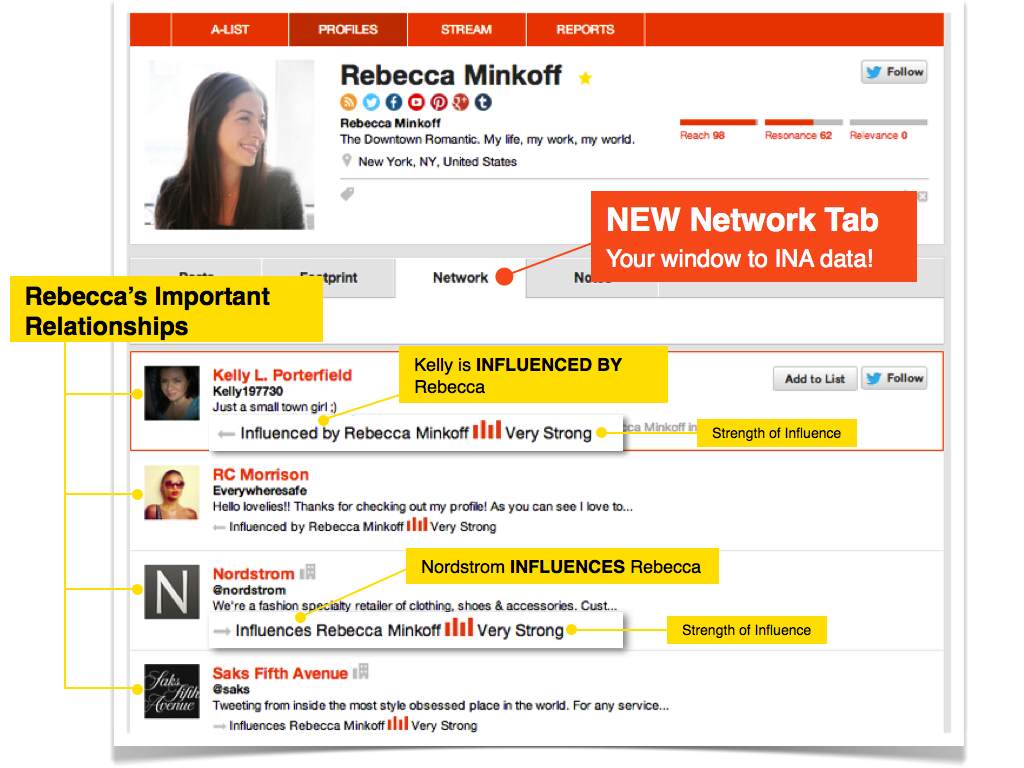
This lack of innovation and fresh direction was highlighted even more when compared to products like Traackr, who came out with solutions like their Influencer Network Analysis.

Traackr Influencer Network Analysis

This allowed users of Traackr to not only see who was influential based on real metrics like Relevance and Resonance, but also who essentially influenced the influencers – an added depth of identification that really laser-targeted the people you wanted to connect with.

Or consider Appinions, who measure offline influence as well as online influence, to offer a full spectrum of data and insights. This includes identifying the originating source of something that’s impacted discussion across the web, and how offline news stories and journalists drive online conversation and actions.

When comparing Klout’s social scoring algorithm as a measure of influence against real influence platforms that drive the insights needed for business goals, it was always going to be an uphill battle for Klout to be taken seriously as an influence marketing platform.

And then there were the Perks.

The ROI of Reach and Noise

Touted as a way to connect brands to the army of influencers in Klout’s database, Klout Perks were introduced in 2010 and were seen as one of Klout’s business models to monetize their platform.

Advertisers and brands would pay Klout a premium, which would differ based on the target audience and size of the promotion, and Klout would offer that brand’s product as a freebie to people who qualified based on their Klout score.

The problem was, there was no real relevance or context to the Perks. All that would happen is Klout would identify a bunch of people they perceived as influential in the brand partner’s niche, and – by giving them freebies like car test drives and airline trips – the Klout influencers would share their experiences and drive sales for the brand.

Klout Perks

Except that never really happened – or at least, not in the numbers that the brands probably expected, given the investments and amount of influencers promoting the brand’s goods.

The reason was simple – Klout didn’t dig deep enough into the audience of the influencer. They didn’t know if the followers of an influencer were in the market for the product being promoted; they didn’t know if they had brand loyalty elsewhere; and they didn’t know how contextual the influencer truly was in the area of the promotion.

This meant that, essentially, the Klout influencer was simply promoting without any knowledge of where their audience was in the purchase life cycle – a key factor in successful influence marketing campaigns (and something Sam Fiorella and I talk about extensively in our Influence Marketing book).

When you look at the public case studies Klout shares about their Perks, very few talk about tangible financial ROI. There are lots of examples of social shares, blog posts, etc., which is great for brand awareness. But for actual ROI and sales? Little evidence of success.

For brands that are spending upwards of $25,000 and more on Klout Perks, you want to see returns for your investment. The occasional example of ROI success after at least 400 campaigns and 1 million Perks being claimed is not a number designed to inspire confidence when it comes to breaking down your latest fiscal year’s marketing budget.

Klout’s Failure is Good News for REAL Influence

As I mentioned at the start of this post, $100 million isn’t chump change. However, given the financial history of Klout investment-wise, its business model of Perks, and its uncertainty as to what exactly it wanted to be (a recent pivot to a content curation platform seems too little, too late), you have to wonder what Lithium saw in the platform.

Perhaps it’s to identify influential customers (since Lithium serves the social customer industry), so that their issues can be resolved before they become an online crisis. However, that path could be fraught with negative feedback if customers feel they’re being ignored in lieu of “influencer customers”.

Perhaps it’s access to the data that Klout has. While there’s no question some of the data is for inactive accounts, there’s still a lot of information available for Lithium to integrate into its own solutions.

However, that’s for a future discussion once Lithium’s plans become clear. What’s clear right now is that Klout’s failure is a victory for real influence marketing technologies and strategies.

Social scoring was always a popularity game, with little relevance attached to actual influence – swaying a customer’s purchase decision at exactly the moment they make it – and more weight on social signals and amplification.

Now, with the flag-bearer of social scoring acquiescing to what almost looks like a desperation sale, the companies that are truly pushing the influence conversation forward can do what they do best, and meet the needs of brands and marketers that are looking for more than social shares when it comes to an influencer campaign.

Social scoring is dead – long live influence.

Update March 31: The Klout/Lithium deal has been signed off, valuing the company at $200 million in a mix of cash and shares in Lithium.

image: Jamie Koroluk

How Readz is Aiming to Take Content Marketing to the Next Level

Metrics

This is a sponsored post on behalf of Readz – however, all opinions are my own.

Mention the term “content marketing” and, for the most part, you’ll probably think of three things – web content, social content (tweets, Facebook updates, Google+ posts, etc), and good old fashioned blog posts.

You can also add video marketing and white papers into the mix. All things considered, content marketing has been the word on pretty much every marketer’s lips for the last 12-18 months.

The problem is, once you move away from the type of rich content found on blogs (written, spoken or otherwise) and native social updates, content marketing can get a bit sterile. Think of the last white paper you read, for example – did it leave you inspired or nonplussed? After all, there’s only so many times a straightforward PDF can grab your attention…

To counter this, as well as help brands and agencies (as well as bloggers) ramp up their content marketing efforts, software platform Readz is looking to make it easy to create the kind of content that’s shareable, measurable, and usable.

The Readz Goal

The goal of Readz is simple. In their own words,

At Readz, we believe content marketing is more than a website, a blog, or even social activities. Content marketing touches every single piece of content that marketers use to communicate with prospects, customers and partners. We believe that PDFs are a poor tool to do marketing. They are not responsive, do not offer SEO, no detailed analytics etc. So many of the qualities we see in good website and blog management tools are lacking in PDFs. We believe better tools are needed to bring a better experience to customers and a higher conversion to marketers.

To enable this goal, the Readz process is pretty straightforward:

  • Create an account;
  • Create your content. This can be either articles or PDFs uploaded to your dashboard, or pulling in content via RSS;
  • Publish through Readz;
  • Share your Readz brand URL. This creates a responsive landing page that can be read on any browser and is hosted on the Readz site;
  • Measure using Google Analytics integration, optimize, rinse and repeat.

The solution itself is optimized for all browser settings, so it doesn’t matter if your customers are desktop-based or mobile-based (smartphone or tablet), the experience will remain consistent.

But as you’d expect from a company looking to boost your content marketing efforts, there’s a lot more to the Readz experience than simply creating a cool way to share content and measure its performance.

Branding the Experience

Because the Readz solution drives visitors to a Readz URL versus one that’s part of your existing website, keeping the feeling of brand continuity is key. Thankfully Readz offers various options to ensure your Readz landing page ties into the design, look and feel of your internal landing pages.

Readz branding

Better yet, the drag-and-drop interface enables all levels of expertise to be able to create a seamless transition (although, obviously, skilled designers will make the platform perform more than your average Joe).

Optimizing for Search and Performance

Perhaps one of the areas where Readz really shines is that of search engine optimization (SEO) and the analytics that can be gleaned from that. In addition, you can see how your campaign is performing, thanks to Readz’s integration with Google Analytics.

On the SEO front, any blogger or content marketer responsible for the SEO of their content will recognize the ability to optimize titles, descriptions and tags with any Readz-powered content. Because the content is hosted online, versus a downloaded PDF, the SEO juice from these options can help a brand find a fresh audience.

On top of that, running your campaign through Google Analytics will break down the performance of a particular piece of content, including views, traffic flow, demographics and much, much more.

Readz Analytics

This can either be set up as a special campaign in Google Analytics, or a brand new UA. This type of integration helps you optimize not only the current campaign, but give you insights into the type of content you should be creating as you move forward.

Other features include responsive design for all campaigns, no app downloads needed, and integration with your existing marketing solutions like MailChimp, Infusionsoft and other platforms.

The Readz Experience – A True Bigger Picture

However, while the features are comprehensive, it’s not until you start getting into the Readz experience that you really begin to see the benefits this platform can offer, compared to the static white papers and PDFs the company is looking to oust.

Because the platform enables rich media as natural inclusions, what was once a straightforward PDF now becomes a fully interactive and far more immersive experience. Take the 9LIVES “Town of Runners” campaign, for example.

Readz 9Lives

Highlighting the story of the Ethiopian town of Bekoji, the Readz version of the original documentary takes the reader into the inspiring story of the incredible athletes from this part of the world.

As you scroll through the storyboard, you can click on certain action points, as highlighted by the image above. These can expand into little speech bubbles, or text boxes, or similar, to offer more information on anything you wish to have the reader interact more with.

As an education resource, you can see the benefits this option could offer – FAQs could become far more immersive, and cheat sheets could be more than just a line of text.

It’s not just these little calls to action that stand out, however. Because of the way Readz creates content (either from an existing web URL or a dedicated file upload), you can embed video directly into the Readz presentation.

Readz 9Lives video

In the example in the screenshot above, you can view the official trailer for the documentary directly within the Readz content. Not only that, but by clicking the call to action, you can buy your copy directly there and then, keeping the reader on your content while buying your product.

For any marketer using content to promote their services and/or products, this level of interaction is a great way to control the message while retaining your audience. It’s not just marketers, either.

For example, consider the benefits to an independent book publisher or self-published author. Let’s say you give a free chapter to anyone that pre-orders your book. In addition to the chapter, the reader could also receive a unique Readz piece, that has the author reading a chapter from the upcoming book, as well as a special thank you message, all in embedded video within the free chapter download.

Or let’s say you’re an indie singer/songwriter or band. Anyone that pre-orders your new CD could receive a free song download – but on top of that, you send them an exclusive Readz link, where they can read about the creation of the album, see an embedded video performance, etc.

As you can see, the potential is there for anyone that uses content to connect with their readers or fans, and not just limited to marketers.

Readz – The Verdict

The features highlighted in this post are just a few of the options available to you. Depending on the type of content you create, Readz can be used to transform multiple publications into more immersive experiences:

  • White papers;
  • Magazines;
  • Brochures;
  • Manuals;
  • Annual reports;
  • PDFs.

In addition to the tools, Readz also offers a wide collection of best practices and guides to help you understand how to get the best from the platform, including higher converting white papers, guides on technologies for digital publishing, and glossaries of marketing terms for mobile consumers.?When it comes to support, Readz definitely has you covered.

Readz examples

However, there are some areas where I feel they could improve.

Native Analytics

As mentioned earlier, Readz can be integrated with Google Analytics to show you how your content is performing. However, this is another step to add and many smaller businesses may be uncomfortable using multiple Google Analytics accounts.

Instead, it’d be great to see native analytics within the Readz dashboard. This could show you not only the standard metrics from Google, but also the behaviours of subscribers to your Readz channel.

  • What kind of content gained the most subscribers?
  • What kind of content was the most acted upon for ROI, versus the most popular?
  • How do audiences behave when interacting via Readz versus comparative pages on your own web properties?

This kind of data would be hugely useful to have as an embedded part of Readz, versus relying on a third-party provider.

Embeddable Content

Speaking of embedded, currently Readz doesn’t support embed codes – it simply creates the URL for your particular campaign, and you drive traffic to that. While this is primarily to help Readz keep your brand experience consistent, it does still drive traffic away from your own domain.

Instead of just offering the current URL option, it’d be great to see the ability to embed a Readz campaign on your own landing pages. This would allow you to hook into your existing analytics package, as well as understand the changes you need to make to your own portal versus one operated by Readz (mobile optimization, for example, or rich media versus text).

In fairness, the CEO of Readz, Bart De Pelsmaeker, has indicated that the embed feature is already under development for the next update, which will be a great addition to the platform.

Apart from these current quibbles, there’s not really a lot to “dislike” (for want of a better word) about the Readz platform. While building your first campaign content can be daunting, the guides and support is excellent and helps you change your mindset on how a publication is created.

Pricing starts at $25 per month for up to two content pieces/whitepapers 10,000 page views, going up to $300 per month for 50 whitepapers with 100,000 page views.

There are also one-off payments as well as simple turnkey options. To see if Readz is right for you, you can request a free demo here, and there’s also a free, 30-day trial for brands and publishers.

This is a sponsored post on behalf of Readz – however, all opinions are my own.

  • « Go to Previous Page
  • Page 1
  • Interim pages omitted …
  • Page 24
  • Page 25
  • Page 26
  • Page 27
  • Page 28
  • Interim pages omitted …
  • Page 174
  • Go to Next Page »
© 2026 Danny Brown - Made with ♥ on Genesis