• Skip to primary navigation
  • Skip to main content
Danny Brown

Danny Brown

podcaster - author - creator

  • About
  • Podcasts
  • Journal

Latest posts from Danny Brown

Enjoy the latest posts from Danny Brown, and feel free to add your own thoughts in the comments after the post.

Does Influence Marketing Have a Future?

The business of influence

Last week, Forbes published an article entitled Who Are the Top 50 Social Media Power Influencers, 2013? by Haydn Shaughnessy. It followed similar posts by Shaughnessy on The Top 20 Women Social Media Influencers, also on Forbes, and a similar Top 50 list 12 months earlier.

The article soon came under fire from certain areas of the web, including Mark Schaefer’s Grow blog and Jure Klepic of the Huffington Post. Additionally, there were numerous conversations across Facebook on the Forbes article, with the majority of people discounting its validation.

So why did a publication like Forbes receive such criticism, and what does the discounting of influencer results like the one on Forbes mean for influence marketing in general?

Popularity is Not Influence

This is beginning to sound like a broken record, but popularity does not equal influence. While having 100,000 followers on Twitter might be a nice statement of your social proof (hint: it’s not really), does that make you influential (another hint: no)?

This is where the majority of the criticism of the Forbes article comes into play.

In his preamble to the list, Shaughnessy shares the “algorithm” behind identifying the influencers, and that he uses Twitter measurement platform Peek Analytics. That should raise the first red flag – Shaughnessy is only defining influence from a single platform.

However, it’s Peek Analytics’ own description that devalues Shaughnessy’s article even more. From the Peek Analytics website:

Social Pull is not a measure of a single individual?s ?influence;? rather, it is an audience-based metric that is a direct reflection of the quality and size of the Twitter audience that has been ?pulled? into following an account or mentioning a keyword @name, hashtag, or URL on Twitter.

So, Peek Analytics doesn’t measure influence; they measure data based on interactions. So why does Shaughnessy use a tracking platform that doesn’t measure influence to create an influencer list?

It’s this flawed approach that the majority of the criticism around the web has picked up on.

…this is a suspicious methodology to define social media influence, and that is about as charitable as I can be. – Mark Schaefer

With their tired standard of measuring Twitter followers, PeekAnalytics adds nothing to the conversation of influence measurement. Similar to every other list that has been made based solely on Twitter followers, there is no attention paid to the metrics of comments on their blogs, content quality and other social networks.?- Jure Klepic

…the thing that bothered me about the Forbes list is they clearly did it based on Twitter followers alone. There are two people on there I know, for a fact, they paid for their followers and don’t interact, engage, or build community. – Gini Dietrich

These criticisms, and others like them, clearly show that the social web has moved way beyond just numbers and a platform where spam bots are plentiful when it comes to defining influence in the truest sense.

Influence is Multi-Layered

The other core issue with the Forbes article is the very fact Shaughnessy limits measurement to a single platform. This is lazy analytics at best, allowing for flawed metrics to be used as a source of influence identification.

It’s also one of the reasons that a recent influence marketing survey of over 1,300 professionals highlighted the need for more accurate and informed data analysis, versus the approach currently taken by social scoring platforms.

Influence marketing survey key insights

For example, Klout’s algorithm only measures your public Twitter data – they need you to connect your other social accounts to offer any true accuracy. From a recent TechCrunch article:

Before we are able to incorporate any data into a person?s score, we need users to connect the network to Klout so we can begin to process the influence data.

So, much like Peek Analytics, they’re using a single platform to measure influence, as opposed to all the other social footprints you may have elsewhere. Klout competitor Kred is in the same boat:

To calculate your Kred, we analyze?billions of tweets?from the last 1,000 days.?We add your Facebook actions when you connect your account.

While there’s no doubt Twitter is an important part of the social media ecosystem, it’s just one piece in a very large puzzle. And it’s this reliance on Twitter data only that dilutes the effectiveness of social scoring when it comes to identifying true influence based on behavioural change, as opposed to reactions to a tweet.

Influence is much more than the sum of Twitter’s parts. If we, as marketers and brands, are looking to truly understand what drives actions in people – the definition of influencing someone – then we need to understand much more than a tweet or social network update.

  • Situational factors – what’s affecting someone’s decision-making at any given time?
  • Peer factors – who offers the most influence based on where you are in that decision-making process?
  • Financial – can you afford to buy, or are you more logical and prudent with your money?
  • Emotional – tied into the financial factor, does emotion for a product override common sense, logic and lack of funds?
  • Familial factors – who’s the decision-maker in the family and how does this impact a brand message being accepted?

These are just a few of the factors involved into identifying where influence may play a part, and who the influencer would be to instill the next part of the equation and, by association, action.

Is Influence Marketing Losing Its Clout?

So what does this mean for influence and influence marketing moving forward? Has the potential of influence already been nixed before it’s even had a chance to reach maturity?

After all, the criticism of a respected media publication like Forbes, as well as questions being raised on current social influence outreach and its effectiveness at ROI, would suggest influence is becoming a tainted topic.

And, to a degree, it is. Lack of results (shared or perceived) harm the medium, as brands (rightly so) look for return on their investments, beyond simple retweets and blog posts that add nothing to the bottom line.

However, as the results of the recent influence marketing survey we shared here show, it’s not influence itself that’s broken, but the definition of how we identify who influencers are today, and what they mean for a brand. Brands are still looking to use influence marketing as a key part of their tactics; but they do expect more.

The problem is we’re still placing “influencers” – whoever they may be – at the heart of the marketing circle, and not always defining what the context is when it comes to filtering them for a brand.

A simple example – Lifestyle Blogger A has a well-read blog, and primarily attracts an audience of women between the age of 25-44. So it makes sense that a brand whose demographics are made up of this audience should work with that blogger.

But the audience has a very different make-up. Blog Reader A is a single mom with two young kids under three; Blog Reader B is a married mom with one kid aged ten and one teenager; and Blog Reader C is a mom who has a child of college age, who’s no longer living at home.

All three of these reader segments fall within the broad category of “women between the age of 25-44” – but that’s where the similarities end.

Disruptive influence

Let’s say the brand sells toddler toys. Using a generic influence outreach campaign, the blogger might be successful at putting the brand in front of the Blog Reader A segment, but the message will be completely off-point for the other two, just-as-important segments.

This is the where the flaws of putting today’s definition of an influencer at the heart of the marketing circle appear; and why we need to move beyond this, and start putting the actual customer at the heart of the circle, and work back from there.

By taking this approach, we understand who the true influencers are – customers – and what they’re looking for, as well as who’s influencing their decisions at a specific point in time.

And if we can redefine influence to the people brands should really be taking notice of, and how to meet their needs and help with their decisions, we can reposition influence back to its true meaning and dispel its lack of effectiveness (perceived or real) currently “enjoyed” today.

In less than three weeks, that repositioning of influence will be ready to take the first steps…
Read Chapter 5 of Influence Marketing, “Situational Influence”, today – click here to download your free copy.

Empathy is a Social Currency

Empathy in the organization

Empathy in the organization

In their excellent book Humanize, authors Maddie Grant and Jamie Notter share their insights into why a truly successful business needs to take the reasons social media has enjoyed exponential growth as a business imprint, and implement it across the organization.

It takes more than simply activating staff on social media and being more “approachable” as a business on the social web – it’s a complete mindset and culture change, for which many organizations today are still not ready for.

It’s probably one of the best business books on this topic today, and is highly recommended.

But as well as offering a roadmap into why organizations need to adapt the social mindset to succeed in today’s business landscape, Humanize – and the underlying concepts within it – raises another, much more important factor: that of empathy as a social currency.

There’s More to Being Human Than Simply Being a People Business

Leading website Ragan.com, a destination for communications and PR professionals globally, published an article detailing the case of a waitress that worked at pub restaurant chain Hooters.

In the article, Sandra?Lupo shares how she had to undergo surgery to remove a brain tumour. As a result of the surgery, she was left bald and sporting a scar from where the surgery left its mark.

Upon returning to Hooters, she was advised by her boss – via the Regional Manager for that particular locale – that she would have to wear a wig to hide her baldness.

Lupo couldn’t afford to pay for the wig; the manager of the restaurant wouldn’t cover the cost. ?Lupo wore a borrowed one which caused scalp irritation so she stopped wearing it, her hours were cut as a result, and because of this chain of events Lupo quit.

She’s now suing the restaurant from a disability angle, which the restaurant is contesting.

Lupo’s case, and the article at Ragan.com, raises a key point that many organizations are failing to address today, when looking to turn their business into not only a social business, but one where the culture throughout is pervasive with the right mindset to begin with, from the top down.

We’ve spoken with, and helped, several organizations that have implemented cultural shifts. Shifts that:

  • Have enabled employees to become social ambassadors;
  • Have identified weak processes and pivoted where needed;
  • Have empowered people of all levels to help drive decisions because they’re the most suitable to do so, even if – by rank and seniority at the organization – they’re more junior.

And while this shift is important and offers validation of where we believe business needs to be moving, there are still many organizations that employ this approach and yet forget the core tenet of being human, or a social business, or a people-led organization.

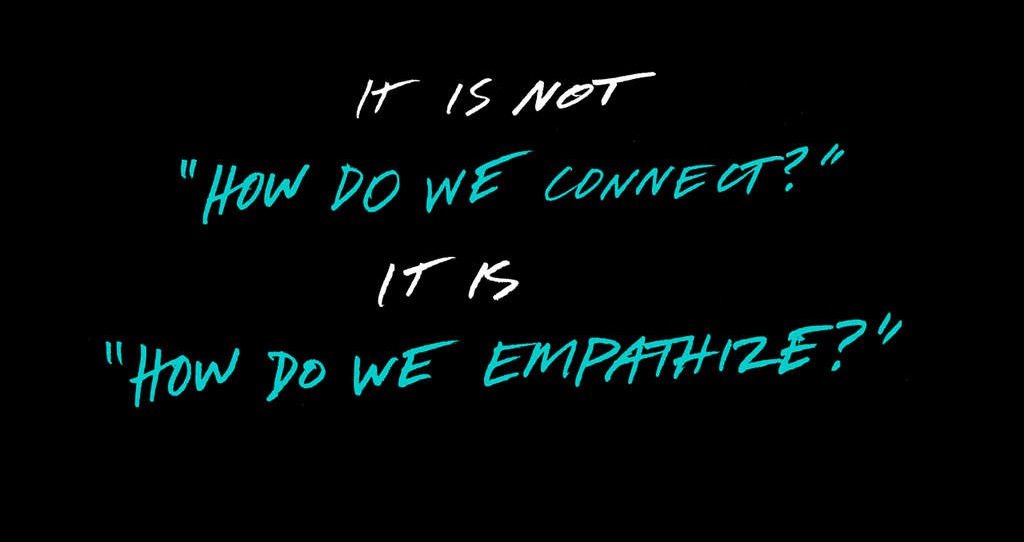
And that tenet is empathy.

Empathy is a Social Currency

The greatest customer service assistant – whether in a retail environment or on the other end of a phone line in a call centre environment – knows that when a customer complains, it’s almost universally never directed at them in person.

Rather, it’s the brand that’s coming under fire. ?With that knowledge, the CSA can adopt two approaches:

  • Tow the company line no matter what claims the customer may have that could be counter to the organization’s edict;
  • Apply empathy to the situation, placing themselves in the customer’s shoes, and working together to resolve the matter with no need for an escalation process to be invoked.

The former option may be the company’s preferred method, when working to the letter of the law, but it’s the latter that will leave a far more satisfactory outcome and potentially set that customer on the path to becoming a true brand advocate.

This approach has been taken with the more successful companies on social media; accepting that there will always be instances where a message was lost, a promotion was poorly timed, or a response took longer than normal.

Trackur-Talking-About-You

As social media opens up multiple channels for the connected consumer to air grievances on, so the need grows for organizations to move away from just being a people business when it comes to customers, and adopt to being a provider in the empathy business as well.

But this should absolutely not be restricted to the customer on an external basis only – it should also be extended to the internal customer as well.

The Culture of Empathy for the Internal Customer

Smart organizations know that employees are also customers. They may not always buy the company product – that purchase still needs to earned by delivering on the sales promise – but they do help shape the purchase decisions of their family, friends and social connections.

Even away from the immediate connections, your employees – and their passion for the organization – are core to how your bottom line is affected.

When potential customers contact a business with regards a product, they don’t care about the sales team now. They’ve already researched the product online and through trusted peers, with 71% of consumers making a purchase based on social media referrals and 74% of consumers preferring social network peer connections to influence the decision-making process.

With the traditional sales team now being bypassed for their recommendations, customers are looking to talk directly with employees immediately attached to the product or service the inquiry is about.

According to Inc., if that employee isn’t up to speed with the product and the company’s support, future plans, comparisons to competitor products, hands-on support and more, that customer becomes a lost opportunity and will move on to your competitor.

As every organizational development trainer knows, the valued employee not only stays with the organization longer; they want to be an embedded part of the organization across multiple areas, and not just where their current position may limit them to.

And the way to value the employee? Empathy.

In the case of Sandra Lupo and Hooters, it could be argued that Hooters did nothing wrong legally. If part of the Hooters “experience” is the physical make-up of the waitresses, then Hooters could have a case that Lupo’s appearance didn’t match the company prerequisite, no matter how questionable we may feel that stance is (if, indeed, that is the company stance when defending the suit).

But the company line isn’t always the best one; nor does it have to be strictly adhered to.

The greatest leaders know that the ability to divert from a course of action, or a path that’s always been trod, is the biggest differentiator between a good company and a great one.

In the case of Hooters, the cost of providing a custom wig for a waitress would allow them to maintain the outward requirements of front-facing waitresses, while understanding and alleviating the pain of someone whose appearance is temporarily “different” through hugely unfortunate circumstances.

Instead of facing a legal case, they have shown belief and support for the people behind their company’s success – the very cultural approach that turns a people business into a human organization.

The Path to Empathy Starts Here

One of the biggest mistakes organizations make is in thinking the only requirement to be successful on social media – or business, in general – is to be human. That is, be your customer’s friend and speak to them as one.

Yet, as Humanize shows, and as many brands have found out, “being human” is not the same as humanizing your organization. Nor is it something your customers truly want.

In a report commissioned by the Corporate Executive Board, one of the key highlights that the report identified is consumers prefer simplicity in the decision-making process, leading to an 86% chance of interest turning into a purchase. Perhaps even more tellingly, only 23% actually cared about a brand relationship (or friendship), which counters the posit you need to be friends with your customers.

CEB report

Instead, the most successful organizations were the ones that were empathetic, in the word’s truest sense:

…the action of understanding, being aware of, being sensitive to, and?vicariously?experiencing the feelings, thoughts, and experience of another of either the past or present without having the feelings, thoughts, and experience fully communicated in an objectively?explicit?manner; – Merriam Webster dictionary.

By understanding what it means to empathize, an organization can implement the culture needed to serve both internal and external customers to drive increased loyalty, engagement, advocacy and collaboration through involvement across the board.

Understanding the Mindset of Employees and Customers

Tracking software with advanced text analytics algorithms are beginning to identify true nuances of conversations between people. Nouns, verbs and adjectives can be layered upon the bigger conversation, and detect mood swings, emotional states, hidden messages and more.

Externally, being aware of these states of mind can help organizations prepare a message for individual customers (based on group personas as well as individual ones) that help show empathy to a current situation, and how your brand can help.

Internally, with tools like Yammer being widespread across many organizations, organizations can identify an employee who feels unappreciated or who has a great idea that isn’t being promoted. This clearly needs treading carefully with regards privacy and the employer/employee relationship, but is worth the effort to agree on with all parties.

Experiencing the Feelings of Another

There’s a reasonably popular television show called Undercover Boss, that explores what happens when the CEO of an organization is heavily disguised and placed into the workforce for a week, to see how well the company is run and identify the great people doing great things.

While not every organization’s CEO needs to do the same, remembering what it was that made your company such a great place to work in the first place is something that should be revisited often.

Adopt an open office policy where every employee’s views can be heard without bias or fear of recourse; spend a day on the job of various department workers; visit the facilities provided, like cafeteria and the quality of services provided to employees while in your care. Be an employee again to experience where your organization needs to make changes.

From a customer point of view, follow their footsteps at every touch-point of their connection to your organization. How does customer service handle their call; what does tech support look like; how are your resellers treating them; how are your complaints heard online when voiced? Be the customer again and resolve the issues before your competitors do.

Being a people organization is one thing; being an organization where people are human and empathize with the flaws as well as the strengths of other humans connected to the organization, both internally as well as externally, is where the true people part comes into play.

The challenge is yours to accept.

A version of this post originally appeared on the ArCompany blog.

The Sunday Share ? Content Marketing Art of War

video and content marketing

video and content marketing

As a business resource,?Slideshare?stands pretty much head and shoulders above most other content platforms.

From presentations to educational content and more, you can find information and curated media on pretty much any topic you have an interest in.

As a research solution, Slideshare offers analysis from some of the smartest minds on the web across all verticals. These include standard presentations, videos, multimedia and more.

Which brings us to this week?s Sunday Share.

Every week, I?ll be sharing a presentation that catches my eye and where I feel you might be interested in the information inside. These will range from business to content to social media to marketing and more.

This week, an excellent re-imagining of the Art of War, from John Lane, Vice President of Strategy/Creative at?content marketing agency Centerline Digital.

As content continues to be one of the key factors for success in any marketer’s toolset, this presentation adapts the teachings of Sun Tzu and shares several excellent case studies on how brands are adapting to the new content-driven marketplace.

Enjoy.


Free Download of “Situational Influence”: Chapter 5 of Influence Marketing

Danny Brown Sam Fiorella Influence MarketingWith less than four weeks until Influence Marketing: How to Create, Manage and Measure Brand Influencers in Social Media Marketing is released, it’s time to offer a little taste of what you can expect when you buy it.

So we’re delighted to have Chapter 5, “Situational Influence: A New Model for a New Era” available for you to download for free today. It offers a pretty good idea of the approach we’re taking with the book – we want it to be a thought-provoking business book and one that makes you look at how we define influence marketing today.

It’s also a nice introduction to what’s to come, as it’s the bridging chapter between where we’ve come with regards influence marketing today, and where we feel the market needs to evolve to tomorrow and beyond.

You’ll also find the detailed Table of Contents, which will give you an idea of the discussions and premises we present in the book proper.

We hope you enjoy the chapter, and we’d love to hear your thoughts in the comments section below, so please do jump back over and leave your feedback once you’ve read this chapter.

And, of course, if you did enjoy the chapter, then the book is available for pre-order today. Enjoy!

Click the book image to download the sample chapter.

Influence Marketing book

Free Download of “Situational Influence”: Chapter 5 of Influence Marketing

Robots replacing humans

Danny Brown Sam Fiorella Influence MarketingWith less than four weeks until Influence Marketing: How to Create, Manage and Measure Brand Influencers in Social Media Marketing is released, it’s time to offer a little taste of what you can expect when you buy it.

So I’m delighted to have Chapter 5, “Situational Influence: A New Model for a New Era” available for you to download for free today. It offers a pretty good idea of the approach Sam and I are taking with the book – we want it to be a thought-provoking business book and one that makes you look at how we define influence marketing today.

The book provides a blueprint that moves influence marketing beyond simple brand awareness and into sales acquisition and customer life time value measurement.

This downloadable chapter also offers a nice introduction to what’s to come, as it’s the bridging chapter between where we’ve come with regards influence marketing today, and where we believe the market needs to evolve to tomorrow and beyond.

You’ll also find the detailed Table of Contents, which will give you an idea of the discussions and premises we present in the book proper.

I hope you enjoy the chapter, and I’d love to hear your thoughts in the comments section below, so please do jump back over and leave your feedback once you’ve read this chapter.

And, of course, if you did enjoy the chapter, then the book is available for pre-order today. Enjoy!

Click the book image to download the sample chapter.

Influence Marketing book

  • « Go to Previous Page
  • Page 1
  • Interim pages omitted …
  • Page 88
  • Page 89
  • Page 90
  • Page 91
  • Page 92
  • Interim pages omitted …
  • Page 283
  • Go to Next Page »
© 2026 Danny Brown - Made with ♥ on Genesis