
• Skip to primary navigation
  • Skip to main content
Danny Brown

Danny Brown

podcaster - author - creator

  • About
  • Podcasts
  • Journal

Latest posts from Danny Brown

Enjoy the latest posts from Danny Brown, and feel free to add your own thoughts in the comments after the post.

Facebook Looks to the Past to Present Its Future

Facebook phone

If there’s one key area that social network giant Facebook has been weak in, its the mobile arena.

Users of the official Facebook app for both major platforms Android and iPhone, as well as other handsets manufacturers, have had to dealt with slow loads, poor user interfaces, bugs and other such quirks.

This is especially true when comparing the Facebook mobile experience to the Google+ one, with the Android app in particular offering a seamless experience.

Facebook, for their part, are clearly aware of this. There are rumours that they’ll be presenting the “Facebook phone” at a special event this week, and Mark Zuckerberg has often been cited as telling his mobile developers they need to up their game.

However, a recent media update would suggest Facebook isn’t just resting its laurels on a new Android-powered Facebook phone – it’s also going much more integrated with mobile leading its strategy for the remainder of 2013 and beyond.

Reanimating “The FaceBook” for the Connected Consumer

Rumoured to have been in production for the last six months, The FaceBook (in a nice tip to the company’s original name) is a tech-laden tablet that’s set to go head-to-head with the MacBook Air and the new, extremely powerful-looking Google Chromebook Pixel.

The FaceBookBuilt solely for the Facebook user, The FaceBook looks set to be the Palo Alto giant’s final piece of the puzzle when it comes to owning the social web. It’s no secret that the platform is being shaped to ensure users never need to go anywhere else, as brands, e-commerce, graph search and more integrate to offer the complete experience.

Facebook doesn’t want people using Google, and the back-and -forth between the two tech giants has seen the battle often get ugly as users are bombarded with why one network is better than the other.

Google seemed to have taken the lead, with its Google+ network integrating across all Google properties and allowing Plussers to have access to pretty much everything they need in one place.

However, Facebook has a much higher user base, as well as one key factor – the Facebook experience is such a heavy part of web users’ culture now, it’d be hard for many to leave.

The FaceBook tablet aims to ensure there’s no need to.

The FaceBook Integrated Experience

Taking a lesson from Google and how their G+ user can access all of Google’s main properties from one key home base (Google+), Facebook has made some interesting decisions when it comes to its new The FaceBook.

  • Facebook will launch its own version of the App store, and when you connect you switch on The FaceBook, all your current apps and games will be synced for you.
  • Built with a high-density retina display, The FaceBook will take a picture of your face while powering up, and cross-reference the image with your personal photos to ensure you are the official user of the account. This is to prevent future hacking.
  • Eye-tracking and sentiment detection software will let Facebook know where on your profile you’re looking the most, and tailor each visit for you. This is Facebook’s attempt to truly serve users ads that they’re interested in, increasing the propensity of a click.
  • Voice recognition will allow you to talk and these will be posted as text updates for users without The FaceBook, and voice updates for other tablet users.
  • Running its own version of a Google+ Hangout (thanks to Facebook’s partnership with Skype), The FaceBook will detect who you speak with the most and automatically connect with those people when they’re online. Using the eye-tracking and sentiment detection software again will allow Facebook to see when you’re happy to talk with someone and when you want to ignore, and will act accordingly.
  • The camera will detect your background and change your profile colour scheme to match your surroundings and mood, using Chameleon? technology.

These are just some of the early stats and features that have been shared so far. But it’s clear to see from just these alone how seriously Facebook is taking this shifting trend to mobile, smartphone-powered browsing experiences.
Facebook phone

With a suggested price point of $999, keeping it under the magic thousand dollar number, it’s also clear Facebook have high hopes of attracting a large number of its existing web-based user base when The FaceBook is launched later this year.

Moving the Old to the New – What Next?

One of the big questions that The FaceBook poses is, what happens now for the web version of Facebook? After all, even though such a technology-enabled tablet is coming in at under a thousand bucks, that’s still out of the reach of many of Facebook’s current users.

The hope for those that can’t initially afford The FaceBook is that they’ll first migrate to the rumoured Facebook phone, and once they’ve had that a year, they will be eligible for a free upgrade to The FaceBook itself.

If Facebook can take the hit on the cost of that – and if any company can, it’s probably Facebook – then we might just be seeing the start of Zuckerberg’s global private social network be taking shape.

Where that leaves Google, Twitter, etc, is anyone’s guess – one thing’s for sure, the next 12 months is going to be one heck of a battlefield.

Full details of The FaceBook announcement can be found here.
The Sunday Share – The Principles of Customer WOW

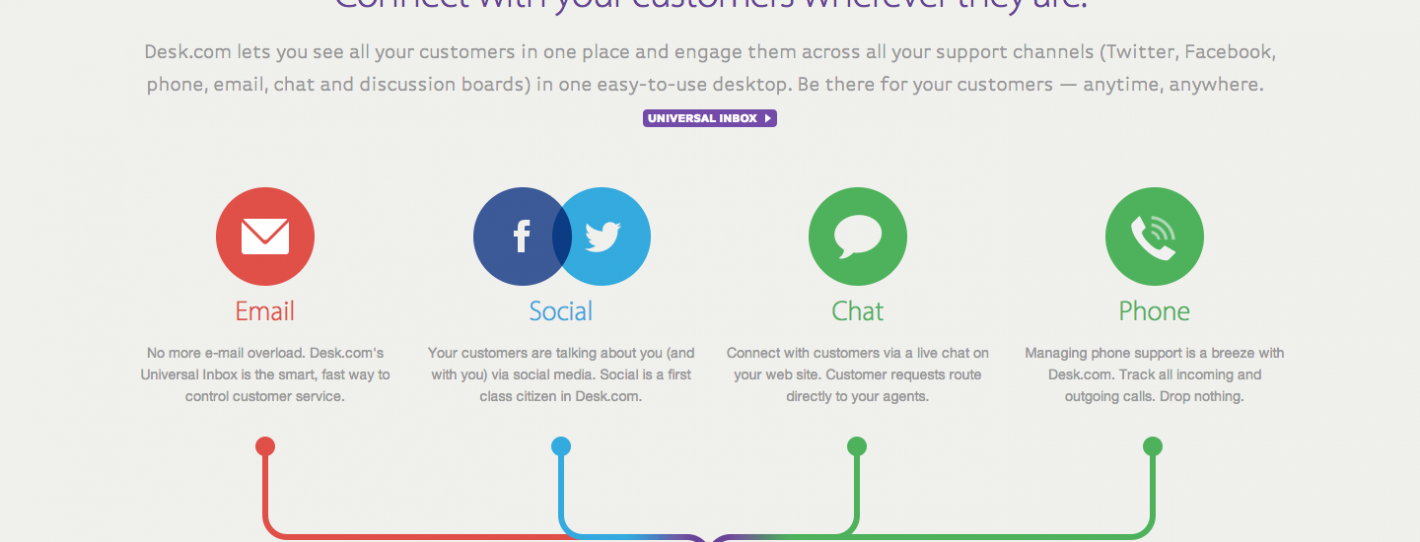
Desk.com The Customer Support App for Small Business and Growing Teams

As a business resource,?Slideshare?stands pretty much head and shoulders above most other content platforms.

From presentations to educational content and more, you can find information and curated media on pretty much any topic you have an interest in.

As a research solution, Slideshare offers analysis from some of the smartest minds on the web across all verticals. These include standard presentations, videos, multimedia and more.

Which brings us to this week?s Sunday Share.

Every week, I?ll be sharing a presentation that catches my eye and where I feel you might be interested in the information inside. These will range from business to content to social media to marketing and more.

This week, an excellent Slideshare from customer service solution experts Desk.com.?

As businesses realize the importance of evolving into true customer-centric organizations, being flexible enough to meet your customer’s needs where and when they’re effective is key to ongoing success.

This presentation offers Desk.com’s insights into what it means to WOW your customers.

Enjoy.


Using the Google Analytics Trackbacks Feature to Create a Content Strategy

Trackbacks chart

This morning, I noticed Google Analytics had added a Trackbacks section to their Social Analytics data. This, to me, is very big news.

While bloggers will know all about Trackbacks and why it’s nice to get them, businesses may not be aware of their importance. Yet as the social web in particular continues to be graded, Trackbacks could become even more important, especially in the eyes of Google, as they look to rank the Authority of content and that content’s creators.

So why is this new Trackbacks edition to Google Analytics important and, more importantly, how can you use them to build your content strategy?

The Validation Factor of Trackbacks

For anyone who doesn’t know what a Trackback is, its definition is:

TrackBack is a type of?peer-to-peer?communication system that was designed to send notification of updates between two?Web sites?via a Trackback Ping.?Ping?in reference to TrackBack refers to a small message sent from one?Web server?to another. TrackBacks are useful for informing a Web site that you have referenced its Web site within your own Web site, and is popular with?bloggers.?TrackBack was first released as an open specification in August 2002. – Webopedia.

So, if I write a post and reference content elsewhere, that’s me providing a Trackback to the article. The reason bloggers like Trackbacks is simple – it offers validation that your content is seen as informative enough that someone else wants to share with their readers too (click image to expand).

Trackbacks  Links

The potential results of that share, or Trackback, are numerous.

  • New readers or subscribers;
  • New potential customers;
  • Growth of influence;
  • Identified as a thought leader in your industry;
  • Search engine optimization (SEO) benefits.

These are just some of the immediate effects; however, by understanding what Trackbacks are and the potential they offer, you can begin to identify opportunities for your business to use this new feature in your content strategy.

Using Trackbacks in Your Content Strategy

As brands begin to understand the importance of content as part of their marketing strategy, using every tool in your toolbox becomes key when it comes to standing above your competitors and attracting eyeballs to your content.

There are a host of ways to do this currently. For example, being part of Google+ Communities or Linkedin Groups, where you can share your content with regards a topic of discussion (in a non-spammy, relevant way, of course).

You can also encourage social sharing via the likes of Twitter, Facebook, employee accounts, etc, or you could join a blog aggregator service like Triberr to increase your content’s visibility.

However, with the new data on Trackbacks available in your Google Analytics dashboard, you can use this additional information to build a content strategy into the bigger picture.

  • Head on over to the blog or article in question, and thank the author, giving you more visibility to their audience, and showing you appreciate these referrals. It gives a good impression of how you do business.
  • Identify the most popular content when it comes to Trackbacks, and use that data to build a series (or series of series’) around these topics.
  • Identify the type of blogs that are sending readers your way, and determine if there’s any kind of partnership opportunity.
  • Identify blogs that send a lot of new traffic via Trackbacks, and begin to link to them as opposed to their competitors, building a relationship that could turn into future business.
  • Offer a value-added service to clients by filtering where they could improve their content and what type of information they could start to produce.

Again, these are quick, simple changes you can make now to start improving your own content strategy (and that of your clients). As the new Trackbacks service solidifies, expect more examples to become clear.

And when you tie that into the information available from the Data Activity Hub (click image to expand), that shows where your content is creating conversations elsewhere across the web, you can see the advantages your brand could begin to exert over your competitors.

Data Activity hub

As I’ve written many times before on this blog, understanding your traffic and how you can utilize that is key, for bloggers and brands equally. Google understands this, and is giving you all the tools you need to make better judgement calls as well as strategic decisions.

Are you taking advantage of these tools enough?

Mentor Monday: Don?t Wait a Lifetime

Wrestling legend Ted Herbert

Wrestling legend Ted HerbertThis is a guest post by Alan D’Cunha as part of the Mentor Monday series.

You always hear about stories where people reconnect with coaches and mentors from their past, and get a long awaited chance to thank them for how they affected their lives.

Sometimes life cruelly intervenes, and your story never has the happy ending you imagine.

This is my story, and an opportunity to mourn a man who I greatly respected, and to whom I owe a debt of gratitude.

The First Steps to Change Are the Toughest

In 2002, I was the prototypical high school nerd: I focused on my grades, had friends who never got in trouble and enjoyed playing video games as often as I could. Like many, there was nothing exactly wrong with my life, but I was searching for something and there was a gap I knew I had to fill.

I wasn?t expecting to find the solution in the world of professional wrestling.

For almost half of our lives, my best friend and I had been hooked on what Bret Hart called the ?cartoon world of wrestling?, an obsession that was passed on to me by my great-grandfather. My friend and I had come across an article in the local paper about a wrestling school that was opening in Brampton, Ontario run by Ted Herbert and his son Santino.

He wasn?t a name I recognized, like Hulk Hogan or Stone Cold Steve Austin, but I was intrigued by the article which said he was willing to train young men and women who wanted to enter this unique industry.

That weekend, I met Ted for the first time and was immediately taken by his quiet charm, imposing presence and passion for the business.

A Giant Amongst Men

Born in Trinidad, he began honing his craft in his native country, before going to Japan where he sometimes wrestled under the moniker Kuroshio Taro, and became the 1972 IWE Rookie of the Year. He traveled the world in the 70s and 80s and worked with the best the industry had: Mad Dog Vachon, Karl Gotch and the legendary Andre the Giant, to name but a few.

In his late fifties when I met him, Ted was looking to pass his knowledge on to a new generation of wrestlers, and he explained how he expected us to stay in school and get an education if we were to come and train with him. My friend signed on immediately, and in the following weeks regaled me stories of his training with Ted.

I spent weeks begging my parents to let me join, and after countless arguments, they finally gave in. I would wake up Saturday mornings thrilled to attend and get to the school early to train with my friend (always the first to arrive) and Ted ahead of the other students. Those are some of my fondest memories, just the three of us working out and talking about anything.

It was there I first learned about neck-bridges and leg squats and how important it was to protect yourself in the ring, with a variety of shoot-holds forever engrained in my mind. For me, a career in wrestling was a pipe dream, because I was 130 pounds at the time, and had poor eyesight without my glasses.

I quickly realized that my goal to become the next Bret Hart was not going to happen, and I watched my friend surpass me and become Ted?s prize pupil and the best wrestler at the school.

For all my disappointment, I found that it didn?t matter, because Ted gave me two gifts that I will never forget, the first of which was confidence, something I had been sorely lacking. He taught me to weight-lift and how critical it was to believe in one?s self. Ted?s time as a body-builder (having won titles in Quebec) really played a role here, in addition to his knowledge as a veteran wrestler.

Success is More Than Simple Victories

He instilled in us the importance of the fundamentals, and how key it was to be an expert at the basics before trying anything fancy. It is a lesson I have never forgotten, and remembered to apply in every aspect of my life; without a good foundation, failure will most certainly follow.

I loved those moments on a Saturday morning, when I was covered in sweat, and in more pain than I care to remember, and the greatest gift that Ted ever gave me was an escape when I most desperately needed one.

In 2003, as my family life was in upheaval, I found wrestling to be a safe haven from the harsh reality of life. Unable to pay for my lessons anymore, I was almost forced to leave, but Ted wouldn?t hear of it.

Privately, Ted told me that I would always have a place at his school, and he let me continue to train there as long as I could, free of charge. In my darkest moments, he was always willing to distract me, and I?ll never forget his tale of slamming Andre the Giant in Japan, a rare feat allowed by Andre because of his genuine respect for Ted as a wrestler and individual.

Thinking back, I believe that was Ted?s gift to me, and to the other kids he trained in those years that he operated his school.

Whether it was family problems, issues at school or something else, Ted gave us all a place to belong and find our inner strength. He made us feel like we could be extraordinary and reach for the stars. He never lied to us and he won our loyalty simply by being who he was.

On Always Taking Opportunities

Wrestling took its toll on me physically, and between that and the arrival of university, I stopped going to wrestle on Saturdays. I lost touch with him over the years, but I never forgot his lessons.

Three years ago, my friend phoned to tell me he had spoken to Ted, who had since closed the school and was enjoying retirement. I was so honored to hear that Ted was proud that I was focusing on my education and getting my Master?s degree.

Living far from the Toronto area, I failed to take advantage of that opportunity to reach out, and as time passed I lost contact with my friend as well. In March of 2013, having returned home, a good friend invited me to a wrestling-themed party he was having, knowing full well my history with the sport.

On the 20th, I pulled out my kneepads for the first time since 2005, and I was immediately overwhelmed by memories. I wondered how Ted was doing, and what he was up to today. I decided to see if I could find my favourite picture of him on the Internet, mid-fight with Mad Dog Vachon, a picture which hung proudly in the front office of the school when I wrestled there.

To my surprise and dismay, the top search result was an article at Slam Wrestling, titled ?Remembering my late Mentor, Ted Herbert?.

On November 19, 2012, at the age of 65, Ted died during heart surgery at Trillium Health Centre in Mississauga, Ontario, leaving behind a loving family of children and grandchildren. I was shocked, saddened and ashamed all at once because I had never expected this.

I never got to the opportunity to tell Ted how much he helped me during the 2 years I knew him, and simply writing it now seems so completely inadequate. There is no other way to end this then to say, thank you Ted Herbert, I will never forget you.

This is for all of us who owe debts of gratitude that have yet to be repaid.

Remember to take advantage of the moments you have, because they can slip away in an instant, and time is too cruel to give you a second chance.

Alan D'CunhaAbout the author: Alan D’Cunha is Senior Manager of Research and Development at Jugnoo, and probably one of the all-round nicest guys I know. You can connect with Alan on LinkedIn.

image credit: Tony Lanza

The Grading of the Social Web and Its Impact on Influence

Robots replacing humans

Where now for influence marketing

Last month, Twitter published an article on their developer blog, about new metadata being added to the Twitter API. There were two additions ? one to help identify the language of a tweet, while the other was the ability to allow developers to ?rank? tweets.

This second addition is of particular interest when it comes to influence marketing, and how we identify influencers, since it offers the potential to further dilute the ability to truly connect relevant influencers and advocates to the brands that are looking to work with them.

Now, in fairness, Twitter hasn?t divulged exactly how the ranking ability may work, apart from the option to possibly gauge tweets by a ?none?, ?low?, ?medium? and ?high? rank. It may be there?s a lot more context to the way the API will identify these tweets.

However, in the meantime, the worry is that true influence, yet again, is being demoted to nothing more than an algorithmic rank with no real context behind it. When this happens, it takes us back to the ?influencer elite??I?ve talked about previously on the Influence Marketing blog.

Which begs the question, can the everyday influencer still exist?

The Grading of the Social Web

It?s not just Twitter that?s taking this approach. Take a look at Google and the importance they?re placing on their Authorship Markup algorithm. Or Facebook with its ever-changing algorithm that places more emphasis on paying for a Sponsored Story to have your content seen versus organic appearance in a feed.

There?s no doubt that the social web is becoming an arena of rank and perceived import ? yet questions remain as to the validity of the import when it?s based on how well you play with a platform?s rules.

For example, let?s say you don?t have Google Authorship enabled on your blog or website, yet you write a fantastic white paper on the origins of mankind that challenges everything we?ve believed until now.

When someone searches for ?the origins of mankind? on Google, your expertise would (should) probably be the one that people should read. Yet because?someone with less expertise utilizes the Authorship Markup script, they actually appear more reverential than you?for that particular search.

The same goes with Twitter?s new API. Let?s say they base their authority score on the amount of retweets and engagement a tweet receives. While this is a good starting point, it lacks the more important aspects of context, perception and situation at the time.

This is particularly true when large events are happening.

Let?s say someone uses the hashtag for the Oscars to post an asinine comment about the price of popcorn at their local 7-Eleven. It gets 1,000 reweets and 500 favourites. That may appear as a high scoring tweet based on the new API.

But does it have the context of an Empire Magazine journalist in the UK only getting 20-30 retweets as he/she live-tweets about the event from the UK? Doesn?t their expertise in the movie arena make them more authority-driven?

This is the problem with grading importance based on reactions versus instilling a true action ? the sign of an influential impact. It also changes the very fabric of influence ? no bad thing on its own, but when it comes to trying to clear the muddied waters of the last few years, it can add to the confusion.

Which brings us back to the topic of this post.

The Everyday Influencer and Where They Fit Today

One of the criticisms levied at influence marketing today is the lack of results for brands using the medium. And that?s a fair criticism.

This can be attributed to several things ? generic social scores with no real relevance to the brand in question; lack of understanding and education on the brand?s behalf; and the gamification of social media channels to be seen as someone of influence.

Whatever the reason, influence has undergone some drastic changes in the last few years when compared to Carnegie?s principle, and not always for the better. The biggest impact this has had is in nullifying true individual influence, the kind that brands really want ? and need ? to connect with.

Activity and popularity online has led to people being seen as influencers, while the true influencers ? the ones not worried about social scoring and perceived ranking ? are the ones that should be identified.

These ?everyday influencers? are finding themselves marginalized because they?re not playing to a computational score; nor are their hands being tied by a search engine?s goal of making you use all their products to be seen as relevant.

The problem is, these are exactly the people brands should be connecting with. They?re the advocates; the consumer marketers; the people who truly have the ear of those that make a difference when it comes to the purchase cycle of their friends, colleagues and peers.

As public scoring and authority plays continue to evolve and find bigger footholds across the web, the question becomes:

Can the everyday influencer still exist, when the games being played to ?be? one nullify results based on much deeper questions?

My co-author on Influence Marketing Sam Fiorella and I believe so. In the next few weeks, we?ll show you why and, more importantly, how.

A version of this post originally appeared on the official Influence Marketing blog. Subscribe today and stay up-to-date with the latest innovations and future trends in influence marketing.

  • « Go to Previous Page
  • Page 1
  • Interim pages omitted …
  • Page 90
  • Page 91
  • Page 92
  • Page 93
  • Page 94
  • Interim pages omitted …
  • Page 283
  • Go to Next Page »
© 2026 Danny Brown - Made with ♥ on Genesis