• Skip to primary navigation
  • Skip to main content
Danny Brown

Danny Brown

podcaster - author - creator

  • About
  • Podcasts
  • Journal

Latest posts from Danny Brown

Enjoy the latest posts from Danny Brown, and feel free to add your own thoughts in the comments after the post.

The Crossroads of Influence Marketing

Where now for influence marketing

Influence marketing is at a crossroads. As we know it today, influence marketing is primarily defined by social scoring platforms like Klout, Kred and PeerIndex.?However, while these platforms are decent starting points for brands looking to identify influencers, they don’t really go deep enough into contextual and situational human relationships to offer a true metric of influence.

What’s needed is a bigger understanding of how the human psyche works; what makes us tick as people; what impacts our decision process; and where we can predict paths of influence based on transactional relationships, where historic interactions can be merged with current knowledge and the likelihood of a future action based on that knowledge.

To get to that level, though, we need to move to the Third Wave of Influence Marketing.

The First Wave of Influence: Celebrity Endorsements

While Dale Carnegie can arguably be called the Grandfather of Influence as we knew it before social scoring entered the fray, it was the late Dan Edelman and his championing of celebrity endorsements that ushered in the First Wave of Influence.

Edelman saw the value in connecting celebrities with brands to share that brand’s message. The middle of the last century saw Edelman employ people like movie star Vincent Price to be the voice of the California wine industry, and people like baseball legend Nolan Ryan and activist Gloria Steinem.

This type of brand recommendation resulted in several successful campaigns, and turned Edelman’s fledgling self-named company into a global public relations powerhouse.

However, in recent years, the sheen has started to dull with celebrity endorsements. In 2008, Bloomberg BusinessWeek published an excellent article on the dangers of celebrity endorsement, which included (lack of) relevance of the celebrity to the brand.

On her agency blog, Margie Clayman took it one step further and highlighted the worst case scenario for brands when using celebrity endorsements – that of the celebrity “going rogue”.

Tiger Woods and his infidelity; Lance Armstrong and his doping scandal; Oscar Pistorius and the killing of his girlfriend (drawing comparisons to the OJ Simpson murder trial).

The combination of dangers associated to celebrity endorsement, as well as consumers becoming smarter when connecting the dots between endorsement and context, paved the way for the next wave of influence.

The Second Wave of Influence: Social Scoring

The social web has opened up a veritable treasure trove of opportunities for individuals to become the “new celebrity”, or influencer. By having access to social networks, blogging and more, everyday web users can grow a sizable audience and loyal following.

Brands began to take notice of this and naturally wanted to connect. There was just one problem – old school broadcast messaging didn’t quite work on the new web. Instead of connecting with influencers, brands came across as spammy. They needed a conduit.

Enter social scoring.

Early movers in the social influence space like Klout, Kred and PeerIndex saw the opportunity to create a platform that could connect these social influencers to brands looking to use them to promote their goods.

Soon, public scores were attached to individuals, with the higher scoring ones being invited to accept free products from brands, in the hope of exposure to that influencer’s audience.

This was all well and good, until the cracks started to appear.

klout no profile

Questions arose over the validity of the data being used, since it was just based on publicly available information versus more in-depth conversations happening behind closed networks and privacy settings.

People also questioned the right of these platforms to create a public profile and attach a score to you, without your specific content.

Privacy violation was also a hot topic, as well as the creation of profiles of minors – a big no-no for the social networks where the scoring platforms were scraping information from.

Perhaps the biggest crack was the resulting shift in how influence was perceived. Instead of context and micro relationships, influence was now judged by a score and how well a user played into the algorithm of the scoring platforms.

Even today, after improvements to the data, people with social scoring profiles can see their scores drop if they stay away from the likes of Twitter and Facebook for a few days. This “you’re only influential if you’re online” approach has left people questioning the validity of scoring as a method of influence.

Much like celebrity endorsements before them, social scoring platforms are being questioned over the context of how their influence is measured, and where the true transactional influence – that where trust, relationship and more comes into play – sits in their algorithm.

Which leads us to the next wave.

The Third Wave of Influence: The Business of Influence

The biggest problem facing brands today when it comes to influence marketing is the actions and end result that come from their campaigns, and did they result in leads and customers.

While there are various aspects to an influence campaign – short term buzz, new product awareness, donation run for non-profits, etc – the long tail aspect is often forgotten: customer acquisition and loyalty.

The reason for this can be attributed to many things, but the biggest overriding factor is clear – brands are still using influence marketing campaigns as one-offs, and with a campaign mindset.

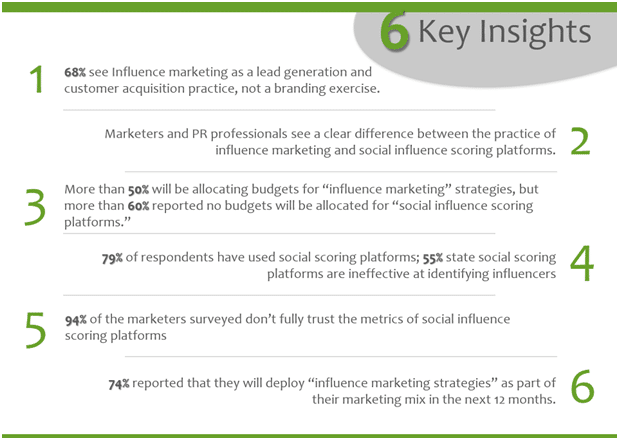
Influence Marketing survey key insights

This means they find their influencers, agree on the promotion, let the influencer do his or her thing, and then analyze how successful that campaign was.

However, this misses a huge opportunity – to turn influence into true advocacy, and build a loyal and engaged army of fans that are also customers. To do this, brands need to start looking beyond the short-term (potential) viral effect of an influencer, and instead address the needs of the customer via the influencer.

A CRM platform like Nimble can help in this process, and taking influence beyond buzz and into true actionable business return is the natural next step.

Otherwise, the current direction of influence may erode brand trust. The recent indifference to the Kred and LinkedIn Top 1% emails showed early signs that perhaps consumers are getting tired of where we are today.

Instead of generic, we need to address complexity.

  • We need to decipher opinions of those that matter and how they impact us;
  • We need to adapt to fluid influence and how it continuously changes;
  • We need to move beyond public personas and into micro influencers;
  • And we need to stop confusing popularity and amplification for influence.

But most of all, we need to place the customer at the heart of the influence circle, and understand their needs; where they are in the purchase life cycle; and who immediately impacts their decisions based on their current situation (financial, emotional, etc).

The stage is set for The Third Wave of Influence Marketing – all it needs now is you.

[vimeo width=”600″ height=”400″]https://vimeo.com/65202873[/vimeo]

Book Pre-Order Special Offer and Influence Marketing Teaser Video

Danny Brown Sam Fiorella Influence MarketingIn two weeks (or less, depending on shipping), Influence Marketing: How to Create, Manage and Measure Brand Influencers in Social Media Marketing will be released.

The culmination of over three years worth of client research and implementation, discussions with technology vendors, concerns over the impact of scoring on peoples’ livelihoods and more, the fruits of that labour is almost ready to be shared.

I won’t lie – it’s exciting to know that the methodologies Sam Fiorella and myself are presenting in the book will soon be out for all to read and share feedback on.

It’s also a little nervy, since the approach requires a shift in thinking on how we define influence – and, by association, influencers – today.

Thankfully, early feedback so far has been great:

After reading [the free sample Chapter 5], I can tell you it?s a phenomenal chapter that leaves one hungry for the parts on either side of it. Assuming the rest is like Chapter 5, they have certainly written the book that will transform the practice of influence marketing. Evy Wilkins, VP Marketing, Traackr.

Loving the book and its approach – this stuff is incredible. Hessie Jones, CEO, ArCompany.

The sample chapter has certainly made me want to read more; it is thought-provoking. Tema Frank, CEO, Frank Online Marketing.

Brilliant; truly groundbreaking. Tonia Ries, Founder, The Realtime Report.

If we can make people think and reposition how they approach influence marketing today, and see feedback like the early examples above turn itself into business results for readers of the book and the companies they represent, we’ll be happy.

Sales are definitely key (and also help our publisher feel safe that they didn’t sign up a couple of duds when they signed the paperwork with us!) but it’s the transformation in thinking, and shifting influence back to the source – customers – that will really validate the book for Sam and myself.

Which brings me to this special pre-order promotion if you order between now and May 10.

Influence Marketing Book Pre-Order Offers

As part of the launch week, Sam and I have come up with some offers that enable anyone, from solo entrepreneurs and professionals to business owners and executives of organizations, to take advantage of.

Because our goal is to transform the discussion around influence, these offers range from digital to physical and will really complement the book and the methodologies within, and help your business understand and succeed in this important marketing tactic.

So, the offers.

1. Pre-order one copy of the book and, as readers of this blog, you will receive a free copy of the first two videos in the video series we’ve created to partner the book.

2. Pre-order 5 copies, and receive a guest byline for your blog or publication from either myself or Sam, between now and the end of 2013.

3. Pre-order 20 copies, and receive a free, business-specific webinar presentation for your employees and/or clients.

4. Pre-order 50 copies and receive 3 hours of digital or influence marketing consulting. This will include an overview of your business’s target audience, their purchase cycles, and how to filter who influences them directly based on our Customer Centric Influence Model.

5. Pre-order 100 copies, and receive free, on-site presentation to your employees/executives, and/or clients. This also includes identifying your influence marketing goals and providing a framework for your business to follow, based on audience and our Customer Centric Influence Model. You simply cover flights and accommodation for either Sam or myself.

Note: These offers apply to both the digital as well as print versions.

Why You Should Buy Influence Marketing

Prior to the launch of the book, the companies Sam and I work at carried out a survey of over 1,300 professionals, PR consultants, marketers and executives around the topic of influence. The results were clear.

Influence Marketing survey key insights

Influence marketing is becoming an increasingly important part of the marketing landscape, and businesses and organizations are looking to allocate more time and budget to the space in the next 12 months and beyond.

However, they’re looking for true business results and moving beyond social scoring and into a more detailed, targeted and measurable methodology. The Influence Marketing book provides that and more.

We present detailed breakdowns of successful influencer campaigns, both by us and from brands, where identification of true influencers and who impacts their purchase decisions at any given time led to both top line and bottom line results.

We present a blueprint for your business to use – which technologies meet your needs, how to create influence paths (the glue that holds all influence marketing tactics together), and how to not only address the influence question strategically but, more importantly, make it a long-term part of your business’s success and less of a short term hit.

We’re biased, obviously, but we do firmly believe we’ve written a book that will change the influence conversation forever. By writing a business book in the truest sense, we’ve also laid the foundations for your business to be successful and do things the right way in this space for all your influence marketing campaigns.

But we’ll leave it with the words of Evy Wilkins, VP Marketing of Traackr, one of the influence platforms leading the charge in the next wave of influence.

Sometimes a book changes the way we do business.?Influence Marketing: How to Create, Manage and Measure Brand Influencers in Social Media Marketing?will be one of those books.

The first step is almost here – let’s get started. You can pre-order either print or digital versions from your preferred bookstore below.

Influence Marketing book Influence Marketing book Influence Marketing book Influence Marketing book

Note – to take advantage of the various pre-orders here, simply forward a copy of your sales order receipt to info@influencemarketingbook.com with the message header Pre-Order Promo – X Books Ordered, provide your preferred contact details, and we’ll be in touch to arrange.

[vimeo width=”600″ height=”380″]https://vimeo.com/65202873[/vimeo]

Special Pre-Order Promotion for Influence Marketing Book

Influence Marketing survey key insights

Danny Brown Sam Fiorella Influence MarketingIn two weeks (or less, depending on shipping), Influence Marketing: How to Create, Manage and Measure Brand Influencers in Social Media Marketing will be released.

The culmination of over three years worth of client research and implementation, discussions with technology vendors, concerns over the impact of scoring on peoples’ livelihoods and more, the fruits of that labour is almost ready to be shared.

I won’t lie – it’s exciting to know that the methodologies Sam Fiorella and myself are presenting in the book will soon be out for all to read and share feedback on.

It’s also a little nervy, since the approach requires a shift in thinking on how we define influence – and, by association, influencers – today.

Thankfully, early feedback so far has been great:

After reading [the free sample Chapter 5], I can tell you it?s a phenomenal chapter that leaves one hungry for the parts on either side of it.?Assuming the rest is like?Chapter 5, they have certainly written the book that will transform the practice of influence marketing. Evy Wilkins, VP Marketing, Traackr.

Loving the book and its approach – this stuff is incredible. Hessie Jones, CEO, ArCompany.

The sample chapter has certainly made me want to read more; it is thought-provoking. Tema Frank, CEO, Frank Online Marketing.

Brilliant; truly groundbreaking. Tonia Ries, Founder, The Realtime Report.

If we can make people think and reposition how they approach influence marketing today, and see feedback like the early examples above turn itself into business results for readers of the book and the companies they represent, we’ll be happy.

Sales are definitely key (and also help our publisher feel safe that they didn’t sign up a couple of duds when they signed the paperwork with us!) but it’s the transformation in thinking, and shifting influence back to the source – customers – that will really validate the book for Sam and myself.

Which brings me to this special pre-order promotion if you order between now and May 10.

Influence Marketing Book Pre-Order Offers

As part of the launch week, Sam and I have come up with some offers that enable anyone, from solo entrepreneurs and professionals to business owners and executives of organizations, to take advantage of.

Because our goal is to transform the discussion around influence, these offers range from digital to physical and will really complement the book and the methodologies within, and help your business understand and succeed in this important marketing tactic.

So, the offers.

1. Pre-order one copy of the book and, as readers of this blog, I will include a free copy of my Parables of Business ebook, which offers business tips and advice through the art of storytelling.

2. Pre-order 5 copies, and receive a guest byline for your blog or publication from either myself or Sam, between now and the end of 2013.

3. Pre-order 20 copies, and receive a free, business-specific webinar presentation for your employees and/or clients.

4. Pre-order 50 copies and receive 3 hours of digital or influence marketing consulting. This will include an overview of your business’s target audience, their purchase cycles, and how to filter who influences them directly based on our Customer Centric Influence Model.

5. Pre-order 100 copies, and receive free, on-site presentation to your employees/executives, and/or clients. This also includes identifying your influence marketing goals and providing a framework for your business to follow, based on audience and our Customer Centric Influence Model. You simply cover flights and accommodation for either Sam or myself.

Note: These offers apply to both the digital as well as print versions.

Why You Should Buy Influence Marketing

Prior to the launch of the book, the companies Sam and I work at carried out a survey of over 1,300 professionals, PR consultants, marketers and executives around the topic of influence. The results were clear.

Influence Marketing survey key insights

Influence marketing is becoming an increasingly important part of the marketing landscape, and businesses and organizations are looking to allocate more time and budget to the space in the next 12 months and beyond.

However, they’re looking for true business results and moving beyond social scoring and into a more detailed, targeted and measurable methodology. The?Influence Marketing book provides that and more.

We present detailed breakdowns of successful influencer campaigns, both by us and from brands, where identification of true influencers and who impacts their purchase decisions at any given time led to both top line and bottom line results.

We present a blueprint for your business to use – which technologies meet your needs, how to create influence paths (the glue that holds all influence marketing tactics together), and how to not only address the influence question strategically but, more importantly, make it a long-term part of your business’s success and less of a short term hit.

We’re biased, obviously, but we do firmly believe we’ve written a book that will change the influence conversation forever. By writing a business book in the truest sense, we’ve also laid the foundations for your business to be successful and do things the right way in this space for all your influence marketing campaigns.

But I?ll leave it with the words of?Evy Wilkins, VP Marketing of?Traackr, one of the influence platforms leading the charge in the next wave of influence.

Sometimes a book changes the way we do business.?Influence Marketing: How to Create, Manage and Measure Brand Influencers in Social Media Marketing?will be one of those books.

The first step is almost here – let’s get started. You can pre-order either print or digital versions from your preferred bookstore below.

Influence Marketing book Influence Marketing book Influence Marketing book Influence Marketing book

Note – to take advantage of the various pre-orders here, simply forward a copy of your sales order receipt to info@influencemarketingbook.com with the message header Pre-Order Promo – X Books Ordered, provide your preferred contact details, and we’ll be in touch to arrange.?

The Sunday Share ? Disruptive Technologies and the Digital Revolution

Digital revolution

Digital revolution

As a business resource,?Slideshare?stands pretty much head and shoulders above most other content platforms.

From presentations to educational content and more, you can find information and curated media on pretty much any topic you have an interest in.

As a research solution, Slideshare offers analysis from some of the smartest minds on the web across all verticals. These include standard presentations, videos, multimedia and more.

Which brings us to this week?s Sunday Share.

Every week, I?ll be sharing a presentation that catches my eye and where I feel you might be interested in the information inside. These will range from business to content to social media to marketing and more.

This week, a thoughtful presentation from Carlos Domingo, President and CEO of Telefonica I&D.

With the arrival of Google Glass and the buzz around where technology is taking us, Carlos offers us a timely look at how disruptive technologies have changed our lives forever, and what it means for our children and their futures.

Enjoy.

Why Diminishing the Benefits of Slacktivism Isn’t A Great Idea

Over on Facebook, my friend Gini Dietrich posted a question about trying to locate an image, used by a non-profit organization in a new campaign.

The image in question is the one below.

UNICEF Facebook Likes campaign

The messaging behind the campaign is simple – while Liking unicef.se (unicef Sweden) on Facebook is all well and good, and they certainly wouldn’t discourage that, it costs money to actually carry out the work unicef and other non-profits do every day of the week.

That makes sense.

What doesn’t make sense is potentially alienating the very people you’re pseudo-criticizing in a campaign like this, by implying slacktivism doesn’t do any good.

Slacktivism and What Defines Action

A relatively new term, slacktivism is regarded as follows:

Slacktivist activities include signing Internet petitions, joining a community organization without contributing to the organization’s efforts, copying and pasting of social network statuses or messages or altering one’s personal data or avatar on social network services. – Wikipedia

To use the slacktivism definition with regards the unicef.se ad, the suggestion is all the social activity in the world (in this case, Facebook Likes) isn’t going to save lives because it’s not resulting in hard cash.

That view is echoed in a comment on Gini’s Facebook wall around the ad by marketing professional Lisa Byrne:

People think clicking like means they are now supporting in some way cos they’re spreading a message – it’s all too easy a copout. I love what Unicef did – CALL TO ACTION PEOPLE!

This implies that unless hard cash is being donated, or a more substantial action taken other than Liking a status update or Page, then it’s not really action at all. Which, while that viewpoint is understandable, misses the longer tail picture.

The Benefits of Slacktivism

Social Change Anytime EverywhereIn their excellent book Social Change Anytime Everywhere, authors and ?non-profit specialists Allyson Kapin and Amy Sample Ward share case studies, examples and methods on how to support non-profits via social media (as well as through “traditional” methods).

In Chapter 2 of the book, they look at the slacktivism question, and offer a very balanced overview of both pros and cons.

From the book:

Regardless of the era (this isn’t a new phenomena), the emphasis and effort spent on spreading information and raising awareness has always resulted in people doing what organizations ask, even if it’s considered slacktivism.

Liking a Page, liking a post, and all the rest are not the actions and real impact you’re looking for, ultimately, but those actions are important! Why? Because, through them, people are telling you that they will do what you ask to support the cause.

As both Kapin and Ward point out, while the end goal may be financial donations, the path to making those donations happen can come in many forms, and the act of spreading awareness – even through something as simple as a Like – is part of that path.

Taking it further is Steven Edward Streight, a New York-based senior copywriter and trustee for a local non-profit. In Steven’s words:

I am a trustee of a local non-profit. The grant writer told us that Facebook Likes, Comments, and Shares actually do help with getting grants and donors, because social media interactions indicate we are reaching out to the community and the community supports what we do (Peoria Historical Society).?So I believe that the non-profit is wrong.

This endorsement is a perfect example of why slacktivism, even though it may not be a financial action, should not be dismissed as not adding anything to the bottom line.

The ROI Equation

Back in 2009, I founded a social media-led charity project called 12for12k. The goal was to find 12 charities, and support a different one throughout the 12 months of 2009, and hopefully raise $12,000 per charity throughout the year. Hence the name 12for12k.

I was fortunate to be surrounded by some very kind and awesome friends – people like Susan Murphy, Jon Aston, Darin Bernston, Rachel Kay, John Haydon and many, many more who believed in the project and donated their time and expertise for free.

Since the aim from day one was to give 100% of donations to the supported charities, this free expertise was a Godsend.

However, as focused and as determined this original small group was, there’s no way in heck we’d raise $12,000 between 6-8 people every month. And this is where a combination of awesome supporters and slacktivism came into play.

We created avatars that people could display on Twitter and Facebook. We connected with blog partners who would feature each new charity every month. We asked people that couldn’t afford to donate to simply share or blog posts and other content across Facebook and Twitter.

And it worked. I can give you at least fifty or so examples of people struggling financially, but who worked their asses off at getting the charities in front of more fortunate friends (from a financial point of view).

Those passive little 12for12k avatars that started popping up across social networks? People saw them standing out from others, and asked about 12for12k and the charities we were supporting.

12for12k avatar

This led to several mainstream media news stories and features about the project.

The end result? While we didn’t hit the overall goal of $144,000 across 12 charities, we did raise more than $91,000 in 12 months, and a further $9,000 in the first month of 2010.

A Clear Definition of Action?

These examples, and many more like them, highlight a simple fact – while unicef’s ad may be technically correct, it doesn’t start and end there.

No-one is denying that non-profits need donations to carry out the awesome and often-hard and unrecognized work that they do. It’s why between 30,000 and 60,000 non-profits are believed to close each year – and that’s just in the U.S.

The truth of the matter is, we need to support non-profits financially, and ensure the causes most at supported by non-profits can actually be helped. But to suggest that slacktivism isn’t helping is doing a huge disservice to those folks that can’t afford to help financially, but want to help in any other way they can.

This is where social media-led action – or slacktivism, if you like – can raise awareness and put a charity in front of the very people that can not only donate at that time, but become involved more deeply with the charity and support for years to come.

Turn these people away, and the next non-profit to “fail” could be one that doesn’t see value in all forms of support beyond financial.

And one final piece of irony, that made me smile wryly when I saw the unicef ad – UNICEF USA approached 12for12k early in 2009 to partner with them, and that partnership happened in June 2009.

I guess a project that uses slacktivism as a key component can offer benefits…

  • « Go to Previous Page
  • Page 1
  • Interim pages omitted …
  • Page 87
  • Page 88
  • Page 89
  • Page 90
  • Page 91
  • Interim pages omitted …
  • Page 283
  • Go to Next Page »
© 2026 Danny Brown - Made with ♥ on Genesis