• Skip to primary navigation
  • Skip to main content
Danny Brown

Danny Brown

podcaster - author - creator

  • About
  • Podcasts
  • Journal

Social Media

Where Addressable Advertising Can Benefit from Social Media

Addressable advertising

Addressable advertising

I read an interesting piece over at Marketing Magazine the other day. It discusses cable company Cogeco and their move into “addressable advertising” next year in a pilot scheme throughout limited households.

If you’re not familiar with addressable advertising, it’s the method of using far more targeted ads based on location and demographics. So, certain areas may be more affluent while other areas may be more working class.

What Cogeco’s aiming to do, via their pilot on local cable channel CHCH, is to test out targeted advertising and send out ads that are geared to someone’s specific address.

So, for example, someone living in an affluent are of the Golden Horseshoe – the area of south Ontario, Canada, where the scheme will be piloted – will see ads for luxury cars. Those living in a less affluent area will see ads for minivans or compact cars.

The goal is clear – if people are to buy something, they’re more likely to buy what’s in their cash range.

Targeted or Taking Aim?

It’s a great idea – although I’m not too sure if closing your potential customers off by ignoring them due to current financial status is a great idea. Everyone has aspirations, right? And what better way to aim for a goal than seeing something to aim toward (like a more luxurious car, or nicer home, or bigger vacation)?

There’s also the problem of the demographics. Just because someone lives in an affluent area doesn’t necessarily mean they are affluent. They could be working their asses off to pay the higher mortgage, and have little-to-no fluid cash.

Additionally, is the affluent neighbourhood made up primarily of younger people, or the “reward year boomers”? The latter category are people that have worked their lives to become affluent and now have time to relax and enjoy their savings. So they’d be perfect – but if that’s just a small part of the audience, will addressable advertising be successful?

Without seeing exactly how the company putting the plan together for Cogeco has come up with their information, it’s hard to say. Using Invidi’s Advatar system, it may be that they have all the information they need for the pilot to be a success. While the system looks perfect for showing when a TV is on and what’s being watched, it’s less clear how demographics and spend power is determined.

Of course, one of the ways Cogeco (and others like them) could really target an audience (along with the addressable advertising platform) is to combine the project with social media.

People, People, and More People

Because social media is such a perfect tool for not only messaging your target audience, but actually finding out if they’re in your sights to begin with, it makes perfect sense to combine the offline cable advertising with online and social network promotion and focus.

Facebook

For example, using something as simple as Facebook Advertising can allow Cogeco and their partners to gauge how many people in their target audiences (affluent and otherwise) will be in the Golden Horseshoe area.

Facebook Advertising

If you base an ad on the cities that will be targeted (from Marketing Magazine’s article), then you have just over 917,000 people living in the Golden Horseshoe between 18-64 years of age (both sexes). But not a lot of 18-year olds will be affluent, so change that age to 30-64 and the audience drops to just over 600,000.

Let’s say it’s a sports car – that’s going to appeal primarily to men (sorry ladies!). Making the age between 30-50, and male demographics only, shows a return of just under 217,000 (quite the drop).

However, it shows that there’s the potential for a Facebook ad campaign to highlight what’s coming via CHCH (and at a far lesser cost than say, a print ad campaign or TV one). So, use a Facebook ad to drive traffic to a landing site that explains what the project is about, and get people to sign up there as well with more detailed information (including available spend power and likelihood of spending through targeted ads).

Twitter

While the audience on Twitter is a lot less than Facebook (particularly in the demographics and locale that Cogeco is piloting), there are still 5,500 registered users on Twellow (the Twitter Yellow Pages).

But this is just for registered users. Go to Twitter Search and start using it for highlighting the areas of interest and what’s being said about ads over there, and it begins to give you a very focused look at the likelihood of certain ads working while others, not so much.

For instance, this tweet from Hassan Al-Ghareib popped up from a search I did on some terms that the addressable advertising audience might be interested in.

[blackbirdpie url=”http://twitter.com/Hassan_AG/statuses/11477534243819520″]

It complains about a new de-icing solution that obviously isn’t working (Canadian winters aren’t very car-friendly). So, if I’m an auto parts store, I know I may have an in there with Hassan and others like him. I find out where Hassan lives (Toronto area), do some more searches to see if others are having similar issues, and then make sure my ad runs in that locale. The fact that Hassan’s in marketing at Samsung helps, too, from a word-of-mouth viewpoint…

Oh, and using Twitter advertising to direct people like Hassan to the CHCH channel is just a simple addition to complement the addressable advertising.

And don’t forget you have the likes of YouTube (visual ads) and BlogTalk Radio (audio ads), as well as mobile advertising (a whole other topic of discussion and the perfect partner for social media). Add these guys into the mix and you really begin to get full-on addressable advertising.

It’ll be interesting to see how the pilot scheme from Cogeco works, and if the statistics – cost versus return for advertisers and awareness of consumers – will be shared. Hopefully they will – it’s a brave new path and one that deserves to work.

And with a little help from social media, it could have an even bigger return… Stay tuned!

image: Dreamer7112
An Interactive Q&A Session with David Siteman Garland

Faster Smarter Cheaper book

Hey there, and welcome to a very special blog post. Today, from 12.00 noon Eastern / 11.00am Central / 9.00am Pacific time, the blog is being given over to you and my very special guest, David Siteman Garland of The Rise to the Top.

David’s an entrepreneur extraordinaire, who helps businesses grow their success and shows them how to do it without any of the fluff you can often find from similar folks. He’s one of the most passionate people I know, and is a rollercoaster (in a good way) of fun, smarts and energy.

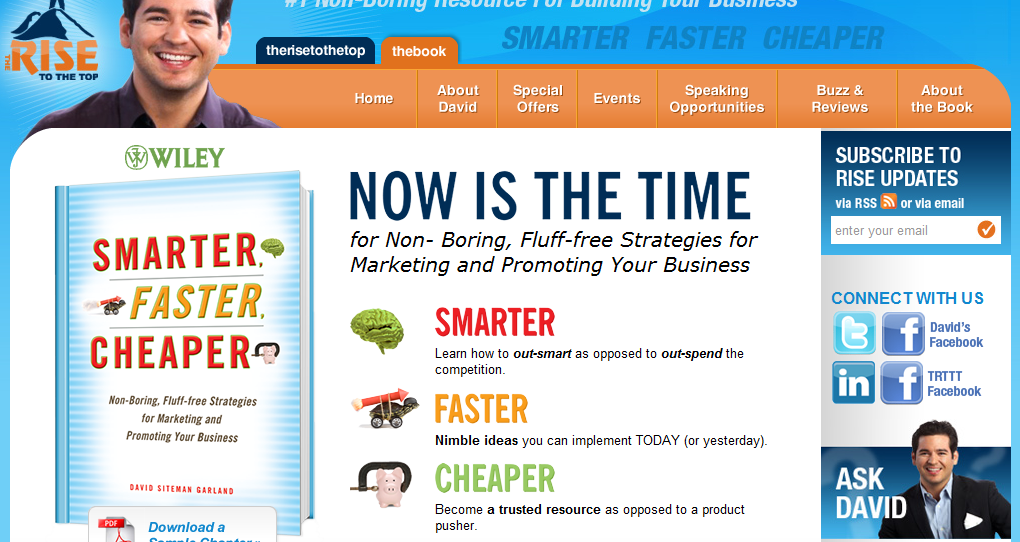
He’s just released a book called Smarter, Faster, Cheaper that continues his no-fluff approach to building, marketing and succeeding at your own business, as well as the community around it. And today he’s on this blog to answer any questions you have.

Because I use Livefyre, it’s more like a chat room as opposed to a standard comments system. Not only does it update in real-time, but you’ll see a cool little alert box to show you when a new comment has been posted. That way, you can jump between the conversation whenever you want.

To use the interactive options, you can either sign in using your Twitter or Facebook profile (if you have one), or create a Livefyre account when you post your first comment (just select the Create Commenter Profile option).

So, for an hour or so from noon onwards, David will be all yours. He’ll be waiting for your questions about starting a business and/or community, and building it successfully. Simply ask your question in the comments, and David will reply as soon as he sees it pop up. You can wait on your reply, or jump to other questions – the choice is yours!

Now, this could be a huge success or a crazy ass mess. Either way, though, let’s have fun and ask a ton of questions.

I’ll let David introduce himself and the book in the video below, and then the comments and the rest of the blog is yours and David’s – so, over to you!

You can buy David’s book at the official Smarter, Faster, Cheaper website, as well as pick up some cool giveaways.


This post contains a video. If you can’t see it displayed properly in your feed, you can view it directly here.

A Special Interactive Book Review with David Siteman Garland

Faster Smarter Cheaper book

Faster Smarter Cheaper book

This coming Wednesday, December 8, at 12.00 noon eastern / 11.00am Central / 9.00am Pacific / 5.00pm GMT, there’s going to be a (hopefully) cool and special interactive experiment here on the blog.

Using the interactive features of the Livefyre comment system that’s used here, my special guest will be David Siteman Garland, who’s probably better known as the Rise to the Top guy.

David is one of the leading voices on building and promoting a business, and has a book out called Smarter, Faster, Cheaper. Instead of me writing “just another book review”, David has agreed to be a “live guest” on this blog on Wednesday.

So how’s it going to work?

David will be recording a video, which will be his own take on the book – what it offers, who it’s for, how to use it, etc. I’ll embed it in my post, and then at noon, David will be here to answer your questions about the book, starting a business, promoting it and more.

The difference is, this will all happen in the comments section.

Because Livefyre offers real-time live updates, it’s more like a chat system than your normal blog commenting system. The cool thing is, when a new comment has been posted and you’re on the page, a little alert box pops up to say there’s a new comment (or several, if more than one new comment has been posted as you read).

You can then click on each alert, and it takes you directly to the new comment, so you can see what questions and views are being shared as soon as they’re posted.

So all you need to do is ask your question for David via the comments, and he’ll be spinning his fingers all over the place to respond. You can then reply to David, or anyone else’s comments, and really make it an interactive book review and discussion like no other.

Not only that, but David also has some special giveaways for everyone taking part in the experiment on Wednesday.

To take part, all you need to do is the following:

  • Choose your profile. Because Livefyre is a profile comment system, you need to either have a Livefyre account (which you can create here by using the Join option), or sign in to comment using your Twitter or Facebook profile. You’ll see these options under the Comment As option to the right of the comment box.
  • Set yourself a reminder (I’ll be tweeting and using Facebook to send out occasional reminders) to be here between 5-10 minutes before noon on Wednesday December 8 to watch David’s video review of his new book.
  • Get your questions ready, and fire away from noon onwards.

Like any experiment, there could be some technical gremlins, but hopefully not. The Livefyre guys are working behind the scenes to try and make it as smooth an experience for you as possible. And David has his gremlin-slapping gloves ready, just in case.

Hopefully you’ll join us on Wednesday and have a bunch of great questions for David. I think this could be a lot of fun, and something to show how blog comments can really come alive.

Look forward to seeing you here – cheers!

A Charitable Social Media Mission for 2011

Charities and social media

Charities and social media

This post wasn’t meant to be here – it sprung from a thought I had, which I then posted as a status on my Facebook page. Here’s the thought:

Wouldn’t it be cool if big corporations that supported charities took an allocation of their donation, and paid for consultants to help non-profits learn about social media? The consultants don’t have to charge the charity, the corporation is still helping the charity, and the charity can allocate these funds back into the organization and those who need it the most. Just a thought…

From that simple thought, I got a ton of feedback and stories.

Helping charities

From the conversations with Abbie, Shana, Catherine and Kimberly, it’s clear there continues to be a huge need for social media within the non-profit sector.

Not only can it help reduce costs from an advertising standpoint, but (as we discovered with the 12for12k project), it can help raise awareness and reach like no other medium.

The problem is, too many charities can’t afford the extra cost of hiring a consultant or agency to train them on how to use social media to its fullest.

On the flip side, people that offer their time pro-bono to try and help educate non-profits often find they can’t continue to allocate free time and still work their own job to pay the bills. Sadly, this leads to them giving up, and the charity is back to square one.

So. Here’s a challenge for 2011. A mission statement, if you like.

Let’s build a database of social media consultants and agencies, either with expertise in the non-profit sector or working with clients that donates funds to non-profits, and look at how we can use their skills.

Let’s add companies and corporations to that database that are willing to fund social media education for their chosen charity, or ones that we can help suggest and connect.

Let’s find and add quality, creative agencies that understand the power of storytelling and want to make a change, and can bring amazing visuals to a charity’s words.

Simply put, let’s make it a mission to connect people who can help each other – consultant-to-business-to-charity-to-consultant.

Along with my business partner Troy Claus, I’ll be speaking with a bunch of folks over the next couple of weeks as we put in place some of the stuff we’ll be doing with 12for12k next year as it returns from its sabbatical.

I’m now making this mission one of the key goals for 12for12k next year.

I’m pretty sure we can find enough willing parties from all aspects of this mission to make a good start on the database and how it’ll work. Then the real fun can begin.

Interested?

Leave your details in the form below (it’s just for letting you know when the database is up, as well as ideas along the way – no spamming, I promise!) and let’s see what magic we can create next year.

Thanks!

[gravityform id=4 name=SocialMedia for NPO’s Mission 2011]

image: niznoz

The Problem with Influence

Ego and big heads

I just read something by a friend that’s both interesting and sad at the same time (and sad as in lame, not as in Bambi).

My friend mentioned that he was speaking to a well-known PR guy and author a few months back.

The topic of the conversation was a site for bloggers and authors that my friend works at. According to the PR guy, the site would never be much of a success because he (the PR guy and author) wasn’t ranked high enough.

The PR guy then went on to say that the site wouldn’t be a success because, “You have to make sure the biggest influencers are ranked at the top.”

As my friend so eloquently put it, well f*ck me sideways.

Influence Shminfluence

The problem with influence is that it all boils down to relevancy. You can’t tell me that a pig farmer in Alaska (tough old pigs out there!) is influenced by what a PR guy is saying about the 2.0 or 3.0 world.

Instead, I’d think he’d be more influenced by bacon writers and pork chefs, and analysts looking at how the pork buy trade will look in the next two years.

When it comes to influence, the folks that matter to us are the ones that are in our industry, or affect the industries of our customers and clients. That’s what influences our business and its success (or lack of it), not someone who’s in an industry that has little to no relevance to us.

There’s no doubting that the PR guy is influential in his sphere – but does that mean he should be viewed as such in all spheres, and “ranked higher” because of it?

Egos and Eggheads

And this is where the real “problem” with influence comes in – when it starts to make you feel you automatically deserve to be in a certain position, or recognized more by something or someone.

The quote my friend uses – “You have to make sure the biggest influencers are ranked at the top” – is possibly the biggest reason why influence is coming under so much flak at the minute (just Google “Klout sucks” to see some examples).

We seem to be creating an environment where people expect to “be someone” because you have some success in a certain field, which is a shame.

There’s nothing wrong with success, and there’s nothing wrong with pride in your achievements. Hell, success should be celebrated.

Ego, on the other hand (especially one where your head gets as big as an egg’s on a pin tack) is a different beast altogether. When it reaches the stage that someone says a venture won’t be successful because the influencers aren’t ranked higher – then we have a problem.

Influence and Success

We need influence. Consumers buy from their favourite celebrities and their recommendations of a product. Professionals buy from people they trust when that person makes a recommendation. Brands use “names” to help promote products and services.

So influence works. But wouldn’t it be better to be the right influence, as opposed to the type that’s defined by someone who appears to have a huge dose of self-importance?

And as for that site that would never be a success?

There are about 30,000 authors and bloggers registered with the site. The company had a great Blog World Expo, and are about to launch a new platform that (ironically) will help people like the critical PR guy connect with bloggers for PR campaigns.

Not too bad for something that defines its own influence, huh?

image: Divine Harvester

  • « Go to Previous Page
  • Page 1
  • Interim pages omitted …
  • Page 26
  • Page 27
  • Page 28
  • Page 29
  • Page 30
  • Interim pages omitted …
  • Page 38
  • Go to Next Page »
© 2026 Danny Brown - Made with ♥ on Genesis