• Skip to primary navigation
  • Skip to main content
Danny Brown

Danny Brown

podcaster - author - creator

  • About
  • Podcasts
  • Journal

Social Media

A Very Merry Social Media Christmas

Social media Christmas

I was originally going to write a Christmas blog post of my own, to thank you all for continuing to be part of this little part of the web, and for giving up the time in your day to be here when you could be somewhere else.

But then I thought – it’s Christmas Eve, you’re probably busy preparing for tomorrow, and the last thing you want is another long-ass Christmas post to say what I hope you know I feel every other day of the year.

So instead, I’ll just say have a safe and very Merry Christmas – I hope you spend some deserved downtime with your loved ones and have a wonderful day full of laughs, good food, hearty drink and a circle of love.

I’ll see you on the other side of Christmas – I’m taking a few days off, but I’ll leave you with this rather cool little social media Christmas video. Avoid Romans, indeed…

Merry Christmas, everyone!

This post contains a video. If you can’t see it displayed in your feed properly, you can view it directly here.

Setting Your Stall from Your First Blog Post

Setting stalls and expectations

Setting stalls and expectations

As I start to wind down for the year – and, I guess, with the ubiquitous year-end blog post to come – I looked back at my very first post on this blog to see where I started.

(Note – I’ve been blogging on and off for about 12 years but this is the one that I’ve made my own, so to speak).

The reason for looking back was simple enough – I’m a firm believer that your first post should set out your stall on what you hope to accomplish, and what you’ll be talking about. After all, you’re looking to (hopefully) attract an audience and build a community (in whatever shape that may be) – so it’s not a bad idea to start as you mean to go on.

Looking back at my first (short) post, I think I’ve blogged in the way I set out – talking about emerging/social media and its effect on people, business and communities. So as far as stall-setting and follow-up goes, I think I passed my test.

Which made me curious about the main social networks and how they fared when it came to setting their stall out on their first (public) blog posts. So I did some digging, and here’s what I found.

Twitter

Probably my favourite social network, the Twitter blog’s first public post was back on August 03 2006. Posted by co-founder Biz Stone, the post was about Biz feeling an earthquake and how it was his friends tweeting about it that confirmed he wasn’t imagining things. So, almost 5 years ago and Twitter was already being used to break news and report on natural events – I think it’s safe to say it’s continued to live up to its early promise.

Facebook

Fast becoming my second favourite network, thanks to a certain Facebook Group and some great banter and interactions on various Pages, Facebook’s first blog post was also in 2006, on Tuesday August 15. This inaugural post talked about the launch of the Facebook Development Platform, enabling developers to build apps for the platform. With apps being a huge part of the Facebook experience, again, like Twitter, this first post seems to have been a perfect primer.

LinkedIn

Although LinkedIn is the oldest of the main social networks, its blog started after Twitter and Facebook’s, with the first public post happening on April 24 2007. Written by the ever-present Mario Sundar, it was a simple enough post that promised to help users find their way around LinkedIn, and asked for feedback to be constantly shared. A normal enough post, but nothing that showed what LinkedIn’s potential might be.

YouTube

Before Twitter and Facebook decided to start blogging, YouTube was already posting regularly, with its first one being written way back on July 07 2005. It spoke of wanting to make YouTube “the digital video repository for the Internet”. Additionally the post shared tips on browsing and linking videos – something that’s a key part of today’s experience on the channel. As a lesson in setting your stall out from the start, YouTube’s first blog post is perfect.

Slideshare

One of the perceived newer networks, Slideshare has actually been active for a while, and its first blog post appeared back on September 25 2006. It was a pretty vague post – unless you were an alpha tester of the new platform, for which the post thanked you for feedback about the software. There was nothing that suggested Slideshare would become one of the best resources for information, presentations, ideas and statistics on the web. It’s also kind of funny to see the URL for the post still keep the standard WordPress one for first posts – “Hello World”, indeed.

Flickr

The oldest post of the ones I looked at, Flickr’s blog first posted on February 04 2004 – and there was absolutely nothing that indicated what was to come. Instead, the Flickr post welcomed GNE players – a nice touch from the company, who created the Game Never Ending (GNE) that made way for Flickr. Like Slideshare, it too asked for comments and feedback as it advised of graphical overhauls in the coming days and weeks.
So there you have it – six of the better-known social networks, and how they started (at least from a blogging point-of-view).

I think it’s fair to say that YouTube and Facebook offered the clearest take on direction, while Twitter showed the real-time potential of its service. LinkedIn kind of tried, while Slideshare and Flickr simply added to the buzz that was building around the platforms.

As for MySpace? I tried finding their official blog, but got lost on their “wonderful new layout” and landed on a bunch of different developer blogs instead. And with no archives readily available to get to the first blog, I wasn’t going to start digging for the first one. Confusing and not user-friendly – kind of like MySpace, then…

How about you – what does your first blog post say, and how have you fared in building on its promise?

Influence That!

Klout and Influence

There’s a lot of negativity around online influence tools at the minute. Things like Twitter Grader, Klout and similar are coming under fire, with common complaints being how is influence decided, what metrics are used, and does it even matter anyway.

Allyson Kapin came up with a great statement, about measuring impact as opposed to influence – show us real metrics of success from your actions as opposed to success with your interactions (big difference).

There’s no doubt influence can be beneficial – think of Ashton Kutcher getting his Twitter followers to buy a bunch of mosquito nets to fight malaria, for example.

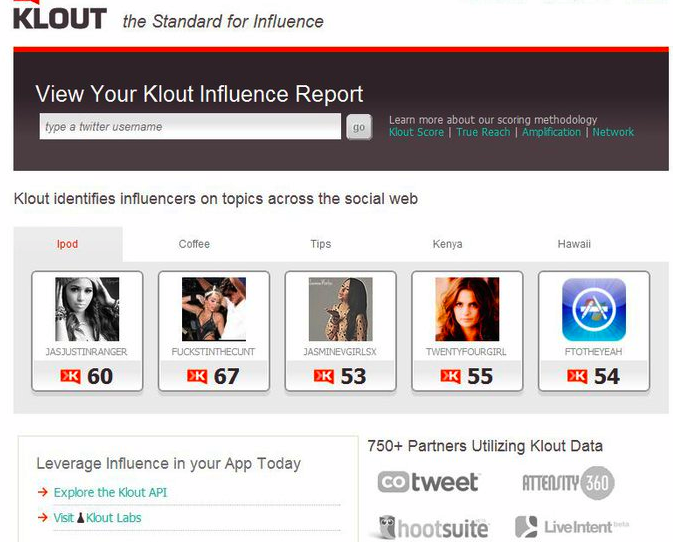
Yet, as the second image from the left below (taken from the Klout homepage) shows, there’s still a ways to go on defining influence, and sums up perfectly why influence measurement tools are coming under fire.

Unless there’s a big market for vaginal influencers…

Does Klout influence matter

Personal Marketing with Canadian Pet Connection

Brandon and Lorne Forder of Canadian Pet Connection

Brandon and Lorne Forder of Canadian Pet Connection

How are you influenced? By adverts? Marketing campaigns? Email blasts? Word-of-mouth? A little bit of each?

How about personal marketing?

Would you be more inclined to shop with someone that actively takes the time to know who you are, what your needs are and what your shopping pattern might be? I know I would.

Case in point ? pet health nutritionists Canadian Pet Connection (disclosure – client).

If you live near their stores in Oakville, Ontario, and you go in to buy something for your pet, father and son owners Lorne and Brandon Forder treat you as if you’re old friends.

They chat warmly; they ask after your pet (which they remember by name); they’ll talk to you for as long as you want about what could be wrong with your pet, and offer solutions without being pushy salespeople; and they’ll remember your preferences every time.

They take that same family-friendliness online, where the Canadian Pet Connection blog is full of great pet advice as well as featured people and local businesses; their Facebook Page is a fun mix of advice, questions and best Christmas films for pets(!); and their Twitter stream is a constant of chat, tips and facts.

Brandon even monitors for people mentioning their pet’s birthday, and often sends out a surprise package for the pet to make that extra year all the more fun. And with a new e-commerce store about to launch, that could mean pets further afield getting the birthday treatment too.

Simply put, Canadian Pet Connection are successful because they genuinely care.

So how can you reflect this personal approach online?

From a business point of view, you could offer similar. Offer an email list for your customers to sign up to, and ask certain questions that allow you to personalize your message.

Customers in Canada? Set up an email message wishing them a Happy Canada Day. The same goes for the UK (four different celebrations for Saint days), the US (send an Independence Day message) or anywhere that has a specific celebration. It might take a little work on your behalf, but isn?t the end result worth it?

You can use the same ideas even on a personal level. New follower on Twitter? Either reply with a response to their last tweet or send a personal DM that references their last tweet or their bio. Leave some advice on someone?s Facebook status and if you have a solution (if it?s answering a question) let them know that you can help in the future.

These are just two examples of two of the most popular social networks. The same principles will work anywhere.

Social media allows us to connect with people and offer solutions to those same people like never before.

Is there any part that says these solutions can?t be personal? Canadian Pet Connection don’t seem to think so.

How about you?

How a Q&A Session Saw Livefyre Change the Game for Blog Comment Systems

Livefyre comments system

Two days ago, I watched something very cool happen on this blog.

Using the Livefyre comments system as the platform, and the always awesome David Siteman Garland as the sacrificial guinea pig (or bunny!), I carried out an experiment on where I see the true strength of blogs – the comment section.

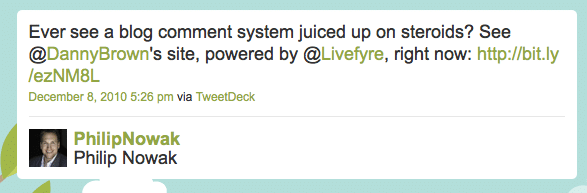
Because Livefyre is a real-time comments system, it’s more like a chat function as opposed to your standard comment options (whether core comments or other third-party systems). You get live updates, new comment alerts, real-time chat functions and much more. Think of it as comments on steroids (thanks, Philip!).

So what was the experiment, and why was it so cool?

Seeing the potential of Livefyre (I’ve been using it for about three months now), I wanted to show just how interactive both it, and the blog comments the system powers, could be. And what better way than a live, real-time Q&A with one of the most lively and passionate guys on the web?

So that’s exactly what happened.

Formatted like a chat show but with the questions and answers via blog comments, the experiment saw David come online for an hour and answer any questions asked of him in the comments of the blog post.

These answers included following your passion to start a business, making that business a success, building your online presence, being a trusted resource and how to gain collateral and support for your non-profit.

It was uncharted waters for blog comments, and could have been an unholy mess. But I think it’s safe to say that, instead, it was a huge success.

With Livefyre rocking the comment updates and alerts, as well as David knocking it out the park with the speed of his response, it showed what the future of blog comments is.

  • True real-time alerts and updates.
  • Instant back-and-forth interaction.
  • Interview-style conversations.
  • Social integration, with the ability to invite friends from Facebook and Twitter into the conversation.

Not only that, but it showed just how well a system like Livefyre complements the blogging experience. It encourages dialogue, and showed that – even in beta – it’s the most interactive comment system around. Basically, Livefyre is what blog comments were built for.

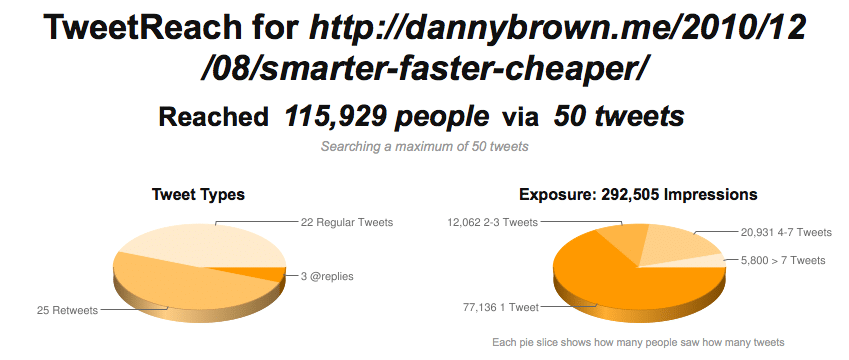
Twitter impressions for Livefyre experiment

It also showed it could handle a ton of calls to its service. During the Q&A session, which lasted just over an hour, the following numbers are indicative of how successful Livefyre and David were at showing the system off:

  • An average of three comments per minute coming into the post.
  • Just under 200 comments in the space of 70 minutes.
  • A constant of 60+ people in the Q&A at any given time.
  • 292,500 impressions on Twitter for the experiment.
  • 5,310 impressions on my Facebook Page.
  • 1,015 page views in 70 minutes from Google Analytics.

The post is also continuing to grab interest after the event, from the very positive feedback that was generated both in the comments section on the day, and online (Facebook, Twitter, email) from people that either attended the Q&A on the day, or simply watched the instant updates and alerts as they came through.

For a comment system on a blog to generate so much activity and interaction speaks volumes, both of the system itself and obviously the guest that made it such a blast. My thanks to both David Siteman Garland and Livefyre, for showing that blog comments can be as real-time as Twitter and as valuable as a great business seminar.

Somehow, I don’t think I’ll look at blog comments in the same light ever again.

As part of the experiment, David provided two signed copies of his book for the best questions. The first one goes to Genevieve Lachance for this question, and Philip Nowak for this one. I’ll be in touch soon for your mailing addresses!

  • « Go to Previous Page
  • Page 1
  • Interim pages omitted …
  • Page 25
  • Page 26
  • Page 27
  • Page 28
  • Page 29
  • Interim pages omitted …
  • Page 38
  • Go to Next Page »
© 2026 Danny Brown - Made with ♥ on Genesis