• Skip to primary navigation
  • Skip to main content
Danny Brown

Danny Brown

podcaster - author - creator

  • About
  • Podcasts
  • Journal

Social Media

Discussing Blogger Ethics with Joe Hackman

Blogger ethics

Blogger ethics

Blogger ethics and transparency is quite a big thing around here, as well as many other places online. I’ve written about the topic a few times, and read/commented on other posts around the web on it as well.

As someone who both blogs and uses bloggers as part of client outreach programs, making sure the blogger is ethical is paramount. Making sure the blogger is also honest about our campaign is also key.

Yet there’s much more to blogger ethics than simple transparency when writing as part of a PR or promotional push, and it’s something I’ll be discussing with Joe Hackman tomorrow night (Wednesday, January 12) on his BlogTalk Radio show.

Titled (simply enough) Blogger Ethics and Transparency, we’ll be looking at how blogging has become a big business, and why ethics, transparency and more are key (especially with the likes of the FTC and ASA becoming involved on both sides of the Atlantic).

It’s a late show – it starts at 10.00pm Eastern – but I think it should provide an interesting topic, so if you’re free and have time to pop along, you can find the show here. Additionally, you can ask questions in the live chatroom under the radio channel, or call in with your own (the number is on Joe’s page).

You can also leave any questions you have about blogger ethics, legal requirements, blogger programs, where you fit in and more in the comments below, and I’ll let Joe pick some of the best to cover in the show.

If it’s too late in the day for you, the show is recorded and archived, so you can listen to it or download it later to listen at your own leisure.

Blogging ethics and transparency is always a question that raises great points on both sides of the debate, so would love to see you there with your take.

Cheers!

image: kristiewells

How Social Media is Teaching Us to Give Again

The gift of giving

The gift of giving

Back in the 80?s, there was the yuppie movement. Short for ?young upwardly mobile professional?, the term represented everything that was bad about greed and personal selfishness.

That?s not to say that all yuppies were greedy, but generally the majority stood for all the negative aspects of capitalism gone mad.

It was a case of ?I?m in it for what I can get and only for me? ? basically looking to see where the next big deal would come from and who cares if someone gets screwed over in the process. This malaise may have continued if it hadn?t been for the massive stock market crash of October 19, 1987 ? Black Monday.

The result of this crash was that the whole money-over-everything attitude pretty much disappeared as humility and stark reality took over. For the next few years, it seemed as if people had learned lessons and were instead using an ?I?ll succeed by helping others? approach.

Yet over the last few years, particularly in corporate America and the UK, the greed factor of the 80?s seemed to be creeping back in. Large companies and the CEO?s that presided over them seemed to be more about what could be taken from the company. Just Google the likes of Enron, WorldCom, Barings Bank and BCCI for examples.

The result? Today?s financial mess. Companies that were propped up by false reports crashing down to Earth. Leaders without a clue ? or with bulging wallets after kickbacks ? allowing the economy to disappear into a meltdown situation.

So, getting back to my opening statement, why does it all remind me of social media?

Simple ? because social media has the opportunity to show how to really build a business model that we can all benefit from. Instead of being out to get everything we can, social media is helping and encouraging growth with other like-minded people.

Users of social media sites are using their blogs to offer free advice and tips to help other users succeed. They?re organizing podcamps and similar seminars (offline as well as online) to ensure that everyone is getting the most out of the medium. They?re openly discussing do?s and don?ts in forums and chatrooms. Simply put, they?re being social.

The result of this is that there are more people with the knowledge and confidence to go into business for themselves, knowing that they?ve built up a wonderful network of contacts that they can fall back on for advice. Or they?re taking this new-found knowledge and support network back to their full-time jobs and increasing their use to the relevant company.

No longer is it, ?I can?t help you? ? now it?s ?I can?t help you but I know someone that can?. And as social media continues to mature with a wider audience, this network of help, knowledge and encouragement will only get stronger and more relevant.

Now if only the people that make the decisions would join the party…

image: Andy Woo

Why Your Social Media Strategy Sucks

Social media strategy sucks

Social media strategy sucks

Social media is crap. Social media is a waste of money and time. Social media can’t be measured so we’re just wasting energy. Social media doesn’t offer lead generation. Blah blah blah.

I’ve seen a ton of criticism about social media and what it can and can’t do. People and companies are quick to jump in and castrate those of us using the medium as charlatans and maggots. Generally the excuse is any one of the reasons above, amongst others.

Most times the biggest complaint is that “social media isn’t working for us”, and because of that, social media is automatically a crap shoot.

But maybe those doing the loudest complaining should take a long hard look in the mirror and ask why it’s not working. Because I’m pretty sure that it’s not because of the reasons given at the start of this post, but a far simpler one – your social media strategy sucks.

And here’s why.

Blogs and Books Are Your Education

You read a ton of blogs. You follow all the big names and hang on their every word, gleaning nuggets of wisdom and tips and real-life examples of companies that “did social media right”. Then you take these posts and use them for your business, or product, or team.

And then get all upset because the advice in A-List Blogger’s latest masterpiece didn’t work for you. But are you really surprised?

A blog post isn’t a strategy. A blog post isn’t a campaign measurement stick. A blog post isn’t a research and development program. A blog post is just a drop of water in a bigger pool of ideas that bring a strategy to life.

A blog post isn’t specifically written for you, either – it’s a generic cover-all that can apply to thousands of other readers, some of whom will be your competitors. So why would you replace specific with generic?

As for these never-ending social media books that are hitting the marketplace at the rate of what seems like one a week? Many are just regurgitated blog posts with a new introduction anyway, so all you’re doing is doubling your chance of failure.

Forget generic – start thinking specific.

It’s Not Strategy If There’s No End Goal

Setting goalsWhat’s your end goal with your social media activity? What are you looking to get out of it?
Brand awareness? More eyeballs on your company blog? Sales? Customer service satisfaction levels up? Head hunt new employees? None of the above?

If you’re going into social media without an end goal in mind, why are you even going in? Where’s the benefit? Is it because your competitor is doing the Twitter and they look like they’re having fun and getting people talking to them?

Great – but what’s being said between your competitor and these people? Is there an end goal there? Is it simply building relations on another platform, much like having open days at your workplace and inviting the public in?

Whatever it is, if you’re not getting any results it’s because you haven’t set any results up to be met.

  • Ask how many connected conversations it’s going to take to turn into one sale.
  • Ask how many products you’ll have to give away via a blogger outreach program to raise awareness, positive sentiment and actionable intent on your audience’s behalf.
  • Ask how many people you’ll need to man the social phones and react to hundreds if not thousands of questions being thrown at you.
  • Ask what your cut-off date is and what happens next – cut and run or adapt and conquer?

Every single thing we do in life has an end goal. The difference with life is that our very end goal we have no choice in. But in business, you do. Set your end goals out and work strategically toward them.

You Don’t Believe

You’ve used print and radio ads for longer than you can remember. They must be working, because you’re still in business. Besides, everyone reads newspapers or listens to the radio – you have a guaranteed audience. Can the same be said of social media?

Well, yes, it can, with targeted audience marketing. But let’s forget that for now, because you don’t believe you can target success in social media. You don’t believe you can bring in sales with social media, or improve your business practices, or customer satisfaction level, even though there are plenty of examples of these and more.

Simply put, you don’t believe in social media. And as that wise little guy Yoda once said, that is why you fail.

Sure, you’re tweeting. Yes, you’re Facebooking. Yes, you’re Linking In. But your heart’s not in it. You’re not in it. You’re only here because others said you should be.

But you know, maybe you don’t need to be – social media isn’t for everyone. It is for everyone’s customers, but then there’s a whole other approach you can take for that.

So stop wasting your time. If you don’t believe in something, are you really going to put your heart in it? No. Plain and simple.

Believe or leave.

It Doesn’t Need to Be This Way

I could run a ton of other reasons off why your social media strategy sucks, but I think you get the gist. Some of it might be you, the complainer’s fault; some of it might be your boss and his or her whip cracking on you.

But it’s not a lost cause. It doesn’t need to be this way.

Everything can be turned around; all courses can be plotted again and new directions taken when an obstacle or turbulence kicks in. Just because you think it sucks now doesn’t mean it can’t suck a whole lot less in a fairly short amount of time.

  • Stop acting on what works for others and build for what works for you.
  • Take advice with a grain of salt and ask if that great post is really talking to you, or just talking (albeit greatly).
  • Write your own books. They don’t need to be physical – successful campaigns are books, just in a different format.
  • Think with the endgame in mind, or don’t play the game, period.

Bad strategy sucks, not social media. But then isn’t that true for everything?

image: JKonig
image: successfromthenest

The Influence of Trust

The influence of trust

The influence of trust

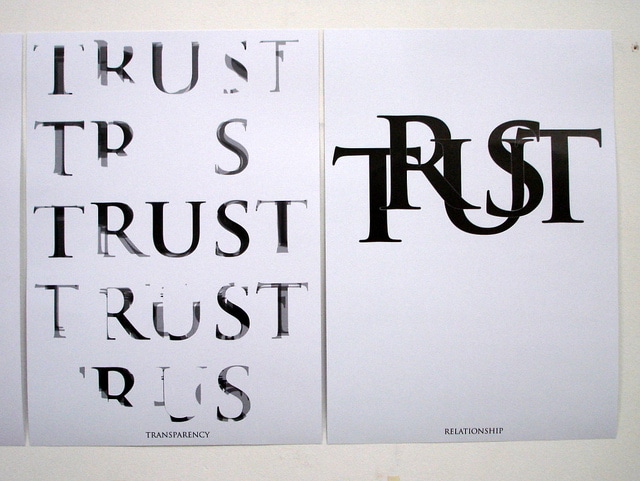
What is trust, exactly? Is it the same for everyone, or can it be different?

Can trust in a celebrity, for example, be as strong as trust in a friend or family member? It might seem a strange concept, but if that celebrity has a lot of influence over you then isn?t that just as strong as advice from a close friend?

And how about a business? Does the sales or marketing message from a business hold more sway than word-of-mouth from a friend or connection if the business hasn?t been wrong so far?

Sony, for example, used CGI-rendered demos for their soon-to-be-released Playstation 2 console back in 1999 yet claimed they were in-game graphics. When the actual games came out, they couldn?t possibly live up to the hype, yet the console would go on to become one of the most successful ever.

So can trust be overcome with huge marketing and advertising budgets and sheer brute force of numbers?

It?s often said that the capital of trust is crucial for any business success. It?s also part of what makes us who we are, and how we view others (and are viewed ourselves). But can trust be manipulated to the point that it?s difficult to differentiate between a sales pitch and a genuine recommendation?

As paid blogging and sponsored tweets continue to come under both praise and criticism, it?s clear that trust will define who is successful and who isn?t. Or will it? Does trust disappear when monetary value comes into play?

How does your trust come about? If it?s broken, is that forever or do you offer second chances? Can companies be trusted implicitly, or is it it the means to an end for selling a product?

I trust your views ? feel free to share them and let?s open up the conversation.

image: scottburnham

Are You Making Yourself Attractive Enough?

A big yawn

A big yawn

What’s your take on corporate talk? You know, the words that never seem to go out of fashion when you read a news release, or a job description, or a What We Do page on a company website?

Are you a fan of the big words and the sprawling descriptions? I’m genuinely curious, because often I wonder if it’s me who should be thinking bigger and describing things differently.

Here’s an example of what I mean:

The Social Media program is a fast-paced, high-intensity, high-visibility program working with agile methodologies to deliver high-quality solutions in the tightest possible timeframe. Reporting to the Manager of Social Media, the successful candidate will be responsible for managing key stakeholders, scoping projects, develop project schedules, charters and develop all aspects of the deliverables relating to Social Media.

The Project Manager will remove roadblocks, procure technology solutions and obtain resources for roadmap items in advance of projects in order to stage projects for success. The Project Manager will oversee all aspects of the projects within the program and provide regular status reports on the program including schedule and budget performance, issues and risks.

The successful candidate will have proven leadership skills, basic understanding of programming concepts, strong analytical skills, a track record of innovation, an ability to proactively identify opportunities and quickly implement solutions, a positive attitude and a passion for exceptional customer service. Further, the successful candidate will be an exceptional communicator.

This is the job description from Canada’s leading mobile technology company. I look at it and I think snooze button. Yet knowing the company involved (I’ve worked on projects for them), it’s also indicative of why they’re falling behind to younger, fresher competitors (to my eyes, at least).

Couldn’t they just position the role as, “Strong candidate needed to work with Social Media Manager, to take our company to the next level with industry-leading strategies and projects. Must know their shit.”

Okay, it wouldn’t be as simple as that, but I just wonder if companies are putting potential superstars off working for them, by making the job sound as boring as hell to start with.

Or maybe it’s just me, like I said. I don’t know – what’s your take? Would this job description inspire you?

image: nishwater

  • « Go to Previous Page
  • Page 1
  • Interim pages omitted …
  • Page 24
  • Page 25
  • Page 26
  • Page 27
  • Page 28
  • Interim pages omitted …
  • Page 38
  • Go to Next Page »
© 2026 Danny Brown - Made with ♥ on Genesis