• Skip to primary navigation
  • Skip to main content
Danny Brown

Danny Brown

podcaster - author - creator

  • About
  • Podcasts
  • Journal

Insights

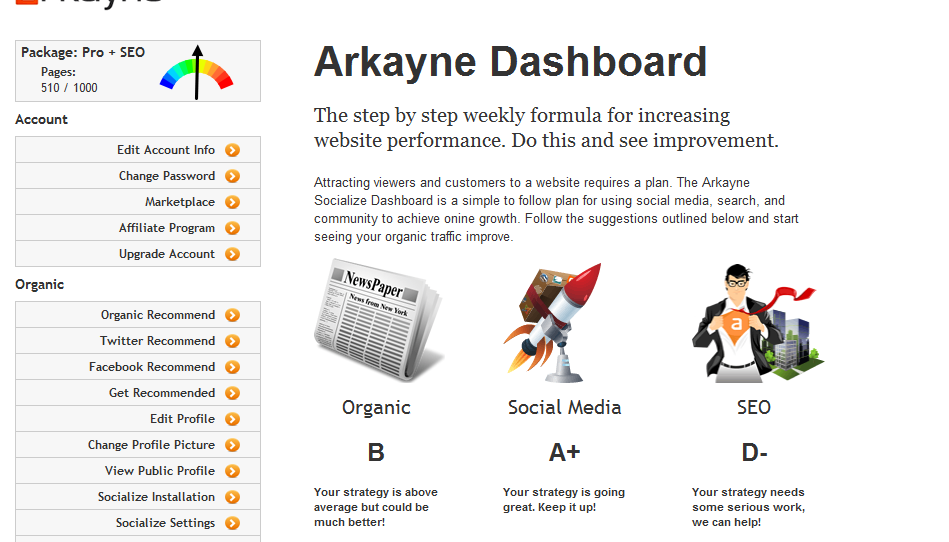
Why Arkayne is Good for Your Blog and Business

For any blogger (especially if you’re using your blog for your business), Arkayne is a pretty solid platform that you might want to check out.

I’ve been using Arkayne on my blog for the last month or so, and I gotta say, I’m enjoying the experience so far. I’ve not used all the features to their full advantage yet, but that’s more to do with me than the tool itself.

So what is Arkayne and why should you be bothered?

Simple. Two of the most asked questions by bloggers is how to get more traffic and how to monetize it. To grow and monetize your blog you need readers but, as any blogger will tell you, finding those readers initially can be tough.

It takes a combination of content worth reading, strong search engine visibility and social network sharing and relevance. Arkayne can help with all three.

Search Engine Optimization

Arkayne’s built-in SEO Analyzer helps you increase the visibility of a page or post to the various search engines. Once your post is written and saved to draft mode, you can use the analyzer to test how well it’s optimized.

Danny Brown 52 cool facts about social media SEO

The Arkayne SEO analyzer scores the post according to title, meta description and content. It then tells you where you’re going wrong and how to improve. You can make the changes and then re-analyze until you get that magic 100% (or A rating).

It’s similar to the Scribe SEO system with one main difference. With Scribe, you’re allocated credits depending on which package you buy. Each analysis uses a credit, as does each re-analysis when fixing your content, which means your credits can soon be eaten up and you have to buy more.

Arkayne’s SEO analyzer allows as many analysis checks and corrections as you need without charging extra – a nice touch.

  • Update – Arkayne has just published a comparison chart between Arkayne SEO Analyzer and Scribe SEO, which shows Arkayne’s offering ahead in most comparisons.

Network Sharing

Another nice feature from Arkayne is the social sharing and network syndication options it offers. There are a few ways it does this and each one offers a great way to increase your traffic by building relevance into each post and share.

For example, if you link your Twitter and/or Facebook account to Arkayne, you can post an update from within your dashboard to your profile. Arkayne then posts this link as a status update on Facebook, or a tweet on Twitter. So what – just like any other content sharing platform, right?

Not quite. Where Arkayne differs is that the link goes back to your publisher page on Arkayne, and offers your profile along with related links to more content you’ve written on a similar topic. But that’s not all.

By searching your content and providing even more relevant links, Arkayne is constantly figuring out how to connect to your site from the link you provided, and increase its traffic and relevance every time.

Arkayne also offers the option to show related posts at the end of your own blog post (both from your blog and content across the web), which again helps decrease bounce rate on your blog while sharing content with and from others.

What I like about Arkayne’s approach is they take the time to find the most relevant links and then add to your post, so it’s not just a bunch of links grabbed by keywords only. It does mean that related posts don’t appear immediately, but when they do you know they will be relevant.

Another way Arkayne helps your blog grow is by its own social network of bloggers and publishers. You can use Arkayne’s recommendation engine to either recommend blogs or publications you read, or help find ones that would be useful to you. And of course this works in reverse.

Each recommendation or connection you make appears on your publisher profile, offering more visibility to that blog. So if you connect to other publishers and they find you relevant, your blog will then appear in their feed, increasing your visibility again.

Using Arkayne for Business

So far, I’ve looked at some of the features that make Arkayne a very cool platform for bloggers, but it doesn’t stop there. It can also help you with your business goals, regardless the size of you and/or your campaign(s).

For example, you can use Arkayne to examine your existing content (web, publisher strategies and relationships) and the social relevance options of Arkayne, and make sure you’re using the right approach (and amend if you’re not).

Additionally, you can also use Arkayne’s engine to find those that can help you spread your message more, as well as manage any syndicated news and content and adapt if any updates about your business are made.

Then there’s the analytics integration with Google Analytics, Omniture and Core Metrics to manage your campaign and click-throughs or tracking codes; traffic metrics to see who’s the best partner for your campaign; and white label branding to make Arkayne part of your client offering.

And that’s just brushing the surface – depending on your needs, you can really get deep into how you manage Arkayne for your business or enterprise goals.

Is Arkayne Worth It?

From my own (still limited) use so far, hell yes. As a blogger, the SEO Analyzer, as well as the RSS syndication and social integration options, makes it worthwhile to me.

And as a business owner, I can see where the various publisher and campaign solutions would be useful as well.

From a price standpoint, Arkayne also makes a lot of sense. As well as a free account, you can also purchase plans for Pro, Pro + SEO (the one I have), Business and Enterprise.

I’m still playing with all the features that Arkayne has, but I can already see the benefits. My bounce rates have dropped since I activated a related posts option, and my SEO visibility has improved too.

Would I recommend Arkayne? Yes – especially since you can test a lot of the features with a free account. Though to really benefit, I’d recommend the Pro + SEO package.

What about you – is Arkayne something you can see benefit from? Or if you’ve checked it out already, I’d love to hear your thoughts – as always, the comments are yours.

The Art of the Story

Apple’s come in for a lot of stick over their new iPhone 4. From reception issues when held a certain way to discoloured screens and other problems, there’s no doubt Apple’s new baby isn’t all it’s cracked up to be.

And yet…

With one single advert, my view of iPhone 4 (as a consumer) is immediately positive again.

Yes, I know it has issues. I know Steve Jobs doesn’t really seem to care about us, as product users and advocates. I know that using all its features will set me back an arm and a leg for contract costs.

But seeing this advert last night makes me consider buying the iPhone. It makes me think that, despite all its issues, the possibilities opened up by this one feature alone make it worthwhile.

Funny how telling a simple emotional story can change our mindsets, huh?

Virally Fungal

A virus is something that comes along, knocks you for six for a while, then usually leaves your system once your immune system kicks in.

A fungus, on the other hand, usually gets its teeth into you then never lets go. It’s there in the background, and just when you think you’ve seen the last of it, there it is again. Ever-present, ever-ready to keep its grip on you.

So many businesses try to go viral with their promotions. Great. Get the extra eyeballs while you can and ride the wave.

But wouldn’t it be better to be fungal instead?

3 Simple Ways to Be Cleverly Quiet in Social Media

We’re told by those that know that we should be in social media. Not just in it, though, but participating.

Jumping in; joining conversations; leading the way; growing our audiences while talking with them at the same time.

And of course, in an ideal world, we should and would follow the above and more.

Problem is, we don’t live in an ideal world.

Time or budget restrictions. Fear of the big scary world that is social media. Lack of buy-in from decision-makers in our workplace, and so on.

All decent points, all valid arguments.

But even if you can’t justify participating actively in social media, there are a ton of ways you can be cleverly quiet in social media and know all you need to know too.

Here are just three. Best of all, they’re all free too.

Use the Search, Luke

A vastly under-used yet hugely effective source of silent participation are the various search options in social media. Twitter, Facebook, YouTube, LinkedIn, Slideshare and virtually every other social media platform you can think of has a search function.

Just like Google’s search box, all you need do is type in the keywords relevant to you and see what’s being talked about when it comes to you and the customers you’re after.

It doesn’t stop there. You can save searches on Twitter, for example, and then jump back in any time and see what’s new in your industry – it’s basically an ever-growing resource centre.

Search is your friend – look after it.

Real-Time or Your Time

So we know search is your friend. But one of the arguments against social participation is the time involved, and that same argument can also be used against searches – you have to always be there. Which is why alerts are also your friend.

By plugging your keywords into real-time search and monitoring platforms, then setting up alerts for them, you can get the information you need to know at your convenience.

Tools like Google Alerts, Social Mention, Surchur and others allow you to set up search parameters and then choose when you want to receive that information. Hourly, daily, weekly, as it happens – you choose. There might be some words less important to you than others, so choose the important ones for more frequent updates, then the others as you see fit.

Alerts are also your friend, since they let us decide when (and if) we need to jump in on something.

Subscribe to Knowledge

According to Technorati’s last State of the Blogosphere, there are more than 133 million blogs out there (probably more since that report came out a year ago). That’s a heck of a lot of blogs – and many of them cover business. Which covers social media.

By combining social and “normal” searches, tags like Technorati’s own social media tags and reading blogs that offer excellent research and information, you can soon build up a great knowledge base on the topics you need to know about to help your business.

Then, to make sure you don’t miss out on that information, make sure you subscribe either by that blog’s RSS feed, or by email subscription so you get all the latest news as soon as it’s published.

Your Turn

Like I said at the start of this post, you don’t need to participate actively in social media to benefit from it. Obviously the more active you are, the more beneficial it’ll be. But if time and resources are currently against you, then silent participation can still benefit you immensely.

How about you – what ways are you using social media silently to benefit you and/or your business?

Creative Commons License photo credit: buddygirlgreetings

How NOT to Win Friends and Influence People

DSNR Media spams Facebook page of Danny Brown

When is sharing information useful, and when is it just spamming off the back of someone else’s community?

I ask because when I logged into my Facebook page today to post an update on a future Bonsai Interactive event, I was met with this at the top of my wall (click to expand).

DSNR Media spams Facebook page of Danny Brown

It was posted by Claire Reynolds on behalf of the DSNR Media Group. At least I think it’s by Claire on behalf of DSNR, since Claire’s Facebook profile has her located in the U.K., while DSNR are based in Israel.

DSNR describe themselves as “a recognized global provider of result-based online and mobile advertising solutions… with cutting edge optimization tools.” Really, DSNR?

So spamming your message onto a Facebook wall is considered cutting edge? Shilling your wares without permission is your great advertising solutions? Posting links to your service where they may or may not be relevant to the audience is ethical?

Here’s a heads-up – spam is not cool.

You can paint it whatever way you like, but you’re spamming.

You’re an online advertising company, so I’m pretty sure you’re aware of Permission Marketing from Seth Godin. Even though it was written over 10 years ago, it’s still more than relevant today. Check it out – it’s a great read and might open your eyes as to why your current spamming approach isn’t welcome.

In the meantime, I’m removing your post on my wall. I respect the community I have over there, and I don’t want them spammed by you either.

Have a great week.

  • « Go to Previous Page
  • Page 1
  • Interim pages omitted …
  • Page 88
  • Page 89
  • Page 90
  • Page 91
  • Page 92
  • Interim pages omitted …
  • Page 174
  • Go to Next Page »
© 2026 Danny Brown - Made with ♥ on Genesis