• Skip to primary navigation
  • Skip to main content
Danny Brown

Danny Brown

podcaster - author - creator

  • About
  • Podcasts
  • Journal

Insights

The Teaser of Uniqueness

In 1947, a businessman from Idaho named Kenneth Arnold reported seeing nine strange disks of light in the sky while flying above the Cascade Mountains in the US.

While his experience wasn?t the first time unexplained objects had been recorded, it was the first time that they were recognized as alien craft. The myth of the UFO was born.

In 1934, one of the most famous photographs in supernatural or unexplained history was taken by Colonel Robert Wilson in Scotland.

Colonel Wilson Nessie

Showing what looked like the head and neck of a plesiosaur-type dinosaur, it brought the legend of Nessie the Loch Ness monster to the attention of the world.

What do these two stories, and more like them, have in common? Simple ? the promise of something fantastic that captures the attention of millions worldwide.

While they may or may not have some grounding in fact, what can?t be denied is that they both sparked conversation, interest and tourism to their relative areas that is still fervent today.

In other words, they built interest and started a huge viral chain reaction before viral was even used.

By offering a glimpse and nothing more, they let peoples’ imaginations take over and built an industry around what was perceived, rather than what was.

It’s that teaser of something that can be unique for everyone, depending on their take, that can be the bridge between you and your audience.

You just need to start laying the cement.

Outgrowing Success and the Question of Scale

Success is a funny thing.?It means you?re doing something right, and that people are enjoying your product, service or (possibly more importantly) your knowledge.

Success means people have?joined your tribe and they want to help you grow.

Success also means that where you started probably isn?t where you are now ? your garage band has moved into a recording studio. Your bills aren?t as daunting and your car starts in the winter.

Yet success also brings its own challenges.

You outgrow your goals and need to set new ones. That?s natural ? but the process can be anything but.

You begin to realize you have to scale, and you?re not sure how to do that.

Do you take your existing audience and hope they scale with you on your new path? Or do you jettison some, keep others, and find new audiences along the way?

If the answer is the former, does that limit your new growth before it starts or is your growth because of the very audience you?re questioning? If it?s the latter, will you find enough new eyeballs to cover the loss of the old?

It?s a fine line, and one that success causes you to face head-on.

Some manage the crossing, while others get stuck with the ferryman on the edge of the pier, staring into the mist and unsure of what lies beyond. The trouble is, the ferryman doesn?t pay the bills; he merely adds to them.

Building your audience is the easy part; what you do next is the real litmus test.

How are you rebuilding?

More Blog Subscribers and Comments? Better Use Postmatic!

Original

Ask any blogger what their two main wishes are for their blogs, and eight times out of ten* you’ll probably get “more comments” and “more subscribers” as the answer.

*Note – eight times out of ten is not a scientific discovery, although it may be.

Especially for bloggers who thrive on engagement, more comments means more goals met. More comments also have a way of increasing subscribers, because if a reader leaves a comment, it means they’ve enjoyed the piece. If they’ve enjoyed the piece, it stands to reason that they’d want to subscribe to get more of the same content.

So, yeah: comments and subscribers.

The problem is, in recent years, many bloggers have complained (some rightly, some not so much) that blog comments have started to dwindle, as more readers took their discussions to other platforms, more often than not Facebook and Google+.

To counter that, third party comment plugins like Livefyre and Disqus offered workarounds – Livefyre’s SocialSync feature pulled in tweets and Facebook comments, while Disqus allowed you to tag Twitter users.

Then there was Comments Evolved, that allowed you to display comments from Livefyre, Disqus, Facebook, Google+, alongside your native WordPress comments. Unfortunately, while that plugin was useful, it stopped being supported.

However, much like many third party plugins (especially ones that have social network support built in), performance of a blog could be impacted, as Twitter and Facebook API calls slowed down response times.

Add to that the recent announcement by both Livefyre and Disqus that sponsored comments and ads would be appearing alongside “normal comments”, and the negativity these announcements received, the need for a solid native WordPress comment solution continued.

Until Postmatic came along, that is.

Postmatic? What’s That, Then?

While many other plugins offer a “unique” spin on how they approach blog comments, Postmatic actually delivers on that promise.

Postmatic free

Instead of having to comment via the web (although that’s still possible – more on that later), Postmatic allows you to get a new post by email, read it, and then comment on that post just by hitting reply to the email you’ve just read.

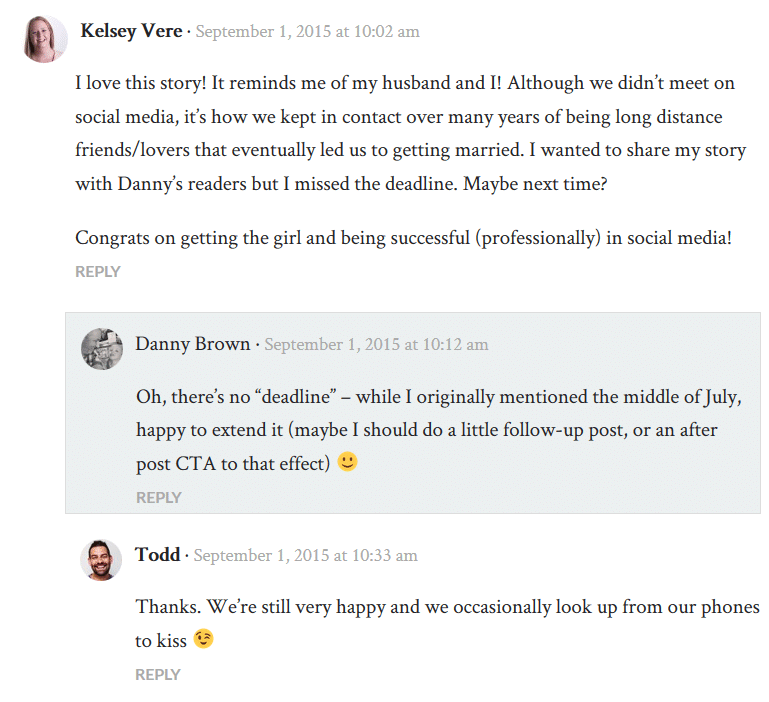
If you want to try it for yourself, simply leave a comment below this post and see what happens when other comments come in!

It’s so simple, you wonder why no-one has really thought of this sooner (there was a stripped down version of this for Disqus, but it was only for admins).

As well as being simple, it makes perfect sense.

Think about it – where do you spend most of your time during the day? A good bet would say email (perhaps second only to Clash of Clans) – so if you’re spending so much time in email, why wouldn’t you manage all your blog post interactions that way too?

In Postmatic?s own words,

We raise engagement by reaching your audience where they are – in their inbox. Except now with Postmatic, they can comment back and keep the conversation going just by hitting reply.

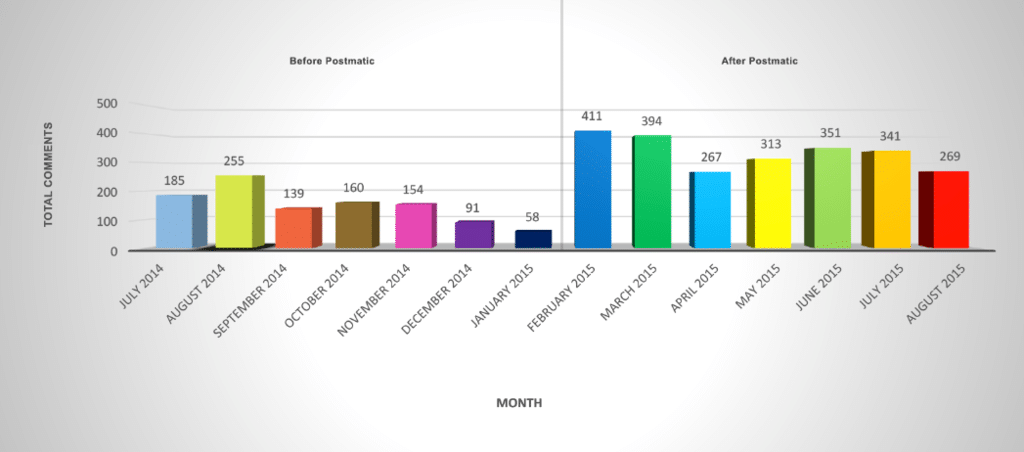
As a user of Postmatic since February this year, I can 100% agree that engagement levels have increased, as shown by the chart below.

Danny Brown Postmatic stats

As you can see, in the seven months prior to installing Postmatic, my comment count per month averaged 149 comments per month. In the seven months since implementing Postmatic, that jumps to 312.

That’s more than doubled my average comment count!

My posting schedule over these 14 months has remained pretty consistent (with the exception of one post per month more in May, June and July this year), as did my social shares – so how come Postmatic grew my comments and engagement when other plugins didn’t?

Simple – people felt comfortable commenting on my blog, because there were no extra hoops like social log ins, account creations, passwords, etc., to jump through.

Additionally, because Postmatic enables commenting by email, people could truly post a comment or reply whenever they wanted – at their desk, at the supermarket, at work, even while lazing at the beach having a cold drink (as I did, numerous times, over the summer).

However, as much as Postmatic raises engagement, there’s so much more to them than that.

Grow, Deliver, Engage, Value

Postmatic’s goal is simple – to reward bloggers for the love, sweat, time and money they put into their content.

To that end, they’ve created a four pronged approach so bloggers can focus on the specific area(s) they want to improve. While each area can work individually, it’s when you combine them that the magic truly happens.

1. Grow

It’s not just engagement that Postmatic grows. Pretty much every blogger also wants to grow their subscriber numbers, whether that’s via RSS subscribers or – more usually – email subscribers, and Postmatic delivers here too.

While there are a bunch of plugins like Optin Monster and Bloom that can help grow your email subscribers already, Postmatic offers a free alternative called, simply enough, Postmatic Optins.

While not as feature-intense as similar plugins, Postmatic Optins offers four flavours of optin forms: Popup over the page, Slider, Top Bar, and After Content.

Between them, these four options cover the most popular optin forms for email lists (with the exception of Exit Intent, which is scheduled for a future update).

As you can see, they don’t look too shabby either.

After content and slider

Each optin has five basic colour options, to help blend into your theme design better (you can also edit them via CSS). Additionally, the copy is fully customizable and supports HTML, so you can create very customized forms specific to your email list goals.

Not only that, but for the pop up and slider optins, you can choose when these display – after a set amount of time, after the reader scrolls to the end of a post, or after they leave a comment.

While there are only four optins at the moment, they more than cover the needs for the majority of bloggers looking to grow email subscription numbers.

In addition to the Optins, Postmatic also has a pretty cool Import and Invite set-up. The import option allows you to import subscribers from MailChimp, Mailpoet, Jetpack, and Subscribe to Comments Reloaded.

With the invite option, you can invite past commenters, commenters who are subscribed to replies but not posts, email lists and more (Postmatic do a great job of ensuring bloggers don’t abuse this option with clear wording around best practices).

2. Deliver

Not only does Postmatic help you grow your subscribers, it also delivers your posts directly to them.

Much like Feedblitz, Feedburner, and Mailpoet’s email delivery service, Postmatic sends out each new post by email to your subscribers. The free version of Postmatic sends the post via the mail service of your web host, while Postmatic Premium uses Mandrill and/or Mailgun, depending on network traffic.

While the free version of Postmatic is more than adequate for email delivery of your posts, it’s when you make the jump to premium that the service really shines.

Postmatic pricing comparison

As well as guaranteeing delivery of your email, the extra features and options available to premium users makes the current $9 per month per site a steal.

  • The ability to customize the header and footer of your email, using either images or widgets (Postmatic adds email widgets to your standard WordPress widgets).
  • The option to differentiate widgets depending on whether the email is a new post delivery, or a comment reply email.
  • Support for other third-party plugins, like Social Warfare sharing, and Skimlinks affiliate links (more on that later).
  • The ability to spam, trash or approve a moderated comment, all from your email.

However, in addition to the features above, and the comparisons in the image above, the key difference between the free and premium version of Postmatic is how the posts are delivered.

If you’re used to receiving posts from Jetpack or Subscribe2, you’ll know the basic look and feel of these emails. Nothing particularly wrong with them – just that they lack the bells and whistles of other email services (branding, images, etc). This is the same for the free version of Postmatic.

Postmatic Premium, on the other hand, converts your post, with all its formatting, to email-compatible HTML and wraps it in the customized template you’ve created with your own images and widget areas.

Postmatic premium

The result is a beautiful, uncluttered, content-focused email template ? with the added bonus that your subscribers can leave a comment (and reply to future ones) all from the comfort of that very same email!

3. Engage

As I mentioned earlier in the post, one of Postmatic’s main goals is to grow the engagement around a blog post. As highlighted by the chart showing my own blog’s engagement growth, this is a goal Postmatic are more than delivering on.

Other bloggers that have switched to Postmatic have also shared how it’s helped their own blogs when it comes to comments and engagement.

However, the mindset to comment via email can still be a big one to overcome – after all, we’ve commented via the web for so long, it’s become the only way we know.

While Postmatic quickly becomes second nature once you’ve actually used it, the team behind the plugin also recognize that some commenters will still prefer web commenting, which is why they’ve released Epoch.

Epoch

Pronounced “epic”, Epoch can best be described as a comment plugin that offers the best features of Disqus – real-time commenting, Ajax loading – while solving some major long-time complaints about native WordPress comments, like page cache support and CDN support, all while remaining SEO-friendly.

Because of the light design of the plugin, it doesn’t eat up resources the same way a Disqus would. Nor should you have any loading issues when trying to post a comment – anyone whose ever seen the little spinning circle of Disqus loading doom will appreciate Epoch’s approach here, especially on mobile.

Since Epoch supports Ajax commenting, every comment left on a post via the web will appear immediately, with no reloading of the page. You can see Epoch in action on this blog – just leave a comment if you’re reading this on the web.

While Epoch is a standalone plugin and can be used on any self-hosted WordPress blog, combining it with Postmatic sees some pretty cool stuff happening.

No matter if you’re commenting on the web, or from your email, every comment is updated in real-time. So, a web user could be leaving a comment, and a new one from an email subscriber could appear on the post – all without disrupting the web commenter.

Oh, and remember the Postmatic Optin option of the Slider or Popup only appearing after a comment has been left? If the blogger has Epoch activated, it will fill out the name and email part of the form, and the reader only has to click the subscribe button – how’s that for frictionless subscriber growth?

Epoch has three style settings when it comes to the look and feel of the comments on your site.

To help you choose which one is best for you, the plugin’s settings asks how much you’d like Epoch to take over that look and feel – “Completely”, “Use my typography and colours”, and “Minimally”.

  • Completely is Epoch’s own styling, and is the one that most resembles your typical third-party comments style like Disqus.
  • Use my own typography and colours is the best of both worlds, inasmuch that your own font and link colours will be used, while the style of the copy will closely resemble your existing comments.
  • Minimally simply gives you all the features of Epoch, while using your existing comment style. However, there may be some glitches based on your theme’s code, so this option may or may not work for you.
Epoch use my typo

My own preference is for using my own typography, as per the image above, but I also use the Completely option on other sites, and it’s an excellent alternative for anyone that prefers the Disqus approach to styling.

Epoch Completely style

Epoch recently came out of beta, but already it’s shaping up to be an excellent commenting option, and one that promises to make blog comments more fun and less complicated again – which is no bad thing at all.

4. Value

The last part of Postmatic’s four tiered approach to helping bloggers meet their goals is the question of value.

When you think of the word value, and its use around a blog, what do you think of?

  • Monetizing a blog?
  • The value a blogger brings to his or her readers, commenters and subscribers?
  • The value of a blogger to brands?
  • Sponsorship opportunities?

All of these, and more, are actually the definition of value when it comes to a blog. Think about it – you read/subscribe to a blog because of the value in the content, and the expertise that blogger brings.

You’re also happy to support that blogger through affiliate links, because of the value the blogger brings in recommending only products that would be valuable to you.

As a blogger, you might feel that the readership and engaged community you have built trust with is an ideal one to help you become a trusted partner for brands looking to do right by their customers.

All of these goals can be met by Postmatic.

  • A blogger grows their list, helping to add to their value to a brand or affiliates/sponsors.
  • A commenter grows their circle of connections, and feels their thoughts are valued more.
  • A blogger thinking of a community membership site can use Postmatic to deliver exclusive, behind-the-paywall conversations and value all from email.
  • Because of the approach to privacy Postmatic takes, commenters and subscribers can be more confident that they won’t be spammed, nor will their information be used for third parties and retargeting, making the relationship between blogger and subscriber more valuable.

These are just some of the ways value can be built via Postmatic.

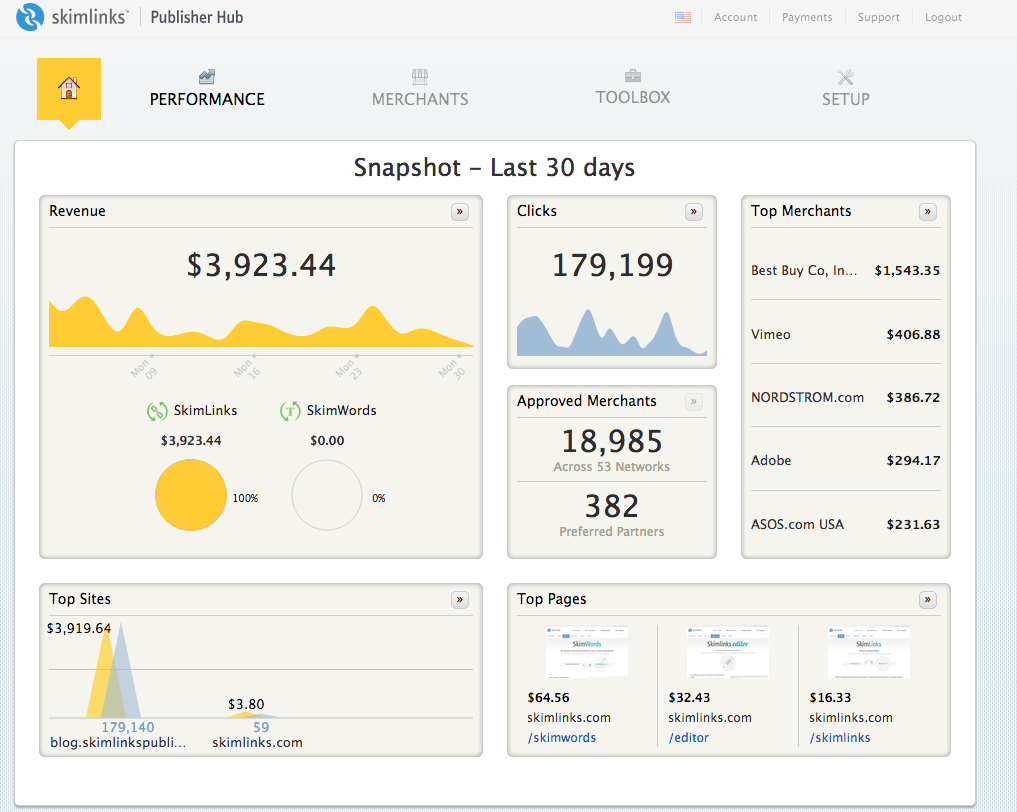
Additionally, they recently announced the support for Skimlinks in Postmatic emails.

skimlinks

Skimlinks is a pretty slick way of working with affiliate links.

  1. If you think Skimlinks is a good fit for your content you sign up on their site.
  2. Install a javascript snippet on your blog (or use their WordPress plugin) and you’re done.
  3. The next time you write about a product or service that has any sort of affiliate program, Skimlinks will intercept any clicks on links in your post, track the sales, and share the commission with you.

Skimlinks work from within Postmatic emails so tracking affiliate sales happens both on the web and in the inbox.

Now when you send an email out, the Skimlinks aren’t just restricted to your website. Couple this with some other vendors Postmatic are hoping to announce soon, and you should be starting to see why Postmatic is a developer to sit up and take notice of.

So, Should YOU Use Postmatic?

Uh, why have you read this far is you’re not interested?? 😉

Seriously, though, I can’t recommend Postmatic enough. I’ve tried pretty much every comment system around – Livefyre, Disqus, wpDiscuz, G+, Jetpack, Echo, IntenseDebate, etc., and Postmatic beats them all hands down (especially now they have Epoch).

Their Optins make it easy to grow subscribers, without the extra cost of other, more popular plugins.

Their support is second-to-none (seriously), and their willingness to listen to their users (and the readers of their users), to add new features and support for other plugins, is something all WordPress developers should take notes from.

Are they perfect? Not quite (but they’re close).

  • You won’t currently get analytics around your emails, but then Postmatic isn’t (currently) meant to replace a Mailchimp or AWeber. Instead, it’s about raising engagement, all while delivering beautiful emails that allow comments to start the moment a post is received.
  • The Optins don’t have analytics like Bloom does – but then, Bloom is premium and their analytics are fairly basic. Besides, it’s easy enough to use Google Analytics to set up tracking subscription statistics.
  • There’s also no weekly digest of emails – yet. However, if that’s something that you prefer over instant delivery of posts, look out for digests in the next major update of the plugin.

Postmatic keeps the features focused and the experience tight, with a major focus on getting people talking about your content, which means they don’t charge hundreds of dollars for the service like others do.

While the free version is fine, ask yourself this – if you could meet your goals as a blogger when it comes to subscribers, comments, brand partnerships, affiliate sales, membership site opportunities and more, would you be willing to spend just $9 per month for that?

I know I would. And did. And I haven’t looked back since.

A version of this post originally appeared on WPKUBE.

Who You Are Versus Who You Think You Are

Look in the mirror. What reflection do you see? What?s the answer that you get when you ask, ?Who am I??.

It doesn?t matter if it?s a personal mirror or one with a business face ? they?re one and the same at the end of the day.

How you view yourself has a lot to do with how you?re viewed by others.

Do you see yourself as the no-nonsense type that doesn?t stand for any bull? Or the caring type that listens to everyone?s questions and concerns and tries to help wherever possible?

Maybe the answer is somewhere in-between, or nowhere near either.

Your view, and that of other people, is what shapes your brand, personal and professional.

  • If you want to come across as narcissistic, you will.
  • If you want to be known as the person that never listens to others and does exactly what you want, you will.
  • If you want to be known as the hard-assed boss, you will.

But you know what people buy from? The brand.

Sure, the product is important, but generally it plays second fiddle to the service. Your brand gets known for its service and is the currency on which your fortune (or lack of) will be built.

I?m a consumer. If I hear about two companies that have exactly the same product and price point, but one listens to its customers more than the other, I know where my money?s going.

If I hear that Jim has built his hugely successful business by being a dick to his staff for no reason, I?d rather shop at Joe?s less successful business.

Why? Because I?ve heard he knows all his employees? likes and dislikes and when their birthdays are.

He also listens to feedback from staff and customers alike and acts on it to make his service better.

We all know who and what we want to be.?Yet we don?t always make the right decisions to get there.

Ours isn?t the only opinion that counts ? not if we want to be truly successful. We know who we are, but others know who we could be. This is what makes a successful brand.

Your brand is your voice but don?t be afraid to let others shape it.

A Dead Child on a Beach is Fine, But the Word Fuck Offends You?

We’ve all seen the tragic and horrific image of little Aylan Kurdi, washed up and face down on a Turkish beach after trying to escape the horrors of Syria.

We’ve seen (finally) the mainstream media really talking about the issues that are facing Syrians as they put their own lives, and that of their families, at risk, only to find that risk takes their lives as surely as the bombs and bullets in Syria would should they remain there.

And we’ve seen the world finally start to get its shit together and realize what’s been going on, now that they’ve been forced to watch by the image of that poor little boy, who could be mistaken for simply sleeping if you replaced the beach with a bed.

Migrant boat accident in Turkey

Sadly, we’ve also seen the assholes and the self-serving come out of the woodwork, as “people” show their true colours when it comes to their place in the world, and how we treat our sisters and brothers regardless of race, faith and status.

I Offend You? Your Ignorance Offends Me

In the days following the release of the picture of Aylan to the world, there were many discussions across all the social networks, as people tried to make sense of what they’d just seen.

On Facebook, a friend of mine shared one of the many news stories about the tragedy, and asked what it will take for the world to end this madness, and actually live peacefully together.

I replied with my usual brass and unfiltered take when horrible shit like this happens.

Sadly, the world can never change when we put the doctrines of religion and hate?above the rights of people to expect a normal life. Despite our outrage, nothing changes and hatred wins?- the world is completely fucked.

An hour or so later, one of my friend’s friends came online, and harangued me for using such unnecessary language. It simply showed ignorance of the English language, and I couldn’t be taken seriously because of it.

Well fucka-doody-doo, mister, and excuse me!

So I asked this guy if my language offended him more than a three year old boy lying lifeless on a beach for the whole world to see. His response:

God works in mysterious ways, and it’s not for us to question or for you to lessen that by vulgarity.

At that point I gave up, because clearly it was pointless trying to reason with someone that couldn’t see the craziness in their statement or point of view.

[clickToTweet tweet=”Why do we think the word fuck is offensive, but reason away a dead child on a beach? #morals” quote=”Why do we think the word fuck is offensive, but reason away a dead child on a beach? #morals”]

Now, don’t get me wrong – while I’m not religious myself, and while I have many issues with how religion of all kinds enforces certain behaviour and beliefs, I also respect people that are religious to practice their faith, and the actions that come through that.

I just can’t believe any religion (or person, to ensure this doesn’t become a post about religious ambiguity) would find a three year old boy lying dead on a beach any fucking kind of acceptable picture.

Because if you do, for whatever reason, then your whole mindset is fucked.

The World is Becoming a Stupid and Dangerous Place

But I guess I shouldn’t be surprised that this could be the case.

After all, you only need to take a look through your Facebook feed, as well as news and media outlets and the comments that come after any kind of serious opinion piece, to see that the world is getting crazier by the day.

In Costa Rica, tourists placed their kids on top of turtles for picture opportunities. On top of that, they stood in front of the turtles as they tried to make their way onto the beach. Apart from showing how stupid people are, its impact is much deeper, as these turtles were trying to lay eggs, but returned to the water without doing so. Nature 0 – Human Idiocy 1.

Over on Facebook, “friends” of friends share?a picture of a burning cross, and claim that President Obama is the anti-Christ and should be “removed”.

In Texas, a teenage Muslim boy is arrested and handcuffed because his dumb school (and the fear around someone that’s just a little “different”) think his science project – a homemade clock – is a bomb.

These are just a few examples of literally thousands (millions?) that highlight how ignorance and self-preservation is taking over the world.

If it’s not in your backyard, it’s not visible, right?

Except is it visible, every single day – we just choose to ignore it.

Not only that, but we choose to ignore the ignorance of others around us when it rears its head, because no-one likes to rock the boat where friendship is concerned, right?

If that’s the case, ask yourself this – at what point do we stand up and say enough is enough, and to hell with the fallout from those we feel we currently refrain from challenging?

Because if we truly think that using the F-word is more offensive than a poor, innocent little boy lying face down on a beach hundreds of miles away from home, then I’m sorry, but we’re more fucked up than we think.

And that is truly offensive.

  • « Go to Previous Page
  • Page 1
  • Interim pages omitted …
  • Page 7
  • Page 8
  • Page 9
  • Page 10
  • Page 11
  • Interim pages omitted …
  • Page 174
  • Go to Next Page »
© 2026 Danny Brown - Made with ♥ on Genesis