Back when I was in high school in the UK, whenever there was a fight a group of kids would create a circle and encourage the combatants.
This was primarily for two reasons – one, to egg the fighters on and hopefully see blood (yeah, we were a civil bunch) and two, to ensure no-one would interrupt until the end of the fight.
We got so good at enabling this “circle of doom” that even teachers struggled to break up really good fights, and sometimes didn’t even try – they’d simply wait until the fight was done, and then dish out whatever punishment was relevant.
As mean as this might sound, one thing I recall would happen every single time is that, once the fight was done, the two combatants would usually smile and be friends.?Kids, eh?
The point being, there was no ongoing damage from that moment of carnage.
Jump forward 30 or so years, and now social media is enabling us to return to that schoolyard environment, but with one key difference – now we’re just being voyeuristic assholes, and the damage isn’t being limited to a few bruises and cuts.
It’s Social Media, There’s No Such Thing as Privacy
Earlier this week, Twitter (and the subsequent social web and entertainment rags) lit up with the live tweeting of a couple’s break-up on a delayed flight.
While waiting on the tarmac for the flight to take off, allegedly a guy broke up with his girlfriend, and their 90 minute exchange was shared across Twitter by New Yorker Kelly Keegs.
The live tweeting started with the image below (I’ve blurred the heads of the couple involved):

This was followed up by a whole bunch of tweets that gave a play-by-play account of what was happening.


Eventually, according to Keegs, the couple started making out and ordered a round of drinks for the flight when it finally took off.
But this wasn’t the end of it.
As Twitter users got hold of the “story”, it started trending, and people started following Keegs to get updates. By the end of the “event”, her Twitter followers had at least doubled (stats by Twitter Counter).

Which kinda says a lot about the kind of people we’ve become, when we see a young couple’s emotional distress as entertainment fodder.
Yet should we be surprised? This isn’t the first time this kind of thing has happened.
I’m Bored, Let’s Stroke My Ego a Bit
Back in November 2013, TV executive Elan Gale live tweeted his exchanges with a passenger on his flight.
Much like the flight Keegs was on last week, Gale’s flight was also delayed. By his account, a female passenger named “Diane” became agitated and demanded special treatment.
This frustrated Gale, and once they were on their flight, he started sending notes to Diane about how awful and selfish she was.
As it turned out, this whole “exchange” was a complete fabrication (many people are thinking the same of the Keegs example, too) made up by Gale.
Much like Keegs, Gale’s Twitter following during the event jumped from 35,000 followers to over 175,000.
Clearly, social media enjoys a humiliating sideshow, real or otherwise, as evidenced by the amount of favourites and retweets both Gale’s tweets about “Diane”, and Keeg’s tweets about the emotional couple, show.

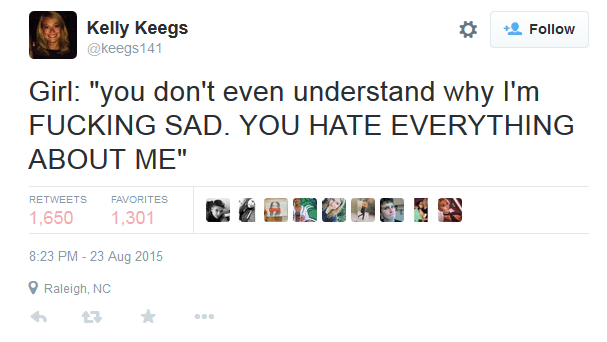
Of course, these are just simple passive endorsements – anybody can like, favourite or retweet.
It’s when you look at some of the commentary around these things that the assholery of our current love for social media voyeurism comes to the fore.


So, not only are we moving from an encouraging-the-chaos-to-continue-to-be-shared mindset, we’re actually laying the blame for all of this on the victim(s).
Like when others decide to stand up for those being humiliated further in the name of social media entertainment, and the peanut gallery tries to deflect this empathy by (once again) blaming the victim.

Because, yes – public place and all that jazz. Except there’s a very big difference between a public place that’s limited by confinement, and public on social media.
Forget Empathy, Give Me My Internet Fame!
Jumping back to Keegs and her live “commentary” of the couple breaking up opposite her,?she seems to have taken all the recent attention in her stride and celebrated it.
From getting all giddy at her Twitter count jump, to saying the worst part about the whole affair was having to apologize to her nana for the profanity in the updates, there’s very little empathy or sympathy on display for the couple in question.
(Note: I haven’t watched any of her TV appearances, or listed to any of her radio interviews, as I have zero interest – she may well have shown sympathy then.)
Which does seriously make me wonder if she didn’t make the whole thing up to get attention – after all, you’d need to be a pretty shitty human being to take joy from someone else’s suffering, right?
Internet fame can be alluring, after all – just ask the countless number of people who try and create viral Vines, or share outrageous memes and social updates in the name of stoking follower count (even through controversy).
But let’s take the viral side of things away for a moment, and look at what’s really happening.
It’s Not Following Along, It’s Voyeurism, And It Can Be Damaging
In the case of the alleged break-up shared by Keegs, this is about a young couple going through one of life’s toughest moments – a romantic break-up.
If you’ve ever broken up with someone – or, more specifically, been broken up with by someone – you know the pain and anguish you immediately feel.
Your heart is broken. Your soul feels empty. Your skin feels like it belongs on someone else. Simply put, you cease to be who you were just a few seconds before.
Now, as bad as that is, we (eventually) get over that. Our friends help us forget and move on, and our family provides the emotional cushion that only they can truly give.
And the reason we’re able to get on with our lives is that the pain and fallout has been kept in a very limited and reasonably private bubble.

Now consider one of your worst moments in life being shared to thousands on Twitter. Not only described in words, but “enhanced” by a picture of you and your soon-to-be-ex breaking up.
Then think of all the abuse coming your way to protect the sharer of your break-up, just so the voyeurs of that break up can justify it by saying it’s in a public place.
That’d suck, right? So why do we encourage others to share the very thing that would break our hearts if it was us?
[clickToTweet tweet=”Why do we encourage others to share the very thing that would break our hearts if it was us?” quote=”Why do we encourage others to share the very thing that would break our hearts if it was us?”]
Take it just one step further.
Someone is emotionally raw, vulnerable. They’ve just had their heart broken. They feel life is over. And then they learn that it’s been not only shared but celebrated on social media.
Mainstream media too, going by the interest in Keegs’ little Twitter adventure.
And then the abuse starts piling up. And the shame, and humiliation, and strangers saying you deserved all you got because clearly you’re highly strung and your boyfriend (or girlfriend) is well shot of you.
You already feel life is over, because the love of your life no longer wants to be with you. So why not actually make it over?
A little far-fetched? Examples around the web would suggest otherwise – all so we can get our voyeuristic kicks.
It’s Not the Same As When We Grew Up
In drafting this post, I shared on Facebook that I was writing a piece on how social media has turned us into voyeuristic assholes.
One of my friends who I respect a lot for his measured take on things is Ike Piggott. He suggested something that I’ve heard a lot of in the last 12 months or so, when this kind of topic is raised.
“Rubbernecking” always existed before automobiles, it just got more pronounced and easy to spot when we were all lined up and going the same way.
The point Ike makes (and it’s correct) is that assholes have always existed – it’s the environment that determines how many assholes are visible.
Social media, by its sheer raison d’etre, merely enables assholes to have the kind of audience they could only have dreamed off pre-2006.
And yet… does that really offer an excuse? Does that essentially agree with the premise that, hey, it’s in the public so it can be shared?
Perhaps, at least legally. Different countries have very different viewpoints on what’s classed as an invasion of privacy versus something along the lines of “fair use”.
And maybe that’s what we, as a generation, have signed up for when we openly share the private moments that otherwise would only have been seen by family and friends. Pictures of our kids on Facebook, for example, or that goofy vacation photo.
But that’s the difference – we choose to share, as opposed to some attention-hungry stranger who gets their kicks out of the misery of others.
Yes, we’ve all seen something happen in the supermarket, or at a bar, or in a park, and we’ve talked about it with our partners, our work colleagues, our friends.
But that’s always been within a very closed circle, with zero targeting of, and abuse to, the person or people in question. That doesn’t make it right, necessarily, but it does “protect” them.
Today, there’s no such protection. Today, everything is fair game. Today, everything and anything can be shared so we can claim our 15 minutes of digital fame.
If you think that this isn’t a big deal, and that it’s simply fun and will soon be forgotten, ask yourself this:
If it’s your son or daughter that’s the object of the voyeurs of social media, would you laugh at them and tell them to stop being such drama queens?
Think about it.