• Skip to primary navigation
  • Skip to main content
Danny Brown

Danny Brown

podcaster - author - creator

  • About
  • Podcasts
  • Journal

Insights

Why We Should Get Rid of Dad of the Year Language on Father’s Day

The family

In less than 10 days, it’ll be Father’s Day here in Canada (it falls on the third Sunday of every June).

While there are many ways this can be “celebrated”, including golf outings, special lunches, book tokens, etc., the gift that seems to make the most rounds is something that includes “Father of the Year” verbiage.

Coffee mugs, gift cards, lapel badges – these are just some of the ways to thank your dad for doing his job, whatever that may be.

And that’s exactly why we should get rid of this whole “father of the year” thinking.

Why Do We Need Father of the Year Anyway?

Let’s face it – this whole father of the year shtick is nothing but a ploy by the likes of Hallmark to get kids to spend money on a card that shows their dads how much they love them.

After all, if you’re father of the year, that makes you better than every other dad around, right?

But who makes that decision? Hallmark? Puh-lease.

This week, my five year old son Ewan has been really sick, with a fever that saw us take him to the hospital to get checked. My wife drove him there, while I stayed home and watched his three year old sister Salem.

When Ewan was discharged, I kept him company and gave him medicine and played games, etc. When he was sleeping, I made sure his room was cool and his sheets weren’t exacerbating the fever.

Does that make me dad of the year? No – because I had help from my wife, and I was just looking after my son.

Compare that to Mark Sutton, the brother of my friend Paul Sutton, over in the UK. Mark and his wife Lucy have three boys, the third of which, Luke, has suffered severe health issues since birth, and faces death every single day.

Does a Hallmark card saying I’m dad of the year for keeping my son’s temperature down mean I’m a better dad than Mark, who – along with his family – is going through so much, but remains a strong father?

Or what about the dad that raises his newborn quadruplets alone after the mother dies at childbirth?

Or simply the dads that make life better just by doing silly little things? Does my card make me better than them?

Of course not – and yet here we are, every year, dishing out cards that do nothing except make a card producer richer.

The Legacy of a Father

I get it. I see my two kids smile when they make me smile, and that means more to me than any card ever could. But if giving me a card that lets me know they think I’m dad of the year make them smile, I should be happy too, right?

And I am. But it’s a “false” smile, because we should be moving away from material and empty awards, and think the bigger, and more beneficial, picture.

If we truly want to think about fathers of the year, how about we actually make the “award” mean something?

  • Judge us, as fathers, by how we raise our children to act towards other people – with love, kindness, respect and equality.
  • Judge as by how we treat their mother, both in front of them and away from their eyes – as an equal, as a human being, as a person.
  • Judge us by how they treat the world when we’re not here, as opposed to how they treat the world when our eyes are upon them.
  • Judge us by how we shy away from defining what it means to be a “real man” and instead defining what it means to be a human being.

The legacy of the children we raise for tomorrow will define how “good” a father we were for today. For me, that’s a far better goal to achieve than something Hallmark says we should be.

Here’s to you, awesome dads. And you too, moms – because we’re all in this awesome “award ceremony” together.

And you don’t need a Hallmark card to show you that.

How Feedio (Kinda) Changed My Mind About RSS

Feedio - Manage and grow your email and RSS subscribers

A few months back, I asked the question as to whether it was time to get rid of the trusty RSS option on your blog.

My key reasons were simple: RSS offers less one-to-one interaction than email, the format of RSS can be clunky and unwieldy for non-techy folks, and the traffic to my blog from RSS was far outstripped by search, email and social network traffic.

The post received some interesting thoughts, both in the comments section and across Google+ and Facebook. Many agreed that RSS is no longer a required option; others felt it offered much better benefits based on niche and industry.

My own personal take remained – RSS was a platform that was out-of-date and no longer the lead choice for bloggers and content creators.

While that’s still mostly true, Feedio has made me look at RSS ?a little differently, and have it actually show value. Here’s why.

User-Friendly and Clean User Interface

One of the biggest bugbears of mine when it came to existing RSS platforms (with perhaps the exception of Feedly) is the user interface (UI) on the front-end could be very unwieldy.

You click the “subscribe by RSS button” on a blog, and it usually takes you to a page where you have a list of RSS subscription options to use. Unless you know what various RSS terminology means (Atom 2.0, RSS 2.0, SubToMe, BittyBrowser, etc.), it can be overwhelming for the average reader.

Feedio does away with this by offering a clean and simple subscription option for your reader.

Danny Brown Feedio profile


By offering just RSS or Feedly, Feedio makes it easy to use your existing RSS set-up without having to go through a whole list of confusing options.

A much better solution, for this non-RSS fan.

Simple, Quick Stats Dashboard and Analytics

The main “complaint” I have with RSS is the lack of details about your subscribers. When compared to the insane amount of data available to you from email providers, RSS is sorely lacking in this department.

While Feedio doesn’t (yet) go to deep levels of analytics, it does give you some useful information via both the Dashboard and the Posts navigation tabs.

Quick Stats Dashboard

When you log into Feedio, you’re greeted by your dashboard, that gives you a quick breakdown of subscribers and post reach.

Danny Brown Feedio dashboard

Since I recently switched over to Feedio from Feedburner, the importing/redirect process is still going through. However, even with the subscribers imported so far, you can start to get a feel for how they’re subscribing, as well as what type of content they’re consuming the most.

One of the more interesting features is the “Unlock” option, which you’ll see in the right-hand column of the Newest Posts section (click to expand if required).

This comes into play if you also use Feedio for email subscriptions, and lets you know which post resulted in a new subscriber. This is a really cool feature that can help you laser in on the type of content that will grow your email subscriber base.

Simple Site Analytics

As well as the RSS and subscriber data, Feedio also gives you a little more insight into your posting frequency, and where your content is being shared the most, with the analytics on your Sites tab.

Danny Brown Feedio sites

As well as showing you the Total Reach of your posts from RSS, Feedio lets you see how many times your post was shared on Twitter, Facebook and Google+.

Again, the benefit of this is if you have certain goals for awareness of your content by channel, this gives you a quick look into how well you’re doing in achieving that goal.

As I mentioned earlier, it’s not super deep analytics, but it’s a nice little feature and beats having no insights into that data at all.

Smart Engage to Build Community and Loyalty

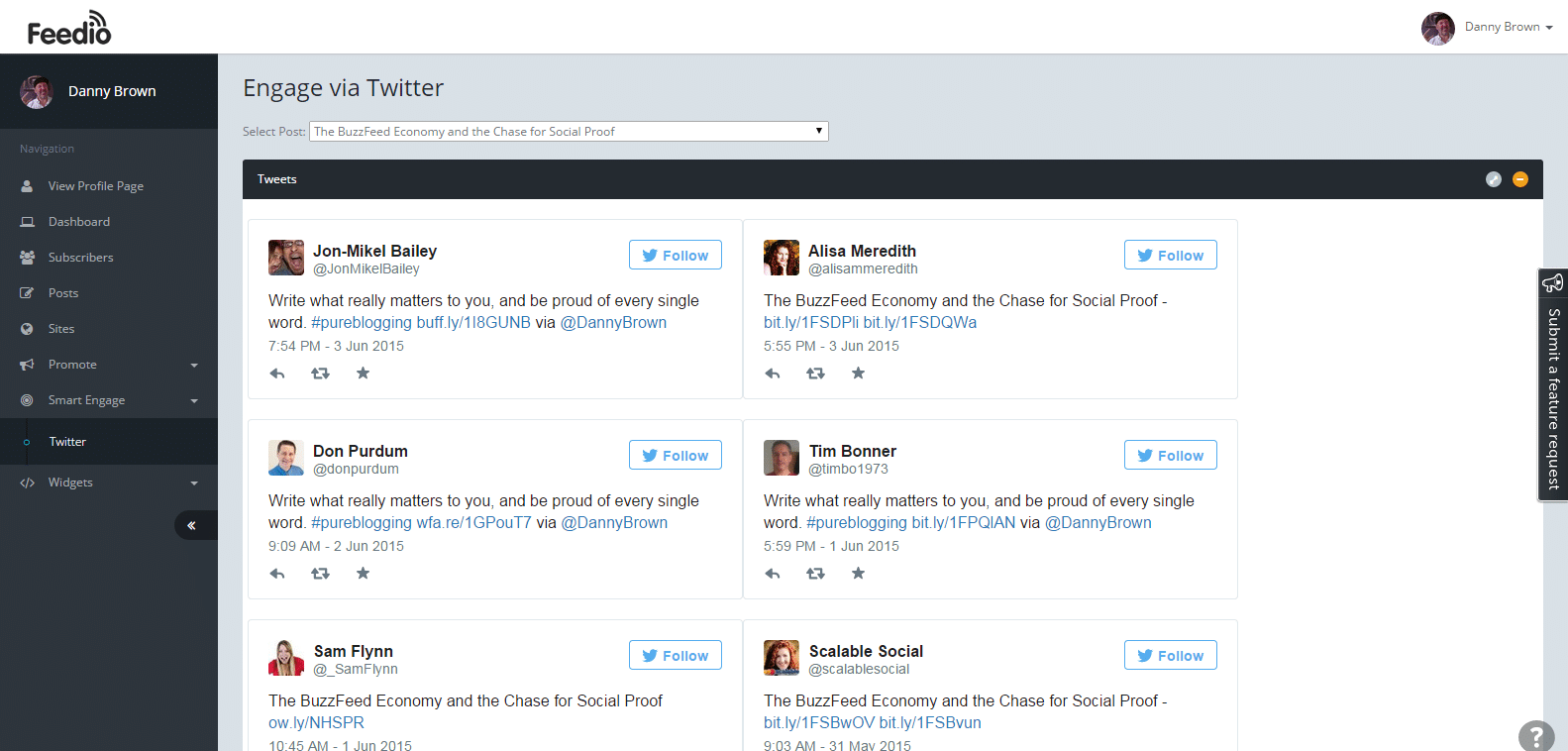
Perhaps one of the smartest features (no pun intended) is the Smart Engage option.

Currently set up for Twitter (though I believe more networks are in the pipeline), Smart Engage gives you an overview of who’s sharing your content on Twitter.

Danny Brown Feedio Smart Engage

Given you can miss this information pretty easily if the person sharing doesn’t tag you with your username, Smart Engage ensures you can see not only the type of content being shared, but who’s sharing it and how often.

Using this feature, you could create a Twitter list called “Content Advocates”, for example, and then begin sharing their content too, as well as finding out more about that person and the kind of content they enjoy.

Additionally, you could simply send a quick thank you, and start to build a relationship with that person, growing not only your reach but finding a potential new avenue for ideas, shares and comments.

[clickToTweet tweet=”It’s not just RSS that @GetFeedio grows, it’s community and loyalty. #content” quote=”It’s not just RSS numbers that Feedio grows, it’s community and loyalty too.”]

It’s a simple but useful solution that does more than your average RSS reader, and offers more reward because of it.

Simple Promote Options

While your blog readers will always be able to choose between email and RSS subscriptions, there’s still a lot of traffic and subscribers that you could be missing out on – social media connections, for example.

Feedio takes care of this with their simple promote option, like this one for Twitter.

Danny Brown Feedio promote Twitter

By providing some recommended tweets, you can let your followers know about your Feedio subscription options, which in turn should (hopefully) grow your subscriber base as well as awareness of your content.

There’s also an email section that provides some recommended emails, which you can copy and paste into an email of your own and send to past connections, chosen peers and colleagues, etc.

What Feedio Needs Next

As you can see, despite my continued misgivings about RSS as a subscriber option, Feedio does do a lot more than your standard RSS providers on the market today.

The fact it does it so cleanly and elegantly is a major plus. However, there are still some features I’d love to see added to take it to the next level of RSS providers.

  • Google Analytics implementation. One of the things that separates email from RSS is the way you can get really granular on the data, via Google Analytics. It’d be great if Feedio could connect to your GA account, and show which post (based on Reach and Shares) drove the most activity around the content from RSS.
  • Trending content. One feature I’d really like to see is that of trending content, with a little Up/Down arrow next to the posts in your dashboard. This could let you take advantage by sharing again on your own networks, or writing a complementary piece and linking to it from the trending post.
  • Deeper analytics on Smart Engage. While it’s great to see who’s sharing your posts on Twitter via the Smart Engage option, it’d be great to see the actions taken on that tweet by followers of that person (retweets, favourites, clicks). I’m not sure how feasible this would be, but it would definitely be a great addition.
  • More personalization options for your profile page. Currently, Feedio offers some personalization options for your front-end profile (the one subscribers see). However, it’d be nice to have some more features like colour picker for links, hyperlinked URL’s, etc. A small change, but one that would make a nice addition.

In fairness, though, while I’d love to see the suggestions above make it into Feedio somewhere down the line, I have to tip my hat to?Justin Butlion and the team behind Feedio.

They’ve clearly looked at the current RSS landscape, and understood the pain points for both bloggers and readers, and actually made RSS enjoyable again.

Not only that, but while they haven’t fully converted me into an RSS lover again, they have made me reevaluate my take on the service.?Given I’m a stubborn bugger when it comes to stuff like this, that’s no small feat, so kudos. 😉

You can check Feedio out for yourself here – and if you want to subscribe to this blog via RSS/Feedly, you can do that here.

The BuzzFeed Economy and the Chase for Social Proof

Content and social proof

We?re told by ?the experts? that we need hundreds of shares to be relevant, hundreds of comments to be important, and thousands of subscribers to be worth reading. So we write the easy content that gets these eyeballs, shares, etc.

And it?s all bullshit.

It?s lazy content that enriches no-one. Not the blogger, and certainly not the reader, despite what they believe. And on and on the circle grows, until we?re all back at square one and no-one cares.

If we want that web, fine ? let?s put out the easy content and the buzzworthy soundbites, and make the web a giant pool of crud.

If we don?t want that web ? write the stuff that really matters to you, and be proud of every single word.

After all, isn?t that why we started in the first place?

How Social Media Automation Can Encourage Engagement

When it comes to social media, there’s a widely held belief that automation is wrong and that all engagement should be human and one-to-one.

When talking about automation, social media gurus and consultants will offer the following reasons why there may be something wrong with automation:

  • Bots, which are fake, automated Twitter accounts, attract bots,?giving accounts the aura of popularity while never reaching a real human being.
  • The platform shift from conversation to broadcast?is a symptom of what marketers measure.?They measure actions, such as tweets, retweets and link clicks, which discourages dialogue because conversations aren’t valued on the action scale.
  • As soon as you start thinking about people in terms of numbers?and how many followers they have as a guide for interacting with them,?there’s a good chance you’ve already lost them.

While these are valid points, they’ve also got business owners and marketers questioning the value of automation in the social space and wondering whether it’s destroying the fabric of social media’s early promise.

And while I can agree?to a point?that it can be bad when it’s implemented wrong, I’m also a supporter of automation and disagree that it’s “stealing social’s soul.”

The User Responsibility That Comes With Automation

The main reason for any form of automation is to make lives easier.

For consumers, simple solutions like coffee makers with auto settings, cruise control on cars and smartphone app updates make life easier.

For businesspeople, automated functions like email list cleaning, targeted updates based on online demographic use, and filtering of leads versus service issues versus queries allows us to scale more effectively instead of having to manually carry out these chores.

But as useful as these automated functions are to get through our days faster, there’s also the ever-present danger that automation can be abused or rendered ineffective for one simple reason: user responsibility.

For instance, while cruise control for a car can take the stress out of driving, it can also make you lazy when it comes to being aware of the road around you. And while targeted updates based on an audience time online can help laser focus your content strategy,?it can backfire horrendously if a national tragedy strikes.

User responsibility is key for any part of our daily decision-making process, but that’s especially true when it comes to automated actions versus manual ones.?Automation is hugely effective and beneficial but only if the user respects the flexibility that automation offers.

Combining Automation With Engagement

One of the main reasons that social media automation is seen as bad is the?fear that it will cause social platforms to shift from being conversational tools to conduits for social proof measurement as a success metric.

And to a degree, there’s some truth behind those fears: The popularity of such tools as Klout and Triberr, where social reach and impressions are driving factors of success, merely strengthen that point of view.

Thankfully, these are the kind of soft metrics that businesses and smart marketers alike are beginning to separate themselves from.

[clickToTweet tweet=”Smart businesses use both automation and engagement to connect with their target audience.” quote=”Smart businesses use both automation and engagement to connect with their target audience.”]

So while social proof?can?be a metric of popularity, which itself can be viewed as a metric of authority, it’s increasingly being seen for what it is?usually fluffed-up numbers with very few actions behind them. But automation can help with identifying insights that inform marketers to be smarter and more effective.

For example, let’s say you want to AB test the acceptance of a new product on the market. You know who your target audience is, but you aren’t quite sure what will tip them from being potential customers to researchers of your product to actual customers.

So you use automation to find out:

  • You craft a series of messages across different content providers?email, video, blog posts, social network updates?and program them to go out at the same time and then at different times.
  • You use PURLs (personal URLs) to track actions on each message and each channel.
  • Your filtering software cleans out the bounced emails, the non-shared content and your low-traffic blog posts.
  • It then analyzes the content that worked, what times were best, where, and on who, and it essentially details what your strategy should be for the full launch.

But that’s just part of the story.

Using text analytics software, you can track all the pieces of conversation around each delivery method?how it made recipients feel, what the overall sentiment was, where a sale would have occurred had there been just the slightest change in information available, who sways your audience’s decision and more.

So instead of simply relying on the data?as strong as it is?from the automated AB testing, you’re combining these results with human intelligence to discover how we can identify the nuances of otherwise unimportant phrases, if left to technology.

And that’s where automation both benefits and is benefited by engagement through conversational insights.

While automated data and research leaves only the strongest lead opportunities, conversational insights can enhance that research by diving deeper into the context that could allow for other opportunities outside those identified by automation.

Now – is that really?such a bad thing?

But That Doesn’t Make You a Writer

I’m sitting here in front of my MacBook, fingers hitting the keyboard letters every now and again, trying to put down into words the cool idea I had for a post earlier today.

I know how it should flow; I know how it should read; I know the start, middle, and finish. But I can’t get it to come out the way it presented itself in my head.

There are many reasons for that.

One, I’m stupid tired. Several late nights and early rises have caught up with me, and my eyes feel like they’d burn holes in snow faster than a drunk’s hot piss.

Two, there are so many distractions around me that, while I know I should be ignoring them, are present all the same. And I can’t ignore them.

The third, and probably most relevant point, is I’m not a writer, so I don’t practice the process of flow, of transferring ideas to prose, and moving beyond the mind-block when the block’s setting in like cement on a new driveway.

Because while I may write content on a page like the one you’re reading now, that doesn’t make me a writer. Enough people – writers, real writers – have told me that enough times that?every one of their disparate statements are now just one single soundbite.

You put words together. You sometimes make it enjoyable. It may even get you praise from your readers. But that doesn’t make you a writer.

So that’s why I’m currently sat here, wondering if I can get the opening pushed through to the middle part and weave its way to the end.

Because if I don’t, I’ve just wasted my time, right?

Maybe so. But do I give a fuck? No.

What Is a Writer?

So I don’t have prose flowing from my fingers like the classics that make ordinary scribes writers.

So I don’t have students of the English language discussing my words as part of their mark for their senior year exam.

So I don’t have a key to the city where I was born, for bringing the literary masses to see where that city’s wordsmith was born, and raising the tourism income a certain percent above the average.

So I don’t get introduced at parties as “the writer, [INSERT NAME HERE]”.

Does that matter?

Maybe I’m not a writer. Maybe you’re not a writer either, because you don’t have any of the prerequisites above to be “a writer”.

Does that lessen the words that do come out? Do they offer less gravitas than someone who’d be described as a real writer, because they write prose and books that sell versus words on blogs that exist?

Maybe. Maybe not. To be honest, it’s not something that should matter.

It’s the Words, Not the Writer

If you touch someone emotionally, are you less of a writer because that emotion bled from a blog post?

If you connect with someone viscerally, are you less of a writer because the visceral origin was a block quote?

If you describe something less grammatically but more visually, are you less of a writer because the visual stemmed from the connected resonance of blogger and reader taking it into a new dimension in the comments?

I don’t really know where I’m going with this.

Like I said at the start, I’m beat,?and a little distracted with several things that need to be done before the end of the week. So I may not even be writing something that flows, or makes some kind of sense to more than just me.

I’m sure those that critique words that don’t fit into?their definition of prose will add a new sentence or two that says the same thing.

You shared your thoughts, but that doesn’t make you a writer.

And maybe that’s true. What do I know? I just put thoughts into words that may or may not form some structured flow, even if that flow is the Orinoco one.

Would the flow be better if I was a real writer? Probably.

Would the direction be more focused if I was a real writer? Probably.

Would the words connect deeper on any level if I was a real writer?

That, my friends, is the question that really matters. And you don’t have to be a real writer to answer it.

  • « Go to Previous Page
  • Page 1
  • Interim pages omitted …
  • Page 10
  • Page 11
  • Page 12
  • Page 13
  • Page 14
  • Interim pages omitted …
  • Page 174
  • Go to Next Page »
© 2026 Danny Brown - Made with ♥ on Genesis