
• Skip to primary navigation
  • Skip to main content
Danny Brown

Danny Brown

podcaster - author - creator

  • About
  • Podcasts
  • Journal

Insights

The Long Tail Issue for Daily Deal Sites

Groupon repeat business complaints

Daily deals

When daily deal sites like Living Social and Groupon came to the market, many observers looked at it as another nail in the coffin for offline retailing.

By bringing huge discounts to consumers via their local business partners, Groupon and others like them would show business a new way to make more money, while bringing more customers to them.

Except it’s not quite worked out that way yet.

Short Term Gain, Long Tail Miss

The problem with daily deals sites – and, to be fair, any of the stack-em-high-sell-em-cheap options that many businesses look at – is that they’re not really set up for long-term loyalty. And that’s a key reason why so many businesses fail in general, and something that many daily deal partners are complaining about.

Sure, they’ll give customers a nice discount and a reason to come to your store or business in the first place. But where’s the incentive to come back if I’m a new customer, once I’ve taken advantage of your sale product?

Unless there’s a relationship sale versus a transactional one, if I don’t normally shop with you then I have no real reason to come back unless it’s for another daily deal. Which sees you lowering your profit margin to make the offer in the first place – not ideal.

Business and Consumer Apathy

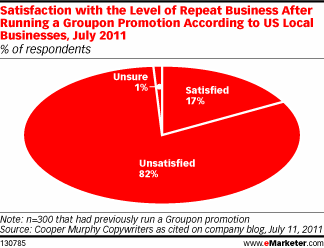
It would appear that more folks from both sides of the fence are beginning to think like that, too. According to a new survey from Cooper Murphy in the U.K., a whopping 82% of businesses surveyed that have run campaigns on Groupon were unsatisfied with the amount of repeat business it brought.
Groupon repeat business complaints

Add these figures to a study by Rice University in May of this year, that reported just over 20% of daily deals customers become repeat customers, and you can see why the daily deals market is one that seems to divide opinion on its benefits.

It’s not just the business owners that are suffering. Because one of the major premises of daily deals is to attract the low-spend customer, restaurant and bar staff have found that customers using a daily deal offer will usually tip less than those paying full price. Ironically, the less you have to pay, the less the tip should be too, it would seem.

So what’s the answer?

Loyalty and Long Term Gain

Everyone likes a bargain. I do; you probably do; I know my wife does. It’s human nature – if we can pay less, we will (although paying more for extra quality isn’t a bad thing).

The problem with constant bargains is that customers get into the mindset that they’ll only wait for these bargains, and ignore you the rest of the time. Get ignored by customers and… well, you don’t need to be a rocket scientist to know the outcome of that scenario.

So while the short-term benefit is clear, businesses need to be building long-term benefits for the customers, to encourage return visits and loyalty.

  • Episodic discounts. Say a daily deal saves you 60% on the transaction. Instead of the one-off approach, offer three transactions saving 20% each time. On subsequent visits or purchases, have an amazing add-on deal that encourages further spend on top of the discount.
  • Split the location. If you’re an offline business, with multiple locations, why not split the offer between different locations on different days? A sports shop could offer different goods on different days of the week at different stores; a restaurant a different appetizer based on location; a movie theatre group, a different 2-for-1 admission to a different movie across town.
  • Promote loyalty. If you don’t already have one, build a loyalty card around your daily deals customers. The first time they come in, have them fill out a short form with their information, and then give a loyalty card with unique offers based around the daily deal. Use it X amount of times and they receive a free product or service (within a certain budget).

The beauty with the loyalty approach is that you can now tailor email and mobile campaigns to your customers (opt-in, obviously) that offers more call-to-action specials just for them.

Run that alongside any specials you offer existing customers, and you’re encouraging growth and repeat custom across the board.?Which seems to be all that businesses and consumers of daily deal sites want, anyway.

Worth a shot, no?

image: jakelevine
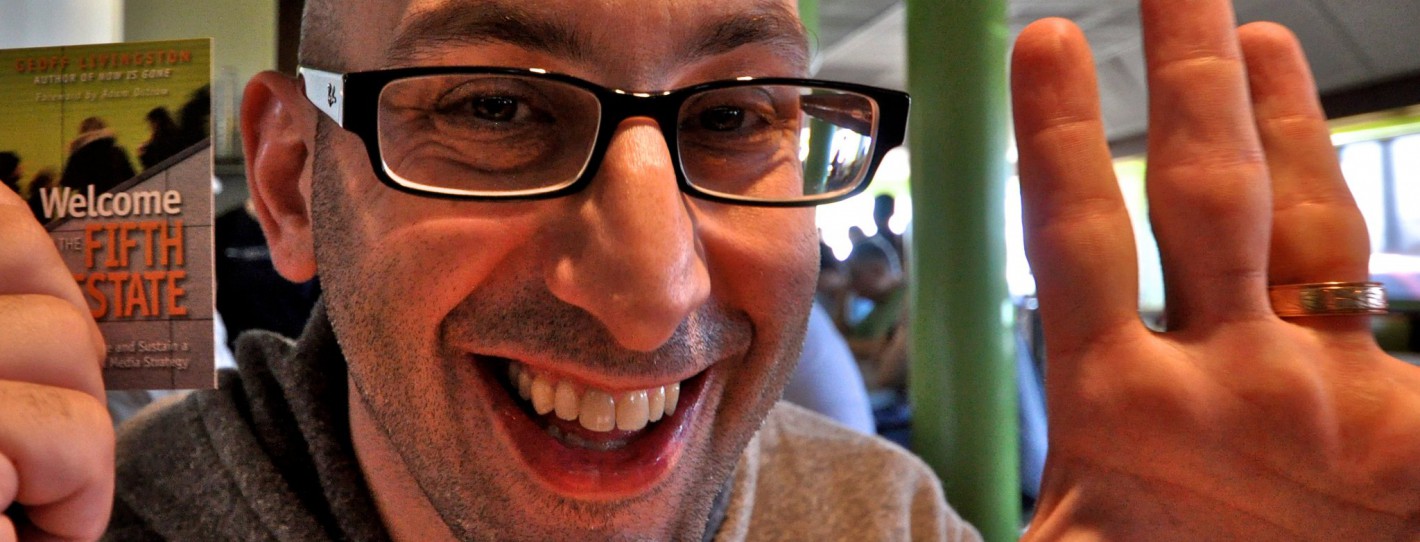
A Special Livefyre Q&A with Geoff Livingston

Geoff Livingston

Geoff LivingstonThis coming Thursday, August 11, at 12.00 noon Eastern / 11.00am Central / 9.00am Pacific / 5.00pm GMT, there’s going to be a special interactive Question and Answer session here on the blog.
Using the interactive features of the Livefyre comment system, my special guest will be Geoff Livingston, author of the new book .?Geoff is one of the smartest writers around today, and brings both organizational and non-profit smarts to the business world.

His new book has been praised as one of the best on sale today, and helps businesses and organizations build long-term and sustainable success using social and new media channels, alongside traditional ones.

Instead of me writing “just another book review” (although the book is that good, I’ll be breaking my “no book reviews” rule here soon), Geoff has agreed to be a “live guest” on this blog on Thursday.

So how’s it going to work?

Watch the video below, and let Geoff give you a small overview of what Thursday will be about. Then, start thinking of questions you would like Geoff to answer – on social media, new media, what channels are best for your business, how to measure and track goals, what part bloggers play in the new business landscape, and more. Seriously – if you have a question about social media and its ramifications for your business, Geoff is the guy to ask, and now’s your chance.

And to make you really get your thinking caps on, Geoff will kindly be giving away two signed copies – one for the best question about challenges business face, and one for the best question on social media and business sustainability (use your own examples, if you like). I also have a little surprise for anyone buying Geoff’s book on the day – details Thursday!

Then come back here at 12.00 noon EST on Thursday, where Geoff will be here to answer your questions about the book, social media and business, online channels and more.

The difference is, this will all happen in the comments section.

Because Livefyre offers real-time live updates, it’s more like a chat system than your normal blog commenting system. The cool thing is, when a new comment has been posted and you’re on the page, a little alert box pops up to say there’s a new comment (or several, if more than one new comment has been posted as you read).

You can then click on each alert, and it takes you directly to the new comment, so you can see what questions and views are being shared as soon as they’re posted.

So all you need to do is ask your question for Geoff via the comments, and he’ll be spinning his fingers all over the place to respond. You can then reply to Geoff, or anyone else’s comments, and really make it an interactive book overview and discussion like no other.

To take part, all you need to do is the following:

  • Choose your profile. Because Livefyre is a profile comment system, you need to either have a Livefyre account (which you can create here by using the Get Livefyre Now option), or sign in to comment using your Twitter, Facebook, LinkedIn, Google or OpenID profile. You’ll see these options under the Comment As option to the right of the comment box.
  • Set yourself a reminder (I’ll be tweeting and using Facebook to send out occasional reminders) to be here between 5-10 minutes before noon on Thursday August 11 to watch the video again as a reminder for the chat.
  • Get your questions ready, and fire away from noon onwards.
  • Be interactive – if you use the little “@” function when commenting, you can bring your friends from Facebook or Twitter into the conversation too. So if you think someone specific could be a great addition to the chat, invite away!

Like any live chat, there could be some technical gremlins, but hopefully not. The Livefyre guys are working behind the scenes to try and make it as smooth an experience for you as possible. And Geoff has his gremlin-slapping gloves ready, just in case.

Hopefully you’ll join us on Thursday and have a bunch of great questions for Geoff. I think this could be a lot of fun, and something to show how blog comments can really come alive.

Look forward to seeing you here – cheers!

Update Thursday, August 11: Anyone who between now and 11.59pm EST on Sunday, August 14, will receive a free copy of The Parables of Business too. Simply email me a copy of your Amazon receipt and I’ll send you the book – simple!

[youtube]http://www.youtube.com/watch?v=Tj2xlzSt0Rw[/youtube]

Ford, Red Tape and Social Media Roadblocks

Ford F-series recalls social media

Ford F-series recalls social media

News came out this week that Ford are recalling more than 1 million F-series trucks, due to a defect in the straps that secure the truck’s fuel tanks to the vehicle. The defect could see the straps corrode, causing the tanks to fail. So far, there have been 8 incidents, three of which included a fire, and one injury.

The news came to the fore after an investigation by the U.S. auto safety regulator, and affects older versions of the truck. In response, Ford has targeted mid-September to notify owners about what to do if their truck is affected.

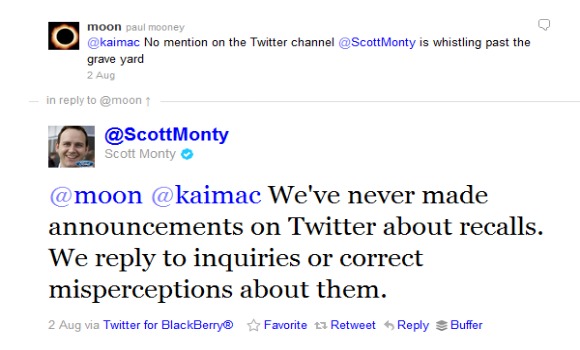
What’s interesting is how a company that’s noted for its use of social media isn’t using social platforms to pro-actively share news about the recalls. Instead, as the image at the start of this post shows, they’re using it reactively when asked about the recall situation, and to correct any non-factual statements. There’s also nothing about the recalls in the Ford newsroom.

Is this a sign of choice or legal red tape?

The Pros of Being Pro-Active

Head of social media at Ford, Scott Monty, says the reasoning behind the “silence” is to avoid inciting panic and unsubstantiated rumours. This is understandable, since we all know the consequences of fake stories and rumours online, and how that can affect brands.

Yet as a way to share news to a wider audience, and quell rumours at the start, social media has continuously proven to be a very strong tool. While Scott may allude to the legal constraints he and the Ford communcations team are under, does being silent unless questioned help?

Wouldn’t it be useful to have an official update in the Ford newsroom, as opposed to having to put out fires by false rumours due to the reactive approach? And a single tweet, or a Facebook page update, that shows a link to where F-series drivers can get the latest and official updates, would help alleviate the very concerns Ford wants to meet.

Additionally, if you’re pro-active, it can also help deflect the view that you have something else to hide (this isn’t just Ford, this is any company online). In a post from 2010, Scott praises SeaWorld on how they were being pro-active at quelling fears, by releasing an official statement from the SeaWorld President and linking to it from their Twitter account.

The Social Media Marketing Blog  When Crisis Attacks

The Cons of Being Pro-Active

As Scott mentions in his answers over at Google+, the reason nothing is mentioned on social media platforms or the Ford newsroom is down to necessity. Ford is handling this recall situation the same way they handle all recalls, and don’t feel the need to say anything “unless the recall rises to a level that is relevant to the wider public.”

Additionally, Ford needs to adhere to regulatory and legal issues and this is tying their hands (at least, that’s how it reads).

Christian Adams, in his response to the question on Google+, advises how he was involved in testing tires after the Firestone fiasco, and that having to wait until the auto safety regulator gave the green light on a problem was very constrictive.

I know the constricted feeling well. When I was contracted at an organization last year, they handled a prize promotion for Canada’s largest airline. Due to some prizes not being delivered in time for the holiday season (a bit attraction to the promotion), there were some negative comments posted on a forum. They asked how it should be handled (as they blamed the couriers and the couriers blamed them), and I advised to let them know that we were looking into it, and that we would reply directly and publicly once an answer had been found.

Due to crappy red tape, it took eight days for someone to come back and tell the person that the case was being looked at. And this was just an update to say the company was aware and would investigate. Eight days is a long time for any answer – on social media, it’s a lifetime.

So I completely get the need to do things right. But couldn’t there be at least one update from Ford, and others like them, to alleviate the questions that will be asked due to silence? Especially if it becomes a wider issue, and the questions become accusations of trying to cover a problem up.

Then again, with the news that Ford has been accused of fraudulent tactics and destroying documents in a lawsuit by a woman paralyzed when her van accelerated out of control, Ford may be feeling the heat and doesn’t want to add to it any more.

Obviously there are pros and cons to any choices made, both by people and businesses. The right one can be difficult to gauge, and perhaps it’ll be in the next couple of months if we see whether the Ford reactive one is the better over the pro-active.

Should Facebook Remove Holocaust Denial Groups?

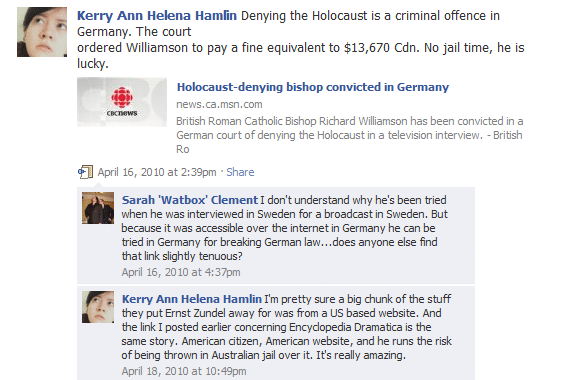
Against Holocaust Denial Laws

Against Holocaust Denial Laws

When the Allied forces began to turn the tide of their conflict against Hitler’s Germany in 1944, one of history’s most disturbing events was about to be discovered.

Named the Final Solution by the Nazis, and subsequently known as the Holocaust around the world, concentration camps were found by Allied forces advancing toward Germany. The first major camp was Majdanek, which was found by the Russians in July 1944. This was followed by other camps in 1945.

The concentration camps were built for one reason – the extermination of the Jewish race by Hitler, in an attempt to breed the perfect Aryan race of blond hair and blue eyes.

While the exact number isn’t known, over six million Jews died in these camps – two thirds of the Jewish residents of Europe at that time. Of this number, one million children perished, along with two million women and three million men.

However, the numbers could be far more – many scholars feel the genocide of other ethnic groups by the Nazis, such as homosexuals, disabled people, Romani and other cultures, should be included. This would mean around 11 million people were murdered in the Holocaust, all because of one man’s twisted vision.

Over the years, there have been many claims by groups and individuals that the Holocaust never happened and that it was a myth created by Israel. Despite the public video footage; the images taken by Allied troops; the admittance of guilt by past Nazi generals – many still believe the Holocaust never happened.

It’s a viewpoint that’s raised questions on free speech and opinions and if, by denying the right to deny the Holocaust, people are having their own right to speak abused.

Now that debate and fight is involving Facebook.

Facebook and Free Speech

A caveat. I’m a huge believer in free speech and differing opinions, and often get shit on because of it – c’est la vie. I will admit I don’t agree on all speech being free – clear hate and sex crime/hate, for example, are some areas I feel opinions step over the line. But then does that make me against true free speech? Possibly.

That’s a personal opinion, though, and would affect very few people in the grand scheme of things (and only if I spoke out). A social network like Facebook, with over 700 million users, is a different kettle of fish. It’s a public platform that allows anyone and everyone to post (and access) status updates, thoughts, views and more.

Holocaust denial

Facebook’s policies look to encourage free speech and opinion, and rightly so. But is there a limit to which this should stop, and a different policy invoked?

That’s one of the questions currently being asked of Facebook by survivors of the Holocaust, in a plea to Facebook to remove groups that have been set up to deny the Holocaust ever happened.

In an open letter posted on the Simon Wiesenthal Center website, the survivors ask Facebook to re-evaluate their approach to what’s classed as free speech versus hate speech so that the atrocities of the past aren’t repeated.

In dialogue so far between the survivors group and Facebook, a Senior VP at Facebook has advised of the importance to “…maintain consistency in our policies, which don’t generally prohibit people from making statements about historical events, no matter how ignorant the statement or how awful the event.”

I’m not sure I can buy that.

Free Speech or Road to Conflict?

As I mentioned earlier, I’m a huge believer in free speech and opinion – yet should all speech be free? Opinion is different – you can keep that to yourself. But, by definition, speech is public and has the ability to change mindsets and start movements.

A speech by Hitler in 1938 led to a movement. It resulted in the deaths of at least six million people.

I’m not naive enough to believe that had the speech never happened, the Holocaust wouldn’t have. Hitler was determined in his path to the Final Solution, and if that speech hadn’t happened, others would have (some did). Nazism was much more than words from a balcony.

But if there’s one thing that history can teach us, it’s that words can be dangerous. When hate is powerful enough, it can see words become a powerful weapon. The world saw its results from Nazi Germany. It sees its results in countries where dictators rule by force, and people live in fear of their gender, sexuality, beliefs and religion being used against them.

Free speech is important – it differentiates true freedom from state-defined freedom. The question is, if free speech is silencing voices and historical fact – and has the potential to incite violence – should it still be free?

I don’t have the answers, just my opinion. You?

Polarization, Fanboys and the Non-Middle Ground

One of the advantages that blogging holds over other forms of media is the often unfiltered voice it allows. From bloggers themselves, to those that comment afterward, the best blog posts – much like the best interviews – allow for some stimulating and thought-provoking discourse around a topic.

It’s always been one of the key reasons that blogs have enjoyed the kind of popularity that they do, since authors – at least the good ones – will allow all sides of an “argument” to be heard, while maintaining a level of respect between the debaters.

Or at least, it used to be.

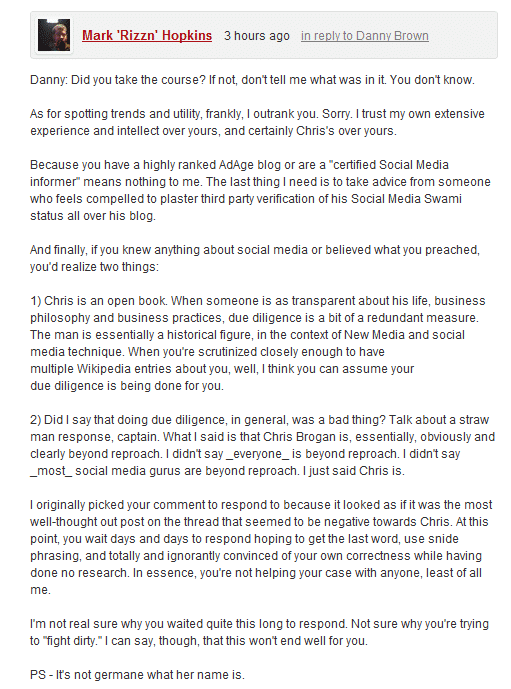
Sadly, many discussions now seem to dissolve into he said, she said kindergarten posturing, as opposed to reasoned discussion. Add to that the “the person you’re talking about is above reproach” (as shown by the image below), and it makes you wonder what happened to agreeing to disagree.

Tunnel vision mindsets

(FYI, Mark – in answer to your question, I took 6 days to reply as I was doing what I get paid to do for my clients, and spending time with my wife and son. I put that first over everything).

There’s nothing wrong with disagreeing. There’s nothing wrong with defending your friends. I’d say both are qualities that should/need to be encouraged more, to ensure healthy debate is allowed and everyone’s voice is heard.

When you start saying someone should apologize for stating their viewpoint, though, or that someone is above reproach, there’s something messed up (as long as the original viewpoint isn’t inciting hate or similar). It takes away the very thing most Internet users celebrate – freedom of opinion and the ability to see all points of view respectfully, whether you agree with them or not.

Instead of questions being asked or viewpoints being shared, you’d be left with people afraid to speak because, clearly, only the opinions of the few and those above reproach are valuable.

Sorry, but I don’t buy that.

Do that, and you might as well start letting the infographics win (hat tip to Marc Girolimetti?for that quip). And just ask Jon Aston what he thinks of infographics to see whether that’s a good thing or not.

Mind you, a lot of this could probably be avoided if bloggers did a better job of looking after all of their blog’s community, and not just the adoring ones…

Note: For the context of the conversation the image represents, click here.?

  • « Go to Previous Page
  • Page 1
  • Interim pages omitted …
  • Page 62
  • Page 63
  • Page 64
  • Page 65
  • Page 66
  • Interim pages omitted …
  • Page 174
  • Go to Next Page »
© 2026 Danny Brown - Made with ♥ on Genesis