• Skip to primary navigation
  • Skip to main content
Danny Brown

Danny Brown

podcaster - author - creator

  • About
  • Podcasts
  • Journal

Insights

Welcoming Livefyre Comments Back to the Blog

Livefyre comments system

If you’re a regular reader of the blog, you’ll notice that I’ve switched the Livefyre commenting system back on, after using the vanilla WordPress option for the last few months.

I was one of the early beta users of the system, and loved the way it took blog commenting and turned it into a real-time chat (as this experiment and the subsequent results show).

However, along with it not really fitting into the blog’s redesign at the time, there were some features that Livefyre lacked, which saw me revert to the standard WordPress comment system (albeit one that was heavily optimized by Bonsai Interactive’s Creative Director, Lisa Kalandjian). But I’ve always kept eyes on the system, and met the team at a conference earlier this year.

And I’m glad I did, because today’s Livefyre is a completely different beast from when I was test-running it, and the features that weren’t around then have made it into the new version. So the time seemed right to switch it back on. So what’s new?

Latest Post or Conversation

Perhaps one of the biggest things that Livefyre lacked previously was the latest post option (or Conversation, as Livefyre calls it). This is what the CommentLuv plug-in offers – the option for anyone leaving a comment to have their last post visible as a link back to their blog.

Livefyre latest conversation option

Where Livefyre’s version differs is that it’s (currently) only for those with a Livefyre account. While it doesn’t offer the same benefits of CommentLuv because of this limitation, it’s a clever way to encourage sign-up. And the cool thing is, if you have multiple blogs, it pulls the last post from the newest publication, so it gives all your blogs an equal amount of promotion.

Simple Site Wide Moderation

When I first had Livefyre switched on, its dashboard area was pretty basic. There were your account details, and the blogs you had registered, and that was pretty much it. It didn’t really allow for analytics or moderation (something the Disqus platform was better at). Not any more.

Livefyre Site Moderation

With the new and improved dashboard, you have much more control. This includes white-listing commenters, banning spammers, marking comments that are offensive so Livefyre can learn them, and more.

It’s a far better system, and makes running the back-end of your commenting system a much easier task.

Improved Social Sharing Options

A lot of bloggers – myself included – have wondered about the effect social networks have on blog comments. Do tweets and Facebook conversations mean fewer comments on the blog (though more overall)? And will the freestyle comment stream of Google+ affect this even more?

Either way, there’s no doubt that a lot of conversations about a post are missed, because they’re taking place on Twitter, Facebook, etc, and not everyone has an account on these platforms. This is where Livefyre is stepping in, to really cultivate the conversation around a post.
Livefyre SocialSync

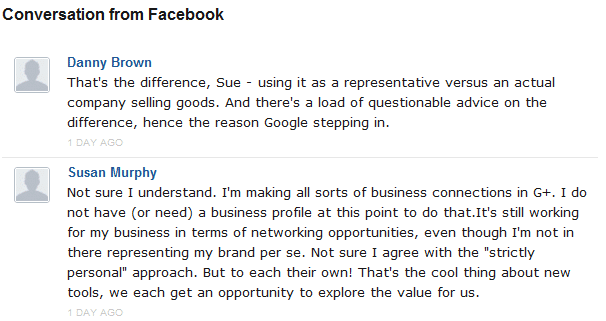
Their new SocialSync feature gives you the option to have tweets and Facebook posts become a part of the post’s comments. This is similar to the Reactions feature on Disqus, with a difference – Livefyre’s way of doing things seems better suited to social conversations being part of the comment stream.

For instance, simple retweets aren’t counted (or shoudn’t be). Instead, only extended conversations around a post are pulled into the comments. The same goes with Facebook – if you share a post on your Facebook Page, then any wall posts by your connections will be pulled over to your post.

It’s not perfect – for example, I’d love the option to be able to reply to Facebook posts from the blog comment (much like you can with the Twitter sync). Additionally, the SocialSync conversations currently split the comments if there are more than 50, as opposed to being at the end of the comment stream (although Livefyre have said they’re looking to fix this). But as a first attempt at really integrating all conversations around a post, it’s a great start. Especially if Livefyre can work a way to include Google+ comments.

The Little Things

So these are three of the main differences in the Livefyre system since last being activated on here. They’ve also added some nice little features – more sign in options (Google and LinkedIn), along with the option to view oldest comments first. Couple these with more CSS options, so you can code Livefyre to suit the design of your blog a bit better, and Livefyre has pretty much got most options covered for a one-stop commenting system.

There are some more features on the way, too, with perhaps one of the most-asked for additions due imminently – the option to allow guest commenting, where you don’t need to have one of the current sign-in options to leave a comment.

I was a big fan of Livefyre before. I think it’s fair to say that, with the new features, I’m pretty much sold on them as the best commenting option out there. Obviously there might be some hiccups along the way, but I’ve always found the Livefyre support to be second-to-none.

And you can’t ask for much more than that.

Advisory: Google Begins Booting Brands

Google Plus

Google Plus

by Danny Brown and Geoff Livingston

Much has been said about marketing on Google+. Both of us have been intentionally conservative about marketing on the new network due to a statement from Google+ specifically asking business and brands to wait until it formalized its business offering. This offering is rumored to include an open API for applications and data usage. Yesterday, a confirmed report from KCET-TV in LA surfaced that Google+ community managers are enforcing the brand “no fly zone.”

To date, ABC News Radio, LAUNCH and Boing Boing have all been removed, or have voluntarily taken down their Google+ profiles. In the face of complaints about brands being unceremoniously dispatched, community managers have indicated that Google+ will focus on optimizing community interaction between people first.

Google Plus business info

Both Bonsai Interactive and Zoetica represent real brands, corporate and nonprofit. We are posting this advisory to provide clear guidance for our clients and network on how to approach Google+ during this interim phase:

1) Do not invest in formal brand marketing on Google+. As we have seen, Google+ is now policing its network and you risk losing your entire time investment. Further, until the business offering is created by Google, no one really knows how corporations and nonprofits can successfully navigate this new social network. In essence, until Google+ for business is released efforts are likely to be all for naught

2) Do experiment on Google+ and learn how the network works using your personal profile. It’s too soon to formally say that Google+ will be a significant consumer network, but with reports of 18 million followers and growing, momentum indicates the network is succeeding. Further, as demonstrated by its policing of the network, Google is clearly focused on community first. Becoming knowledgable through participation on Google+ is prudent at this point.

3) Be wary of marketing services firms and individuals who are seeking paid fees for Google+ marketing insights. Again, per the first point, no one really knows how to market on Google+. Investing financially in Google+ is not a good use of resources until finite offerings are available. Ethically speaking we would not charge our clients for advice and strategies in the face of such uncertainty.

Google+ is starting field trials with brands in the immediate future. As Google works through the kinks and formalizes its offering, it is a great time to become comfortable with the social network.

Many of our fellow bloggers are openly sharing their insights and learning together in a fashion we have not seen in years. Enjoy this time, friends. This kind of new social network launch is unprecedented.

Update 21 July 2011 11.41am: NBC News is the latest to remove their Google+ profile.

image: Sean MacEntee
image: KCET-TV?

Debunking Popular Myths of Social Media

Social media myths

Social media myths

Social media is many things to many people. For some, it’s a core part of their overall business and marketing strategy. For others, it’s a key player in driving traffic to their blog. For others, it’s a new toy they’re just beginning to play with. And for some, it’s about as interesting as pond moss.

So, lots of uses and definitions, depending on who you speak to.

Yet there is one area where all the definitions can come together and agree on, and that’s the area of social media myths. The claims from people that should know better, either for a hidden agenda or a lack of foresight.

So, here are a few social media myths that we can probably all agree are out-of-date thinking at best, and dangerous advice at worst.

Social Media is Free

Bzzzzt (insert noisy buzzer sound here). This one’s been doing the rounds for a while now, and still seems to pop up, even though everything points to the complete opposite. So let’s make it simple – social media is not free.

Yes, the tools are free (unless you have the premium version of these platforms). And, no, not everyone will be looking at the cost investment from the example linked to above.

But even if you’re a small business user or solo entrepreneur using social media to help raise awareness of your brand through interaction, you have to invest a serious amount of time for any traction to begin. So take whatever salary you give yourself, deduct the man hours you put in by the financial cost of this, and that’s the bare minimum of how much social media is going to cost you.

Add to that any advertising on the likes of Facebook Ads and LinkedIn Advertising, and then how you’re going to integrate all your online stuff into your everyday marketing and promotion, and the costs start to add up.

Sure, you can bootstrap your way around social media – but free it ain’t.

Social Media Levels the Playing Field

One of the pros of social media, according to many of its most vocal proponents, is that it levels the playing field. This comes from the viewpoint that it allows the consumer – who never had much of a voice before – to air their grievances in a far more public forum, as well as have access to leading players at these brands.

The belief is that this now means the brand is no longer in control, and the little guy is now the giant. And it’s true – social media does allow the consumer to be a bigger part of the business decisions being made.

Yet there’s also the flip side for businesses. A lot of social media purists will say that small businesses and solo practitioners can compete with the huge corporations and the big agencies, because the tools are the same for everyone.

Except they’re not. A corporation with a $10 million budget for research, strategy, implementation and measuring is going to have a heck of a lot more at their disposal than a small business with $10,000 to play with. And then the scale factor comes into play – can a one-man band (or even a two or three-man band) monitor and respond to social interaction the same way a dedicated team of fifty can for the bigger guys?

The simple answer is no. So, yes, social media can level the field somewhat – but then it also means you have to get new machinery to keep it level, and that’s still beyond the capabilities of many businesses.

You Need the Voice of the Influencers

Like any eco-system, social media has many layers, and at the forefront of these layers are the Influencers. Usually these will be early adopters in the space, and they’ve become influential for identifying trends and looking at how these tools can be used for business.

The problem is, influence is based on relevance, yet many businesses still try and get the Influencers to talk about their products, regardless of whether they’re experienced in that brand’s niche or not. The mindset is that the Influencer has over 100,000 Twitter followers, or tens of thousands of blog subscribers, so it’s an easy “in” to that audience.

Except it’s not.

Because nine times out of ten (not a scientific figure), the Influencer will only share your brand or product for reward. Hard cash, or a large amount of swag. They’ll write about you once, and then move on to the next brand. Because they’re (usually) not invested in you.

But your brand advocates are.

The ones that write and talk about you every day, both online and offline. The ones that truly have your best interests at heart, so they’ll offer you honest feedback on how you can improve. Compare that to the Influencer who thinks your product is great, now just pony up the greenback.

The Influencer may get you a quick buzz, but longevity and success very rarely come from a fire sale. It does come from having an army of advocates and loyal customers, though – look after your advocates and they’ll look after you better than any Influencer can.

Conclusion

There’s no doubt that social media has changed much of the business landscape, and continues to do so. And with potentially game-changing products like Google+ entering the fray, the real fun could just be beginning.

We just need to make sure we’re keeping a level head at what social media can, and doesn’t, offer. If history has taught us anything, it’s that hyperbole is very often the precursor to, “Remember so-and-so?”…

image: Luminis Kanto

If This Was My Last Blog Post

Last blog post

Last blog post

Over at For Bloggers By Bloggers, I offered up a new list of free blog topics to help you with ideas for your blog. There are ten topics to choose from, and it’s something we offer up as a thank-you to the For Bloggers By Bloggers community.

One of the topics suggested is If This Was My Last Blog Post, and its premise is wondering what you would say, if you knew it would be the last post you ever write (if you were to die). A little morbid, maybe, but I’m curious about these kind of things.

So, putting my money where my mouth is, here’s what I would write.

We Waste Too Much Precious Time

We always think we’re too busy to do the things we should be doing. We hang out on social networks; we stay late at the office, doing that one last report; we leave our kids in front of the TV while we read the paper or catch up on emails; and more.

Ask yourself if you really need to be doing these things, or if they can wait. Ask yourself the last time you spent quality time with your loved ones; children; or even just you, away from all the noise and distractions. You might be surprised at how freeing and rewarding it can be.

Don’t Be Afraid to Make Mistakes

As children, we’re unafraid to take risks. We see the world as one big adventure, and if we hurt ourselves along the way we simply shed some tears, get a kiss from our parent(s) and move on to the next adventure. It allows us to grow, because we know not to make the same mistake that hurt us in the first place.

Unfortunately, as adults, it seems like we’ve forgotten the art of learning from our mistakes. We stay with abusive partners; we accept shit from our boss instead of looking for a job where we’re valued; and we never take action on that one big idea we have, because everyone will think it’s stupid.

The thing is, though, we became the adults we are because we learned from our mistakes as children. And we turned out all right (mostly). There’s something to be said for that, no? Don’t be afraid to make mistakes – you’re only hurting yourselves if you do.

Thanks For All The Fish

Bloggers are a strange breed. We basically share our personal thoughts in public, looking for feedback and endorsement (or disagreement). It’s almost like reverse narcissism.

Yet from that weird approach, magical things happen. Communities are built; friendships are grown; mindsets are changed. And sometimes, just sometimes, movements are created from the springboard that a single blog post can create.

I’m incredibly biased, but I see you as one of the best communities on the web. You’ve never been afraid to challenge, whether that be my thoughts or that of other guest writers or commenters. You’ve discussed topics with respect for each other, and helped me grow as a person. Say what you want about online relationships, but you’re all as real and valued as anyone I know offline.

Thank you for being with me while I was on this little blogging journey. It would have been boring as hell without you, and maybe we can continue our conversations on the other side. Underworld+, anyone?

Takeaways and Wishful Thinking

I hope I’ve kept you entertained on this journey. I know I’ll miss everyone I’ve formed bonds and connections with, and I’ll be a little sad for not having the chance to meet more people I would probably be inspired by.

But I can’t complain. I’ve met wonderful people; experienced wonderful events; saw history being changed; and wouldn’t change a single thing. We spend too much time wishing things were different; but sometimes we just need to see the great things we already have because things aren’t different.

If there are any takeaways that I hope I can depart with, it’s that maybe, just maybe, this blog helped you realize you don’t need to be anyone else; that it’s okay to question popular opinion; and that having belief in your convictions is never out of fashion. And maybe gave you the odd bit of business advice along the way…

Take care, guys, and thanks for the memories!

———————–

So, there you have it. My last blog post. I deliberately left out personal words to my family and loved ones, as that would be something just for them. This post – and the premise behind the topic – is for your swan song to your readers.

So – what would you say? Would love to hear your thoughts in the comments. Or, if you’re feeling really inspired, write your own post and either share it in the comments, or link back to the For Bloggers By Bloggers post so others can read too.

Look forward to being inspired.

image: gwilmore

The Art of Patience

Impatient

We’re an impatient bunch.

We always want the new; the shiny; the next big thing. And we want it now.

As consumers, we want the latest and greatest to show off to our friends and family. As businesses, we always want to be first to market to get a jump on the competition.

The problem is, being first doesn’t always mean the best or the shiniest.

The business world is littered with examples of companies that were first to market but were superseded by competitors who learned from the path beater’s mistakes.

On the consumer side, homes are filled with gadgets and contraptions that are no longer needed by the buyer, nor supported by the company that made it (HD-DVD, anyone?).

There’s nothing wrong with wanting to be first. Just make sure it doesn’t end up being the last thing you’re remembered for.

  • « Go to Previous Page
  • Page 1
  • Interim pages omitted …
  • Page 63
  • Page 64
  • Page 65
  • Page 66
  • Page 67
  • Interim pages omitted …
  • Page 174
  • Go to Next Page »
© 2026 Danny Brown - Made with ♥ on Genesis