• Skip to primary navigation
  • Skip to main content
Danny Brown

Danny Brown

podcaster - author - creator

  • About
  • Podcasts
  • Journal

Insights

The Party’s Over for Professional Reviews Leading the Purchase Cycle

11 user reviews before making a decision

Just over 20 years ago, when I first got into marketing, professional reviews were the lead driver of foot traffic to storefronts.

Magazines like Consumer Review and reviews from other print publications, as well as television review shows, would often dictate how well a product would be received once in the open.

It led to a booming industry of professional reviewers, some of whom made a very nice living being known as The Review Person.

But things change.

Jump forward 20 years, and the swan song for the professional reviewer could be about to play out, at least in the tech sector.

It’s All About the Peer

In a recently published joint survey carried out by Weber Shandwick and KRC Research, and involving more than 2,000 U.S. consumers, it’s clear to see that peer reviews have grown beyond just friends advising each other on a new purchase. Now, social connections and search play a far greater role in the purchase cycle, often ignoring professional reviews altogether.

11 user reviews before making a decision

Some of the key findings include:

  • 65% of consumers have bought a product they weren’t intending to buy after reading a positive review;
  • 74% of consumers search for reviews online before making a decision;
  • Consumers read an average 11 reviews before making a decision;
  • Peer reviews are trusted by more consumers (77%) than professional ones (23%);
  • A well-written, fair and reasonable review, with statistics and facts and where the reviewer is named, are the top four factors that will influence a consumer to move from intent to buy;
  • Amazon leads the way in consumer trust, with 39% of the surveyed audience trusting the site completely.

These figures, and some of the other ones in the fuller report, should act as a wake-up call to brands that are still investing in the traditional method of product review – buy advertorial or pitch the mass media – and ignoring search and social graph impact.

Why the Landscape Shifted

It’s easy to blame social media and the advent of easy sharing and research for the trending rise in peer reviews overtaking professional ones. Many brands have cited the lack of accountability when it comes to peer reviews, and as such these reviews should be taken with a pinch of salt.

The thing is, it’s actually the accountability factor that’s helped increase the authority of peer reviews and decreased the need for professional reviews. [pullquote position=”right”]With nothing being invisible thanks to Google Search and other visibility tools, what goes online is there for millions to see.[/pullquote]

If a review on Yelp is seen as false and made with bad intentions to the recipient, it’s removed and the user can’t post other reviews of that business.

If a blogger makes false claims about a company, not only are they liable for prosecution, but the commenters will leave links with the real story for other visitors to access.

And with the likes of the Federal Trade Commission (U.S.) and the Advertising Standard’s Authority (U.K.) addressing the murky waters of false advertising on social media outlets, it’s no longer okay to be a paid shill to promote garbage (if it ever truly was).

There’s also the inherent trust that we build in each other, the more we interact online. Through natural conversations and everyday back and forths, we get to see who’s similar to us in both beliefs and interests.

Influence Marketing book

That manifests itself in our willingness to take their recommendation of something they’ve tried and take a look ourselves, versus some stranger being paid to write about something

And perhaps therein lies the biggest reason for the growth in peer reviews.

The Strength of the Advocate

Whether someone is paid to review a product neutrally, positively or negatively, we know money has exchanged hands. Depending on how long a contract with a publisher is, the author of a professional review may word it in such a way that it’s encouraging the brand to rehire the author.

It’s similar to the failings of focus groups, where the feedback can be biased because of the desire to be invited back and be paid again.

Because of this, people are naturally wary of a professional review and how unbiased (or factual) it truly is.

Switch that around with our social connections who don’t have a play in the game except to help you make your decision. “Yeah, the iPhone is excellent but the speed of the Windows 8 phone was crazy fast compared to my iPhone.”

Peer reviewers (or opinion sharers) aren’t in it for money; there’s no bias; there’s no hidden agenda. It’s simply an honest opinion of theirs to help you make the right choice in yours.

That difference is becoming more evident as we start to filter our connections into groups based on relevance and context to our needs at that time. As these groups and authority within them grow, the professional review will struggle to keep up.

For any brand not making inroads to the peer review marketplace, they might struggle to keep up too…

For a copy of the Executive Report on the survey, click here.

images: Weber Shandwick and KRC Research

We Need Better Insights, Not More Data

A little while back, I wrote about the difference between analytics and insights. My key point was while we may have awesome data at our fingertips, not knowing what to do with that data renders it obsolete and ineffective.

A new survey, with responses from attendees of the recent DMA2012 conference, as well as the recent Forrester Research conference Seizing Opportunity From Digital Disruption, seems to back up that insights versus analytics post.

Filtering The Noise Chamber

Today’s connected consumer has access to an insane amount of information, all at their fingertips, thanks to the ubiquity of smartphone access to the web.

From checking restaurant reviews and stock prices, to taking pictures of a new pair of jeans and asking the opinion of friends on Facebook, today’s consumer is no longer restricted to choosing a brand through a push marketing approach.

This change of direction in the purchase cycle has resulted in brands playing catch up in trying to make sense of this new paradigm.

Instead of buying a media spend and determining results based on increased foot traffic to a storefront, marketers and analysts now have to understand what tipped a consumer from intent to buy to an actual purchase, and what external factors can impact that decision in the first place.

To enable this, technologies and companies have sprung up to allow marketers all the data they need, and more. However, this now presents a new and far more dangerous problem, from the perspective of the marketer:

How can the right data be filtered when there is so much of it? Failure to extrapolate the right data will only make the job tougher for any brand looking to truly understand their customer’s mindset.

Failure to understand your customer equals failure to grow and remain afloat. The scary thing is, though, it’s clear that many marketers just aren’t getting to grips with this new analytical methodology, as the report shows.

The Problem with Data – Lack of Insight

Some of the key findings from the attendees include:

  • 45% said the analysis and application of data is the biggest challenge;
  • 39% are not using demographic information or customer behaviour patterns when creating marketing strategies;
  • 44% don’t envision hiring new employees to oversee this data;
  • 83% plan to start considering using real-time data.

There are other worrying statistics from the results, but I picked out these four because they highlight perfectly the challenges to today’s marketer, as well as the failings of many businesses looking to operate in the space.

If more than a third don’t take something as basic and yet hugely important like demographics and customer behaviour into the equation, and almost half think they’re qualified to oversee this core business component themselves, that’s a problem.

Even more disconcerting is the percentage that don’t use real-time data – 83%.

Eighty three percent.

That’s more than three quarters of the businesses asked not utilizing something as simple as Twitter Search to get the lowdown on what’s being said about their brand or product at any given time, and being able to react to it.

It’s almost like we’re trapped in 2006. If businesses today aren’t utilizing the technology out there to make their business smarter and more effective, then it’s no wonder so many fail when it comes to using social as a complementary component to their other marketing efforts.

It’s not data that’s the problem – it’s the lack of insight into how that data can be mined, analyzed and acted upon. And there’s no need for this to be the case.

Smarter Thinking, Better Execution

Just looking at some of the key points I pulled from the report, there are simple solutions to every one of them.

If analysis and application are the biggest challenges, identify the people who understand this new research opportunity to provide the analysis that’s most important to you – lead generation results, customer service satisfaction, brand perception, competitor activity, etc. (This also addresses the 44% of businesses who don’t foresee employing people to oversee the data).

Additionally, identify the analysis that’s most important to you – lead generation results, customer service satisfaction, brand perception, competitor activity, etc. If you have no-one internally that can address this need, look to the kind of people your competitors have in this key role and act accordingly to, at the very least, match that investment.

Use technology like Quantcast to identify the demographics and behaviour of your web traffic. Cross measure this with tools like Traackr and Nimble, that can identify the key people talking about your brand and then filter them into groups and level of relevance and/or importance when it comes to contact.

Change the mindset of considering real-time intelligence and start making it a key part of your brand’s customer experience reporting. Hell, you don’t even have to be on a platform to set up alerts on the information that matters, and then allocating the right person to deal with that opportunity/situation.

Unless, of course, you’re the type of business that would have the chance to speak with your customer in your shop about how their visit was, and instead advise them you’d rather be in the office drinking coffee and playing Angry Birds.

Data doesn’t have to be scary – you don’t need to be mining every single piece of information out there about your brand. You do, however, need to be mining for the right data that’s important to you at that given time, and act on that.

Reduce the data. Increase the insights. Be a smarter business. You owe it to yourself, and your customers deserve better.

You can get a free copy of the full report here.

Data rich and insight poor

Why We Need One Trick Ponies

Fake social media reviews

As a rule, we love it when people say something that is so utterly foolish we immediately begin ripping it apart.

Call it inbred narcissism, or jealousy, or pettiness, or just pure unbridled joy that someone that was perceived to be smart is, in fact, a rambling, idiotic buffoon. But, we love to destroy.

We take to online networks to decry a blog post or news article, questioning how this latest asshat of the day got any airtime with the content they’ve just shared.

We character assassinate people, saying how dare this person represent our industry when they clearly have no clue what the industry is all about.

We leave angry comments on articles, citing the downfall of Rome and the decay of modern society as being less of a seismic shift for the worst in human intellect than the inane drivel we’ve just read.

And yet…

When we do this, we’re looking at this and reacting to things in completely the wrong way.

Instead of mocking and destroying, we should be praising and wanting more – because, let’s face it, the more obvious idiocy is recognized, the more the smarter examples will come to the fore.

The more we help these folks trip up, the more doing business right will succeed. And that can never be a bad thing.

So let’s celebrate the one trick ponies – after all, they’re helping the thoroughbreds shine brighter…

Why Storify Misses the Point on Protecting Privacy

Facebook groups privacy

Facebook groups privacy

When is a private thought not a private thought? When online curation tool Storify decides to bypass privacy wishes and share that thought publicly.

Over at AGBeat, there’s an interesting (and alarming) story about how Storify can be used to post private updates on Facebook publicly. By using their curation tool, someone in a private or secret Facebook group (where only members can view content) can share something meant for a limited audience for the whole web to view.

Storify co-founder Burt Herman seems to think this is okay, and the perfect example of why you should be careful in who you trust online.

But he’s missing a very key point.

People Can Make Mistakes – Technology Should Be Smarter

In a post on the Storify site addressing the AGBeat article, Herman suggests that curating private posts into a public stream is no different from taking a screenshot of a private update and posting that too.

While technically that may be true, in reality there’s a big difference between the two methods. Founder of business network pioneer Adholes, Marc Lefton, succinctly sums up the issue:

Screenshots are malicious. This [a Storify share] can happen by accident. That’s the difference.

Because Storify makes it simple for people to be browsing a site or network and share something that catches their eye, users (rightly or wrongly) will not always consider the limited audience the original update was meant for.

That’s the equal beauty and fallacy of human nature – excitement about content that grabs attention can result in the emotion of finding that content override the logic of respecting the audience limitation.

Technology like Storify, however, isn’t built on an emotional reaction – it’s bits and bytes taking a logical approach to enabling you to share emotionally-rich content.

Or at least it should be – but as the AGBeat article and Storify co-founder Herman’s shifting of blame to the user proves, the technology only works logically if the developers build it to do so.

Herman’s logic – that you should trust who you share content with not to reshare it if it’s meant to be private – would carry more weight if his platform was consistent in that mindset across all networks. But it isn’t.

If you try and share content via Storify from a protected Twitter account, the privacy settings from the micro-blogging platform prevent Storify from being able to quote the tweet. So it’s clear that Storify’s technology can be stopped by a network’s API.

Which suggests both Facebook and Storify are at fault here – Facebook for not preventing sharing the way Twitter does, and Storify for not recognizing a private group or community’s restricted access settings. Unfortunately, Storify doesn’t really see it this way.

It’s Your Fault

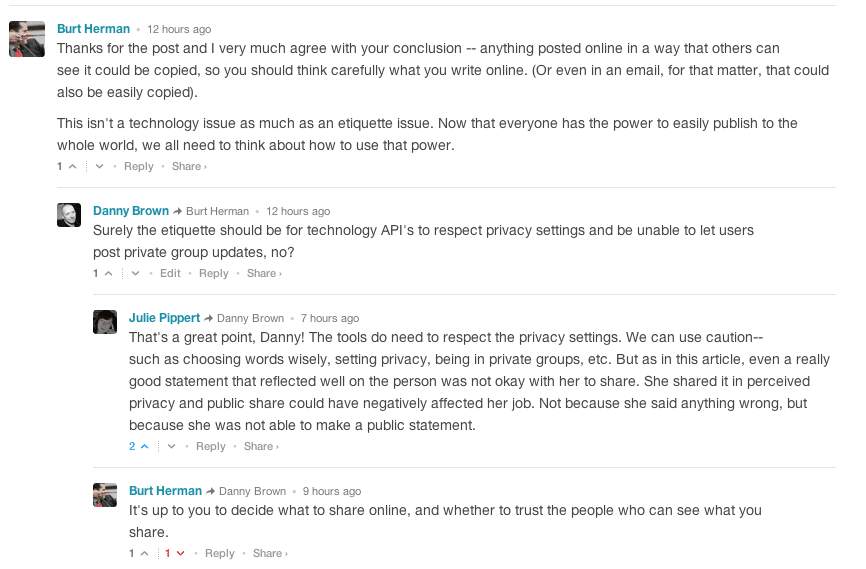
In the comments section of the AGBeat article, I questioned Herman’s stance on user blame after he stated it wasn’t a technology issue, but one of etiquette.

Danny AGBeat

Herman’s answer, ironically, highlights Storify’s failing – the “power” effected by being able to share easily needs to be countered by the ability to identify whether that content should be shared.

Herman’s logic suggests if a private update is shared, it’s your fault for trusting the wrong friends to begin with. But that’s simply absolving responsibility from the platform that offers the public sharing of a private update. Former journalist, and General Manager of Social Media at New York-based technology startup Internet Media Labs, Amy Vernon identifies the flaw in this logic perfectly:

This is the difference:?

You protect your tweets, Storify won’t allow people who are allowed to see your tweets to Storify them. You protect your Facebook posts, Storify will allow people who are allowed to see those posts to Storify them.

Plain and simple.?

Is it, at its root, a human problem? Sure. But all this is changing faster than the average person can keep up. That doesn’t absolve tools and platforms from trying to abide by privacy levels.

Instead of blaming the user, why doesn’t Storify take the higher road and have a filter/blocker in place (similar to the Twitter scenario) where a message pops up prior to the sharing that asks the simple question: “This content is from a restricted source – are you sure you wish to share?” Or, better still, simply change the way Storify scrapes network API’s and only allow sharing of clearly publicly available content.

Of course, to do this would mean admitting Storify (and, by association, Facebook) have a problem. And no-one likes to admit they have a weakness…

image: AGBeat

5 Influence Platforms to Watch in 2013

Meet the social instigators

As we enter a new year, I traditionally start by highlighting people and news to keep an eye on in the year to come.

This year is no different, (yeah, I?m predictable that way). Previously, I shared 5 bloggers for you to watch in 2013 as well as 5 blogs to subscribe to in 2013. In today’s final look ahead, and in no particular order, here are 5 influence platforms to keep an eye on in 2013.

1. Appinions

Recently I was asked what was one of my goals in 2013, and my response was to see social scoring as a means for measuring influence disappear. A number does not reflect a person’s influence – context, relevance, action and integrity do, which is why I like the approach Appinions is taking to social influence.

Appinions

Working directly with brands – they’re not interested in a consumer interface – Appinions uses over a decade of research and academia from Cornell University to connect brands to influencers through a mix of earned, paid and owned media. They also offer strategic partnerships between these brands and their clients, with nary a social score in sight.

2. TrendSpottr

I’ve already featured these guys here earlier this year, but the reason I think TrendSpottr warrants a closer look in 2013 when it comes to influence is simple – they truly have the potential to change the way content is used as a business strategy for companies of all sizes, and how that content influences your marketing strategies.

TrendSpottr

When you think of trends today, you probably think of something like what’s currently trending on Twitter. Yet that’s not a true barometer of trending – that’s simply showing what’s currently popular. For true predictive trend analysis – highlight what has the propensity to become popular based on organic and social conversations – TrendSpottr is the platform to check out.

If you as a publisher or brand can tap into what content is going to go viral – including YouTube videos – and then prepare your own content around that optimized for search, your equity as a thought leader and, by correlation, an influencer has just grown.

3. Traackr

I’ll admit, I confused Traackr with the similarly-named service Trackur, and haven’t looked at them in too much depth before because of this. My bad, since Traackr offers much promise when it comes to highlighting the kind of influencers that really matter to your brand.

TRAACKR  Find the influencers who matter most to you

Instead of pure numbers and how they might amplify a message, Traackr looks to identify influencers based on three core concepts – Reach, Resonance and Relevance. While the Reach part of the equation does take audience size into equation, it’s complemented by the Resonance (the ability to effectively engage that influencer’s community) and Relevance (how contextual that influencer is to your brand) factors, making the overall process much more targeted.

Having just written the chapter in our upcoming book on social influence marketing that looks at these factors as well as others that truly impact your company’s bottom line, I’ll be taking a much closer look at Traackr in the coming weeks for sure.

4. Wahooly

Apart from having a name that reminds me of something a drunken Scot would say in celebration, Wahooly has caught my eye for the approach they’re taking, which is more skewed towards crowdsourced influence.

Wahooly

Kind of like a KickStarter for influence, Wahooly tracks the conversations about startup companies in their database. The more influence your conversation effects around a chosen company, the more points you earn with that company. You can then redeem these points to enjoy “rewards” with that company, from free samples to a chat with the founders and even equity in the company.

It’s an interesting concept, although one that could easily be gamed due to the nature of online chatter and adapting conversations to suit a need. However, the ability to potentially have a say in which startups succeed is one to admire – here’s hoping they can keep the gamification aspect honest.

5. Tellagence

I’ve loved what the Tellagence guys are doing from the first moment I heard about them, mainly because these guys are doing everything right when it comes to online behaviours and understanding how influence truly works on the social web.

Tellagence

Geared solely for Twitter at the moment, but with more networks to follow, Tellagence looks at evolving variables in online behaviour, and how that translates into identifying an influencer at any given time. Instead of saying “Joe is influential in sports”, Tellagence can say “Joe is influential in sports this month, but Sarah will be more influential next month”.

This advanced analysis truly reflects the fluid nature of influence based on a person’s changing interests and makes Tellagence a strong player in the new wave of influence tools about to take off in 2013 and beyond.

Social Scoring is Over

Currently, when you ask someone about influence online, most people will say, “Oh, you mean companies like Klout and Kred and other social scoring platforms”, mainly because that’s all the mainstream really knows about at the minute.

The problem is, social scoring isn’t anywhere near a true measure of someone’s online influence and the impact that can create. Instead, context, situations, relevance, audience behaviour and more are the new currencies of influence.

Or, perhaps they’ve always been the currency, and the platforms such as the ones mentioned above are helping to shape how influence can truly be measured and used in a business setting where lead generation and sales are the end result.

Which, for any business, is what matters the most at the end of the day. Here’s to the future.

Influence Marketing by Danny Brown and Sam FiorellaNote: As we gear up to the launch of our book in the near future, we’ll be hosting a series of exclusive webinars with the platforms and founders we feel are shaping the influence industry for the next 12-18 months and beyond. You can get access to these webinars, and choose which one you’d like to attend, when you pre-order our book and forward a copy of your receipt to info@influencemarketingbook.com – look forward to seeing you there.

  • « Go to Previous Page
  • Page 1
  • Interim pages omitted …
  • Page 37
  • Page 38
  • Page 39
  • Page 40
  • Page 41
  • Interim pages omitted …
  • Page 174
  • Go to Next Page »
© 2026 Danny Brown - Made with ♥ on Genesis