• Skip to primary navigation
  • Skip to main content
Danny Brown

Danny Brown

podcaster - author - creator

  • About
  • Podcasts
  • Journal

Insights

Free Subscriptions Cost Money Too

TORONTO, ONTARIO 1960'S TORONTO STAR NEWSPAPER...
Image by woody1778a via Flickr

About two weeks ago, I started to get the Toronto Star delivered to my doorstep. Which confused me a little, since I get all my news online, and I didn’t sign up for a subscription. Being the good soul I am, I took it indoors from the cold and warmed it up by reading it.

Since it was the weekend when this happened, I thought it might be a one-off Saturday promotion to attract new subscribers.

Then the weekday editions arrived as well, starting on the following Monday. Time to find out what was happening.

I called the Star’s subscription office and explained what was happening. The girl I spoke to was very helpful, apologized and explained sometimes this happens (although no reason was given why). She said she’d make sure the subscription stopped and that I wouldn’t be charged. Cool, case solved and back to my paperless world.

Until the next day, when the Star arrived again. Then the next. And the next. And… well, you get the picture. So, looks like I’m stuck with the paper. But here’s the kicker.

I looked at how much it costs to subscribe to the Star. If you fill out their online subscription form, it’s $4.47 plus tax per week. However, this is a special offer that ends February 1, which saves you 30% on the normal price. So, for argument’s sake, let’s go with the normal price, which would then be $6.40 (by my calculations).

$6.40 per week for 52 weeks – that would be $332.80 per year (plus tax) just for me alone. One person. Now, according to the girl I spoke to, this can happen. I wonder how often, and to how many.

The newspaper industry is in a bit of turmoil at the minute. It’s one that’s been hit particularly hard by online media sources, ink costs and the failing economy. While just over $330 per year may not sound a lot, it soon adds up with every new person it applies to.

I’d hazard a guess that the Star’s subscription team being unaware of why it’s happening – and worse yet, letting it continue – won’t go down well with the rest of the paper’s employees should cutbacks need to be made to save costs.

Which makes me wonder. If you’re in business, do you know where all your money’s going?

If you enjoyed this post, please consider leaving a comment and subscribe to my RSS feed or via email to ensure you can enjoy the latest post(s).

Reblog this post [with Zemanta]

Can I Buy You?

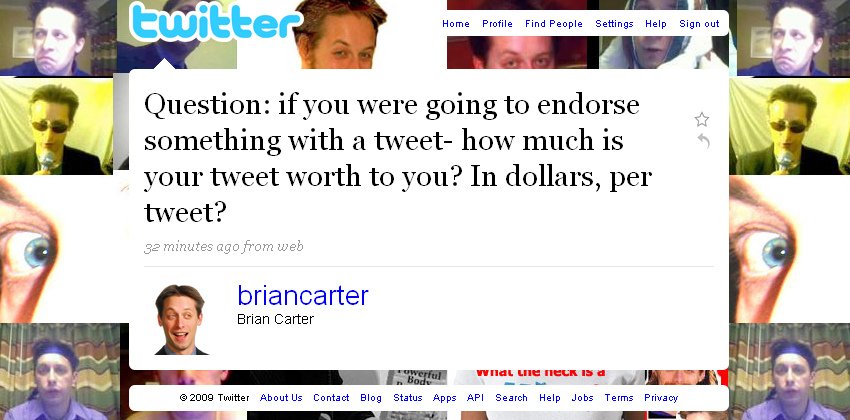
Brian Carter, a guy I admire immensely, raised an interesting question on Twitter today. He asked:

bcartertweetendorse

My own answer was, “It’s a moot point. If I like something enough to endorse it, I’d do it anyway for free. I wouldn’t sell my trust away.” Yet even as I said that, I wondered if I was looking at Brian’s question properly. Is an endorsement any different from a recommendation, or sponsorship?

Looking at the answers that Brian received, there was a definite mixed bag:

  • “I endorse my friends and products for free.”
  • “If I love the product and get a free sample, I would happily tweet for free.”
  • “$1 a tweet.”
  • “I’d say about fifty cents a tweet, $1 to include a link?”
  • “It’s not the matter of the price of my tweet, it’s the price of the endorsement (which isn’t for sale.”

These are just some examples of the mixed reception the question got. (And I’m not saying any of them are right or wrong – these are just some typical examples of the mix). The fact that opinion seems to be evenly split is what makes me question when, or if, paid endorsement breaks the trust barrier?

To me, endorsing something is because you’ve used a product, service or person and you’re completely sold on it. You’re so taken with the results that you’ll wholeheartedly recommend it or them to your friends, family and colleagues. It’s the ultimate compliment – “It’s so good that I’m happy to use it.”

It’s the trust measurement that people who know and respect you will use when making decisions. So would a blind endorsement break that trust?

The fallout can be intensive when someone’s seen to have broken that trust measurement. You only need to look at the recent Izea sponsored posts outcry as an example. Trust is one of our most prized commodities and often it’s what separates us from contemporaries.

But is endorsing something in your Twitter stream for monetary gain any different from advertising on your blog? My own view says there is a difference. Usually you’re not approached by advertisers for a space on your blog (unless it’s a hugely popular one). I’m guessing paid endorsements would see vendors proactively buying your Twitter advertising space more than they might blog space.

Yet with the economy making things hard for people everywhere, should we question people’s rights to make money where they can? After all, we’re sensible enough to make our own decisions on whether a recommendation or endorsement is worth acting on, no?

What’s your take? Is your view for sale?

It’s Not All About The Blog

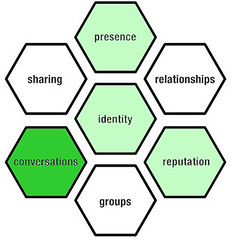
Blogs and the Honeycomb Model
Image by magia3e via Flickr

Should I have a blog? It’s one of the questions I’m asked most frequently when I sit down with a new client to discuss their online presence.

They’ve seen other blogs – personal and professional – and they’re wondering if they should be part of the party. The answer isn’t always what they expect.

Are you ready to blog?

Okay, so I cheat and ask another question instead of giving them an immediate answer – but sometimes questions are answers.

Blogging is something that you really want to do – it’s not always just about the need. Especially for business blogs. Yes, it’s a great tool for offering a more personal voice to your business. And for building community, it’s priceless.

But only if it’s done with the passion and time it needs.

Look at the most successful capitalist on the planet. Bill Gates has made billions of dollars and built the business he started into one of the leading software companies today. Yet he doesn’t blog, nor does it look like he will anytime soon. (People were asking as far back as 2004 when Gates would start blogging – we’re still waiting).

Of course, you could say that Gates is different from most business owners because of his outreach. And that’s true. Still, if you have the product or service that talks for itself, size is irrelevant – word-of-mouth will spread your message.

So no, you don’t always need a blog. There are many ways to tell the world about you and your product – blogging is just one of them. The biggest mistake to make is to have one because your contemporaries or competitors do.

Getting your message out is key – but how key is it if the words are diluted?

Competition and Changes

last one!
Image by presta via Flickr

For regular readers of this blog, you’ve probably noticed the change in design. Again. Despite the previous one being in use for less than a month. So my apologies for any confusion – I swear I’m not going through an identity crisis!

Unfortunately, while I did like the design of the previous theme, there were some compatibility issues with some of the plug-ins that I use. These couldn’t be worked around, so the result is what you see now. I hope you like it.

Of course, subconsciously the re-design may have something to do with the fact that I just helped my wife get her blog up-and-running. While she’s had a couple of blogs prior to her new one, this is her first self-hosted one. Seeing it all come together was the impetus I needed to look at my own, as well as the fact the plug-in issues needed to be resolved.

You should check it out – she’s got a far sharper mind than I have and she has some interesting ways of putting her views across…

So there you go. New design but still same old me, and competition from my wife for readers – just another day in the life.

Thanks for your patience while I keep dabbling to get a fixed abode – I think this one’s a keeper!

Acorns And Oak Trees

Empty Acorn on Tree
Image by Chris Campbell via Flickr

I had the good (?) fortune to sit down with the CEO of a PR agency in Toronto recently. He had been at a seminar I attended regarding converging technologies and mediums and how they fit into the role of the PR professional. We got chatting and decided to have lunch together.

Now, I’m a pretty open guy to how businesses run themselves, but this lunch was an eye-opener.

The conversation turned naturally to the economy and the effect it’s having on agencies and clients alike. My lunch partner said he was finding it tough as his clients just weren’t spending, yet he was sure both would start needing his agency’s services again soon. I asked if he’d lost a lot of clients to the credit crunch – after all, being reduced to two clients must be extra tough.

His response floored me.

“Oh, no, we never have more than two clients at any time – we just concentrate on finding the biggest and most profitable ones and stick with them.” So, no small businesses or entrepreneurs, I asked. The answer: “Why would I want to deal with the little guy? How would that enhance my reputation?”

The lunch ended, we exchanged business cards and went our separate ways. I wondered if I should have probed him more on his views about clients, but the way he emphasized the “my reputation” part made me think he was only in business for one reason – his glory. Which normally means any arguments falling on deaf ears.

Yet perhaps I shouldn’t have been too surprised. Too many businesses in too many industries have forgotten about the little guy. Too many businesses think dollars over development. Too many businesses think pre-built over building.

Just when this mindset happened escapes me – what doesn’t escape me is the narrow-minded tunnel vision behind it.

Did the CEO of the Toronto PR agency start off as a ready-made success story? Did Richard Branson jump into the business world with Virgin already a huge success? Does being a large corporation guarantee success levels?

Of course not. Yet still the belief remains in many businesses that small is a necessary evil, to tolerate while the big boys gather to put small in its place.

These are dangerous thoughts.

True success comes from the building of relationships. Of loyalties being forged. Of give and take and the combining of good ideas and openness to encourage greatness.

Aim high – there’s nothing wrong with that. But just take a minute to think what’s going to get you higher – two giants 100 feet tall who control you, or hundreds of normal sized people who respect you.

The choice is yours – I know whose company I’d prefer to keep. How about you?

  • « Go to Previous Page
  • Page 1
  • Interim pages omitted …
  • Page 153
  • Page 154
  • Page 155
  • Page 156
  • Page 157
  • Interim pages omitted …
  • Page 174
  • Go to Next Page »
© 2026 Danny Brown - Made with ♥ on Genesis