• Skip to primary navigation
  • Skip to main content
Danny Brown

Danny Brown

podcaster - author - creator

  • About
  • Podcasts
  • Journal

Insights

A Matter of Black and White

DeWayne, MLK & Obama
Image by dogsy via Flickr

Think of these names – Abraham Lincoln, Jesse Owens, Rosa Parks, Martin Luther King Jr., Muhammed Ali, Arthur Ashe and Barack Obama. What do they mean to you? Great sports people, politicians and public speakers/activists? Or people who, with others, fought to offer black people better opportunities and rights and encourage integration and equality?

So why are the messages still not getting through?

According to a survey by Lattimer Communications, as many as 86% African-American women say marketers don’t understand them.

86%.

The biggest complaint is that the companies reaching out to them aren’t really communicating with them. Industry culprits include banking/financial, healthcare/pharmaceutical, fast food and the automotive industries.

Consider that the US auto industry calls Detroit “home”, a predominantly black city with almost 82% of its residents African-American. If an industry can’t even get it right with people on its own front doorstep, what’s going wrong?

Is the marketing industry (along with many others) guilty of targeting certain demographics and hoping everyone else joins in? Why does more than 3/4 of a consumer audience feel left out and disenchanted with how they’re sold to?

Sadly, I don’t have the answers. But others do. And they need to look at why they’re alienating such a large number of customers, before someone else does. Barack Obama was swept in on a promise of change – it’s time companies started living up to that premise.

What are you doing to reach out and communicate?

Small Print, Big Noise

small print zine exhibition
Image by moirabot via Flickr

Suite 101 is a reasonably well-known consumer website that uses multi-national freelance writers to provide its content. The writers only get paid from revenue generated by ads and page views, so it’s generally up-and-coming writers that tend to provide the content.

Recently, an email was sent out to all the site’s writers about a competition that’s being run. Up for grabs are three prizes of $101 for three different writers.

All the site’s writers have to do is write about spring, and if their name is one of the three randomly chosen by the Editor, they’ll win the $101. Great incentive, right?

Not exactly – here’s where the small print about entry regulations offers a nice kick in the teeth.

  1. Only writers published in February can enter (so if you wrote about spring in January already, tough).
  2. You have to publish a minimum of five articles about spring. They also have to pass the editorial process, and if one of them needs editing, it’s discounted as one of the five.
  3. Only writers from Canada (except Quebec), the United States or the United Kingdom can enter. Which seems bizarre, since the parent company of the site is German and it uses writers worldwide.

So, all of a sudden, the $101 is only for a select group of people (despite the great work that other writers on the site offer) and you need five “perfect-first-time” articles to qualify.

The minimum word count per article on this site is 300 words. You also need to provide your own images, search engine optimization and formatting. So, generally, an article could take an hour or two to write when coupled with research and tools needed. Suddenly that $101 doesn’t look so enticing, except for the website in question that gets a whole slew of new content to please its advertisers.

I’m sure they may feel that the small print covers their backs when it comes to how crappy this deal is. The problem with small print, though, is that if it’s too small then people start using magnifying glasses to read it. And when it’s magnified, small print can have a habit of coming back and biting you on the ass, especially if it’s perceived as unfair to the end user.

Your choice.

If you enjoyed this post, please consider leaving a comment and subscribe to my RSS feed or via email to ensure you can enjoy the latest post(s).

Reblog this post [with Zemanta]

Market Value

Obverse and reverse sides of single-ride token...
Image via Wikipedia

In Toronto, the main public transport system is the TTC, or Toronto Transit Commission. They handle buses, streetcars and subway trains for the Greater Toronto Area, which is a pretty wide circle of commuters. They had a pretty stormy 2007 and early 2008, with disputes between employees and management and fairly poor service for its 2.5 million daily users.

Yet in the last six months the TTC has been visibly trying to repair damaged bridges. They’re decommissioning their aging streetcars and replacing with energy-efficient LRV’s instead. They’re looking to increase the amount of subway connections to the commuters that really need it. Their buses are being replaced by hybrid vehicles, to fall in line with the Ontario eco-friendly program.

Add to this the improved (yet still not ideal) employee structures, the OneStop Media LCD information screens in stations keeping commuters up-to-date with the latest news as they travel and the fact that TTC fares have stayed the same $2.75 since 2007, and things are looking much better for the company.

Compare that with Mississauga Transit, which is about 36 miles from Toronto yet still falls within the GTA area and is serviced by the TTC subway system. They’ve just put their prices up from $2.75 to $3.00 (this is the same whether you’re a child in grades 1-8 or senior citizen – no discount there).

They’ve cut a lot of services, and many don’t run on a Sunday – not even to some of the larger shopping malls where local retailers count on consumers to stay afloat. They recently closed down one of their main bus stations for upgrades and moved the passenger embarking area without any clear cut announcements. Services at peak time are often 20 minutes to half an hour apart.

They do have a shiny new email alert system for delays, so it’s not all bad…

Market value is a key commodity between businesses and their customers. Word of mouth, both good and bad, is the currency behind the value. What are your customers saying about you?

If you enjoyed this post, please consider leaving a comment and subscribe to my RSS feed or via email to ensure you can enjoy the latest post(s).

Reblog this post [with Zemanta]

It’s Good to Say No

My social Network on Flickr, Facebook, Twitter...
Image by luc legay via Flickr

If you’re a business owner, do you have a social media presence yet? Set up your Twitter account, added a shiny new company blog and joined Facebook? How about a Squidoo page or a Ning community? Networking on LinkedIn? Got them all on your checklist? No?

GOOD.

Despite what you might hear, you don’t need a presence on every single social media network or community.

Contrary to popular belief, social media is not the be all and end all to your business worries. It’s not the one-fit-catches-all solution that will bring you endless streams of revenue and profit.

It is a powerful medium to spread your message and engage with your customers – but your customers need to be there first, old and new.

It is a hugely cost-effective medium when compared to traditional promotional and marketing spend, but you need to invest a lot of time to make it work. Time can be just as expensive a commodity as a media campaign.

Ask yourself who your core audience is. Are they the early adopters that would use social media much like boxers would use mouth pieces? Do they fall within the key users of the mediums you’re looking at? If not, why waste time in that arena? Why try and spread a message to people with closed ears? Even the most silver-tongued persuader will have a hard time if he can’t speak sign language.

By all means, open your business up to the strengths and opportunities that social media can offer. But open up the right doors – make sure your business is the key that fits.

Your business survives because your customers say yes. But sometimes it’s good to say no too. No?

But I’m Not a Shepherd

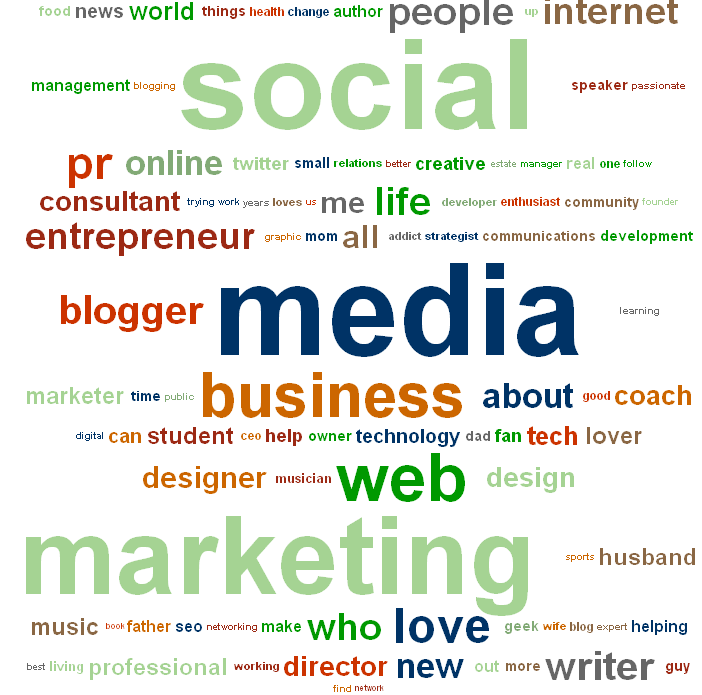
Apart from using the term “sheep”, which seems a little off (sheep follow blindly – people make their own choices), TwitterSheep is a pretty cool Twitter application that offers a visual cloud of someone’s followers. Simply type in a username and you’ll see a word cloud that’s generated by each follower’s profile.

There are obvious instant benefits to this – for example, what a new follower may talk about the most as well as what your own outreach is like.

Here’s mine. Who’s in your radar?

flock

If you enjoyed this post, please consider leaving a comment and subscribe to my RSS feed or via email to ensure you can enjoy the latest post(s).

  • « Go to Previous Page
  • Page 1
  • Interim pages omitted …
  • Page 151
  • Page 152
  • Page 153
  • Page 154
  • Page 155
  • Interim pages omitted …
  • Page 174
  • Go to Next Page »
© 2026 Danny Brown - Made with ♥ on Genesis