• Skip to primary navigation
  • Skip to main content
Danny Brown

Danny Brown

podcaster - author - creator

  • About
  • Podcasts
  • Journal

Marketing

The Problem with Influence

Ego and big heads

I just read something by a friend that’s both interesting and sad at the same time (and sad as in lame, not as in Bambi).

My friend mentioned that he was speaking to a well-known PR guy and author a few months back.

The topic of the conversation was a site for bloggers and authors that my friend works at. According to the PR guy, the site would never be much of a success because he (the PR guy and author) wasn’t ranked high enough.

The PR guy then went on to say that the site wouldn’t be a success because, “You have to make sure the biggest influencers are ranked at the top.”

As my friend so eloquently put it, well f*ck me sideways.

Influence Shminfluence

The problem with influence is that it all boils down to relevancy. You can’t tell me that a pig farmer in Alaska (tough old pigs out there!) is influenced by what a PR guy is saying about the 2.0 or 3.0 world.

Instead, I’d think he’d be more influenced by bacon writers and pork chefs, and analysts looking at how the pork buy trade will look in the next two years.

When it comes to influence, the folks that matter to us are the ones that are in our industry, or affect the industries of our customers and clients. That’s what influences our business and its success (or lack of it), not someone who’s in an industry that has little to no relevance to us.

There’s no doubting that the PR guy is influential in his sphere – but does that mean he should be viewed as such in all spheres, and “ranked higher” because of it?

Egos and Eggheads

And this is where the real “problem” with influence comes in – when it starts to make you feel you automatically deserve to be in a certain position, or recognized more by something or someone.

The quote my friend uses – “You have to make sure the biggest influencers are ranked at the top” – is possibly the biggest reason why influence is coming under so much flak at the minute (just Google “Klout sucks” to see some examples).

We seem to be creating an environment where people expect to “be someone” because you have some success in a certain field, which is a shame.

There’s nothing wrong with success, and there’s nothing wrong with pride in your achievements. Hell, success should be celebrated.

Ego, on the other hand (especially one where your head gets as big as an egg’s on a pin tack) is a different beast altogether. When it reaches the stage that someone says a venture won’t be successful because the influencers aren’t ranked higher – then we have a problem.

Influence and Success

We need influence. Consumers buy from their favourite celebrities and their recommendations of a product. Professionals buy from people they trust when that person makes a recommendation. Brands use “names” to help promote products and services.

So influence works. But wouldn’t it be better to be the right influence, as opposed to the type that’s defined by someone who appears to have a huge dose of self-importance?

And as for that site that would never be a success?

There are about 30,000 authors and bloggers registered with the site. The company had a great Blog World Expo, and are about to launch a new platform that (ironically) will help people like the critical PR guy connect with bloggers for PR campaigns.

Not too bad for something that defines its own influence, huh?

image: Divine Harvester

Business Lessons from Theme Parks

Business lessons from rollercoasters

Business lessons from rollercoasters

When you go to a theme park, do you spend time waiting on the best rides and rollercoasters? Or do you bypass them and go for the more sedate ones with the lesser crowd? Or don?t you go for the rides, more the experience of an enjoyable day out with friends and family?

If you?re like me, you?ll happily wait for an hour (or more) for the fastest rollercoaster, or the one with the biggest drop, or any of the other thrillseeker-type rides. It?s a no-brainer, and if I have to wait to enjoy it, so be it.

Yet is it really a no-brainer?

Think about why you want to ride that rollercoaster, or go on that attraction that shoots you 150-feet in the air before bringing you crashing down to earth in a matter of seconds.

Is it because of your adventurous side, or is it because of the way the ride has been sold to you? Are the words ??death-defying?, ?ultimate thrill ride? and ?your fear is all that stops you? the real reason that you?re in the park?

Theme park operators are some of the canniest minds in marketing.

They know how to reach their target audience and they know exactly which buttons to press to get that audience into their parks. And with theme park technology advancing at such a fast pace, hitting your mark is what separates the must-visit theme parks from the sympathy stop-off when there?s nothing better to do.

Own Your Theme Park

How are you communicating with your target audience?

Do you offer the most exciting rides and the reason why customers should choose your business over the competing one? You need to make sure that your customers are happy to stay in your line ? you need to offer them an end result that blows them away.

You may not have the fastest ride; you may not have the biggest; but if you have the best (or at least the best in the eyes of your customers) then you?ll fill your theme park up regularly. So, how do you make your ride the star attraction?

Offer choices. A theme park would be nothing if there was just one ride, no matter how exciting it was. The ones with the most visitors get them for a reason ? choice.

Your customers are no different ? but are you catering to them, or excluding them? Do your products cater to left-handed people, for example? If not, you can knock 10% from your potential sales figures immediately. Are you excluding minorities? Are there different sizes or designs for the same product? If not, should there be?

Look at what you offer and ask yourself if you can offer alternatives for those that need it. Use analytics and market research to understand your audience and what they?re buying. More importantly, understand what they?re not buying and why.

There are thousands of theme parks all vying for your visitors. Are you giving a reason why yours is the best?

image: Carol Browne

From Stats to Strats – Free Social Media Ebook

Free social media marketing ebook

One of the things we’re always hearing about social media is how it’s changing the business landscape for companies of all sizes.

What we don’t always hear, though, is how you can be part of these changes, whether it’s from your own business point-of-view, or that of your social media-enabled customers.

To help with this, we’ve put together this free ebook that shares some of the more useful statistics of the most popular social networks, as well as some ways you can use this information to build a social media strategy into your other marketing efforts.

Hopefully you’ll find some use in it. We’ll also be offering other ebooks and exclusive business guides soon, so if you’re interested in these, you can use the sign-up form at the end of this post.

And let us know if you found the ebook useful. Cheers!

Free social media marketing ebook

To download the ebook, simply right-click on the image and choose Save Link As.

[gravityform id=3 name=Ebookand Business Guides Sign-Up Form]

The Problem with Automated Urinals

Splashback

Splashback

I have a problem with automated urinals.

Not in how I use them; I know how to pee in public (and I’m sorry if this post veers off into uncharted territory here – I’ll try keep it clean). No, I’m more frustrated with the way automated urinals use themselves.

For anyone not sure what an automated urinal is (my lady readers might not be aware of their delicacies, for instance), here’s the quick overview.

  • You go to a public toilet (or washroom, as they’re called here in North America).
  • You “do your business” at the urinal.
  • You have the choice of pressing a button or flipping a handle/switch to flush, or you leave it to the urinal’s automatic flush.
  • You go wash your hands and leave.

Simple, right? So you’d think. But there seems to be a new breed of automated urinals on the loose, and they’re the ones that are out to frustrate. Here’s why.

Jumping In Prematurely

The difference between a manual flush and an automated one is clear. With a manual flush, you know when you’re finished and ready to flush. Perfect – pee, put away, push button. Job done.

With the automated approach though, it can often begin the flush cycle before you’re done. Which is always fun to get some nice splashback from a still-in-use urinal (sorry, I did say I’d try and keep it clean!).

So, no matter if you’re ready for it or not, automation is kicking in and probably ruining your day. Not good.

One Size Fits All

While this isn’t really a problem just for automated urinals, it does come into play a little bit more when it is automated.

Basically, most urinals (at least the ones I’ve used) are all a standard size. Unless it’s open plan – then it just looks like a line-up not too dissimilar from pigs eating at a trough.

With the closed ones, though, they’re pretty much standardized as far as dimensions go. So, you can be tall, small, wide, thin, hunchbacked or any other numerous descriptions that separates us from each other. And this can be a pain at an automated urinal.

Say you get an extra-wide guy next to you – you have to try and accommodate by moving over a bit (trust me, you don’t want to share pee space!). Of course, the issue is, because you’ve moved over, you’re now in the line of fire of the urinal next to you. And if the automated system kicks in too early again… You get the point. Again, not good.

Being Unprepared for the Unexpected

It happens. You might go to the toilet, and you could be on the phone as you go in (either calling or texting/instant messaging). Generally, if I’m on a call, I’ll say I’ll call back before going in, so no problem there. But I have been texting occasionally before I need to use the urinal.

Of course, the problem here is that the automated urinal only sees what’s in front of it, and gauges that (by the amount of time I’ve been stood in front of it), I must be done. On with the flush cycle which, once more, can come with the lovely splashback syndrome if the urinal isn’t at optimal emptiness for a flush cycle.

Again, as before, not good.

Are You Taking the Piss?

Okay. So we’ve gone through three examples of why I hate automated urinals. And you’re maybe thinking, “What the hell is Danny telling us this for? This is meant to be a marketing blog with social media insights, no?”.

And you’re right.

So, switch out automated urinals for your business. Or your marketing. Or your sales pitch. Or your advertising. Or your branding. Or any other metric that makes or breaks a business. Look at the sub-headers, and ask yourself the following questions:

  • Jumping in Prematurely. Are you jumping into a new market prematurely? Are you expanding your services too prematurely? Is your quality control process premature in offering solutions, and actually causing more problems?
  • One Size Fits All. Are you offering a one size fits all solution when every customer needs a different one? Are you missing leads because you’re focusing on the same sales pitch for every customer? Are you herding your employees into the same “do as we say” mindset instead of encouraging creativity and leadership?
  • Being Unprepared for the Unexpected. Do you have a back-up if things go pear-shaped? Can you run your business if a key supplier went out of business? Are you putting all your leads into a single or limited client basket? Are you prepared for a crisis erupting around your brand?

I started this blog talking about automated urinals (and they do actually bug the heck out of me). But like I say, swap that out to a business view, and it still rings true. If you’re automating things when manual would be better, you’re probably being less useful than you think.

So – are you prepared or are you just flushing your success away?

image: salendron

How NOT to Win Friends and Influence People

DSNR Media spams Facebook page of Danny Brown

When is sharing information useful, and when is it just spamming off the back of someone else’s community?

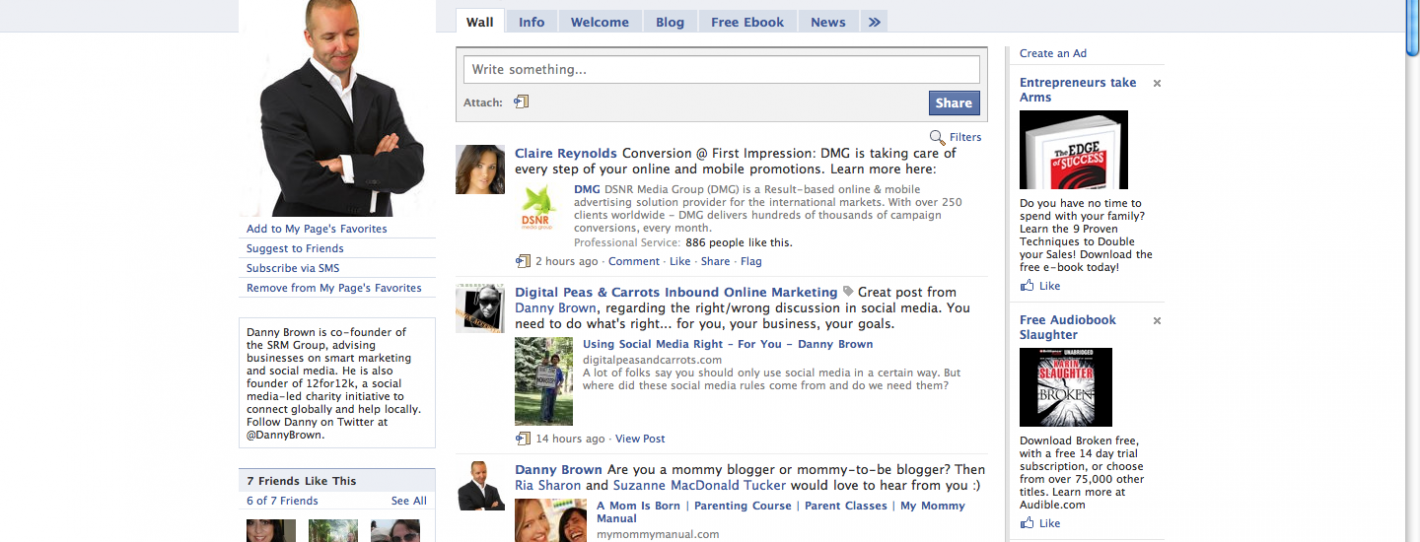
I ask because when I logged into my Facebook page today to post an update on a future Bonsai Interactive event, I was met with this at the top of my wall (click to expand).

DSNR Media spams Facebook page of Danny Brown

It was posted by Claire Reynolds on behalf of the DSNR Media Group. At least I think it’s by Claire on behalf of DSNR, since Claire’s Facebook profile has her located in the U.K., while DSNR are based in Israel.

DSNR describe themselves as “a recognized global provider of result-based online and mobile advertising solutions… with cutting edge optimization tools.” Really, DSNR?

So spamming your message onto a Facebook wall is considered cutting edge? Shilling your wares without permission is your great advertising solutions? Posting links to your service where they may or may not be relevant to the audience is ethical?

Here’s a heads-up – spam is not cool.

You can paint it whatever way you like, but you’re spamming.

You’re an online advertising company, so I’m pretty sure you’re aware of Permission Marketing from Seth Godin. Even though it was written over 10 years ago, it’s still more than relevant today. Check it out – it’s a great read and might open your eyes as to why your current spamming approach isn’t welcome.

In the meantime, I’m removing your post on my wall. I respect the community I have over there, and I don’t want them spammed by you either.

Have a great week.

  • « Go to Previous Page
  • Page 1
  • Interim pages omitted …
  • Page 16
  • Page 17
  • Page 18
  • Page 19
  • Go to Next Page »
© 2026 Danny Brown - Made with ♥ on Genesis