• Skip to primary navigation
  • Skip to main content
Danny Brown

Danny Brown

podcaster - author - creator

  • About
  • Podcasts
  • Journal

Marketing

Culture Club or Knowing Your Customer

International cultures

International cultures

Did you know that in Germany, you should always use a knife and fork to eat sandwiches? Or that in Italy you shouldn?t yawn in front of others?

How about clicking your fingers or whistling in China ? did you know it?s rude?

There are a lot of differences between cultures. Some are less profound than others, yet they?re there all the same. Are you taking that into account when trying to reach that audience?

Say your new client is from Italy and you?re having a webinar. That yawn you fail to stifle during the meeting could skittle that big account you?ve worked so hard for over the last few months. Or you have new investors from Mexico. If you don?t keep your hands above the table, it?s seen as a sign of disrespect. And who wants to work with someone that disrespects them?

It doesn?t matter if you?re in PR, marketing, advertising, manufacturing, retail or a million other industries. If you don?t know either your client or audience, you?re not going to succeed too well.

Online sales have increased massively over the last few years. The Internet and e-commerce have made international trading the equivalent of buying at your local produce market. Even your local produce market – or any offline equivalent – usually has a huge mish-mash of different cultures in the trading stalls.

Shouldn?t we spare that little bit of time beforehand to get to know the culture and see the bigger picture?

image: xiaming
Influence That!

Klout and Influence

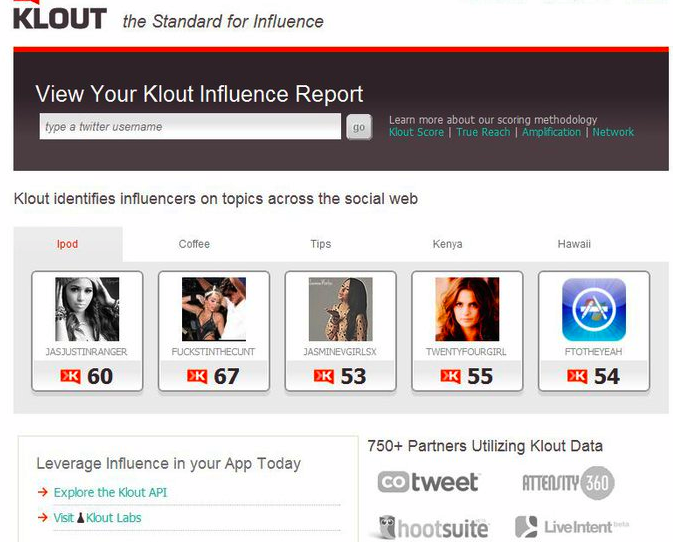
There’s a lot of negativity around online influence tools at the minute. Things like Twitter Grader, Klout and similar are coming under fire, with common complaints being how is influence decided, what metrics are used, and does it even matter anyway.

Allyson Kapin came up with a great statement, about measuring impact as opposed to influence – show us real metrics of success from your actions as opposed to success with your interactions (big difference).

There’s no doubt influence can be beneficial – think of Ashton Kutcher getting his Twitter followers to buy a bunch of mosquito nets to fight malaria, for example.

Yet, as the second image from the left below (taken from the Klout homepage) shows, there’s still a ways to go on defining influence, and sums up perfectly why influence measurement tools are coming under fire.

Unless there’s a big market for vaginal influencers…

Does Klout influence matter

Personal Marketing with Canadian Pet Connection

Brandon and Lorne Forder of Canadian Pet Connection

Brandon and Lorne Forder of Canadian Pet Connection

How are you influenced? By adverts? Marketing campaigns? Email blasts? Word-of-mouth? A little bit of each?

How about personal marketing?

Would you be more inclined to shop with someone that actively takes the time to know who you are, what your needs are and what your shopping pattern might be? I know I would.

Case in point ? pet health nutritionists Canadian Pet Connection (disclosure – client).

If you live near their stores in Oakville, Ontario, and you go in to buy something for your pet, father and son owners Lorne and Brandon Forder treat you as if you’re old friends.

They chat warmly; they ask after your pet (which they remember by name); they’ll talk to you for as long as you want about what could be wrong with your pet, and offer solutions without being pushy salespeople; and they’ll remember your preferences every time.

They take that same family-friendliness online, where the Canadian Pet Connection blog is full of great pet advice as well as featured people and local businesses; their Facebook Page is a fun mix of advice, questions and best Christmas films for pets(!); and their Twitter stream is a constant of chat, tips and facts.

Brandon even monitors for people mentioning their pet’s birthday, and often sends out a surprise package for the pet to make that extra year all the more fun. And with a new e-commerce store about to launch, that could mean pets further afield getting the birthday treatment too.

Simply put, Canadian Pet Connection are successful because they genuinely care.

So how can you reflect this personal approach online?

From a business point of view, you could offer similar. Offer an email list for your customers to sign up to, and ask certain questions that allow you to personalize your message.

Customers in Canada? Set up an email message wishing them a Happy Canada Day. The same goes for the UK (four different celebrations for Saint days), the US (send an Independence Day message) or anywhere that has a specific celebration. It might take a little work on your behalf, but isn?t the end result worth it?

You can use the same ideas even on a personal level. New follower on Twitter? Either reply with a response to their last tweet or send a personal DM that references their last tweet or their bio. Leave some advice on someone?s Facebook status and if you have a solution (if it?s answering a question) let them know that you can help in the future.

These are just two examples of two of the most popular social networks. The same principles will work anywhere.

Social media allows us to connect with people and offer solutions to those same people like never before.

Is there any part that says these solutions can?t be personal? Canadian Pet Connection don’t seem to think so.

How about you?

Where Addressable Advertising Can Benefit from Social Media

Addressable advertising

Addressable advertising

I read an interesting piece over at Marketing Magazine the other day. It discusses cable company Cogeco and their move into “addressable advertising” next year in a pilot scheme throughout limited households.

If you’re not familiar with addressable advertising, it’s the method of using far more targeted ads based on location and demographics. So, certain areas may be more affluent while other areas may be more working class.

What Cogeco’s aiming to do, via their pilot on local cable channel CHCH, is to test out targeted advertising and send out ads that are geared to someone’s specific address.

So, for example, someone living in an affluent are of the Golden Horseshoe – the area of south Ontario, Canada, where the scheme will be piloted – will see ads for luxury cars. Those living in a less affluent area will see ads for minivans or compact cars.

The goal is clear – if people are to buy something, they’re more likely to buy what’s in their cash range.

Targeted or Taking Aim?

It’s a great idea – although I’m not too sure if closing your potential customers off by ignoring them due to current financial status is a great idea. Everyone has aspirations, right? And what better way to aim for a goal than seeing something to aim toward (like a more luxurious car, or nicer home, or bigger vacation)?

There’s also the problem of the demographics. Just because someone lives in an affluent area doesn’t necessarily mean they are affluent. They could be working their asses off to pay the higher mortgage, and have little-to-no fluid cash.

Additionally, is the affluent neighbourhood made up primarily of younger people, or the “reward year boomers”? The latter category are people that have worked their lives to become affluent and now have time to relax and enjoy their savings. So they’d be perfect – but if that’s just a small part of the audience, will addressable advertising be successful?

Without seeing exactly how the company putting the plan together for Cogeco has come up with their information, it’s hard to say. Using Invidi’s Advatar system, it may be that they have all the information they need for the pilot to be a success. While the system looks perfect for showing when a TV is on and what’s being watched, it’s less clear how demographics and spend power is determined.

Of course, one of the ways Cogeco (and others like them) could really target an audience (along with the addressable advertising platform) is to combine the project with social media.

People, People, and More People

Because social media is such a perfect tool for not only messaging your target audience, but actually finding out if they’re in your sights to begin with, it makes perfect sense to combine the offline cable advertising with online and social network promotion and focus.

Facebook

For example, using something as simple as Facebook Advertising can allow Cogeco and their partners to gauge how many people in their target audiences (affluent and otherwise) will be in the Golden Horseshoe area.

Facebook Advertising

If you base an ad on the cities that will be targeted (from Marketing Magazine’s article), then you have just over 917,000 people living in the Golden Horseshoe between 18-64 years of age (both sexes). But not a lot of 18-year olds will be affluent, so change that age to 30-64 and the audience drops to just over 600,000.

Let’s say it’s a sports car – that’s going to appeal primarily to men (sorry ladies!). Making the age between 30-50, and male demographics only, shows a return of just under 217,000 (quite the drop).

However, it shows that there’s the potential for a Facebook ad campaign to highlight what’s coming via CHCH (and at a far lesser cost than say, a print ad campaign or TV one). So, use a Facebook ad to drive traffic to a landing site that explains what the project is about, and get people to sign up there as well with more detailed information (including available spend power and likelihood of spending through targeted ads).

Twitter

While the audience on Twitter is a lot less than Facebook (particularly in the demographics and locale that Cogeco is piloting), there are still 5,500 registered users on Twellow (the Twitter Yellow Pages).

But this is just for registered users. Go to Twitter Search and start using it for highlighting the areas of interest and what’s being said about ads over there, and it begins to give you a very focused look at the likelihood of certain ads working while others, not so much.

For instance, this tweet from Hassan Al-Ghareib popped up from a search I did on some terms that the addressable advertising audience might be interested in.

[blackbirdpie url=”http://twitter.com/Hassan_AG/statuses/11477534243819520″]

It complains about a new de-icing solution that obviously isn’t working (Canadian winters aren’t very car-friendly). So, if I’m an auto parts store, I know I may have an in there with Hassan and others like him. I find out where Hassan lives (Toronto area), do some more searches to see if others are having similar issues, and then make sure my ad runs in that locale. The fact that Hassan’s in marketing at Samsung helps, too, from a word-of-mouth viewpoint…

Oh, and using Twitter advertising to direct people like Hassan to the CHCH channel is just a simple addition to complement the addressable advertising.

And don’t forget you have the likes of YouTube (visual ads) and BlogTalk Radio (audio ads), as well as mobile advertising (a whole other topic of discussion and the perfect partner for social media). Add these guys into the mix and you really begin to get full-on addressable advertising.

It’ll be interesting to see how the pilot scheme from Cogeco works, and if the statistics – cost versus return for advertisers and awareness of consumers – will be shared. Hopefully they will – it’s a brave new path and one that deserves to work.

And with a little help from social media, it could have an even bigger return… Stay tuned!

image: Dreamer7112

Attitude is Everything

no fear attitude

no fear attitude

Two of my favourite actors are Joe Pesci and Danny DeVito. Both different actors, yet also so very similar.

Pesci is more your serious actor that?s famous for his gangster roles (Goodfellas, Casino, Once Upon a Time in America) although he?s had some great comedy roles too (My Cousin Vinny, Lethal Weapon 2, Home Alone). DeVito is more known for his comedic roles ? Romancing the Stone, Twins and the TV series Taxi.

Yet while they?re both great actors, that?s not the main reason I like them. It?s more to do with their attitude of being different and using that as their strength. Neither are what you would call your typical Hollywood heroes, yet it hasn?t stopped them from taking the movie industry by storm and becoming major players.

This makes them great role models for small businesses.

If the Internet hadn?t narrowed the division between large businesses and small ones enough already, the economic meltdown of the last 18 months or so has made it even smaller. Large businesses are feeling the pinch and making cutbacks, while smaller businesses are finding that their value-based services are more in demand.

Now?s the time to take advantage of that. Now?s the time to be Joe Pesci or Danny DeVito.

Small Is Good.

Small businesses have never had a better opportunity to play on a level field with the big boys. Clients are looking for value for money and the personal touch more as large companies become fragmented and lose touch with their customers.

Use that to your advantage. Offer the kind of personal service that only small businesses can. Make every client feel that they?re your only one. Build the personal relationships that mean something, as opposed to the impersonal relationships that are old news.

Brand loyalty is everything ? customer relations foster this and for the small business owner, the opportunity for this is has never been greater.

Be Different.

As I mentioned, where Pesci and DeVito excel is using their difference from the standard Hollywood stereotype and making it work for them. They refuse to be handed roles and descriptions relating to their size, and stand toe-to-toe with some of the biggest heavyweights on the scene.

Use your business?s differences to the maximum.

Be proud of the fact that you may be small but you offer a service that will stand next to any of your larger competitors. Because you?re small, you actually have more intimate relationships with your suppliers and that transposes itself to your clients. The fact that you?re different separates you from the pack ? celebrate it and people will respond to it.

Attitude is Everything.

No matter what movie Joe Pesci is in, one thing that stands head and shoulders above everything else is his ?F**k you!? attitude. You seriously believe that this guy may be small but he has an attitude and belief that many people twice his size could only hope for.

You probably started your business with the belief that you were going to be just as good as the big guys, if not better. Do you still have that belief? Are you passionate about your company when you meet new clients or catch up with old ones?

Think back to why you found these clients in the first place ? belief in that you could do the job of competitors many times your size.

Keep that belief. Have the attitude that your business is the best at what you do, because you live and breathe for making it the best.

Encourage greatness in your employees and instill the same ?We may not be the biggest but we?re going to be the best? attitude that started you off in the first place, and that attitude will both promote and attract confidence in you and your business.

The next couple of years promise to have some tough times ahead for businesses, small and large. Yet with the reduced overheads and the more focused framework that smaller businesses have the advantage of, they can also be the years you really stand toe-to-toe with the big boys.

Aiming Beyond Business

This post has been pretty much about small business and how you, as a small business owner, can compete with the bigger boys. But it doesn’t need to just be for business.

Look at some of the comparisons between Devito, Pesci and the Hollywood mindset, and see how you can take that attitude and implement in your own surroundings.

Blogging; single parent home worker; inventor; artist; storyteller and more. It doesn’t matter how small you currently think you are – it’s how big you want to be viewed moving forward.

Joe Pesci and Danny DeVito have shown the way for the little guys. Ready to join them?

image: Omega Man

  • « Go to Previous Page
  • Page 1
  • Interim pages omitted …
  • Page 15
  • Page 16
  • Page 17
  • Page 18
  • Page 19
  • Go to Next Page »
© 2026 Danny Brown - Made with ♥ on Genesis