• Skip to primary navigation
  • Skip to main content
Danny Brown

Danny Brown

podcaster - author - creator

  • About
  • Podcasts
  • Journal

Marketing

How Smart is Your Local Business Marketing?

Local market

Local market

Every weekend without fail, my local electronics retailer runs a flyer in the local newspaper. It highlights special offers and discounts and proudly displays “This weekend only!” in the header.

The flyer’s nice and bright and there’s a huge collection of images, from large-screen TV’s to computers to video games to smartphones and more.

Great, you might say. Can never have enough advertising or marketing, right?

Wrong.

You see, every weekend the retailer puts out his flyer, it’s always the same. Same products. Same discounts. Same busy flyer with image overkill and small text.

Because it’s the same, customers now wait until the weekend to buy anything. They sit by their breakfast tables waiting for the newspaper to be delivered, grab the flyer, and drive on down to the retailer to maybe buy a new TV, or phone, or games console.

While this is great for weekend traffic, the store’s pretty empty during the week. The busiest it gets is when one of the sales associates gets the vacuum cleaner out and does a round of the store.

Sure, you could say that the retailer must be doing alright, as the weekend business covers the quiet week, right? Possibly. But think how much better it could be.

Mix It Up a Little, Mix It Up a Lot

With very few exceptions, the retailer’s flyer has the same products and offers on sale every weekend. Now, this could be down to the fact that he has less of a relationship with suppliers than the bigger outlets. But he could still make his offers more selective and therefore more effective.

  • Carry out an audit on what’s the most popular product, and then who the most popular supplier of that product is. Then look at what accessories are available for that product. Contact the supplier in question and show them your information and what that relates to in hard sales figures. Then offer to promote the heck out of their brand for a weekend. Better still, have a manufacturer appreciation day during the week to show off their products, with offers only for that day.
  • Take the “less is more” approach with the flyer. The human being is primarily a visual person – it’s how we’ve communicated through the ages and it’s still true today. Instead of assaulting the eyeballs, though, highlight one great product per page and then have four or five smaller additions to complement. The litmus test is how your eyes are drawn to the information – if they go where you want the eyes of the customers to go, you’re on the right track.
  • Stop the regular weekly offers. When something becomes a regular fixture, we know when it’s going to happen. This takes the edge of it, and lessens any impact. Change the advertising up. Compare a weekday ad instead of the usual weekend ones, and tie it into a truly unique offer. The promise of the sexy sale that day will beat the sameness of the weekend flyer – try it.

Take It to the Masses

The beauty with an electronics retailer is that you can pretty much guarantee the audience – male, 18-45, gadget-friendly geeks (and I say this with nothing but love, as I’m one of these geeks).

The great thing about that demographic is that they’re very web-savvy too. They’re hanging out on social networks, online forums and blogs. So take advantage of this.

What People Are Doing - Inside Innovation - Business Week

Do the research to see where your audience is. Then market to that audience accordingly. If you find you have a lot of potential customers on Facebook, consider running an ad on there specifically tailored to your audience. The great thing with Facebook ads is that you can really drill down into your target audience.

Or try banner ads on forums and speak to niche bloggers about special offers that their readers can benefit from (obviously this works better if you offer e-commerce options as well).

I’ve used my local retailer as an example here, but you can swap the ideas for your own business. Yes, social media is international, but so many businesses forget that their local customers are online too – it’s not all down to simple local advertising. And if you’re unsure of how to market effectively online, speak to a company or agency that can help you.

The thing is, local businesses tend to market locally and with the same approach. A flyer in the weekend paper and maybe some radio ads, and with the same offers week in, week out.

This definitely works, and weekend sales might be all you need to get by. But do you really want to continue just getting by at weekends, or do you want to be a business for every day of the week?

image: Kodak Agfa

The Law of Emotional Connection

Emotional Connection

Emotional Connection

The Law of Attraction is a multi-billion dollar industry that has as many critics as it does fans. Its fans rave over its benefits, while its critics point out flaws in its approach and its inability to be measured.

Whatever side of the coin you fall on, there’s another angle that – to me – is more effective and is a prerequisite to any law of attraction, and that’s the Law of Emotional Connection.

Note – don’t worry, I’m not about to go all artsy fartsy on you, this is still just a blog post!

The Problem With Attraction

For years, marketers and advertisers have been trying to generate revenue through attracting eyeballs to brands and products. Usually, many campaigns will go for the quick hit – a big launch, lots of cool words and media, and a call-to-action that pins you back in your seat and makes you say, “Hell yeah!”.

The problem with this is that it’s basically just the law of attraction at work. You make something attractive; your audience finds you (product/brand) attractive; and the sale is completed. Then the cycle ends, and a new one begins, often for thousands (if not millions) of dollars.

It’s kinda like a new couple just beginning to date – initial attraction, but then the buzz wears off, and if there’s nothing left after that, the next step is usually going separate ways. Now, if you’re a big business with a big fund for marketing and advertising, then maybe you can keep this cycle going. The rest of us, though? We need to work on more than attraction.

We need to work on connection, too, and not just any connection, but emotional connection.

The Law of Emotional Connection

My grandfather was a proud, stubborn man – a typical product of his generation, a Scotsman who never took no for an answer even when that was the only answer left. He was married to the same woman for more than 40 years before she passed, and it devastated him.

He began to shrink in stature and voice, and it was almost like watching a giant become a normal person. We tried everything to help but, like I say, he was stubborn.

Then he heard an advert on the radio for a community meeting group in his area. It specialized in lonely, elderly people, and helped connect them to others in the same boat. Now, normally my grandfather would ignore this – “a bunch of scammy shite!”, would be his description – but this advert was different.

Because it tapped into his emotions and connections to his generation.

  • It had music from the ‘twenties in the background, and this reminded him of the dance halls he’d wooed my grandmother in.
  • It had an old-school radio announcer voice, so it reminded him of the war, and the community spirit that was built in Britain while Hitler was destroying its cities with bomber runs.
  • And it had a sympathetic yet emotional message about people of his age and how there are fewer friends to connect with as time goes by.

Simply put, it made my granddad think of all the great times he’d had and how he could still have them, even if the love of his life wasn’t there to spend these times with him.

So he called the company, started going to the meet-ups, and never looked back. He met wonderful people and began to live his life again. And he said it was the best decision he ever made.

The Connection Generation

Iggy Pintado wrote a great book called The Connection Generation, on how different generations are using technology to connect better and overcome stereotypes and barriers. I think the title is a great way for marketers and advertisers to look at how they’re currently trying to attract eyeballs, and really get past the attraction mindset and into the emotional connection arena.

Some are doing this already – think ads targeted at parents with the sole aim of getting their kids so excited about a product that there’s no way a parent can’t get it without being the worst parent in the world.

So emotional marketing is nothing new. But emotional connection marketing? That – to me, anyhoo – is still pretty untapped. Yet there’s no reason that it should be.

We have an unbelievable amount of tools at our fingertips that can tell us what people are buying; how they’re buying; when they’re buying; and a lot of what triggers their buying actions.

Yet many businesses aren’t looking at these as a key connector to their customers. Instead, they’re just seeing costs and another techy thing that they have to invest in.

But think about it. If you run a small brick and mortar business, you know your customers. You know their birthdays. You know their children’s names, likes and dislikes. You know if their pet is ill.

Because you talk. And listen. And connect.

Why should that be any different online? In fact, it’s easier, because you’re getting to know your customers and their likes, dislikes and buying triggers without them even coming into your “store”. And you can also bootstrap your costs if you’re working to a limited budget.

So isn’t it about time you started using that information and build on connecting with products and services based on actual wants and needs, as opposed to what you feel we should be attracted to?

Because if you don’t, others will. So – ready to connect?

image: Sterneck

Mobile is the New Digital Native

Mobile communications and smartphone interaction with digital

Smart businesses know that understanding your audience is key to your overall success. It doesn’t matter if you’re business-to-consumer or business-to-business focused – your audience, and their interaction with you, is what defines how well you meet your goals.

Which is why this new report from Exact Target is key reading for any business, small or large.

Mobile communications and smartphone interaction with digital

Taking a look at the way different mobile phone users interact with different digital channels like Facebook, Twitter and email, etc, the report shows a definite split between smartphone users and non-smartphone users.

And for any business wondering where to allocate their marketing spend when it comes to social media, it’s a split they need to take into account.

Mobile Excess Needs Mobile Access

According to the survey, smartphone users are far more active digitally than non-smartphone users across the major platforms. For example:

  • 45% of smartphone users check email constantly throughout the day, compared to 28% of non-smartphone users.
  • 23% of smartphone users check Facebook constantly throughout the day, compared to 12% of non-smartphone users.
  • 32% of smartphone users check Facebook at least once per day, compared to 28% of non-smartphone users.
  • 5% of smartphone users check Twitter daily, compared to only 2% of non-smartphone users.

In pretty much every example, it’s almost double the amount of interaction by smartphone users than that of non-smartphone users. Which is understandable, given the superior browser functions of the latest smartphones.

It’s also a great pointer as to how you approach your online marketing strategies.

Are You Thinking Smart?

Do you know the breakdown of your current customer base and how they use their mobile phones? Do you know if they’re smartphone enabled or not? If not, now’s the time to find out.

Use your database – you do have one, right? – to contact your customers and advise them you’re updating your records to make their shopping experience with you the best it can be (because you will be). To do so, you just need to know if they use a smartphone or a standard cell phone.

If you don’t have a database, then use your analytics information (you are using analytics, right?). See how many visitors to your main site or other online outposts are via mobile browser, and then see which platform they’re running on.

If the majority of people that are invested in you – existing ?or potential – are smartphone enabled, then you need to start making some decisions.

  • Do you make your site more interactive for smartphone audiences or easier to browse for non-smartphone users?
  • Do you build a mobile app that can be used to build your knowledge of your customer base (and be used as a further lead generation tool)?
  • Do you become less active on Twitter and concentrate more on Facebook for potential customers?
  • Do you build a mobile-enhanced micro-site that allows you to make quick offers and use push SMS marketing to promote?
  • Do you refocus on email marketing, knowing that your (potential) audience checks that more often than social networks?

These are just some of the basic questions you need to start asking. There are more, but these depend on industry, demographics, manpower and investment ability. amongst others.

The key point is, most businesses are looking at social media as the next big thing for their marketing pushes. But that should only be part of a much bigger overview – and the real gold could be just sitting there, waiting on you to hear its ringtone…

Stop Driving Me To Your Competitors

stupid business

stupid business

You’re in business for one reason – to make money. There are many reasons you can be in business, but at the end of the day the key factor across all is making money.

Otherwise, you wouldn’t be in business at all – you’d be working at a business (though the reason would still be to make money). So, if you want to make money, why are you so determined to lose it by driving me to your competitors?

Why is your service and small print built so that when something happens, the first thing I want to do after speaking with you is to leave you?

The Rogers “Experience”

My business partner Troy has an Android with Canadian service provider Rogers. It’s the Samsung Galaxy S Captivate, and a pretty damn sweet phone (I have one myself – it’s a Bonsai thing).

Today, Troy dropped his phone and cracked the screen. So he calls Rogers and explains the situation, and how does he go about replacing it. Easy, is the reply – buy a new one. But at full retail price – $549.99 + tax, which equates to $621.49.

Troy replies he’s been a Rogers customer for years, and he understands he has to pay, but full retail price? Seems a bit harsh – can’t he get the new customer offer of $49.99 + tax? The simple answer – no, he has to pay full retail price, because the handset is still within the first 12 months of a three-year contract.

So let’s get this straight – Troy accepts he’ll have to pay, but as a loyal customer he doesn’t get any leeway? Instead, Rogers (by their actions) don’t care if he leaves, and would rather lose a customer than swallow the cost of a new handset? Which they’d recuperate in about three months’ worth of Troy’s usage?

Cool – Telus, one of Rogers’ competitors, is currently offering a deal where you can upgrade your handset at any time, no questions asked. Don’t like your handset – no worries, they’ll upgrade. So guess where Troy’s going later this week? And Bonsai are getting some new handsets this week as part of a new business account – guess which provider we’ll be going to?

In the meantime, Troy’s being well looked after by an independent called Techville, who’re fixing the phone for $130 and have given Troy a BlackBerry Bold loaner until his is fixed. Something Rogers couldn’t do…

The Tim Hortons “Experience”

It’s not just Rogers who don’t seem to know how to create a great customer experience (also known as building loyalty in your brand). Our intern Dan recently won a nice $100 in the Tim Hortons Roll Up The Rim promotion.

Roll Up The Rim To Win with Tim Hortons

Tim Hortons is a Canadian coffee chain and every year they have a promotion where you roll up the rim of your coffee cup to see if you’ve won a prize. Which is where Dan’s $100 comes in. But here’s the kicker – Dan has to mail in the rim, as well as two forms AND a skill question, to the Tim Hortons head office to claim his prize.

Tim’s will then send out a Tim Card to the value of $100 to Dan. Here’s where I get stumped, and wonder who the brains are behind this wonderful way to claim a prize.

Tim Hortons has a bunch of these Tim Cards in their stores. You simply choose the one you like, add money to it at the cash register, then you can buy coffee, donuts, sandwiches, etc, and use the card until it needs topped up again.

So why can’t Dan simply take his winning rim to a store and have it rung through the till and get his card there and then? Okay, there may be a security reason where Tim Hortons don’t want their employees possibly scamming the system (though that doesn’t say a lot for their trust in the employee to start with). But couldn’t a manager be responsible for both scanning and informing head office?

Additionally, how much extra are they paying for postage per card to send out?

It just seems like a backward way to say thank you for being a customer and puts me off wanting to even play the stupid game, if I have to go through hoops for one of the lower-end prizes.

The User Experience

It’s a fact that it’s cheaper and more effective to keep an existing customer happy than it is to market to a new one. You already have a warm lead; treat them right, and your customers suddenly become your marketers.

So why do brands continuously look to piss their customers off?

Are they really so vain that they feel they can lose the odd customer here and there, because they have millions more? Do they really feel they have us locked in because that’s how everyone is doing it?

Contrary to what brands might think, customers are becoming less tolerant and more savvy when it comes to getting the best deal – because the best deal is no longer enough. Now the user experience is key – get that wrong, and you begin to lose your grip. Big time.

So, Rogers and Tim Hortons, and others like you. Continue with your crappy service, and customer experience, and crazy hoops. It might keep you going in the short term. Heck, it might even keep you going in the medium term. But every business is a marathon, and you might just find that the stamina of your customers is beginning to fade.

Want to stay in the race? Start thinking like customers – surely that’s not too difficult to do. Is it?

image: Stacie Bee

Using Lijit As a Content Marketing Platform

Lijit search

If you take a look at the sidebar to the right of this post, you’ll see the Lijit logo next to the search box. Lijit is a third-party search platform for bloggers – and a heck of a lot more on top.

While it’s perfectly fine to use whatever standard search box comes with your blogging platform (or add something like Google Custom Search), using Lijit takes all the goodness of your search box options and then amplifies it to the power of, oh, eleventy billion or so.

Here’s why.

Snapshot Audience Intelligence

While you can’t beat something like Google Analytics or Woopra for a full-on overview of your site traffic, Lijit gives you a great and user-friendly checklist for you to see how your blog is performing and help you target areas to work on.

Lijit search

By looking at these stats for the last 30 days on here, I can see that I had just under 20,000 unique readers, but just over 48,500 page views. So this tells me that the average reader is spending time checking out at least one more page or post while they’re here – great for keeping your bounce rate down.

Additionally, I can also see that almost a quarter of these page views came from search engines, which is great news since it means I’m not relying solely on social networks for my audience. So, if Twitter or Facebook died overnight, I’d still have a nice amount of blog traffic. It also means my SEO (search engine optimization) is working too, for the topics I want to be found for.

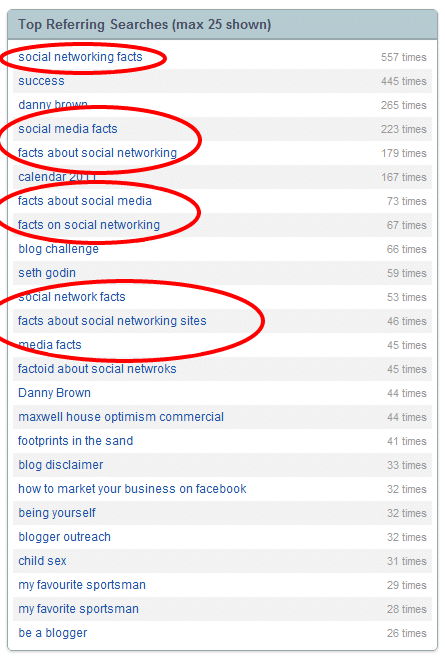
I can also see what the most popular search is – both on-site and off-site – and I can use that to tailor future blog posts and topics.

Blog Content Guidance By Your Audience

While I always say that you need to be writing for you first and that everything else is a bonus, it also makes perfect sense to ensure you’re at least aware of what your audience wants to read about. After all, they’re the ones that make blogging so enjoyable, by sharing their thoughts in the comments and making you look at topics in a new light.

So why wouldn’t you want to write on something that clearly interests them (and bring new readers to your blog into the bargain)?

social media factsLook at the figure to the right, for instance, and you can see that one of the most popular search terms in the last 30 days has been for “social media facts”, or other keyword terms based around that.
That search is pretty understandable, since I wrote a post last year on 52 cool social media facts that turned out to be pretty popular and resulted in a lot of social shares and syndication.

However, because Lijit shows me within my dashboard that this is still a pretty popular term – and the original post was written last summer, so the stats are already out of date – then perhaps I should be thinking of updating the post, and include newer networks.

Additionally, I can ask myself whether it might be an option for me to compile an ebook, which looks at the stats and collates them into a more flowing form.

And, say I was to offer some strategies based around the social media facts, could that ebook be premium, or would I want to offer it as a free ebook, which could then lead to premium offerings down the line?

So as you can see, already I’m starting to get a feel for my audience and understand both the current readers, and those coming in from search engines and what they’re looking for while they’re here.

Location Based Marketing – Not Just for Mobile

By using Lijit so far, I’m seeing where my audience is coming from, and what searches are happening not only off-site, but on-site too. This is allowing me to build up my audience’s profile which in turn is helping me write content that they’re going to read.

This is key for both personal and business blogs, and everything in between.

But then we can start taking that one step further, and really start writing content for a specific target audience. Not only that, but then we can start using our other social profiles in a far more strategic way.

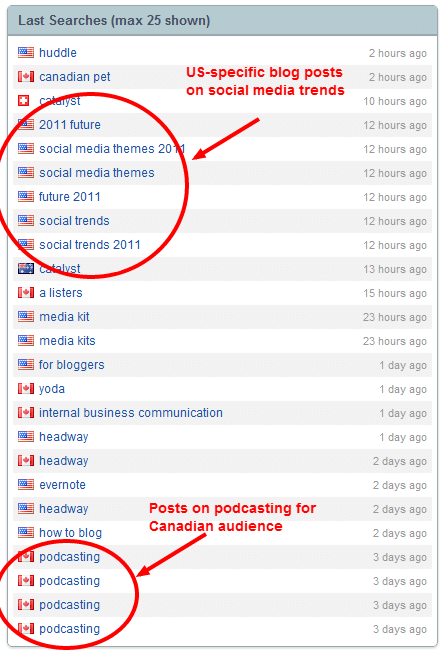
location based content marketingFor example, you can see by looking at the image on the right that there are two key pieces of information that stand out, that I could tailor into future posts:
  • A lot of U.S. visitors are looking for information about social media trends for 2011.
  • A lot of Canadian visitors are looking for information on podcasting.

This means I can now tailor some posts around social media trends and how they affect U.S. social media users for the next six months or so.

These can be for personal social media use in the U.S.; mobile browsing; social media and business use in the U.S.; is the U.S. falling behind in social media use compared to the rest of the world or leading the way; and more.

Switching to Canada, I could then tailor posts based around podcasting and its position within the Canadian space. Is it more popular in Canada than elsewhere; are there opportunities for guest posts from Canadian podcasters; can businesses use podcasting more in Canada, as opposed to text or video blogging?

These are just some of the approaches I could take. As you look more into the Lijit dashboard and the intelligence it builds around your readers – especially internal searches from the Lijit search box – you can really begin to blog strategically. Which is perfect for growing your existing blog audience.

The Added Bonus of Community Content

While Lijit is great for intelligence based around your readers and audience, one of the things I really like about the platform is how it lets you promote other parts of your own network, and that of your community.

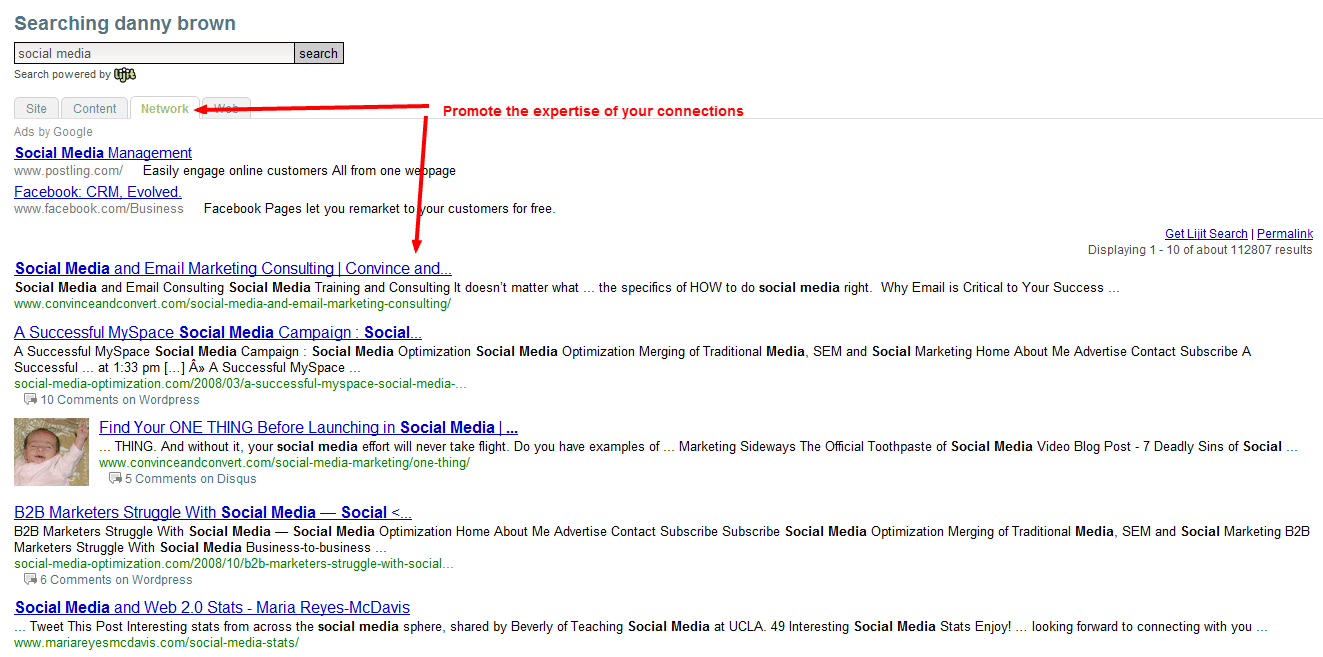
When you set up your Lijit account, you can add all your other profiles from around the web (as seen by the Content Tab on the search result in the image below). This then lets you pull search results from other blogs you might have, or your company website, or video channels, etc.

community intelligence

Next to the Content Tab is your Network Tab. This looks to your social profiles, along with any blogs you may link out to via your blogroll, and shares similar posts based around the search term on your blog.

The nice thing about this is that you’re not only allowing your reader to get the most comprehensive results for their query, you’re also sharing the cool folks you’re connected with and (potentially) driving traffic to their site too. Which is nice.

These are just some of the ways you can use Lijit to build a content marketing strategy for your blog. There are more, and this recent case study by Marketing Sherpa expands on some of these (disclosure – it features a certain Scotsman…).

Any blogger will tell you that knowing your audience is key – Lijit makes this just that little bit more effective. Which is never a bad thing, right?

  • « Go to Previous Page
  • Page 1
  • Interim pages omitted …
  • Page 13
  • Page 14
  • Page 15
  • Page 16
  • Page 17
  • Interim pages omitted …
  • Page 19
  • Go to Next Page »
© 2026 Danny Brown - Made with ♥ on Genesis