• Skip to primary navigation
  • Skip to main content
Danny Brown

Danny Brown

podcaster - author - creator

  • About
  • Podcasts
  • Journal

Blog Tips

Making the Full Switch to Postmatic ? What You Need to Know

Alarm

Regular readers and subscribers to this blog will know of the praise I’ve been putting the way of email commenting solution Postmatic in recent months.

Not only does the solution work seamlessly, it does exactly what it says on the tin – encourage blog commenting, comment interaction, and increased engagement. And it does it all in a snazzy email template that looks great on both desktop and mobile.

So enamoured have I been with the difference Postmatic has made not just to this blog, but to my overall blogging enjoyment too, I’ve decided to make the full switch over to a Postmatic-powered blog (at least as far as email and commenting is concerned).

Given I currently run a weekly newsletter with MailPoet, this is going to mean some changes. Here’s what they are, and what they mean for you.

If You’re a Current Newsletter Subscriber

If you’re an active subscriber to my weekly newsletter, you don’t need to do anything – you’ve already been moved over. However, this is only if you’re an active subscriber – so, you opened or clicked one of my newsletter emails.

If you didn’t do any of that, an email invite went out yesterday to advise of the change, and how to subscribe to the new format.

* Note – due to a glitch between MailPoet and Postmatic, several of you may have received multiple invites. My sincere apologies, and the Postmatic team is looking into what happened.

If you wish to continue receiving my posts, but now as soon as they’re published as opposed to a weekly digest, you’ll just need to reply with “agree” in your email and Postmatic will do the rest. If you don’t wish to change over, simply ignore the email and job done, subscription over. 🙂

The last newsletter will go out this coming Sunday, June 21, with an update on the new set-up.

If You’re a Current RSS Subscriber

Lucky you – you don’t have to do squat! 😉

Because Postmatic is an email-based delivery and commenting solution, my move won’t affect your RSS subscription. You can continue to get the posts you like via your chosen feed reader, or Feedly, since these are handled by my RSS provider, Feedio.

Of course, if you did want to get email delivery instead of RSS curation, then the next section is for you.

If You’re Not Yet Subscribed via Email

Because I’m moving from MailPoet to Postmatic, this means my email list details need to change. So, from this post on, anyone that uses the email subscription box at the end of each post will be added to my Postmatic email service.

This means any new posts I publish will be emailed straight to your Inbox, and then that’s when the fun really begins.

Because Postmatic not only delivers my posts to you by email, but also allows commenting by email, you never need to leave your Inbox again (at least for this blog).

Here’s what’ll happen:

  • I create a post and hit Publish
  • Postmatic delivers to your email
  • You read the post, and if you want to comment, you hit Reply
  • You write a comment as you would an email, and hit Send
  • The comment appears on my post in the comments section
  • Any replies to your comment, or new comments by others, will come back to your Inbox
  • You choose whether to reply (by repeating the third and fourth bullet points)
  • You continue to take part in the comments as long as you want.

The real beauty of Postmatic is that you, the reader/subscriber/commenter, are fully in control of what comes into your Inbox.

  • If you simply want to read a post, you get that post by email, read it, then delete it. You won’t see any comment emails unless you leave a comment yourself.
  • If the comments are getting too busy, Postmatic will pause notifications (when there are more than 6 comments on a single post within an hour). You choose if you wish to continue receiving notifications.
  • If you simply want to stop comment notifications, you just send an email with the word “Unsubscribe”, and you drop out of that conversation.

Don’t worry, Postmatic reiterates these points with an introduction email when you sign up to my blog via email.?It’s a very elegant way of ensuring your Inbox doesn’t get clogged with multiple emails from the same blog post.

So there you have it. As of this post, all future posts will be delivered by Postmatic. There are also some cool features coming down the line to make your experience an even better one, so stay tuned.

Thank you for being with me this far, and I look forward to seeing you in the comments in posts to come!

How Feedio (Kinda) Changed My Mind About RSS

Feedio - Manage and grow your email and RSS subscribers

A few months back, I asked the question as to whether it was time to get rid of the trusty RSS option on your blog.

My key reasons were simple: RSS offers less one-to-one interaction than email, the format of RSS can be clunky and unwieldy for non-techy folks, and the traffic to my blog from RSS was far outstripped by search, email and social network traffic.

The post received some interesting thoughts, both in the comments section and across Google+ and Facebook. Many agreed that RSS is no longer a required option; others felt it offered much better benefits based on niche and industry.

My own personal take remained – RSS was a platform that was out-of-date and no longer the lead choice for bloggers and content creators.

While that’s still mostly true, Feedio has made me look at RSS ?a little differently, and have it actually show value. Here’s why.

User-Friendly and Clean User Interface

One of the biggest bugbears of mine when it came to existing RSS platforms (with perhaps the exception of Feedly) is the user interface (UI) on the front-end could be very unwieldy.

You click the “subscribe by RSS button” on a blog, and it usually takes you to a page where you have a list of RSS subscription options to use. Unless you know what various RSS terminology means (Atom 2.0, RSS 2.0, SubToMe, BittyBrowser, etc.), it can be overwhelming for the average reader.

Feedio does away with this by offering a clean and simple subscription option for your reader.

Danny Brown Feedio profile


By offering just RSS or Feedly, Feedio makes it easy to use your existing RSS set-up without having to go through a whole list of confusing options.

A much better solution, for this non-RSS fan.

Simple, Quick Stats Dashboard and Analytics

The main “complaint” I have with RSS is the lack of details about your subscribers. When compared to the insane amount of data available to you from email providers, RSS is sorely lacking in this department.

While Feedio doesn’t (yet) go to deep levels of analytics, it does give you some useful information via both the Dashboard and the Posts navigation tabs.

Quick Stats Dashboard

When you log into Feedio, you’re greeted by your dashboard, that gives you a quick breakdown of subscribers and post reach.

Danny Brown Feedio dashboard

Since I recently switched over to Feedio from Feedburner, the importing/redirect process is still going through. However, even with the subscribers imported so far, you can start to get a feel for how they’re subscribing, as well as what type of content they’re consuming the most.

One of the more interesting features is the “Unlock” option, which you’ll see in the right-hand column of the Newest Posts section (click to expand if required).

This comes into play if you also use Feedio for email subscriptions, and lets you know which post resulted in a new subscriber. This is a really cool feature that can help you laser in on the type of content that will grow your email subscriber base.

Simple Site Analytics

As well as the RSS and subscriber data, Feedio also gives you a little more insight into your posting frequency, and where your content is being shared the most, with the analytics on your Sites tab.

Danny Brown Feedio sites

As well as showing you the Total Reach of your posts from RSS, Feedio lets you see how many times your post was shared on Twitter, Facebook and Google+.

Again, the benefit of this is if you have certain goals for awareness of your content by channel, this gives you a quick look into how well you’re doing in achieving that goal.

As I mentioned earlier, it’s not super deep analytics, but it’s a nice little feature and beats having no insights into that data at all.

Smart Engage to Build Community and Loyalty

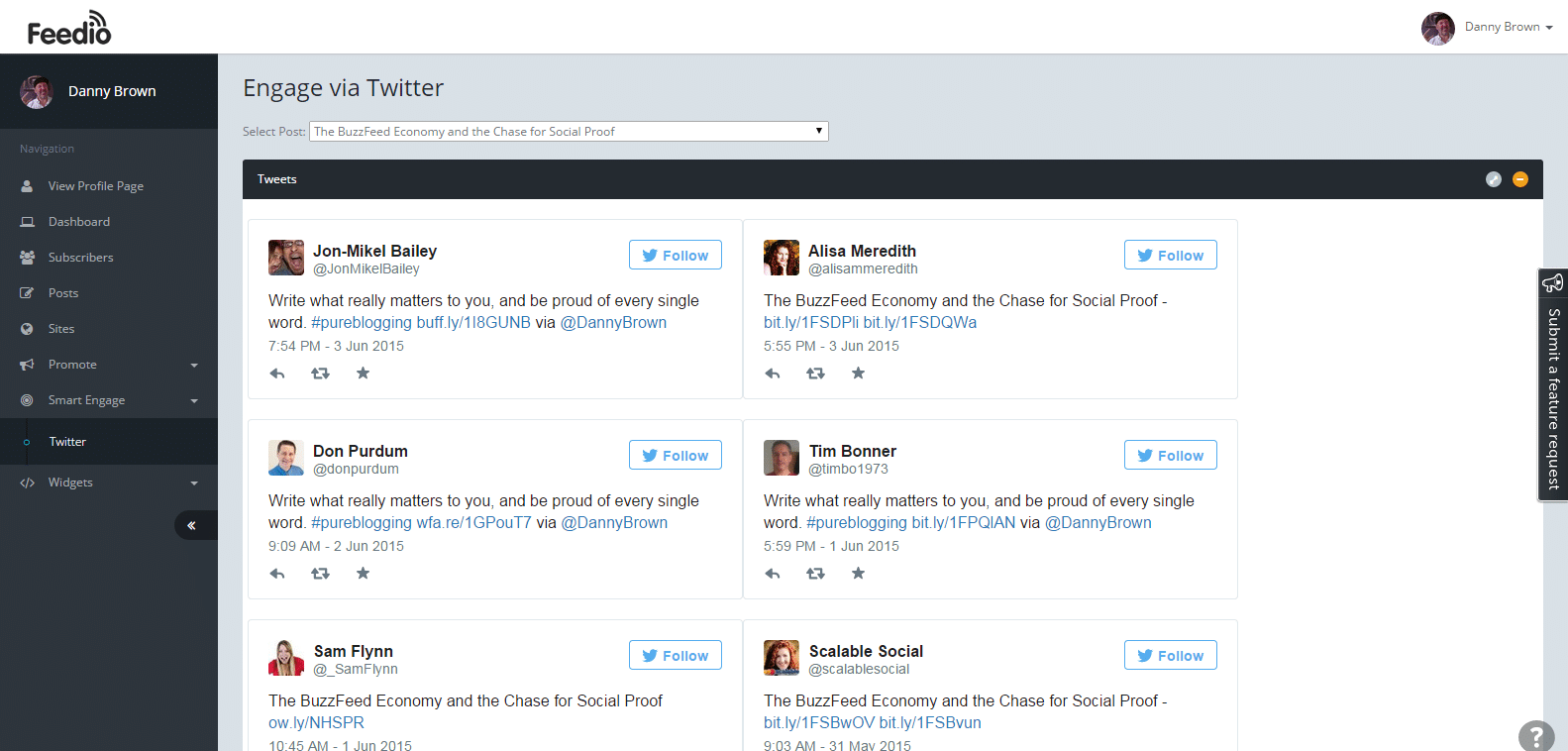
Perhaps one of the smartest features (no pun intended) is the Smart Engage option.

Currently set up for Twitter (though I believe more networks are in the pipeline), Smart Engage gives you an overview of who’s sharing your content on Twitter.

Danny Brown Feedio Smart Engage

Given you can miss this information pretty easily if the person sharing doesn’t tag you with your username, Smart Engage ensures you can see not only the type of content being shared, but who’s sharing it and how often.

Using this feature, you could create a Twitter list called “Content Advocates”, for example, and then begin sharing their content too, as well as finding out more about that person and the kind of content they enjoy.

Additionally, you could simply send a quick thank you, and start to build a relationship with that person, growing not only your reach but finding a potential new avenue for ideas, shares and comments.

[clickToTweet tweet=”It’s not just RSS that @GetFeedio grows, it’s community and loyalty. #content” quote=”It’s not just RSS numbers that Feedio grows, it’s community and loyalty too.”]

It’s a simple but useful solution that does more than your average RSS reader, and offers more reward because of it.

Simple Promote Options

While your blog readers will always be able to choose between email and RSS subscriptions, there’s still a lot of traffic and subscribers that you could be missing out on – social media connections, for example.

Feedio takes care of this with their simple promote option, like this one for Twitter.

Danny Brown Feedio promote Twitter

By providing some recommended tweets, you can let your followers know about your Feedio subscription options, which in turn should (hopefully) grow your subscriber base as well as awareness of your content.

There’s also an email section that provides some recommended emails, which you can copy and paste into an email of your own and send to past connections, chosen peers and colleagues, etc.

What Feedio Needs Next

As you can see, despite my continued misgivings about RSS as a subscriber option, Feedio does do a lot more than your standard RSS providers on the market today.

The fact it does it so cleanly and elegantly is a major plus. However, there are still some features I’d love to see added to take it to the next level of RSS providers.

  • Google Analytics implementation. One of the things that separates email from RSS is the way you can get really granular on the data, via Google Analytics. It’d be great if Feedio could connect to your GA account, and show which post (based on Reach and Shares) drove the most activity around the content from RSS.
  • Trending content. One feature I’d really like to see is that of trending content, with a little Up/Down arrow next to the posts in your dashboard. This could let you take advantage by sharing again on your own networks, or writing a complementary piece and linking to it from the trending post.
  • Deeper analytics on Smart Engage. While it’s great to see who’s sharing your posts on Twitter via the Smart Engage option, it’d be great to see the actions taken on that tweet by followers of that person (retweets, favourites, clicks). I’m not sure how feasible this would be, but it would definitely be a great addition.
  • More personalization options for your profile page. Currently, Feedio offers some personalization options for your front-end profile (the one subscribers see). However, it’d be nice to have some more features like colour picker for links, hyperlinked URL’s, etc. A small change, but one that would make a nice addition.

In fairness, though, while I’d love to see the suggestions above make it into Feedio somewhere down the line, I have to tip my hat to?Justin Butlion and the team behind Feedio.

They’ve clearly looked at the current RSS landscape, and understood the pain points for both bloggers and readers, and actually made RSS enjoyable again.

Not only that, but while they haven’t fully converted me into an RSS lover again, they have made me reevaluate my take on the service.?Given I’m a stubborn bugger when it comes to stuff like this, that’s no small feat, so kudos. 😉

You can check Feedio out for yourself here – and if you want to subscribe to this blog via RSS/Feedly, you can do that here.

One to One Blog Consulting? I’m Your Huckleberry

Blogging success

For the last 8 years or so, I’ve helped a lot of friends and family dive into the wonderful world of blogging, both for personal and professional use.

Many have been put off blogging up until then, thinking it was either something we did in solitary, or something that they had little time (and even less inclination) to do so.

Once they jumped in, though, and set realistic goals based on what they wanted from blogging – from a place just to put down thoughts and encourage others to chime in, to using a blog as an awareness and lead generation platform – they loved it, and haven’t looked back.

I’ve tended to stay away from “teaching” blogging to a wider audience up until now, primarily because I didn’t feel the need to offer it. In the last 3-6 months, however, a lot of readers, subscribers and online connections have asked if I ever do hourly consulting/teaching.

And that actually made sense to offer. So here we are.

Why Trust Your Blog With Me?

Good question, and one that I’m not going to come back with a hundred reasons pointing to this reason, or that one, or blah blah blah.

Instead, I’ll simply say I’ve been blogging for about 15+ years now – it’s been one of my passions for a long time, and remains so even with all the naysayers that say “blogging is dead, social media is the new content king”. Yawn.

In that time, I’ve probably shared thousands of hours of advice, tips, ideas, and content to give you some insights into how to start, manage and nurture a blog.

This has included premium content, as well as consult for agencies and brands looking to take their own brand message into more content-driven direction.

The one thing that’s stood out over these years is that while tips and advice are helpful, it’s only when you get down to the real one-to-one consulting/discussion that we can really start to work on what your goals are, and where they can be met (some won’t be, and that’s okay).

Because of this, I’m only going to be offering two very specific options:

  • An initial consultation, where we can chat about what your goals are, I can give you some advice right off the bat about the changes needed to make those goals happen, and where you might need further consultation down the line. Cost: $80 USD
  • An ongoing consultation, where you choose how often you wish to work together, what each consult should help you on, and where you’re ready to take the reins yourself for the next phase in your blogging journey. Cost: $100 USD

And that’s it. No one-size-fits-all course; no downloads; no “Follow these ten steps and you’ll be a blogging superstar” message.

Instead, you’ll get honest feedback and direction, as well as the support of someone who truly cares about your goals, and how you’re going to meet them (and which ones you need to put on the back-burner for now).

If that sounds like something you’re interested in, awesome – just use the form on my consulting page, and let’s get started. Make sure to enter your blog’s URL in the “Notes” section so I can review before our Skype or Google Hangout.

And as a welcome offer, use the code INTRO20 on your payment screen for a 20% discount.

I look forward to working together.

If you have any pre-sales questions, feel free to drop them in the comment section below and I’ll be happy to answer them.

Why I’ll Only Use Postmatic for WordPress Blog Comments

Blogging success

It takes a lot for me to be completely won over by a new product out of the gate, never mind make me a staunch supporter of it from that very same gate.

Usually, I’ll find a bunch of things I don’t like, and use that as an excuse to look for another solution, or one that does the stuff the one I’m looking at doesn’t.

Now and again, though, the actions of the developers or creators of a product make you forget what’s missing, and instead make you focus on the very cool stuff that’s included in the current version.

That’s exactly what happened with the Postmatic WordPress plugin that enables blog comments by email. And now, I really can’t see myself using any other option.

If At First You Don’t Succeed…

When Jason Lemieux, the co-founder of Postmatic, first reached out to me about his product (I think it was on Twitter), I’ll be honest, I didn’t really have the time or inclination to check out another plug-in.

For one, I was tired of content and commenting. Not so much content and commenting itself, but the myriad of commenting systems I’d already tried out and had left for various reasons.

Livefyre, Disqus, Inline Comments, Google+ Comments. All with their strengths, all with various reasons to go with one over the other, and all with the same problem – they don’t play well with each other when it comes to leaving a comment.

You want to leave a Livefyre comment, you need to create a Livefyre account or sign-in with social log-ins (unless the blogger allows guest commenting). Same with Disqus.

You want to leave an Inline Comment, the reader needs to be aware Inline Comments are actually available. Since comment bubbles only appear after a comment is left (unless you want intrusive comment boxes after every single sentence), Inline Comments are invariably missed by readers.

You want to leave a Google+ comment, you need a Google+ account. Not only that, but the notification system is poor, since you don’t know people have commented on your content unless you’re tagged in that comment. You can imagine some of the stuff that could appear on your blog with that in mind.

So, four comment systems, four reasons to sigh. So, yeah, when Jason reached out, I initially wasn’t interested.

But, fair play to him, he didn’t give up, and reached back out at a time when I was ready to look at commenting options again, especially given how I want to turn this blog into a very personal destination, where conversations are the driver of the content as much as being the other way round.

And I’m glad he did, because Postmatic has made commenting fun again, and reminded me of what it used to be like when blogs were the hub of conversation, versus the multiple social channels that blogs fight for attention with.

Why Postmatic Should Be on the Radar of Every WordPress Blogger

So, you should be getting the gist that I’m a fan of Postmatic, even in its early form (the product is just coming out of beta). Given that there are alternatives to the commenting solutions mentioned earlier, why the big love for Postmatic in particular?

Simple – it’s made by WordPress lovers for WordPress lovers. Specifically, WordPress blog comment lovers (although it does a good job with email delivery too).

Postmatic WordPress Blog Comments by Email

Because my whole mantra with this blog has always been about the conversation, and for everyone to have the same voice when it comes to commenting and sharing ideas, Postmatic’s main goal strikes a chord with me.

Engaging in meaningful, timely conversation online is out of reach for too many people, especially in the blogosphere. We have created blogs for so many organizations that publish thought-provoking and essential content, but it often goes overlooked and under-discussed. Last spring we started thinking about how to change that. And so it is that we made Postmatic.

Jason Lemieux

Based on what I’ve seen on my own blog since initially installing Postmatic, and from comments of others I’ve recommended Postmatic to, the team behind the plug-in are well on their way to meeting that goal, and more.

As I mentioned in my initial post back in February, it takes a little getting used to, to not only reply to a blog post by email, but to leave a comment, and continue leaving comments, by email too.

Ever since blog commenting became more open source, we’ve needed to jump back to a post to leave a comment, and then sign up for notifications if we wanted to know if anyone replied to us. That kind of behaviour is ingrained in us.

So, flipping the mindset to commenting via email takes a little leap of faith – but the benefit to us, as bloggers and commenters, is worth it.

Especially with the new features from the recently public version.

More Than Just Comments by Email

While Postmatic’s methodology is sending a blog post out by email, then inviting people to leave a comment by simply hitting “Reply” to that email, it feels like it’s more than that simple premise.

Probably because it is more than that, intentionally or otherwise. When chatting with Jason about some ideas regarding future additions to the plug-in, I mentioned that I see Postmatic more as an engagement optimizer than a simple comment plug-in.

Because that’s exactly what Postmatic does – it not only encourages more comments and engagement by removing the technology barrier to leaving comments, it optimizes how that looks and feels for both commenter and blogger.

Since my initial look at Postmatic in February, the team behind it have added a whole slew of features to ensure a seamless and, more importantly, user-friendly experience for reader and blogger alike.

Seamless Integration with Any WordPress Blog

As long as you have a self-hosted WordPress blog, and you use native comments (or even wpDisquz, which supports Postmatic integration), you can get Postmatic set up in minutes.

Because Postmatic uses email to reply to, and receive, new comments, your existing native WordPress comment styling isn’t touched. All that changes is you have a little box below the comments to sign up for Postmatic comment replies, and you’re good to go.

If you currently use another solution (like Livefyre, or Disqus), and you decide to switch back to that from Postmatic, your comments are there ready to import back into that platform. Try that the other way round, without getting some weird leftover Livefyre or Disqus styling in return.

Moderation via Email

Run any blog with comments activated, and you’re going to come up against comment spam. It’s the bane of every comment system, even with the various filtering, moderation and blocking features around to combat it.

Postmatic makes it really easy to moderate via email, even when on the go. As a moderator, you can use “Approve”, “Trash” or “Spam” as a reply to a comment notification and Postmatic takes care of the rest.

Again, a bonus if you don’t have time to jump into your WordPress dashboard (or third party comment system admin area) to quickly moderate spammy or abusive comments.

Responsive HTML Email for Posts, Comments and Invitations

While the free version of Postmatic offers a perfectly functional email notification system, it’s when you jump up to the premium version that the design really kicks up a notch.

Standard Postmatic
Premium Postmatic

Using the Postmatic Premium template, you can add your own header, end of email widgets (for promotional banners, email sign-up, or anything else you’d normally put in a WordPress widget), and footer template.

This lets you have a branded email and comment reply notification that is immediately recognizable as yours – and it’s all responsive, so will look good on any display.

Email Notification Throttling

When I wrote about Postmatic in February, the post ended up getting over 200 comments. 100 of these came within the first couple of hours of the post going live.

Now, while this is great for engagement, you can imagine what that must look like for someone’s Inbox, especially if you leave the conversation for the day, then come back to your email in the morning only to see your email clogged with comment notifications.

Enter Postmatic’s notification throttling, one of the new features that a lot of early users of Postmatic – probably commenters more than bloggers – have been asking for, and a great addition to make the user experience even more enjoyable.

If a post gets more than six comments in an hour, Postmatic will pause notifications and instead send out an email that advises the post discussion is taking off. The post commenter/subscriber then gets an option to leave it on pause and resubscribe to the conversation at a later time, or rejoin there and then.

It’s a slick implementation that puts full control into the commenter’s hands – if you rejoin, you know what you might be getting yourself into. If you no longer want notifications, you won’t get them.

Past Commenter Invitation and Email Provider List Migration

I mentioned earlier that I see Postmatic as more of an engagement optimizer than a commenting solution, and their “past commenter invitation” option is part of that.

When you switch Postmatic on, you have the option of sending an email out to people who have commented on your blog before, but may have dropped off the radar.

You can send a personalized invite out to those folks, advising of your switch to Postmatic and inviting them back to the conversation, with the promise of never contacting them again if they don’t reply (click to expand).

Postmatic invite

It’s a great way to reach out to members of your community that may have slipped out of sight. This also lends itself to migrating your existing email list subscribers, if you also want to use Postmatic to deliver your content.

Instead of sending a blast email out to everyone, Postmatic determines those that have taken an active action in a certain timescale on your existing list – click, open, forward, etc, – and only sends an invite out to those people.

It’s another way of showing respect to subscribers, and keeping spam out of the inboxes of email users.

So, Postmatic is Perfect, Then?

These are just some of the new features that Postmatic is offering, now they’ve moved out of beta. There’s also:

  • Guaranteed email delivery and seamless Jetpack, Mailchimp, and MailPoet list integration
  • Almost instantaneous comments (within 6 seconds of sending the email)
  • Social sharing within email using multiple supported sharing options
  • Better privacy for all users
  • URL support when commenting on a blog natively, so your username/name links back to your own blog/site
  • Full control over commenters and comment history, and more

I’ve also been fortunate to have a look at what Jason and the team have coming down the line in the next few weeks and months when it comes to even deeper integration between comments, blogger and readers, and they’re pretty damn exciting.

With all that being said, Postmatic isn’t perfect – yet. Some of the core things I’d really like to see are:

  • Email and comment analytics. Currently there’s no way to know how many people opened your email, forwarded, replied to comment, etc. While that’s not too important from a commenting angle, it’s an important requirement for email lists. The team have mentioned this is in the pipeline – it’ll make a big difference.
  • Video embeds inline. If you have a video embed in a post, the Postmatic email template doesn’t pick it up. Instead, there’s a message that says, “This format is not supported by your email client”. While it’s not super important, it does mean you need to click through to the post to view, which dilutes the “reply by email” benefits a little. In fairness, most rich media content creators and subscribers prefer RSS for this, so it’s less of an issue than it could be.
  • Weekly digests. Currently, I run a weekly newsletter versus instant updates, as do many other bloggers I know. Postmatic doesn’t support this format – however, this is something else that the team are working on, and hopefully it’ll be here soon as an option.

In the grand scheme of things – with perhaps the exception of the analytics – these are minor quibbles in what is otherwise an awesome plug-in and experience.

And, to be fair, Postmatic isn’t positioning itself as a replacement for the Mailchimps and the Awebers of the world – yet. Instead, they want to make the process of blog post to email to reader to comment-by-email to ongoing engagement as smooth as possible.

In that regard, they’ve succeeded in spades.

The Proof is in the Engagement Pudding

While Postmatic doesn’t offer analytics for comments, etc., at the moment, there are other options out there that you can install, if you want to track the change pre-Postmatic and post-implementation.

One of these is Graphical Admin Report, that shows you behind the scenes statistics about growth of your blog, including comments. Using this, I ran a comparison of my own blog’s comment count for the six months between November 1 last year, and April 28.

The first three months – November, December and January – are all pre-Postmatic. The last three months – February, March and April – cover the period since I switched Postmatic on.

Despite the plug-in doing a weird right-to-left comparison, you can see for yourself how effective Postmatic has been at increasing comments and, by association, engagement on my blog.

Even the lowest of the comment count for Postmatic (for this month) is still more than the highest comment month in the previous quarter (November).

This rise in engagement seems to be happening elsewhere, too, once Postmatic is installed. A couple of bloggers I introduced to Postmatic, Jens-Petter Berget and The Jack B, have seen an increase in comment numbers since installing, and are good examples of the way Postmatic can increase engagement when introduced properly.

Because it is a mindset change, as well as a change in behaviour, and as humans we’re often not good at that – a good introduction by the blogger helps ease readers into the change.

Wrap your head around it though, and email commenting makes so much sense.

We already do it, anyway – if we use Livefyre, Disqus, Jetpack or native comments, we get an email notification telling us of a new comment or reply. And we still have to jump through another hoop to comment. Postmatic removes that hoop and leaves you to spend that time more effectively.

As the title of my post says, when it comes to WordPress blog comments, it’s the only solution I’ll use on my blog moving forward.

For a blogger that cares about engagement and true interaction with his readers, that’s the highest possible endorsement I can give.

You can check out Postmatic, and get a free two week trial of the Premium option, here.

How to Build a Loyal Blog Community With the Power of Give

Disclose FTC

One of the conversations that often arises when talking about blogs is community, and?how to both grow and reward loyalty.

Making sure your blog community knows you appreciate them helps in several ways – there’s two way respect between blogger and reader/subscriber/commenter, as well as opportunities for advocacy?and blog growth through referral.

One way to do this is to offer exclusive content to blog or newsletter subscribers – a free ebook or white paper, for example.

Of course, that approach on a blog would mean that to really benefit from exclusive content, your readers/community would have to be subscribed to a newsletter or email subscription. Which would then negate the rest of your readers that don?t subscribe this way, but still show loyalty by coming back time and again.

So what ways could you reward on your blog, for both subscribers and everyday visitors/readers?

Loving Your Blog Community

Face it, without a community a blog is nothing more than a broadcast platform. Your community nurtures the growth of your blog; it helps share with others; it defends if needed; and it keeps you growing as a blogger by sharing great insights in the comments.

It doesn?t matter if it?s a personal blog or more business-oriented ? community is the real king (sorry, content lovers). For business blogs, community is the relationship to the sale ? look after it and look after your business.

So what are some of the ways to reward a loyal blog community?

Exclusive Content

As I mentioned earlier in the post, this would normally be via a newsletter or email subscription, so may negate some of your readers (although it?s a great way to build an even more loyal community on subscription too). Some of the things you could offer might be:

  • A free ebook;
  • White papers;
  • Solid business advice not normally seen on your blog;
  • Discounted offers on affiliate programs.

There?s a lot you can make exclusive to really say ?thanks for being part of my community?. You?ll have a better idea of what would appeal to yours ? all you need to do is put that into action.

The Freemium Model

Because exclusive content needs an exclusive outlet to really make it work, you run the risk of excluding the readers that visit every day, comment and are as just as important a part of your community as subscribers.

So how do you make sure that you?re not ignoring them and focusing on your exclusive content?

  • Episodic content. This can work in two ways. You can either write a series of educational posts on topics your readers would find useful, or you can offer the first chapter of any ebooks that exclusive content subscribers receive. That way, ?normal readers? still receive value and can decide whether to expand into the subscription option.
  • Actionable content. Want to be seen as a thought leader or serious blogger in your space? Then offer action points that anyone visiting your blog can take away and make work for them.?John Haydon does this all the time when it comes to non-profit advice, while Jon Loomer is one of the go-to guys for Facebook marketing tactics you can use regardless of business size. Help others; help you.
  • Highlight your community. Another way to reward your community is to give them some reader love. By coming to your blog every day and commenting or sharing you, your community is helping you grow awareness of you. So do the same for them. Have them guest post on your blog, or post about someone from your community?when you feel they might appreciate a pick-me-up. We all like to feel appreciated; make sure your blog community knows you appreciate them.

Protecting Your Community

Growing your blog community is the first part; but it doesn?t stop there. Just as your community nurtures you and helps you, so you need to do the same in return, but take it to an extra level ? by protecting them.

Think about it ? if someone?s taking the time out of their life and schedule to read and share their thoughts on your blog, the very least you should be doing is making sure it?s somewhere that they want to hang out, and feel comfortable doing so.

  • Make it clear you won?t tolerate abuse to your community. One of the best things about any blog is the comments section ? so many great thoughts and ideas can come from here, and new friendships can be made. So making it a safe haven is paramount ? protect your commenters, protect your blog.
  • Have a comment policy. Not only can a comment policy?help you set both guidelines for new visitors, as well as assure your current community you have their best interests at heart, it ensures there are no grey areas as to why a comment was removed. It’ll also show new visitors your blog is a safe haven from trolls and bullies – something missing from a lot of online outlets today.

These are just some examples of how you can use your blog to reward the people that make it what it is. There are a ton of other things you could do?? the main thing is you?re at least doing something to reward your blog community.

After all, they reward you just by stopping by each time ? thanking and looking after them is the least you can do, no?

  • « Go to Previous Page
  • Page 1
  • Page 2
  • Page 3
  • Page 4
  • Interim pages omitted …
  • Page 13
  • Go to Next Page »
© 2026 Danny Brown - Made with ♥ on Genesis