• Skip to primary navigation
  • Skip to main content
Danny Brown

Danny Brown

podcaster - author - creator

  • About
  • Podcasts
  • Journal

Latest posts from Danny Brown

Enjoy the latest posts from Danny Brown, and feel free to add your own thoughts in the comments after the post.

Important Message for Subscribers to DannyBrown.me

A little over two years ago, I shared a post on why I was leaving Feedburner which, up until then, had pretty much been the go-to service for bloggers looking for an easy way to offer a subscription service for readers, either by email or RSS.

At the time, I mentioned I was moving to Feedblitz, and offered reasons why. However, since then, Feedblitz has continued to lack in certain areas – statistics around subscribers are always erratic, very limited templates to work with, delays in publishing, etc.

So, this will be the last “newsletter” (read “email updates”) that email subscribers to this blog will receive from Feedblitz. There will also be some changes to the way the content here is presented – more on that soon.

In the meantime, here’s what you need to do to keep receiving updates.

Email Subscribers

If you subscribe to this blog via email, and you wish to continue, there’s nothing you need to do. I will be importing your details into the new database over the next couple of days, and you will continue to receive updates as normal – with a slight change to delivery schedule.

Instead of receiving the post as soon as it’s published, I will be changing to a newsletter format. As well as including the latest post, the newsletter will include a link to an article from other content creators, or news story, that I think might interest you.

Danny Brown nesletter

I really want to start sharing some of the content creators that inspire me more, so each newsletter will include a recommendation for you.

Additionally, I will share a tip – it may be a trick to use a social media platform better, or a new tool to check out, or similar. And finally, I’ll be sharing my thoughts on something that’s caught my eye that week and made me think, and opening up the conversation with you around that.

Basically, the newsletter will offer a more personal experience than just getting the latest blog update, and I look forward to seeing where we go with it. One thing I will promise – as always, I will never spam you, and will only share recommended reading, etc., that I feel you will really enjoy.

The newsletter will go out at 10.00am EST every Sunday morning (starting on Sunday, September 7), and I hope it will offer something for you to relax into the last day of the weekend with.

If this doesn’t sound like something you’re interested in, no worries – simply use the Unsubscribe link at the end of this email, and you’ll be removed completely from the new set-up and future updates.

RSS Subscribers

This is pretty straightforward – for now, I’ll be continuing with Feedblitz for RSS subscribers, so you don’t need to do anything at all. I may change the publisher of the RSS feed in the future, but for now everything remains exactly the same.

Should I change the feed, you’ll be the first to know, and I’ll post instructions on how to update your current subscription.

Of course, if the new newsletter format sounds like something you’re interested in, hop on over to this actual post on my blog, and use the Subscribe box at the end of the post. If you remain subscribing via RSS, you’ll continue to just receive the post itself.

Thanks For Being Here So Far

As always, I’m really grateful for you subscribing to the blog, regardless of format – email of RSS. The fact you allow me into your busy lives is something I really appreciate, and hopefully that will continue in the new “format”.

My goal with the newsletter is to provide a more “complete” experience, and a more personal one. Hopefully you’ll see that happen, and please, always feel free to email me with thoughts on the content of a particular newsletter, or a suggestion for a future one.

Thanks for being here so far – here’s to the next “stage”. Cheers!

3 Types of Editorial Calendar to Manage Your Business Blog

Blog challenge

This is a guest post by Sarah Arrow, and is part of her 30 Day Blogging Challenge.

30 day blogging challenge

If you’re going to grow your blog, and publish content that your audience will love on a regular basis then you’ll need an editorial calendar.

In this post I’m going to share with your three types of editorial calendars, and how to populate them so that they free up your time and work for you.

When planning future blog posts ask yourself these questions about reaching your audience:

  • Where does your audience currently get their information?
  • What sources are trusted and what sources are considered unreliable?
  • What sources have the highest traffic flow for your demographic?

Editorial Calendar Planning – Things to take into consideration:

  • Monthly conversation theme.
  • Weekly conversation theme.
  • Blog post title.
  • Target audiences (primary, secondary & tertiary)
  • Author (more than one person can contribute to your business blog)
  • Editor – who’s going to oversee the content and chase the blog posts?
  • Buyer?s cycle (awareness, consideration, preference, purchase, loyalty)
  • Draft due date – Content has to go out in a timely fashion and when it’s relevant.
  • Primary keywords?(5-10) for your blog posts and headlines
  • Supporting image(s)
  • Other supporting media (image, video, podcast)
  • Embed in other resource kits or publications
  • Syndication
  • Possible whitepaper ?/ free report (repurpose)
  • Client testimonial / graphics

At the end of this article, you’ll be able to download a free editorial calendar template to help you with your planning.

Your editorial calendar isn’t carved in stone, it can and should be adapted to your needs and your business. When doing your first editorial calendar it’s easy to get overwhelmed.

You don’t have to include everything listed above, at once. You can add in parts as you become more adept at planning your blog posts.

Let’s investigate the editorial calendar tools:

A day to a page diary.

There’s nothing that beats a good old-fashioned diary when it comes to creating your editorial calendar.

When you buy a diary it comes with all the important dates in it already. Christmas, Easter and all the religious holidays are marked. You then mark in all the dates that are important to your ideal readers.

If your ideal reader is based in the US and is a mom, you’ll know that the school holidays start in June and the kids go back to school in August.

If your ideal reader is a mum in the UK, then the school holidays start at the end of July, and the kids go back in September, unless its Scotland in which case the kids go back to school at the end of August.

The next step is to locate all of the conferences and national seminars your prospect is likely to attend and mark them in the diary.

Then add in the things that impact on your life including birthdays, anniversaries and important business dates. Remember to add in staff training days, staff birthdays and anything else you celebrate in your workplace.

Your diary is now about half full. But you’re not done yet. Go and get a copy of Blog Energizer.

This will give you all the crazy holidays out there like; national jam week, international?soccer day as well as things like international women’s day and black history month. In your diary copy over any of the events that your ideal reader will love.

Then check out the blogging prompts here and add them into your diary. If you add in one a week, you’ll find your editorial calendar is pretty full up with things surrounding your prospect, her interests and where she’ll be.

You now just have to add in the titles to your editorial calendar spreadsheet, and you’ve pretty much got all your content ideas planned out for a year in advance.

Not only that, you’ll have a good idea what your prospect wants to read, and when. Nothing beats the diary when it comes to planning :).

WordPress Editorial Calendar plugins.

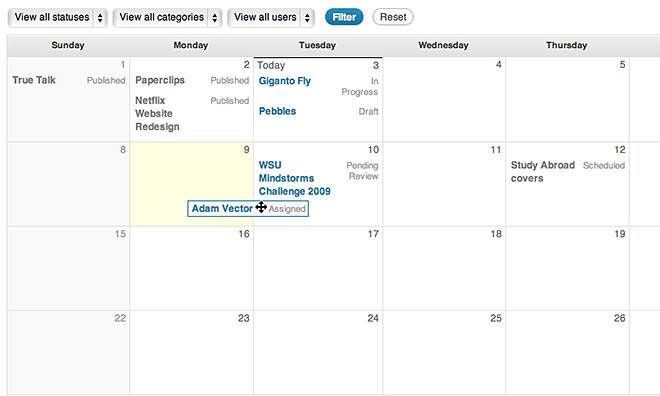
The?Edit Flow??plugin shows in your WordPress dashboard areas and will help you manage communications between you and your contributors.

If you’ve got a business blog with regular members of your team contributing, the Edit Flow plugin will save you a lot of time and hassle. If it’s just you, and you’re writing your own business content then the Edit Flow Plugin isn’t as important.

Edit flow

Features of the Edit Flow calendar include:

  • Calendar – A convenient month-by-month look at your content in your WordPress dashboard area.
  • Custom Statuses – Define the key stages to your workflow.
  • Editorial Comments – Threaded commenting in the admin for private discussion between writers and editors.
  • Editorial Metadata – Keep track of the important details.
  • Notifications – Receive timely updates on the content you’re following.
  • Story Budget – View your upcoming content budget. Handy if you purchase content.
  • User Groups – Keep your users organized by department or function.

The WordPress Editorial Calendar is a great tool for sites with just one main contributor, and you can use it with a contributors too, if you prefer. The best part about this plugin is that you can drag and drop your blog post titles all around your calendar.

Wordpress calendar

Writing about something and a disaster happens? Too sensitive to publish the post? Drag it three months into the future and write something else instead.

Features of the WordPress Editorial Plugin include:

  • See all of your posts and when they’ll be posted.
  • Drag and drop to change your post dates.
  • Manage your drafts with our new drafts drawer.
  • Quick edit post titles, contents, and times.
  • Publish posts or manage drafts.
  • Easily see the status of your posts.
  • Manage posts from multiple authors.

Got an assistant? Give her your day to a page diary and ask her to add in all the dates as drafts on the corresponding date in the Editorial Calendar plugin. You then have a visual in your dashboard. You can then drag, drop, delete and publish accordingly.

The only downside is when you see you have 300 drafts in your calendar and not enough time to write up the content *sigh*.

Co-Schedule

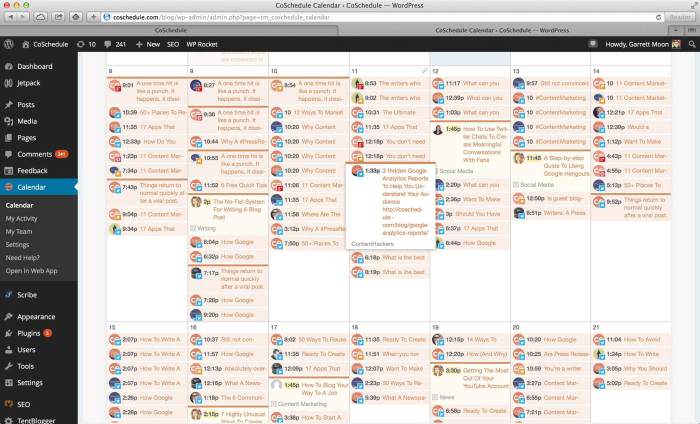
Co-Schedule is the new kid on the block when it comes to editorial calendars, and it’s been getting rave reviews from bloggers everywhere.

Its biggest advantage over a diary and the Editorial Calendar plugin is the ability to automate posts to social media. This eliminates some of the time suck of promoting your content.

Coschedule

  • Drag And Drop Editorial Calendar
  • Lightweight WordPress Plugin
  • Automated Social Publishing
  • Simple Team Communication
  • All-In-One Publishing Solution
  • No More WordPress Hacking
  • Small monthly fee

The third most common type of editorial calendar is an Excel Spreadsheet. It’s not exclusive to WordPress and many spreadsheets can be imported into Google Docs and shared with other people.

This means at any point people can access the calendar and see what they’re meant to be doing and when. This is also handy when you use a content management system other than WordPress for your blogging activity.

The spreadsheet isn’t limited to just content planning, it can also be expanded into who is promoting what and where. You can also keep track of your call to actions in the spread sheet and monitor what’s the most effective and why.

Like the WordPress plugins, you can add the diary to the spreadsheet to give you an overview of what’s going on in your prospect’s world.

Spreadsheets make it easier to present data in the form of charts, and make it easy for you to see in a single glance what’s working and what’s not. The only downside to a spreadsheet editorial calendar is that it takes over your life and you start to think in cells and merges.

Here’s a copy of one of my spreadsheets.

Blog Editorial Calendar Template_overview

It’s empty, you’ll have to add in your own content. Right click and save as to your desktop.

An editorial calendar in whichever format you choose is a powerful tool, and will enable you to blog consistently for any amount of time.

Sarah ArrowAbout the author: Sarah Arrow is one of the UK’s leading bloggers. She loves all things blog. You can find her on her own blog at sarkemedia.com or organising blogging challenges (of which this post is a part of). Her first one was back in 2007, and she instantly loved how her writing muscle developed when she worked it hard.

If you’ve already subscribed to Sarah’s 30 day business blogging challenge then you’ll have an editorial planning checklist attached to your email.?Not subscribed? Join?here.

image: Cindy Gedenspire

Loyalty Is Not a Given – Like Trust, It Needs to be Earned

Loyalty and trust

Back in July 2012, I spoke at an event in Toronto. During my talk, I made a quip about whether or not anyone still used Canadian smartphone giant BlackBerry (previously known as RIM).

While it was a throwaway joke that most people laughed at, it attracted its share of criticism too. James Howe, for example, thought it was classless and a low blow at a Canadian institution (for the record, we had a chat afterward and have since had beers and spoke at the same event, so all good).

Recently, on Facebook, I answered a question about the viability of BlackBerry to survive as they are, with both Google’s Android system and Apple’s iPhone essentially owning the smartphone market. I suggested BlackBerry couldn’t, even though I really wanted them to succeed, being a Canadian company.

For that answer, I was called unpatriotic, and not loyal to seeing Canadian companies succeed. The unpatriotic part made me smile, as I’m a Scot who moved to Canada and took up residency in 2006, so I guess that part was true (even though I feel at least half-Canadian now).

But it was the loyalty part that stuck with me, because for me, loyalty isn’t a given. Instead, it needs to be earned and constantly nurtured – something BlackBerry started to slip at in recent years.

Loyalty is All About the Customer

The biggest misconception brands have when it comes to the loyalty question is the definition of where it starts and what it looks like.

Too many make the mistake that loyalty begins and ends with great offers and meeting the customer’s needs at point-of-sale. While this definitely impacts how a customer views your brand, it’s a small part of the much bigger picture.

Any brand can offer great discounts. Any brand can undercut competitors and make an offer a customer really can’t refuse. Any brand can make split decisions in the showroom or retail space, and entice the customer to buy because of that decision (an extra 10% off, for example, or an extra year’s warranty).

That’s the easy part – but it doesn’t build loyalty.?Instead, the bigger customer experience is key.

  • How does this product answer my immediate needs?
  • How does this product make me feel?
  • What’s the brand experience like?
  • How does the after service look, both reactively and proactively?
  • How does the brand listen to feedback and future product suggestions?
  • Does this improve my everyday life through use?

These are just some of the very simple, yet important, questions that brands need to consider when it comes to loyalty building.

Building customer loyalty

My co-author on Influence Marketing, Sam Fiorella, heads up the Customer Experience agency Sensei Marketing, and provides a wealth of information on this hugely important aspect of your customer’s “relationship” with you.

Delivering on Expectations

Back in the 80’s and 90’s, I was a huge proponent of Japanese video game giant SEGA. While popular thinking said their big competitor Nintendo had the better hardware and video game mascots, there was something about SEGA that just resonated more.

This saw me support each new hardware release without question (even the dud Mega-CD / 32X combo). No matter what the press might say, and what my friends were playing, SEGA met my needs consistently.

  • Their hardware took risks. They were the first console manufacturer to offer mass Internet gaming, and accessories like their R360 unit were groundbreaking.
  • Their games were some of the most innovative on the market. From the beauty of Shenmue, to the addictiveness of Chu Chu Rocket, or the weirdness of Seaman, SEGA consistently pushed the envelope on what video games should be.
  • They were a gamer’s game company, as shown by their arcade heritage and their determination to bring that experience home with each hardware update.

Sadly, this innovation came at a cost. Nintendo’s devout fanbase proved hard to crack, and when Sony entered the market with their PlayStation, it heralded a new mass market gaming industry, where quantity of games over quality of games talked.

SEGA couldn’t compete, and left the hardware market in 2001. If they were to come out with a new system tomorrow, though, I’d be first in line – because they always delivered. They’ve earned my trust through consistency and understanding what SEGA fans were all about.

Why Loyalty Is Not a Given

Which brings me back to BlackBerry. In recent years, it almost seemed like Canadians bought new handsets from the Waterloo, Ontario giant purely because it was Canadian, and it’s just “always been the way”.

And, for a while, that made sense.

BlackBerry delivered on its promises. Its hardware was secure, making it perfect for Enterprise-level organizations and small business owners everywhere. Its operating system was one of the best around. And it’s BBM messaging service was a unique feature not found anywhere else.

And then then wheels came off.

Whether it was arrogance based on its lofty position, or the fact no-one had come close to disrupting its Enterprise model, BlackBerry got complacent, expecting that its name alone would be enough. And it might have been, had it not been for a combination of circumstances that looks to have sealed the company’s fate.

  • Its once-secure network saw major security issues, with the Canadian government issuing warnings and its new flagship Z10 being held up for its potential to be breached.
  • Its previously stable network suffered a major outage when it crashed for four days in 2011, leaving millions of users without service.
  • Its physical QWERTY keyboard seemed misplaced as more users switched to touchscreen phones from Apple and Google.
  • Its previously strong Enterprise relationship softened, as IT managers acquiesced to employees that preferred to buy their own phones and have them hook into the corporate server.

Add to the fact that BlackBerry seemed out of touch with what its loyal customers really wanted, and the stage was set for the Canadian giant’s fall from grace, one that’s led to the possibility of the company being sold.

While there are several factors contributing to BlackBerry’s downfall, the loss of loyalty from even its staunchest supporters can’t be underestimated.

BlackBerry may have made the mistake of thinking loyalty would always be a given, but when they failed to deliver on the simplest of experiences, that’s when a customer’s true loyalty is tested, as the company is finding out today.

Something we can all learn from.

image: Pure Metal Cards
image: Hans Mestrum

The Bullshit Excuses for Attitudes Towards Women Need to Stop

Domestic violence victim

Warning: This post contains profanity and disturbing imagery. If this offends you, you may want to skip today’s post and I’ll see you next time around.

A couple of nights ago, I shared a link over on Facebook to an article over at RYOT. The piece references a project by Associated Press Chief Photographer for Spain and Portugal, Emilio Morenatti, which shares the equally horrific stories and images of women in Pakistan who refused forced or arranged marriages, and had acid thrown at them as punishment for their “crimes”.

It’s not just refusal to marry that’s punished – for some Pakistani women, just the fact their gender is “wrong” is reason enough to be punished, as highlighted by Najaf Sultana.

Najaf Sultana
Image copyright: Emelio Morenatti

Now 16 years old, Najaf’s crime was to be born a girl to a father who didn’t want another female in the family. So, when she was just five years old her father burned her as she slept. Her parents then deserted her, and she’s been raised by relatives ever since.

The image of Najaf, and many more, can be found on Morenatti’s Flickr album Acid Attack Survivors. I urge you to visit and understand how some cultures see this as an acceptable practice.

As horrified as we in the West may be, these attacks are, tragically, a violent addition to the culture of women as second-class citizens that pervades even our “advanced culture”.

Men in the Loosest Sense of the Word

Recently, I wrote about how certain cultures have an endemic hatred towards women. Because hatred is exactly what it is when you think of how women continue to be “treated” by men. And, in the case of the men highlighted here, I use that term in the very loosest sense.

Despite there being very high profile movements like the #OneWoman hashtag on Twitter and Instagram, highlighting the issues that women face every single day, still the degradation and misogyny continues. And it’s not going to get any better while we make bullshit excuses for this treatment.

Take the recent “punishment” doled out to NFL running back Ray Rice of the Baltimore Ravens. Rice was accused of beating his then-fiancee (now wife) and knocking her unconscious in an elevator in an Atlantic City, New Jersey casino in February, after she allegedly spat in his face. Video surveillance caught him dragging her from the elevator.

Because Rice accepted a pre-trial intervention program, his plea of not guilty to aggravated assault was accepted and he avoided jail. However, while non-punishment sends out a questionable message, it’s the actions – or lack of – of Rice’s employers, the NFL, that speak the loudest: Rice received a two-game ban and was docked two weeks pay as well as a match day check.

TWO. FUCKING. GAMES.

To put that into some kind of perspective, Cleveland Browns receiver Josh Gordon received a year’s ban for marijuana abuse. So, a violent attack on a woman is valued less severe than smoking pot? Clearly the NFL think so, as evidenced by their defence of Rice’s punishment.

“… if you are any player and you think that based on this decision that it’s ok to go out and commit that kind of conduct… in terms of sending a message about what the league stands for, we’ve done that.” Adolpho Birch, senior vice president of labour policy for the NFL. Source.

It sends a message alright – it tells players that you’ll only miss a couple of games for hitting a woman, but a year of your career if you smoke pot. So go out and hit away, because that’s okay – just don’t be high when you’re doing it, or you’ll really be fucked.

Yet perhaps we shouldn’t be surprised by this – after all, this is the NFL, purveyor of a sport that means so much to so many Americans. Just look at the recent Steubenville rape case.

Nothing More Important Than Our Game…

A 16-year old girl was raped by two players of the Steubenville school football team. The attack was filmed by several people and uploaded to Facebook and Twitter, with apparent celebration of the act (and the capture of it) by those involved.

When the attack eventually came to light, there was a huge backlash against the way the school had handled the case. There were examples of failure to report, alleged destruction of evidence, and more. The reasoning that came to light was endemic to all that’s wrong with how we treat women – the victim was so drunk she couldn’t look after herself, so essentially she brought it on herself.

Worse still, many people took to the web to “slut-shame” the victim and blame her for ruining two promising young stars of football. After all, their “lives were over”, as stated by one of the attackers. Yes, raping a girl and forcing her to live with that memory for the rest of her life clearly pales in comparison to your precious football career.

Ironically, Steubenville high school would seem to agree. One of the rapists, Ma’lik Richmond, is back on the school’s football team roster after serving just 10 months for his rape of a girl who clearly asked for it because she was drunk.

Like the Rice example above, to offer some context here, over in Broward County, South Florida, an 8-year old boy was banned from school for two years for taking a toy gun to school in his backpack. Now, in the light of recent tragedies like Newtown, the zero tolerance for guns policies that schools are enforcing are obvious paths to take.

But this was clearly a toy gun. This is a child – an 8-year old boy. Yet he gets a two-year ban, while a rapist that actually ruined a life gets back onto the football team and can aim for a scholarship in the big leagues after just 10 months?

Doesn’t that seem just a little fucked up to you?

Excuses are Bullshit Ways to a Clear Conscience

The thing is, we’re making excuses for the kind of mindset that encourages this second-rate view of women as property, and apportioning any blame directly onto them whenever a crime is committed.

https://www.youtube.com/watch?v=I3K3pwBbK1o

Take the case of Seth Rudnitsky, who was tried for multiple sexual assaults on the University of Maryland campus in 2009. In the defence of his client, Rudnitsky’s lawyer, Mark Schamel, put the “intrusions” down to nothing more than a drunken mistake.

This is not a sexual assault case. You have a really good kid who has never been in trouble his entire life. It’s your typical freshman “I went out and had too much to drink and was being silly” kind of case. Source.

Right. Because sexual harassment and assault is always excusable when alcohol clouds judgement. After all, it’s not as Schamel?is alone in that thinking. When there was a string of similar attacks at the George Washington University, the school’s paper, The Hatchet, is quoted as reporting,

…[the sexual assault] shows that students have a responsibility to keep themselves safe.

Not that the University has a responsibility to provide a safe environment. Not that the assailant has a responsibility to his fellow human beings to respect their fucking rights. No, the responsibility should be on the victim – of course.

Because that’s always the easiest way out, right? Place the blame on the victim, because clearly if they hadn’t been asking for whatever punishment they got, or attack they endured, they were clearly asking for it just by being them – women.

Silence Is the Biggest Enemy to Change

These examples, old and new, are just the continuation of how women around the world are being treated. From hate crimes in Pakistan to sexual crimes in America, and across the world – women are being forced into situations and a “way of life” that we can never comprehend.

After all, as a guy, when was the last time you,

  • Heard a woman say,”He deserved it when I sucked his dick, he was so out of it”?
  • Had acid thrown on you because you ditched your fiancee for another woman?
  • Had women come up to you randomly and grab your crotch and ass, and say, “Come on, you know you want it”?

As Andrea Weckerle, founder of CiviliNation?- an organization dedicated to creating an online culture of acceptance and tolerance without fear of harassment or retribution – succinctly states,

I am sickened by girls and women being treated as second rate. I am sickened by misogyny, whether in “milder forms” as in North America or in the more extreme forms we see in other parts of the world. And I am sickened by far too many women buying into the negative messages females receive when they dare to demand equal treatment.

There is a major issue at stake right now, and there has been for a very long time. And it’s never going to get better if we stay silent and accept excuses. But we can change that.

RAPE SURVIVORS BUILD MONUMENT CHANGE US CULTURE The Monument Quilt

If a culture believes it is okay to burn women and disfigure them because they don’t want to marry someone they don’t love, then that culture is fucked.

If it’s not the widespread culture but individuals hiding behind the culture, then punish the individuals heavily and make the culture one that won’t allow these people to hide behind it, or stay silent for fear of bringing shame onto the culture.

If you truly believe that a women deserves molestation and abuse because of how she dresses, or how much she drinks, or the way she walks, and that “boys will be boys”, you are not a man. You are a fucking beast that deserves to be put in jail.

We all have a choice – we can either excuse this hatred and misogyny by way of cultural and gender behaviour, or we can shout out against it until we’re heard. Either with our political votes; our voices; or, more likely than not in this world where the mighty dollar still talks loudest, with our wallets.

Boycott countries where the culture of hate is commonplace. Boycott organizations where the culture of violence against women is deemed less criminal than smoking pot. And boycott educational facilities where the protection of students seems to be less the responsibility of the faculty and more about the victim should have known better.

At the very least, stand up and say something if you see a friend, or colleague, or family member say or do something that you know isn’t right, and is only fostering more hate and misogyny.

Inaction

Maybe it’s a dumb idea. Maybe I’m being naive. But something has to change – and naivety has ways of turning into educated decisions and making real change.

For the sake of our mothers, sisters and daughters around the world, naivety is a better start than no start at all.

image: marsmet tallahassee?

Blog Comments, Digital Universes, and the Future of Social Conversations

Grandiose

Back in “the good old days”, conversations around a blog post would happen at source – the blog itself. This led to a few direct results:

  • The blogger would be seen as an “authority figure”, since the ability to spark conversation meant his or her thoughts were worth listening to and debating;
  • Commenters could share their thoughts and, by adding extra value to the conversation, potentially increase awareness and interest in their own blogs or social footprints.

Then social media happened (and, yes, I firmly place blogging as one of the granddaddy’s of social media, but for this post I’m going to separate the distinction).

Instead of blogs being the sole recipient of comments, now there were Facebook discussions, Twitter conversations and, more recently, Google+ threads. The domain of the blogger was no longer the domain of the conversation.

For bloggers, this was seen as a major problem – just Google has social media killed blog comments to see how much concern there is. Personally, I blame crap content over social conversations when it comes to this complaint, but then I’m a grumpy bugger.

For brands, who used blogging as a way to garner immediate and direct feedback on company culture, product launches, etc., the problem was more pronounced.

Instead of being able to monitor on a single domain, the question of scale reared its head as multi-channel conversations painted a much more fractured picture of how their brand was perceived.

The thing is, this new challenge shouldn’t be viewed as a challenge, but an opportunity.

The Hyper-Extended Conversation

While having multiple discussions going on at the same time causes its own set of problems as far as scale goes, it’s also nothing really new.

Just because a pre-social blog post kept comments on its domain, that doesn’t mean the topic wasn’t being discussed elsewhere. Email shares and forum posts, for example, continued the conversation away from the eyes of the blogger.

Additionally, despite what many bloggers might think, our blogs aren’t the centre of everyone’s digital universe. Web users have vastly different social behaviours – some prefer engaging on blogs, while others prefer their own “safety zones” in the shape of their chosen social network(s).

Future of social conversations

As people and as businesses, this is how we learn – by allowing people to share honest thoughts and acting on them.

Often, blog readers may be put off commenting on a post. The reasons can be many:

  • There’s already a lot of conversation happening, so why add more at the source?
  • The blog community seems like a clique.
  • The blogger doesn’t respond, so why should you leave a comment?
  • The reader simply doesn’t feel comfortable offering their details to comment.

All valid reasons to not comment – yet these very reasons (and more like them) don’t mean that same person won’t discuss the post elsewhere.

This unwillingness to comment on a blog directly, but still discuss elsewhere, offers a great learning opportunity for those looking to truly understand what makes an audience tick, both from a blog reader angle and potential customers through a business blog.

The Closing Loop of Fragmentation

Technology vendors are recognizing this need for closing the loop on fragmentation, and are trying to offer solutions that marry the best of blog commenting in their native form with their social counterparts.

For example, Livefyre – which I use on here and pretty much all my blog properties – took a big step in collating the conversations around a blog post with their SocialSync feature.

Livefyre SocialSync

This cool feature identifies conversations on Twitter (see above image) and Facebook Pages, and delivers them into a blog’s comment stream. This ensures any additional discussions on two of the bigger social networks aren’t missed, as well as enables the blogger to reply directly from their own comments back into that network.

While the SocialSync feature is perfect for bloggers looking to truly optimize the conversation, Livefyre’s business solutions for brands goes even deeper and offers social signals from multiple touch-points online.

Livefyre’s main competitor, Disqus, offers their own take on closing the conversation loop. As well as pulling in Reactions from Twitter, the company provides deeper insights into the community around your blog.

Disqus Audience

By analyzing the kind of content your readers consume elsewhere, as well as the content that encourages them to leave a comment, Disqus can recommend similar content on your site.

By providing this overview, you can tailor the content you produce based on the goals around your blog – discussion, consumption, lead acquisition, and more.

Disqus’s ability to implement these focused tactics based on comment intelligence, and Livefyre’s true social integration, offers a glimpse into where we’re going and how content producers can truly drive their own deliverables.

If you’re a self-hosted WordPress blogger, then Comments Evolved for WordPress offers a simple, out-of-the-box solution that collates the main comments around your posts in one place – on your blog itself.

Comments Evolved for WordPress

The plugin allows you to run either native WordPress comments (the standard system that comes with WordPress), or a choice of Facebook, Google+, Livefyre or Disqus.

From a social network angle, if your post encourages discussion on Google+, these will show under the G+ tab. If the post is shared on a Facebook profile, any subsequent comments on Facebook will be pulled in.

It’s a quick solution for those looking to see the bigger conversational picture and offers more options for readers to use their preferred system.

The Future of Social Conversations

While these current platforms, and more like them including the likes of Echo and IntenseDebate, are looking to offer an all-round experience when it comes to blog commenting, the future should be looking to move way beyond even that.

Comments are merely the starting point of where we can go – the possibilities and insights comments can truly offer are limited only by the vision of what we see as important, and the technology to provide these goals.

Influencers and Advocates

While comments offer social proof and validation for the interest in a blog post topic, the actions after that are where we, both as bloggers and brands, can gain the real value from.

  • Which commenter drives even more interaction on the post with other commenters?
  • Which commenter extends the conversation and drives more traffic your way by sharing elsewhere?
  • Which commenter evokes you to rethink your position the most over time?
  • Which commenter jumps into other blog posts elsewhere to promote your argument over that blogger’s?

These are just some of the data points we can gather from following the social footprint of a commenter, and identifying who the influencers are in our community, and how that ties into blog or brand advocacy.

It helps us reward these folks and increase the loyalty we already enjoy with them, as well as identify who may be the best “community marketers” that can help us when we have something to share – an offer, promotion, news, etc.

Emotional Resonance and Content Strategy

One of the biggest advantages a blog has over more mainstream print media is the ability to connect on an emotional level.

While you can still find some excellent examples of emotional reporting, especially in Time Magazine, which seems to be going through a renaissence, most print publications don’t position themselves as emotional connectors, mainly due to editorial standards and restrictions.

Blogs, on the other hand, can offer a very distinctive and human voice behind the content, which can connect emotionally with the reader and build a long-term fan.

While that reader may leave a comment advising of how much the post meant to them, on less emotional posts, it’s harder to decipher.

By combining sentiment analysis technology with Natural Language Processing (NLP) and a blog’s chosen comment system, the blogger (or brand) can start to see which content instilled which emotion.

  • Did the content leave the reader elated, happy, sad, blase, concerned, etc.?
  • Did certain parts of the content offer one reaction, and other parts of the same content offer another?
  • How did they share that content afterward – positively or negatively?
  • How did they feel when you responded in the comments to one of their questions – did you grow confidence in your ability to be conversational, or alienate a previously friendly face?

These are just some of the ways we can use social intelligence in comments and the reactions from our content, and start to see what works, what converts, what instils actions and reactions and how these compare to the actions we were hoping for.

Brand goals

By doing so, we tailor our content creation to be the strongest it can be, and – ideally – provide exactly the type of content that delivers on whatever our goals may be.

Social Conversations and the Win Factor

Now, for the average “hobby blogger”, this may seem like something that’s way overblown and unnecessary and that’s probably true.

But as we move towards content creators becoming mini-media operations, and brands looking to both connect with their creators as well as tailor their own corporate content more strategically, it’s a future that’s worth thinking about.

From the blogger’s side, they become more authorative and produce the content that makes their part of the web more attractive than others in their field.

Subscriptions rise, content is shared, and the conversations around the blog – regardless of where they are – drive consistent and informed content.

From the brand’s side, they understand the consumption behaviour of their customers – existing and potential – and deliver the type of content and calls-to-action that increase ROI, loyalty and brand share of voice.

They can also only identify the very best bloggers and content partners to work with, based on relevance to not only the brand but the brand’s goals, and how that blogger and his or her audience fits into them.

From the reader’s viewpoint, they receive only the very best content and non-invasive promotional offers and news, based on their own previous decisions that have helped shape the new consumption model they’re now part of.

Of course, there needs to be a strict adherence to respecting privacy. Data is powerful when used properly – but dangerous precedences can be set in motion when this power is abused.

But for the companies and content creators that build and use this data ethically, the future of social conversations awaits. And it’s even closer than we think it is today…

For an excellent complementary piece to this post, please check out The Broken Art of Company Blogging (And the Ignored Metric That Could Save Us All) from Dan Shure on the Moz blog.

Update March 17, 2015: After almost three years of using Livefyre, I switched over to a mix of wpDiscuz and Postmatic. More information on that can be found here.

image: Reilly Dow

  • « Go to Previous Page
  • Page 1
  • Interim pages omitted …
  • Page 56
  • Page 57
  • Page 58
  • Page 59
  • Page 60
  • Interim pages omitted …
  • Page 283
  • Go to Next Page »
© 2026 Danny Brown - Made with ♥ on Genesis