• Skip to primary navigation
  • Skip to main content
Danny Brown

Danny Brown

podcaster - author - creator

  • About
  • Podcasts
  • Journal

Latest posts from Danny Brown

Enjoy the latest posts from Danny Brown, and feel free to add your own thoughts in the comments after the post.

Auto-Pilot is Life’s Blindfold

Being on auto-pilot is just the same as switching off your senses and letting the machinery take over.

You miss the real things that are happening, the real stories, the real people.

Fine if you’re a machine, but as a human being?

Auto-pilot is life’s blindfold.

The Beautiful Freedom of Not Giving a Crap

carefree

When I was much younger – say, around 8-9 years old – I used to get in trouble with my school teachers, and other adults in positions of authority, regularly. Pretty much not a day would go by without my mother receiving some troublesome news about me.

I guess, looking back, I simply had an aversion to authority.

And while that continued until my early teens, when I learned what it meant to really show respect and understand conflict with authority was primarily in my mind, I also learned something at that young age that must have made an impression (even subconsciously) from my granddad.

Wisdom Has No Age Limits

I always loved my granddad. He was the safety net I’d cling to when everyone else seemed down on me. He was the one that would let me watch TV just that little bit later. He was the one who would let me read my comic under the bed with the flashlight, when everyone else would confiscate the flashlight.

In short, he was the one that would break the rules and let me be who I wanted to be. Except, not really.

Instead of letting me be an out of control tearaway, looking back he was actually guiding me to be a better person because of the trust I had in him. When he spoke, I’d agree and nod – even if I didn’t like it. And – usually – do as he said.

Whether or not my mother was in cahoots with him in this endeavour, I’ll never know. Perhaps, perhaps not. Either way, he made me stop and think of the things my mother was trying to teach me.

So, when I was having my brush with people in authority, my granddad pulled me aside, and said the following:

You might think grown-ups are bad, and stopping you from having fun. And, sometimes, they will. But it’s only because they love you. Now – you can choose which ones to listen to. And, I know ?not everyone is worth listening to. So here’s a trick – listen to the people who love you, every time. Your mum. Your sister. Me. Your grandma. Listen to your friends, but only the ones who don’t make you feel bad about yourself. And listen to your teachers who make you smile when you’ve done something. These people are all just trying to help you enjoy life. And that’s something not everyone will do.

Now, I know I’ve paraphrased some of his words. After all, this was almost 40 years ago (holy crap, I’m getting old!!). But the gist of the message is definitely there.

And it’s one I use today in pretty much everything I do, and you should too. Here’s why.

Living Life The Way It’s Meant to Be Lived

In a recent edition of TIME, there was a fantastic memorial article by David Von Drehle, about a gentleman named Charlie White. David and Charlie were neighbours, and David’s piece wrote about the lessons Charlie instilled from a life well lived. Charlie was 109 when he passed last month.

The article recounts passages of time from the turn of last century, and is a fascinating and warm look into a period of time most of us will never have known. Yet it’s also a reminder of how to live a life well lived.

Charlie’s “secret” to a happy life was the realization that you have to separate the things you can’t control from the things you can. This was a lesson he imparted to one of his daughters when she was having issues with someone that was frustrating her. Charlie’s advice?

You can’t change people like that. If I let people irritate me, I would have been dead long ago. Source.

The fact Charlie lived such a long and happy life has to have some part in this mindset. It’s the same mindset my granddad had, and is – essentially – the one I try to live to these days.

After all, let’s face it – how important are the words of others who actually have no real impact over who we are and what we stand for?

Those That Matter and Those That Meh

Back in April of this year, I wrote a post on why readers of this blog might want to unsubscribe. It was a post that shared the direction this blog was moving in, and a heads up that if readers wanted to subscribe to a purely marketing blog, this one wouldn’t be for them (and I recommended five other blogs to subscribe to instead).

I’d just become bored of only writing about marketing, social media, etc., and all that entails. We’re people, all of us – we’re not tied to talking about just business in life, so why should we be on our blogs (or other social footprints)?

After this post, I received a whole bunch of emails (as well as comments on the post itself) from others who felt the same, and were “glad” to see someone say it out loud, encouraging them do the same thing. And that’s the real beauty of blogging and content – even if you help just one person make a choice, that’s all that matters.

Arik Hanson, a PR and communications pro over in Minneapolis, shared his thoughts in a post entitled “Is the age of the independent PR blogger over?”. He looked at how many of the bloggers in his feed had either changed direction, or simply given up altogether to concentrate on, well, life and family and all that important stuff.

In the comments, social media guy Jason Falls left quite the entertaining diatribe?(click image to expand).

Is the age of the independent PR blogger over

When I got the update to the comment being left, it made me chuckle – because, really, who gives a crap?

It doesn’t matter what Jason thought (and I like Jason, he seems a decent guy), because it wasn’t for him (hence the dog picture reply). The original post was for the folks who said it helped them make up their minds to produce the content they really wanted to produce.

And that’s why we need to collectively take more of a “who gives a crap?” approach to comments, blog posts, social updates, etc. The people that moan and react usually aren’t the ones that either matter (from an audience point of view), or who have little relevance to you anyway.

If someone on Google+ calls you an idiot for having a point of view, who cares? The real idiocy comes from trying to stifle opinions with rudeness or ignorance. If that person has little effect on your bigger picture, let them stew in their own little miserable bubble.

Same goes for the content you produce. Own it, and be happy to own it.

Enough With the Egg Shells

There was a great post earlier this year from Marc Ensign, called “The Pussification of the Internet”. In it, Marc shares how the web has become this place where we’re too scared to have an opinion, because we’ll be jumped on by others, or called to task, etc.

Because of this, the web is in danger of becoming a sanitized version of what it should be – open, challenging, questioning and, most of all, bare bones honest. It’s a great – if not quite safe for work read – and well worth your time,. Because it’s true.

Last month, the Pew Research Internet Project released its latest report, and it made for some enlightening – and a little bit scary/sad – reading.

Entitled “Social Media and the Spiral of Silence”, it shared the answers of just over 1,800 adults and their thoughts on the impact of the Edward Snowden / NSA fallout in the US and beyond, and how that affected the way these adults conversed online.

There are many interesting takeaways from the report, but two in particular stood out.

  • In both personal settings and online settings, people were more willing to share their views if they thought their audience agreed with them. For instance, at work, those who felt their coworkers agreed with their opinion were about three times more likely to say they would join a workplace conversation about the Snowden-NSA situation.
  • Previous ?spiral of silence? findings as to people?s willingness to speak up in various settings also apply to social media users. Those who use Facebook were more willing to share their views if they thought their followers agreed with them. If a person felt that people in their Facebook network agreed with their opinion about the Snowden-NSA issue, they were about twice as likely to join a discussion on Facebook about this issue.

Now while these two points refer to unease on how the US government is monitoring the conversations of its citizens, it also highlights the growing issue of just going with the flow as opposed to taking a stand.

It’s a walking-on-egg-shells mentality that both limits our growth and inhibits our learning. If we were all meant to have the same point of view,?we may as well quit now because there would be no need for us to be.

That’s not to say we ignore everyone else – far from it. But we do need to start standing up for ourselves and our opinions more, and not just be part of the herd.

Like my granddad said himself, think of who you want to listen to. Think of who you want to take advice from. Think of who actually matters, and whose opinion and feelings you wouldn’t want to hurt. And be respectful of those you disagree with.

For everything else – who gives a crap?

The Boy With the Bread – A Business Parable

The boy with the bread

In a small town not far from you, a boy watched his father at work. His father was the town baker, and every morning without fail he?d rise at 3:00am to begin the day?s baking.

Fresh pastries, sugar-coated sweetbread, biscuits of all shapes and sizes and ? the most popular ? the softest bread you could ever hope to eat.

All the ingredients for the bakery came from the local farmers and shops. Since the town was small and fairly isolated, this was more of necessity than choice, although helping the local community was more than just an added bonus.

It was the thing that shaped the boy?s future.

Shared Treasures

As he watched his father hard at work, and the shoppers who would come to the bakery and buy the savouries and pastries and bread, the boy also noted how some could afford more than others.

He?d watch at school how children of the wealthier ? and thus, perceived more influential ? parents would have fresher bread and tastier pastries (not to mention more of them).

As someone who didn?t have to worry about how fresh his food was, he didn?t like the idea of his friends not sharing the same good fortune. So he hatched a plan.

He asked his father if he could learn to bake. He?d watched him enough times in fascination; now he wanted to become more than just the pupil.

His father agreed, and soon the boy was making small pastries and bread rolls. Nothing too fancy, but enough to begin to learn the intricacies of how dough was shaped; how heat would turn a mess of ingredients into a masterpiece of flavours; and much more.

The boy would always bake more than the shop needed, though, and pocket the best ones for school. There, he?d share his treasure with the less well-to-do kids. The boy soon became known as the boy with the bread, and the faces of his friends would light up on baking day.

This continued through high school, where the boy?s skills had become more evident in the soft bread and sweet cakes that even his father had never been able to make. It was even said that the boy with the bread was instrumental in helping the school team win their first football trophy, by keeping players fed on a daily diet of goodness they would never be able to afford.

When time for college came, tragedy struck. The boy?s father, the town baker, became ill and was unable to run the bakery. So, instead of going to college with his other friends, the boy took over the bakery and kept the town stocked with the freshest baked goods.

Years went by and, as with many small towns, the one in which the boy grew into a man changed. Large retailers moved in, chain stores replaced family businesses, and the boy-now-a-man saw his long-passed father?s beloved bakery suffer. He knew it wouldn?t be long before he too, had to close.

But he didn?t close.

Instead, all his life choices came back in one single visit from an old school friend. Someone the boy had fed the secret fresh bread to. Someone who?d been the star quarterback on the football team that was fed to victory by the boy.

Future Legacies

Someone who had never forgotten the boy with the bread and how that boy had made him the person he was today. The boy?s old school friend had aced college, started his own business, invested wisely and was now a millionaire several times over.

The old school friend knew about the troubled times the boy-now-man was going through. This made what had to be done easier. He bought the bakery and told the boy with the bread that the bakery must never shut.

And it never did. It?s still there today, flourishing under the food of the baker and the guidance of the old school friend. They ship their foods further afield now, and fancy restaurants eat the savouries and sweets that only the small town had known about before.

The boy with the bread is now the man with the bread and his father?s legacy remains.

Everyone starts somewhere. We never know who will become what, or how our paths may cross with those that can change our lives forever with one single motion.

  • In your business, you might be the boy with the bread now. But the decisions you take today will be altering the future already. Instead of chasing that one big client, build relationships with many smaller ones ? one of them might be the next Apple.
  • Instead of trying to get the attention of the influencers and A-listers for your blogger outreach program, develop touch points and feed the smaller bloggers ? even Seth Godin was an unknown at one point.
  • Instead of just watching what others are doing, learn your trade and help others grow through it. The earth is round ? your good deed will find its way back around to you at some point, and often when you need it the most.

The boy with the bread is in every one of us; it?s how we share that bread that defines us.

This is a chapter from my Parables of Business ebook, helping businesses understand how old wisdom can help shape new mindsets. You can learn more about the book, and grab your own copy, here for just $0.99.

The Future of Content Part 3: with Richard Becker

The future of content

As content continues to become an ever-important staple for businesses of all shapes and sizes, I thought it?d be interesting to share some thoughts on what the future of content might look like.

However, instead of?sharing just my own thoughts, I wanted to bring you what the future of content looks like for some of the folks I look up to and respect in this space.

This mini-series will bring you some of the web?s most critical thinkers when it comes to content ? hopefully you?ll enjoy reading as much as I did, and these thoughts will spark ideas of your own on what the future of this thing we call content looks like.

Today?s thoughts come from Richard Becker, president of Copywrite, Ink.

The Future of Content Marketing Isn’t in Marketing Content

When most marketing professionals think about content, they think in terms that have grown all too familiar. They want to produce consumable content that is considered valuable, shareable, and drives measurable action.

It doesn?t matter what form the content takes as long as it meets those three criteria. Social media, articles, electronic newsletters, case studies, white papers, videos, webcasts, photos, and other content are all part of the marketing mix.

Sure, most marketers prefer some tactics over others, which is largely based upon budgets, production capabilities, content trends, and self-actualized outcomes.

When you boil it all down, however, content marketing is largely the same with an emphasis on brand attention over substance ??short, punchy bits of data that marketers hope (emphasis on hope) will propel the public to do something, anything.

Richard Becker on the Future of Content

Like it or not, that is the model. It isn?t a very attractive model, but that is the model that has grown out of what some people branded a social media revolution.

They were partly right too. It changed marketing, just not necessarily for the better.

As the social media revolution continued, marketers created new barriers in that the only way most organizations think they can be heard is to increase production budgets and increase the volume of content as if spray and pray is a real strategy.

It all coincides with how marketing is perceived right now. But not for long.

Marketing is Ripe for Another Technological Shakeup

We are currently standing at the edge of the next technological leap forward and most marketers are largely unaware and unprepared for it. But once the right piece of hardware is introduced, the term ?medium? will be given up for multimedia with an increasingly immersive participant experience.

What is the right piece of hardware? The writing is on the wall, but not everyone sees it.

The next generation device will be whatever technology provides a portable processor strong enough to allow a participant access to all of their applications and data (desktop or mobile) and then project any number of them onto relevant screens or display panels with the wave of a hand or voice command.

We?re this close to it.

The next generation smart watch will likely provide enough processing power to enable access to desktop-tablet-mobile applications and content and then direct this data to the most appropriate interactive display device ? whether it is function-specific tech like a motorcycle helmet, handheld like a tablet, desktop screen and keyboard, table- or wall-mounted flat screen, or full room virtual reality display.

So whatever desktop you sit down in front of will become your desktop. Whatever presentation is in the room will become your presentation screen.

Whatever table- or wall-mounted flat screen is within proximity can become your gaming access pass or set up a tabletop game with a touch screen interface. No wires needed.

The functionality will be dynamic enough that people will be able to simultaneously interact with content in different ways on more than one screen, enable shared interactive features on demand, and enjoy an increasing array of creatively interactive touch displays. Interactive paper and notebooks are not too far off in the future.

A portable processor would likely bring them to market sooner.

What Will Content Marketing Look Like in Such a World?

While some of the specifics are only as limited as your imagination, there are some core concepts that have some universal benefits in such a world. As an introduction to an exploratory of what is possible, here are four key components to the future of content and content marketing.

Multimedia

While some people bank on content marketing becoming more visual, they are neglecting that not all people consume information the same way. As educators know, people can be visual (see), auditory (told), kinesthetic (touch), or language (read/write) learners.

This suggests that the content of the future needs to be more malleable, catering to each learning style, or more multimodal, catering to all styles at once.

To accommodate, marketers may have to be more effective in creating multimedia presentations that reach people in whatever way they are most comfortable, including content that might augment big screen presentations with small screen definitions, graphics, or exercises.

Richard Becker on the Future of Content

Nonlinear

As a natural extension to multimodal content, information will become increasing nonlinear. Linear communication can be effective in many instances, but? isn?t always the most efficient means of communication as it relies on sequential data.

Nonlinear data opens up a scalable communication experience whereby every piece of data can be attached to additional bits of increasingly in-depth data.

For example, a reference to a battle during World War II might lead to a non-sequential array of data about that battle or about the politics of the war or about the individual combatants. In short, the participant drives the direction of the data, helping fill in details they might not have.

Personal

A nonlinear communication array doesn?t necessarily have to be tied to pre-existing data. It can just as easily provide participants with a seamless choice of communication options, thereby allowing them to move from data sources to messaging platforms to one-on-one calls to town hall video conferences.

Imagine, for example, the effectiveness of Twitter if participants could move from typing to talking to video chat or from one-on-one to one-to-some or one-to-all communication simply by directing the application to a suitable display.

In short, people can pick what style of communication makes the most sense without changing applications or devices much like social media managers do today but without the need for a middle man application.

Interactive

By giving people the power to choose what they learn, how they learn, and by what degree of intimacy they communicate, technology really could change everything about content.

It would provide people with the ability to learn about a product or service, focus on details that are important to them, provide outside opinions, and contact live customer service representatives on demand.

https://www.youtube.com/watch?v=b7AYfq9uIY8

When all of these factors are brought together with varying degrees of interactivity among people as well as people and their proximity within an environment, anything is possible. ?This can be?via visors or glasses or googles (without the added bulk of technology on your face) to activating full-room virtual reality simulations.

Technology is Still the Best Bet for Form to Fit Function

In biology, it is commonly accepted that form fits function. This means that things take on designs and shapes based upon their function. It?s why nature works.

The Internet is designed in reverse. Sites are given a form and participants are required to adapt to it. In essence, form dictates function.

The next technological leap, with a nonlinear, multimodal, interactive form that accommodates personal choice is the first step in realigning the space as it was meant to be experienced, with form fitting function on the screen and in our day-to-day environments.

But you don?t have to wait. Function-first content can be now.

Richard BeckerAbout Richard Becker: Richard R. Becker (Rich) is an American writer, journalist, communication strategist, educator, and entrepreneur.?He is best known as an accredited business communicator and president of Copywrite, Ink., a strategic communication and writing services firm with experience on more than 1,000 accounts, including BlogCatalog, City of Henderson, Fidelity Investments, McDonald?s, National Emergency Number Association (NENA), U.S. Air Force, and Volkswagen.?

In addition to this position, he currently serves as a city council-appointed commissioner on the Las Vegas Parks And Recreation Advisory Commission, social media director for AIGA Las Vegas and the Vegas Valley Book Festival, and is a co-founder of BloggersUnite.org. He has also assisted more than 60 nonprofit and professional organizations as a consultant and/or board member. This includes nine years of service as a governor-appointed state commissioner for Nevada Volunteers (AmeriCorps) and a decade as an examiner for the IABC International Accreditation Board.?

Read more from Richard on his blog, or connect with him on Twitter, Google+ or LinkedIn.

image: Emerson

Other posts in this series:

  • The Future of Content Part 1: with Clay Morgan
  • The Future of Content Part 2: with Lisa Gerber
  • The Future of Content Part 4: The Return to Pure Blogging

Why We Shouldn’t Confuse Real Time Marketing with Data Driven Marketing

Real time or old time

When I was a teen, back in the 80’s – yes, I’m old – there was this bakery just off my local high street.

It was a family-owned bakery, and had a mix of fancies, pastries, bread and sweets (candy, in North America). While the goods being sold were a great mix, and kept the bakery successful, it was what the owner did to keep it that way that interested me (and probably instilled the first concept of marketing to my subconscious).

If there was a sports match on, he’d make small cakes in both team colours. Nothing new there. Except when a team took the lead, he’d quickly put little sad faces on the cakes of the losing team, and sell those at a discount to cheer the losers up.

It didn’t hurt that the bakery was two doors down from a pub, and he’d send his help into the bar to sell the new cakes, with the challenge to make the other team wear the sad faces.

When the game finished, he’d invariably give the remaining cakes away to the losers, and he’d have baked a bigger cake in the shape of the winning team’s mascot for them to eat for free when leaving the bar (for afternoon games).

This is just one example of some of the cool things he’d do on the fly. Royal weddings? Check. Huge charity events like Live Aid? Check.

For every major event, as well as local sporting ones, he and his bakers would be on the ball, making something essentially on the fly to take advantage of the occasion. Sound familiar?

Real-Time Marketing or Old School Initiative?

In February 2013, the lights went out at the Super Bowl. Oreo Cookie famously took advantage of it with a quick creative that they posted on Twitter.

Twitter   Oreo  Power out  No problem. ...

As you can see from the image, it received almost 16,000 retweets, and was favourited 6,400 times. It received praise from various publications, and was used by many social media consultants as the dawn of real-time marketing.

Except, it wasn’t really real-time.

While there’s no doubt it was a masterful stroke of quick thinking and marketing on the day, it was more than just that. The Oreo team and their social media agency had been strategizing for the previous 18 months on how to effectively use the medium, in order to celebrate the brand’s 100th birthday.

Cue the power outage, cue the result of being ready to act and the ensuing praise.

Yet as deserving as Oreo and their team was of the praise, it wasn’t the start of real-time marketing, despite the best efforts of those consultants trying to capitalize on the new darling phrase and charge clients more for the benefit.

Real-Time Marketing, Before Social Media

The funny thing with social media is it often makes marketers – or at least, digital marketers – forget there was ever a time before 2006, when the words “social media” and “marketing” were beginning to be used together more.

Yet for those purporting real-time marketing as the latest new child in the social media-led school of business firsts, they might want to look a little bit further back.

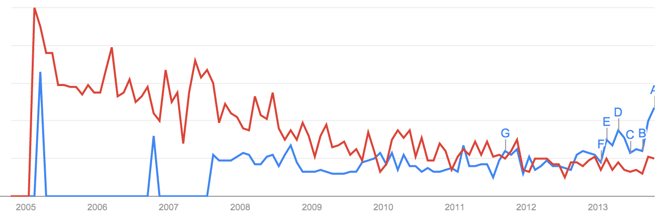
Over at the evergage blog, Rob Carpenter shares his thoughts on where real-time marketing first became more visible, based on search terms and traffic spikes on Google Trends.

Real time marketing web search

The blue line relates to “real time marketing” while the red line relates to “web personalization”, or the ability to personalize your business website based on traffic, demographic, cultural offers, seasonal specials and more.

As digital marketing via e-commerce and landing pages was growing (personalization), so was the need to be able to quickly put together offers that would initiate your desired call to action (CTA). This speed to create was the same as today’s real-time marketing, except today we have better tools to do it with.

As the blue line shows, there was a huge initial spike back in 2005, then a steady rise since 2007 (as social media filtered its way to the mass market).

Real-Time or Data Driven Marketing?

You only need to look at the clamour by brands to offer the coolest celebration of the Royal birth of Prince William and Duchess Kate’s baby to see how big the “business of real-time marketing” has become.

Yet the problem with real-time marketing – or at least, the version brands are trying to emulate but often failing at – is it’s too fast for its own good, and is simply trying to take advantage of a major news story without thinking through how that brand fits.

The beauty of the original Oreo tweet at the Super Bowl is it had been planned meticulously. Perhaps not the tweet itself, but certainly the message, the way it appeals to Oreo?aficionados, and the execution.

Because it was based on data the brand knew about its audience.

And this is where the real value of real-time marketing comes into play, and has been used for as long as the first business owner thought on their feet on ways to beat their competition, and bring customers to their store versus a competitor’s.

It’s exactly the point David Meerman Scott makes in his book, Real-Time Marketing and PR, published in 2010. In both the book and on his blog, Scott shares examples of the best types of real-time marketing that don’t hype themselves by using the phrase.

Just look at how the airlines adapt to ensure there are rarely empty flights, and how they can change pricing on the fly to sell unsold seats. Or look at the way Amazon has redefined the customer experience to ensure every visit is optimized to offer products and services that truly interest the visitor.

This isn’t the result of some buzzword – instead, it’s taking years of data and research about customers, their buying patterns, their purchase life cycles, and their value to a brand, and utilizing it into offers and timely promotions that make sense.

It’s like my hometown baker with his winning cakes, regardless of the victor on the sports field that day.

There’s no doubt that real-time marketing, when done well, can provide a mix of viral buzz and sales success. But let’s not be mistaken that it’s a new tactic, nor is it the saviour of marketing today.

The saviour of marketing today, much like the saviour of any business strategy, is and will remain simple – know your customer, understand what makes them tick, use the data you have on top of the data you’re continuously gathering, and integrate all of that into something called “marketing strategy”.

You might be surprised at the results, real-time or otherwise.

image: evergage

  • « Go to Previous Page
  • Page 1
  • Interim pages omitted …
  • Page 55
  • Page 56
  • Page 57
  • Page 58
  • Page 59
  • Interim pages omitted …
  • Page 283
  • Go to Next Page »
© 2026 Danny Brown - Made with ♥ on Genesis