• Skip to primary navigation
  • Skip to main content
Danny Brown

Danny Brown

podcaster - author - creator

  • About
  • Podcasts
  • Journal

Latest posts from Danny Brown

Enjoy the latest posts from Danny Brown, and feel free to add your own thoughts in the comments after the post.

Is It Time to Trade Your Blog for a Newsletter?

This is a guest post by Randy Milanovic, Principal of Kayak Online Marketing, and takes a look at a changing shift in how content is being presented.

A few months back, I noted that a handful of prominent bloggers were switching?things up and taking their content straight to Google+.

As a behavioural change,?I found it interesting; as an online marketing practice, it wasn?t something I was?willing to try.

G+ isn?t the only alternative to blogging, though.

Lately, another set of well-known bloggers ? including our host Danny here on this blog, and Shelley Pringle of Polaris Marketing and PR ? appear to be refocusing their efforts into an email newsletter.

In?Danny?s case, it appears he hasn?t quite given up blogging entirely, though his?posts seem to be shorter and mainly feed into newsletter subscriptions.

If shares and comments are to be viewed as social proof, the number of these?on Danny?s site?has dropped significantly from what were showing with his pre-newsletter?articles.

I assume of course, that Danny?s readers are opting to read the?newsletter rather than engage online. Nothing wrong with that. But what about?getting visitors to his website?

Has he built enough of a following that he doesn?t?need new traffic? That new prospects will ignore the drop in social proof? Or that he?doesn?t need any more clients? After all, last I heard, he has a day job, a young?family, and a real off-line life.

So, is it time to consider trading your blog in for a newsletter like Danny and Shelley did?

Before I get to my own answer, let me start with what I think are the obvious?reasons for doing so.

The Benefits of a Newsletter Approach

A newsletter generally takes less time than a blog (due to reduced online?engagement) and involves a different communication pattern. If you?have a large list of subscribers, there is value in being able to go straight to?them without making them click through to your individual articles.

I wouldn?t be surprised at all if Danny is getting great results and is happy with?his decision. But it?s probably not the same call I?d make for myself, or my?clients, in the near future.

There are a few simple but important reasons why.

The SEO Value of a Blog

For an email newsletter to work, I believe you already need to have a large number of?subscribers.

Blogging, on the other hand, ties closely into website building, social and search?engine optimization, which are about developing a bigger audience and platform as?you go. No matter how optimized your newsletter might be, it isn?t going to?help you rank on Google or the other search engines.

As an aside, though, one benefit to this approach I see is that it removes the?temptation to tailor your content around search engines rather than people. I?would call that a net positive, at least in terms of creating compelling content?that people actually want to read.

Blog Posts Attract Visitors

Even going beyond the search value, fresh blog posts give readers a reason to?come back to your website again and again, while email newsletters generally?don?t (with the exception of a click through to a specific landing page or longer?article).

Generally speaking, good things happen when people go deeper and?deeper into your website, so I would be hesitant to give up anything that draws?them in.

The Perception of Email as Spam

Because most email newsletters are overt sales pitches, subscribers tend to?ignore or unsubscribe from them. That means you could be seen as guilty by?association, even if your articles are timely and insightful.

The simple fact that?people expect them to be sales-oriented might work against you. It?s not lost on?me that blog notifications are emails.

That said, when I get a blog notification,?I?m typically expecting it.

The Time Factor

A lot of people get way too many emails already.

And so, while it might take?them the same amount of time to read a blog post as it would to read your?newsletter (not likely, as I?d expect a newsletter to be ?more?), one is?something they seek out for answers and information, while the other could be?perceived as an interruption.

Problems With Deliverability

Not only do email newsletters need to be CASL-compliant, but lots of popular?email services (like Gmail) aren?t friendly to newsletters.

This could result in you having your messages blocked or inadvertently marked as spam or (gasp!)?promotional, or have all the images blocked, or possibly never get to their inbox?due to security measures blocking image- and link-rich content, which is usually?associated with porn or drug spam.

The Ability to Touch on Multiple Topics and Campaigns in a Blog

In most cases, a series of newsletter emails will need to follow a similar theme?or topic. Blog posts do, too, but can be a little more varied to fit different?themes, campaigns and time-frames.

In that way, I think they have more utility?to appeal to different audiences or marketing personas over time, and, they can?be referenced months and years into the future.

Even with these reservations, I want to be careful to point out that I don?t?necessarily think using a newsletter instead of a blog (or?emphasizing?a?newsletter instead of a blog) is a bad idea.

It’s more on why marketers?should be careful about jumping away from a strategy that is proven to build?your online presence.

But is that the last word on the subject? I?m not sure. I?ll be watching Danny, Shelley and?others as they navigate the newsletter approach.

Who knows, maybe they?ve?figured something out that we haven?t yet.

Randy MilanovicAbout the author: Randy Milanovic is an entrepreneur, marketer, and author of the books 21 New Rules of Content Marketing and 10 Crucial Strategies for Turning Your Online Presence Into Something Your Company Can Actually Use?.

He blogs about online marketing,?SEO & social engagement topics. A Stage IV Cancer Survivor, Randy has been featured as a?Social Media Today?Best Thinker, and has also been profiled by Financial Post Magazine, under FP Entrepreneur Nov 4/14 (pg 84).

You can read more from Randy on the Kayak blog, and connect with him on Twitter, Google+ and LinkedIn.


Of Gratitude and Recollection on Remembrance Day

When I think back to how I got to wherever I may be today, I see a lot of paths that have been taken.

I see a schoolboy who was incredibly fortunate to have a wonderful education at an amazing school that accepted children for brains as well as financial clout.

I see a teenager at high school who was able to choose the subjects he liked, as opposed to the subjects his parents thought he should take or his teachers wanted him to take.

I see a young man that left home at 19 and moved hundreds of miles away from his family to start a career path that would lead him to this place, right here, right now.

I see the moments that changed his life, and led him to another country, another continent, and have the support to be who he wants to be.

In short, I see a lot of good fortune and encouragement.

But I also see one overarching reason for anything that has happened, and anything that will ? the power of freedom.

Freedom to make the choices that shape me and the lives of those around me, whether they be right choices or otherwise.

Freedom to live lives that we choose to live as opposed to lives that would be chosen for us.

Freedom to disagree, and be disagreed with.

Simply put, freedom to be.

And for that freedom, I?m forever grateful to the men and women who went before me and are braver than I ever could be to make my life, and yours, the ones we choose them to be.

November 11 is a day to remember, and offer gratitude for those that went before. On this and every Remembrance Day, let’s take the time to reflect, and thank, and acknowledge.

They earned it.

Why Context Marketing is Nothing New

So, the latest buzzword in the online space is context marketing, or the ability to look into the context of what your customers want and deliver on that need.

And so we have another cool word to join the lexicon of other cool marketing buzzwords in the online space – content marketing, advocacy marketing, persona marketing and, yes, influence marketing (guilty of that one).

But here’s the thing – if you’re not already a “context marketer”, you need to ask yourself what kind of marketer you’ve been so far.

Context in Marketing is Nothing New

While social marketers looking to present a new billing revenue driver to clients might try and push context marketing as the new “must have solution”, the truth of the matter is context is nothing new when it comes to marketing.

Probably the best example of context marketing is an email drip campaign. Much like the term suggests, this uses automated selections (drips) based on recipient actions to move a customer along the purchase life cycle. A basic example would look like this:

  • Email sent out;
  • Action taken (opened or ignored/bounced);
  • If opened, move to the next stage (send a link to a download, free resource, etc). If bounced, clean list. If unopened, send different message;
  • If new link from opened email acted upon, send a sales message/final CTA (call to action). If new message to the previously unopened email acted upon, move to the next stage (download link, free resource, etc.);
  • Close the sale or move to next stage, or clean list;
  • Rinse and repeat.

As you can see, this is a really simple overview of a drip campaign via email, that uses the context of the action to deliver the next phase, all the while moving the customer along the various stages of the purchase life cycle.

The reason this is pertinent, though, is it’s been happening for years, long before “context marketing” started to gain traction in the online space.

Context Marketing in the Offline Space

It’s not just the digital world where context marketing has been used way before it even became a phrase, though. Retailers, for example, use context in everything they do when it comes to their marketing campaigns.

It’s why you’re occasionally asked for your postcode when shopping, or asked to fill out surveys online after your shopping experience. This data allows flyers to be targeted to the demographic of a specific neighbourhood based on age, gender, income, etc.

The same goes for seasonal ads – at their most basic level, these are also examples of context marketing at play. Look at the back-to-school ads that begin running in the weeks leading up to a new semester; or the games and toy ads that begin in early Fall for the festive season.

Then there’s the context of emotion and surroundings that sway the purchase decision based on where you are and what your perception is of the venue you’re at.

For example, independent coffee houses play soft music, while mixing the scents of coffee with the aroma of scented candles and dimmed lights, to evoke a peaceful setting in which customers are more likely to stay longer and make repeat purchases. Home stagers place a roast in the oven, or leave a freshly baked cake on the countertop, to evoke a feeling of homeliness to attract buyers.

All of this is context. And all of this is carried out away from the “we’re so cool” brigade that deems context marketing the next big thing.

You Want Context? Understand Your Customer

Perhaps we shouldn’t be surprised that marketers are jumping onto this new term with such enthusiasm, though. After all, anything that can be sold as added-on services is good for the bottom line, right?

Maybe – but is it really good for your clients that you’re only jumping on this boat now? The truth of the matter is context marketing is nothing more than understanding your customers, and this has been the heart of good marketing for decades – or should have been.

Seen by many as the Father of Advertising, David Ogilvy nailed it in his belief that,

The function of advertising is to sell; successful advertising for any product is based on information about its consumer.

It doesn’t matter if you’re talking about advertising or marketing – knowledge of your consumer gives you the data you need to meet your consumers’ needs. In other words, understand your customer and you’ll have the context to be successful.

If you don’t understand your customer, whether you’re trying to retain or gain them, any message you put out will lose a large part of its effectiveness. Lose the effectiveness, lose the customer.

Hopefully brands can at least understand the context behind that marketing equation…

The Little Boy That Could (Or Why We Need to Make What We Do Brilliant Every Time)

Stephen was born in 1942 at a time of worldwide struggle. Europe was divided and broken, Asia was in turmoil and the United States had been dragged into a conflict it had tried to avoid.

In fact, Stephen was almost never born ? a missile fell on a property just two homes away from his parents? house.

So even before he was born Stephen was faced with adversity.

As a child, Stephen was known as a good student, but not brilliant. He chose safe subjects like math and science, and continued this to University.

He almost never made it this far, though, due to poor study habits and lack of note taking ? his passing grade was just enough to get him into University.

At University, the problems started.

Stephen began to feel frequently weak. His muscles would become sore and stiff and he suffered terrible cramps. He would continue to suffer throughout University with these attacks, but this didn?t prevent him from gaining his Ph.D.

After leaving University, Stephen continued to suffer from poor health. Then, in 1974, the weakness and the cramps became an aside as he lost all use of his limbs. His speech slurred and then that, too, was lost. As a result, Stephen has been confined to a wheelchair for more than 30 years and communicates through a voice box.

Yet that?s just half Stephen?s story.

There Is Nothing But You Holding Yourself Back

Despite his disability, despite his inability to move and talk normally, Stephen is one of the most successful people in the world.

He?s been awarded an OBE in the United Kingdom; he?s won numerous awards and distinctions across the world; and he?s consistently cited in thousands of magazines and publications for his knowledge.

He?s made scientists worldwide rethink a lot of their discoveries.

Perhaps most unlikely of all, Stephen took a zero gravity flight in 2007 that allowed him to move freely without his wheelchair for the first time in 30 years. He?s also fathered three children.

So what?s the moral of this story?

That you can do anything. There is nothing but you holding yourself back.

That business you want to start? Do it.

That book you want to write? Do it.

That one big pitch to set you up for life? Do it.

That unbelievably beautiful girl or guy you want to ask out? Do it.

Life is short. We have a limited time to do everything we want to do, or need to do.

We need to make what we do brilliant every time. We need to nail that sales pitch. That marketing plan. That PR strategy. That customer service experience. That blog post. That online connection. That offline connection.

If a little boy called Stephen Hawking can overcome adversity from before he was born and be brilliant in his adult life in spite of an insane obstacle to overcome, then surely we can try and be brilliant every time too?

———————————————-

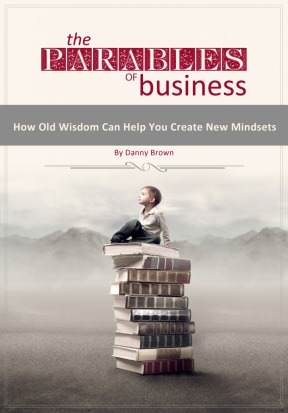
Parables of BusinessThis is a chapter from my ebook “The Parables of Business: How Old Wisdom Can Help You Create New Mindsets”.

Available for just $0.99, it offers 11 chapters of business tips and advice through the art of storytelling.

You can learn more about it here.

Is ‘Mental’ Health a Misnomer? Why We Need to Destigmatize Depression

This is a guest post by Robert Clarke, and is a personal recollection and call-to-action on how we need to change the conversation around depression.

Two young men.

The first young man is 19, a constant joker who enjoys nothing else than making people laugh and bringing joy to those around him. He is big into robotics and the challenge of solving problems. He also helps his close friends solve their problems by being their go-to guy when they need a shoulder to cry on, or simply someone to listen.

The second young man is also 19. He has a lot of social anxieties and gets depressed. He often lies in bed for days, shutting out TVs, phones, and even food. He?ll make excuses to not go out with friends. His mind is burdened with such an unbreakable cycle of negative thinking that the best part of his day is falling asleep, and the worst part is waking up.

The first young man?s name is Lucas.

Last week Lucas took his own life.

He was the son of a close friend to Danny Brown. Danny says,

There?s got to be something missing. For someone to seem so happy all the time and always willing to help others, but not themselves. It just doesn’t add up.

I won?t pretend to have any easy answers, but I can offer some insight on the topic of depression.

That?s because the second young man I describe above is me, nearly half my lifetime ago.

The Dangerous Compartmentalization of Depression

Since that age I’ve gotten better. A lot better.

After years of keeping things bottled up, I finally was able to reach out for help, and got it.

The question is, why did it take me so long? Why is it so hard for people to reach out for help?

I think it starts by the way we frame the discussion of mental illness. Specifically, what we mean when we say mental illness.

We compartmentalize mental issues as being exclusive from physical issues. This mind/body dualism school of thought dates back to Enlightenment thinkers such as Rene Descartes.

And I think it’s bullshit.

Our mental state, or consciousness, is a biological phenomenon just like any other part of our body.

Notable modern philosopher John Searle, who would agree with me on this point, says:

It is true that [our brain] has special features, most notably the feature of subjectivity, but that does not prevent consciousness from being a higher-level feature of the brain in the same way that digestion is a higher-level feature of the stomach, or liquidity a higher-level feature of the system of molecules that constitute our blood.

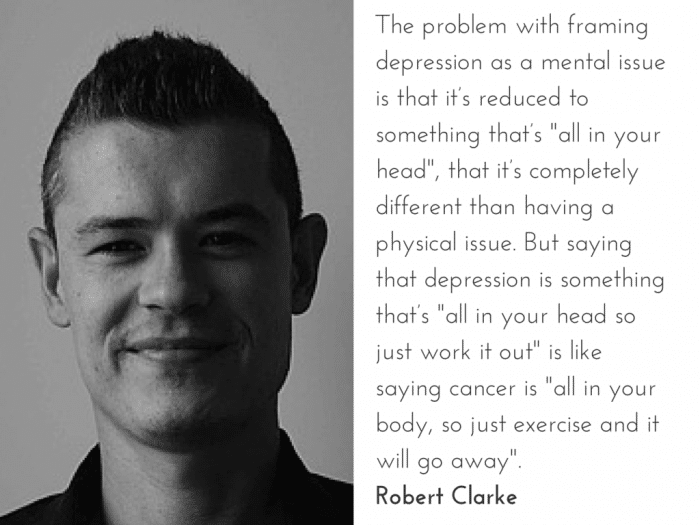
The problem with framing depression as a mental issue is that it?s reduced to something that?s ?all in your head?, that it?s completely different than having a physical issue.

What we imply when we say something is ?all in your head? means it doesn?t really exist, so you should be able to just work it out for yourself.

But saying that depression is something that?s ?all in your head so just work it out?, is like saying cancer is ?all in your body, so just exercise and it will go away?.

Depression can be physical.

Robert Clarke on the stigmatization of depression (2)

The Physical Illness of Depression

Did you know that that the hippocampus is smaller in some people with a history of depression than those with none? Or that neurotransmitter or chemical imbalances in the brain is a source of depression? Other causes can include abuse, death or loss, major events, and genetics.

Do any of these things sound like they?re ?just in your head??

No, they are real. They are physical or have materialized in our physical world.

My point is, people with depression often won?t reach out for help because they believe their issues are in their head, and not something that could possibly be a natural phenomenon in human beings.

They think they are solely responsible for their problems, and are solely responsible for solving them.

I personally always felt like my feelings of depression were like some sort of character flaw, and the reason I couldn’t just break the cycle of negative, depressive thoughts was because I simply wasn’t smart enough, good enough, or normal enough.

Consequently, my poor attitude about myself just reinforced my negative thoughts, and my negative thoughts reinforced my poor attitude about myself.

And around and around we go.

So I believe that to help more people with depression we need to not only destigmatize mental illness, we need to treat it with the same care, compassion, and understanding that we would physical illness.

We need to change the conversation.

CAMH

Ask yourself, why is it that we get annual physicals, but it has nothing to do with how healthy we are feeling?

Why is it that when we get injured, we can go to physiotherapy and train or rehab the injured part of our body until it gets better, but we don?t think we can do the same with our brains?

Why is it that we have cancer ribbons, campaigns, runs, and mega-fundraising campaigns, but people battling or who have battled depression or mental illness don?t benefit from an equal support system?

Cancer doesn?t discriminate, but neither does depression. It just happens, and can happen to anyone. No-one should feel guilty about getting cancer, and no-one should feel guilty about feeling depressed.

Some facts on mental illness in Canada:

  • In any given year, one in five Canadians experiences a mental health or addiction problem.
  • Nearly 4,000 Canadians die by suicide each year ? an average of 11 suicides a day.
  • While mental illnesses constitute more than 15% of the cost to treat disease in?Canada, these illnesses receive less than 6% of health care dollars.
  • Just 50% of Canadians would tell friends or co-workers that they have a family?member with a mental illness, compared to 72% who would discuss a diagnosis of cancer and 68% who would talk about a family member having diabetes.
  • The economic cost of mental illness in Canada is estimated at $51 billion per year. This includes health care costs, lost productivity, and reductions in health-related quality of life.

(Source: CAMH)

So what can we do?

Learning?to Accept That It’s Normal to Not Feel Normal

Besides changing the way we look at depression, and talk about mental illness, I think another major part of the solution is early education.

Just like we have gym class to encourage fitness and home economics to teach kids how to manage a household, we need to teach them to recognize and understand the signs of depression and mental illness even before they?re old enough to get them.

In other words, set expectations and equip kids with the right tools.

http://youtu.be/EUb063stmfU?list=PLGaXn-0H6JmvhCPvdIcr_g2QNepfeyQxa

Teach kids that some of them might not feel ?normal?, and that this is perfectly normal. Let them know what the signs of depression might look like, feel like, and what they can do and who they can talk to. Above all, they should understand that it?s fairly common and not something to be ashamed of or run from.

It?s part of being a human being.

And it can?t be easy growing up these days. Before the internet and mobile phones, kids could at least go home at the end of the day to safety and security. Now, with Facebook, texts, Instagram, Twitter, etc., there?s seemingly nowhere to find that comfort zone.

I think it?s the responsibility of parents, educators, and even the makers of social media sites and devices to work together and find solutions for kids to safely use and participate in an online world.

With more awareness and funding for mental illness, there?s increasing hope that more can be done to uncover the specific causes of depression.

And to learn more about the causes of depression, we should also learn more about the causes of happiness,?because?they?re two sides of the same coin.

In the meantime, you can also help.

Lobby your MPP, MP, and school board to get proper mental health education in schools.

Perhaps even more importantly, help change the conversation about mental illness. It?s not something to run from, hide from, to be ashamed of.?It?s something worth talking about.

When you experience a pain in your side for a prolonged period, you visit the doctor. You don?t even think about it, it?s automatic. Depression should be the same – when you don?t feel right, you should seek help without even thinking about it.

And if you or someone you know may be suffering, say something. Tell someone.

And if you want to talk about me about my experiences, your experiences, or anything at all, please send me an email: robert.at.op-ed.ca

Let?s make sure people like Lucas don?t have to suffer in silence any longer.

He?d like that a lot.

He?s still helping people.

  • If you would like to help change the conversation on depression, and support young people suffering from it, the family of young Lucas have chosen to support Kids Help Phone, an organization offering anonymous and professional help. You can make a donation in memory of Lucas here.

Robert ClarkeAbout Robert Clarke:?I’m a listener, engager, and purveyor of social media (when done right). Constantly curious about all things digital, marketing, and more. Partner at Op Ed Marketing in Oakville, Ontario.?Proud daddy to three beautiful girls and a basset hound to boot. A wonderful wife, a wonderful life. Read more at Op-Ed Marketing Blog, or connect on Twitter and/or LinkedIn.

  • « Go to Previous Page
  • Page 1
  • Interim pages omitted …
  • Page 53
  • Page 54
  • Page 55
  • Page 56
  • Page 57
  • Interim pages omitted …
  • Page 283
  • Go to Next Page »
© 2026 Danny Brown - Made with ♥ on Genesis