• Skip to primary navigation
  • Skip to main content
Danny Brown

Danny Brown

podcaster - author - creator

  • About
  • Podcasts
  • Journal

Latest posts from Danny Brown

Enjoy the latest posts from Danny Brown, and feel free to add your own thoughts in the comments after the post.

Speed of Resolution Over Speed of Response is Key to Social Media Success

Speed

For a lot of consumers, companies that can respond within minutes on the social sphere send out a far more positive message than those that dilly-dally.

But does this type of instant response really benefit us, both as customers and brands? While this speed might be something that would always exist in an ideal world, unfortunately we don’t live in an ideal world.

Not only that, but by setting these expectations, we’re also?setting companies up?to fail by jumping to action as soon as their name is mentioned.

It’s why, instead of the speed of response,?it’s speed of resolution that should really define how successful a company is in social media (or any other business medium).

The Problem With Speed of Response

In an ideal world, we (as consumers) would have answers to our questions almost as soon as we’ve asked them. If we have a problem with a product, it’ll be resolved immediately.

Or we have a complaint – it’ll be heard and acted upon quicker than you can say, “Sorry, sir/miss/madam, we’ll get onto that right away.”

But the desire for that kind of brand interaction?falls short of the realistic one, for several reasons.

Legal red tape

You’d think that a simple, “We’re sorry you feel that way, and we’ll look into this for you” would suffice as an acceptable way to cover a customer issue. And it should be.

The problem is, if it’s an issue that involves legal counsel, everything has to be approved. Everything. Even a simple “We hear you”.

Because if a multi-million dollar lawsuit is the potential outcome (especially involving a pharmaceutical company, for example), then the?company better make damn sure everything is documented and carried out to the letter of the law.

Locale and culture differences

Say you’re a consumer in Canada, but the main team you need to speak to is in China. So there’s a time difference to start with. There are also different cultural holidays; so response times are immediately affected.

The issue of scale

Sure, we’d all like to think our companies?(either own, employed or those we buy from) are the biggest on the market, so we should expect a 24/7 every-minute-of-the-day personalization level. But that’s never going to happen.

There are only so many people a business can employ and still make a profit, while allocating the right resources to customer care and crisis communications. Timescales will always be governed by numbers.

There are more reasons why the speed of response isn’t necessarily a core ingredient to a business’s success; but these three are the most common starting points. And ones that dovetail nicely into…

The Preferred Option of Speed of Resolution

Generally, consumers are smart people. We understand businesses have other customers, and that sometimes we’re maybe making a bigger deal of something than it deserves.

Yes, we’re also antsy assholes at times – but, generally, we offer leeway when we feel we’re being listened to. And “listened to” isn’t the same as “hearing”.

A company might hear me, and offer a speedy pat response, just to show that they’re listening and responding to social media standards. The problem is, a pat response shows why?being heard?is completely different from?being listened to – nothing is usally fixed. The same issues that were there before are still there now.

However – switch that around and listen to my problem and resolve it within an acceptable timeframe? That’s far more benefecial to me than giving me faux customer love.

But that still leaves the response time issue, no? Not necessarily.

If you’re a brand, make it clear on every single customer touchpoint what your practice is for issues and queries:

  • Standard customer service issues will have a response within 2-3 hours.
  • Identified escalated issues requiring further investigation will have a response within 12-24 hours.
  • Emergency issues or concerns that have health implications will have a response within the hour (if not immediately, based on the issue).

Make it clear too, that a response is not the same as a resolution. Offer timescales for internal procedures to let customers know that, to get the answer they need to really resolve the issue, the process is X departments and Y amount of days, to get to Z resolution options.

Also, make it very clear that you’re monitoring countless hundreds (if not thousands) of conversations around your customer base, and that sometimes a query or question may be missed.

In that case, have an easy contact option on your business website where customers can follow the same process as social media questions, but accept that the time to reply will be dictated by submission time.

We Don’t Need You To Be Fast – Just Right

Ask the majority of customers what they prefer from the two – a speedy response, or a speedy resolution, and more times than not you’ll get the latter as the preferred choice.

It’s why customers will wait in line at the Apple Genius Bar, as opposed to going to the local computer store – they know the longer?waiting time?means a quality service where they’ll get their problem sorted first time, as opposed to a quick buck band-aid that leads to even more issues down the line.

While not every company can be an Apple, most consumers will prefer service like an Apple customer. And speed of response has never been Apple’s modus operandi.

Maybe that’s something we can all learn from, businesses and consumers…

What Happens When You Change Your Blog Subscribers Over to a Newsletter Format?

About three months ago, I made the decision to change up the way my blog posts were delivered to email subscribers.

While RSS subscribers would still receive the usual instant notification once a post went live, email subscribers would now get my post as part of a weekly newsletter.

This decision was driven by three key reasons:

  • Up until that point, I had been using Feedblitz for delivering emails to my subscribers. However, I’d become very disenchanted with that service – erratic subscriber metrics, and severe lack of templates/template customization, being just two areas I felt Feedblitz were letting me down. This played into the second reason for changing delivery format.
  • I’d been thinking of running a newsletter format for a while, but I wanted it to be different from many of the newsletters I used to receive. Instead of just being sales pitches for a blogger’s books or products, I wanted to have a newsletter that was more intimate, without just being focused on my own stuff. This played into reason three.
  • Earlier this year, I took stock of the content I was producing, and decided to stop writing solely about marketing, social media, etc., and instead write more personal content that talked about the things that really mattered to me, as a human being. This shift in focus now gave me the more personal touch needed for the newsletter content I wanted to create, and moving away from Feedblitz to MailPoet allowed me to create the type of newsletter that would let me achieve these goals.

Once I decided that the time was right for me personally to move to a newsletter format, I wanted to make sure that it was right for my subscribers. So I went back over 6 months worth of Google Analytics in the campaign settings, and how the metrics there tied into the metrics I had for my email subscribers.

Two things stood out:

  • Many email subscribers weren’t interacting any further with the post, other than opening the email and then reading the content via their own inbox (at that point, my feed was set to Full Post);
  • Many email subscribers weren’t clicking on the day the email went out. Instead, they were (probably) saving it in their To-Do list, and then opening the email later. Further analysis showed this “later time” was the weekend.

With this extra data, I was confident that now was the time to make the switch to a weekly format. In the words of Upworthy, what happened next might surprise you.

The Benefits of Switching to a Newsletter Format

Changing the delivery format of the blog was weird, at first. I’ve always been used to writing a post, hitting publish, and then seeing it go out to whoever had subscribed, either by email or RSS.

By changing the delivery to a weekly newsletter, this meant only RSS subscribers would get instant notification – email subscribers would have to wait until 10.00am EST on Sunday morning (my chosen delivery time, based on previous open metrics).

Initially, I thought this might have an impact on traffic to the blog, comments, shares, etc. While I’m not too bothered about social shares (anyone can tweet or Like a post, but it takes commitment to subscribe and read), I was curious to see how the new format would play out when it came to reading a post.

  • Would “out of sight, out of mind” play a part? After all, if folks were used to immediate updates, would they forget to check their email on a Sunday morning for the newsletter?
  • Would interaction suffer? I’m a fan of blog posts that invoke conversations (no matter where that may be – blog, Google+, Facebook, etc.). Would changing to a less regular format inhibit the willingness to interact?

Thankfully, for the most part, these “fears” would appear to be unfounded.

Out of Sight, More on Mind

Whether it was the fact that email subscribers now had an exact day and time when to expect my content, or whether it was because it was the weekend and folks had more time on their hands, I’m not too sure. However, my fear of being out of sight, out of mind didn’t take shape.

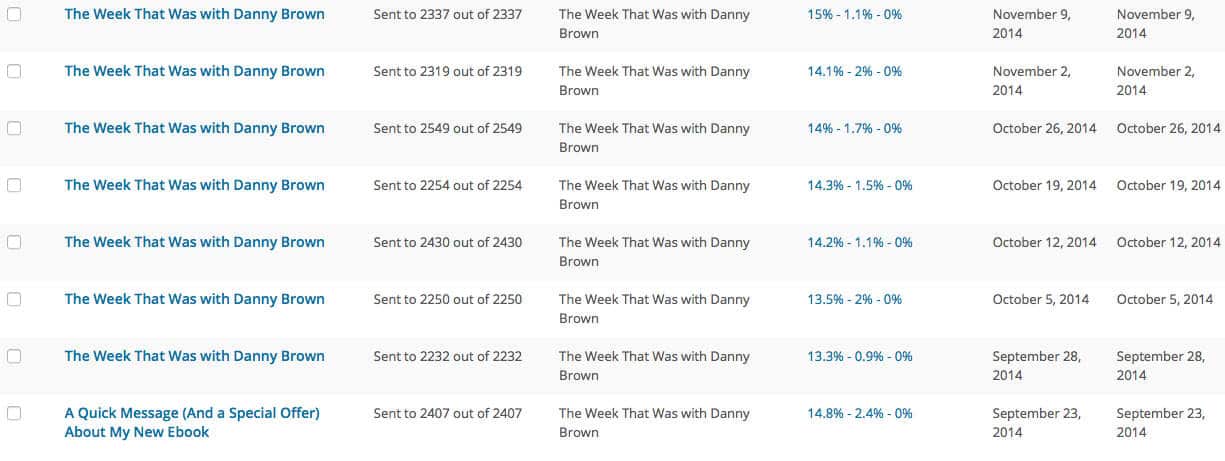
Clicks on the Open metric were up from my previous provider. Up until then, I was hovering around the 10-11% open rate. Not poor, but certainly not great when comparing to the standard 13-14% that many email metrics say is the expected open rate of subscriptions.

By switching to a weekly newsletter, it was clear that folks were opening the email which, as we know, is the first major hurdle to overcome. Better still, the metrics were showing that I was hitting industry standard metrics – an improvement of 3-4% from the previous delivery format (click to enlarge).

Danny Brown newsletter open

On top of that, clickthrough rate was also better. While the screenshot above shows clickthroughs of approximately 1-2%, these are based on overall emails sent, as opposed to emails opened. When you adjust that, the clickthrough rate is around the 12-14% – again, a major improvement on my previous delivery option.

This tells me that my subscribers know when to expect my newsletter, and are ready for it, hence the increased opens.

Additionally, it also tells me they’re willing to click through more. Admittedly, I now have an excerpt for my content versus full feed, so to read my latest post you have to click through. However, it’s the clickthrough of the content I’m recommending that shows an increase in interaction.

Interaction Wins On Two Fronts

In his recent guest post on my blog that shares his viewpoint on newsletter delivery, Randy raised the question of visitors, as well as social shares and comments, suffering due to the newer format. From that post, Randy mentions,

If shares and comments are to be viewed as social proof, the number of these?on Danny?s site?has dropped significantly from what were showing with his pre-newsletter?articles. I assume of course, that Danny?s readers are opting to read the?newsletter rather than engage online. Nothing wrong with that. But what about?getting visitors to his website?

As mentioned in the previous section, visitors have gone up due to increased open and clickthrough rate. In addition, pages per session and average session duration have increased, as subscribers clicking through are taking time to check out any other posts they may have missed.

It’s not only my own site that’s benefiting, though. As mentioned, each newsletter I send out links to two other articles I feel are worth reading. Based on my MailPoet metrics, these are also getting visited with healthy clickthrough rates (often, equal to my own content clicks).

With regards comments and social sharing, the social proof aspect doesn’t bother me as much. Comments can take place anywhere – my blog, on G+, etc. Same goes for sharing – anyone can share, not everyone that sees a share will visit.

A?quick comparison of posts before and after making the switch to newsletter delivery shows that comments on the blog posts are, indeed, down a little (from 506 for the previous three months, to 421 for the three months since I made the switch).

However, using the Data Hub Activity on Google Analytics, I can see discussions around the post are up across social media. Additionally, I’m having more conversations via email from subscribers that mail me directly to talk about a post, and I’ve really been enjoying that.

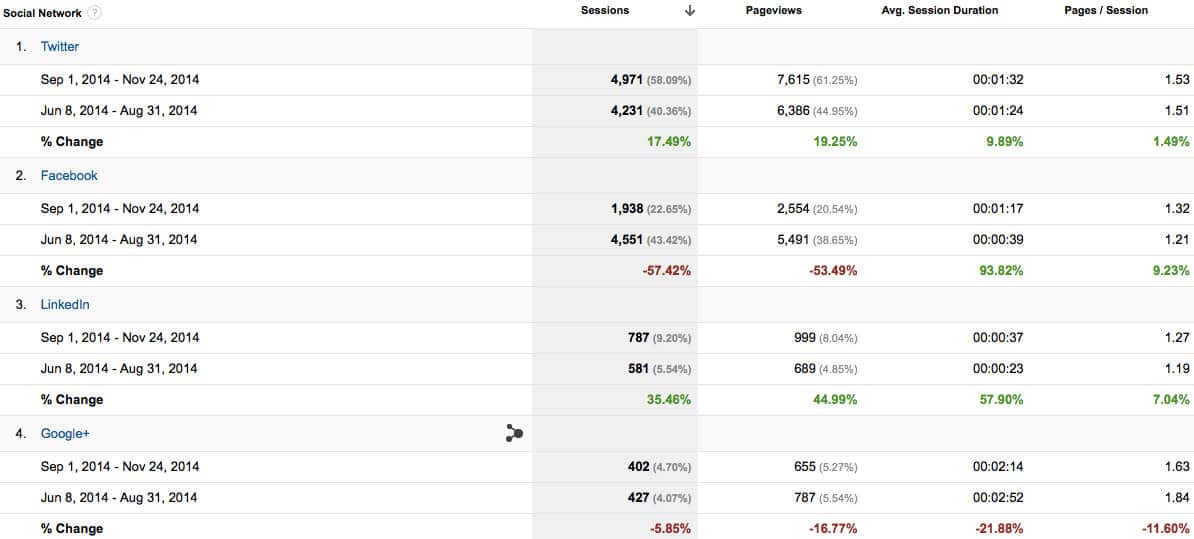
Social media referrals are also up, as you can see from the image below. The drop in Facebook traffic can be written off based on the amount of traffic I received from an evergreen post about Facebook for Android, which accounted for thousands of shares in the previous period (click to enlarge).

Danny Brown social media referrals

Indeed, pretty much every metric is up, with the exception of Google+. Which makes perfect sense, given it’s the network where I spend the least amount of time.

All in all, I’d say the vanity metrics since moving to a newsletter format have either remained static, or had a very minor drop. More importantly, the valuable metrics – open rates, clickthroughs, action taken, etc., have increased.

On Moving to a Newsletter Delivery Format – My Takeaways

It’s certainly been interesting to watch how things have changed since making the switch way back in August. While not for everyone, I know that changing to a newsletter format has been a success as far as I’m concerned.

As well as improving on some key metrics that I wasn’t getting with my previous email delivery option, the change to a weekly format has allowed me to spend less time online, and more time offline with my family, a huge plus in my books.

Additionally, it’s enabled me to think bigger and to really look at content outside the usual social media bubble, both to drive the type of content I want to write about, as well as find articles and posts that my subscribers may want to read. Feedback from my subscribers (so far) has shown that the time I spend finding content to share is worth it.

I’m also getting to spend more time checking out new tools and technology, which allows me to share that with newsletter subscribers. Looking at clickthrough rates, I’ve sent a decent amount of traffic to tools like Flare, Atomic Reach and Sumo, which is excellent to see, as they’re all great tools to help you with your content.

Is this approach for everyone? No, and that’s something that was highlighted and led to some great conversations in the comments after Randy’s guest post on my blog. However, if you are considering making a similar switch, my advice (for what it’s worth) would be:

  • Go either or, and not both. Offering both email subscriptions to your blog, and a subscription to a newsletter, could be confusing. Additionally, I’ve seen bloggers promote their newsletters with the blurb, “Get my best stuff here”. If that’s the case, why would I want to subscribe to your second-rate blog? So, keep blogging, just choose which delivery system you want to go with.
  • Offer real value, and not just more selling. As evident by my own metrics, my own content hasn’t lost out because I share content from other people in my newsletter. So don’t be afraid to share stuff that doesn’t solely drive subscribers to your latest landing page. My own experience would suggest that’s appreciated.
  • Be open to personal interactions. Because I open each newsletter with my personal thoughts on anything that may have happened to me, or the world around me, it’s led to a far more personal experience for my subscribers. This has led to some wonderful conversations in private via email. If you make the switch, be sure to give your subscribers the attention they’re giving to you.

Switching to a newsletter format isn’t for everyone, and your own analytics will help guide your decisions should you be considering the switch.

However, for me, it’s been one of the more rewarding decisions I’ve made when it’s come to my blog. Now, I can’t wait until I sit down on a Saturday evening to pen the following day’s newsletter, and I have no regrets about making the switch.

In fact, I only wish I’d done it sooner…

This originally appeared as a guest post on the Kayak Marketing blog.

Three Web Design Trends to Consider for 2015

Web trends

Ever since businesses started using the internet for commerce, one thing’s been constant: the need to evolve with consumer behaviors.

Much like local brick-and-mortar stores need to adapt to compete with off-site retailers, so, too, do businesses need to adapt to the way customers interact with their sites when making a purchase.

As we move into a more mobile-driven landscape?and one where frictionless buying truly is the holy grail?website design mindsets need to change with the ever-evolving buyer. With that in mind, here are three of the more popular web design trends for next year.

1. Truly Interactive Storytelling

There’s a lot of buzz online at the moment about how businesses need to tell better stories to connect with their customers. The problem is, while this advice is generally good, it also places a lot of pressure on business owners to try to work out what your story is and how to tell it. Some companies have found a way to do it?just take a look at Tesla Motors.

The company’s Go Electric page answers consumer questions about the evolution of the Tesla motor, how the?electric-powered cars work, the benefits to users and much, much more. Check it out for yourself?simply scroll down the page and see how the story plays out with multiple forms of media.

This is the way to tell your brand’s story, and you don’t need the design budget of Tesla to do so.

If you run a WordPress powered site, Aesop Story Engine is a wonderful solution that enables you to blend multiple media together to tell one cohesive story. From text and full-width images to overlaid videos, PDF embeds and historical timelines, it’s an excellent and inexpensive solution for your business.

If you’re not on WordPress, then Readz offers another solution for combining multiple media together into an embeddable presentation that can be used on pretty much any main web platform. (You can see an example of the “9LIVES” project here.)

This online form of brand storytelling is a powerful and inexpensive way to interact more with your customers and a great way to set yourself apart from your competitors.


2. Richer Backgrounds on Web Pages

One of the most underused components in web design is the background of your site’s pages. Many sites are content to have a simple dark font on a white background (or vice versa) and let the copy do the talking. However, you’re missing a big?opportunity to really attract your visitors’ attention.

While there’s been a rise over the past few years in using background images, the ability to really make backgrounds more than just static images opens up a whole new world of design potential. HTML video, for instance, allows you to have fully responsive HD video embedded in the background of whatever your sales page or call-to-action may be.

Think of sports teams?selling season tickets: You enter which game you went to that year,?and the site loads video replays of that game’s best plays on-screen.?Depending on which seat you choose, the video can highlight that, and the call-to-action could might be “Relive the magic again?your seat is reserved.”

The design is simple, effective and plays to the buyer’s impulses, given their connection to the product, their sentiment around a victorious day and the very seat from which they watched it all happen.

3. One-Page Scrolling Instead of Clicking

Scrolling website design, which is when?all the information about your company, services and more is on one page, has its?critics, mainly because of its potential impact on SEO and how one-page design is implemented. But there’s no denying that it’s becoming more popular?and understandably so.

Instead of having to worry about poorly implemented navigation menus that use multiple drop-down tabs, the one-page site can offer an elegant and effective experience for the end user.

Additionally, one-page websites are perfect for the kind of?interactive storytelling highlighted at the start of this article.

Themeforest offers a great collection of HTML, site templates, WordPress themes and more that offer one-page scrolling with excellent support and documentation. Some good examples?of one-page scrolling sites include:

  • My Life Without Me
  • Beatrate
  • Whitmans

The Future Is Bright

These three trends are just a few examples of where the web is heading from a design point of view in the coming 12 months and beyond. Also making inroads in Web design are:

  • retina display, which allows for much higher-resolution browsing on tablets, smartphones and hi-definition monitors;
  • material design, which takes the current-darling flat design and adds slight gradients and layers to achieve a richer effect; and
  • a more personalized experience?driven by cookies?that remembers a visitor’s preferences and loads up a customized UX on their next visit.

Creative web design offers everyone a chance to make their business stand out. The great news is, the cost is becoming less prohibitive and the potential is only beginning to be realized.

This post originally appeared on my monthly column at OPENforum.

The Official Annual Black Friday Rant by The Q

Black Friday

This is a guest post by Amanda D. Quraishi. It was originally a Facebook?update, and is republished here with her permission.

I hate Black Friday.

I think it’s everything that is wrong with America today.

It’s a day that is made up specifically for the purpose of encouraging crass consumerism, using a religious holiday as an excuse. Let that sink in. Holy Day Sales.

It’s not just about shopping. It’s about sacrificing time with family and friends that used to be for watching movies and playing games to go into the cold, electric light of big box retailers and going into debt buying shit that your family will forget in six months to a year.

It’s about being FIRST IN LINE. It turns purchasing gifts into a bloodsport (literally) where each year people are injured and/or killed. And despite the injuries, stores are more than happy to keep plugging Black Friday.

Because what matters to them are hordes of people who need a deal badly enough to be there at 5am for their fucking ‘door busters’.

Black Friday is evil. It doesn’t need to exist.

From Thanksgiving to Christmas there are 29 days to buy your shit. You don?t NEED to shop on Black Friday. Big fucking stores need you to shop on Black Friday so they can put themselves in the black. Get it?

This has nothing to do with anything except commercialism and consumption. It’s manufactured by marketers to make you think you’re getting deals when it’s really just a few things marked down to get you in the door.

I hate Black Friday.

If you absolutely MUST shop for holidays this weekend, go shop locally for Small Business Saturday. Or visit the Armadillo Bazaar or any place where you can buy something real and meaningful made by the person selling it to you.

Buy gifts that last for years, even generations. Or buy the materials to make something beautiful. Bring back American dollars to American manufacturers, artists and artisans. Gift the gift of services (massage, salon, etc.)

Stop the Pavlovian drooling over the ads that come too soon and the promise of love that comes with a purchase. It’s a lie.

Amanda Q

About the author:?Amanda Quraishi is a blogger, interfaith activist and technology professional living in Austin, Texas.?

She is the Technology Solutions Specialist?at?Charity?Dynamics, a marketing & technology consulting agency that works with non-profit organizations on national fundraising campaigns.

She also leads a populist-based interfaith initiative at?InterfaithActivism.org,?and is the Principle Web Media Strategist for?BlogathonATX. You can read more from Amanda on her blog.

When Does Convenience of Service Overcome Lack of Ethics?

If you’ve spent any time online in the last few days, you can’t help but see all the bad news that keeps seeming to appear about personal taxi service Uber.

While the service has come under plenty of criticism in the last 6-12 months over some of its practices, the last seven days or so has seen a major upsurge in negative stories around the brand.

  • Uber Executive Suggests Digging Up Dirt on Journalists (Buzzfeed)
  • The Moment I Learned Just How Far Uber Will Go to Silence Journalists and Attack Women (pandodaily)
  • Sexist French Uber Promotion Pairs Riders with “Hot Chick” Drivers (Buzzfeed)
  • Uber Exec Proposes Smearing Female Reporters Who Criticized the App (Valleywag)
  • Uber Driver Told Cancer Patient She Deserves to Be Sick After Canceling Ride (New York Daily News)

Quite the list, huh? And that’s just in the last seven days – run a Google search, and the number of results are staggering. So it’s clear that Uber may not only have some very questionable business practices, but morally questionable ones at that.

Yet for some, this may not matter. Over on Facebook, my friend Justin Kozuch shared?a news story on why the City of Toronto is seeking a court injunction against Uber operating in the city. The story from the Toronto Star highlights a sizeable list of risks, including:

  • increased risk to passenger safety due to lack of driver training and mechanical inspections;
  • unregulated fares resulting in price surging (which Uber did to Torontonians in last year’s bitter winter);
  • increased safety risk to drivers due to lack of training and vehicle security equipment;
  • inadequate insurance that fails to meet municipal codes and may not provide proper coverage for drivers, passengers and other road users.

Again, quite the list. Despite this though, and despite the multitude of examples of Uber’s approach to ethics, it seems turning a blind eye in lieu of convenience is the more popular route. It’s not just Uber where this is happening, though.

When We Silently Complain

Earlier this year, I wrote a post about why the bullshit attitudes towards women needs to stop (warning: contains graphical and disturbing imagery). One of the examples I used in it was that of Ray Rice, who was the running back for the Baltimore Ravens at the time.

Rice was caught on tape hitting his then-fiancee, and (at the time) received a pitiful punishment from the NFL (a two-game ban, which was increased when more details came out about the case).

However, Rice was seemingly just the tip of the iceberg when it came to the issues that were about to unfold for the NFL.

  • NFL Star Adrian Peterson Arrested for Child Abuse (BBC)
  • Face It, Women, The NFL Does Not Give a Shit About You (Jezebel)
  • Panthers Disappointed in Greg Hardy, But No Discipline Imminent (Charlotte Observer)
  • The NFL Needs to Take Domestic Violence Seriously (TIME)
  • Misogyny and Homophobia in the NFL: Is America’s Crisis of Masculinity Playing Out In Its Favorite Sport? (Huffington Post Gay Voices)

Much like Uber, this is quite the collection of events for the NFL, and all from this year. Following these articles, videos, etc., social media lit up with condemnation, and calls to boycott the NFL, etc., especially when this damning Keith Olbermann video came out, attacking the NFL for its degradation of women.

https://www.youtube.com/watch?v=6fc_AnLaBew

Some of my friends over on Facebook were the most vociferous in their condemnation. Then game day one arrived in the new NFL season.

Many of these critics were now cheering on their teams, and paying into the money machine again either by going to games themselves, and buying the relevant beer, food, etc., or they were paying the cable companies to get live access to the game.

While the NFL issues didn’t necessarily appear forgotten, they did seem out of mind now the cheering had begun.

Away from the US, here in Canada there’s currently a case involving media personality Jian Ghomeshi and domestic violence around his sexual preferences:

  • More Workplace Allegations Made Against Jian Ghomeshi (CBC News Toronto)
  • Dirty Little Open Secrets: How the Jian Ghomeshi Scandal Helped Turn the Tide Against Bill Cosby (Salon)
  • Jian Ghomeshi: How He Got Away With It (Macleans)
  • Can Jian Ghomeshi Salvage His Reputation? (Toronto Star)

Again, much like the Ray Rice/NFL case, there was a lot of condemnation and outrage on Facebook and other social media channels, as friends and their connections moved from incredulity to anger and disgust.

Yet according to Facebook today, five of my own friends are still “fans” of the Jian Ghaneshi Facebook Page.

Jian-Ghomeshi

The irony of that,?given the way a Facebook Like can be seen as an endorsement, isn’t lost in light of the way those same folks decried Ghomeshi and his behaviour. Damn you, forgotten Facebook Page Likes!

The Right of Choice and Why It Needs to Be Defended

Going back to the Facebook post I referenced earlier from Justin, many of his friends still supported Uber and stated they’d continue to use the service. And, as Justin mentions himself in his reply, that’s exactly how it should be.

Critical thinking should always trump emotional reaction. If we can’t have the former, then we’re in serious trouble. It’s your choice [to continue using], and I respect that decision.

And that’s correct – people make their own decisions based on their needs at a given time, thanks to the freedom – or the right to choose freely – that so many men and women gave their lives for in order we could live ours without fear of reprisal (where legally acceptable, of course).

But sometimes, don’t you wonder if the choice is a little more black and white than that?

Take Uber. Clearly a company with both business and ethical issues that permeate from the top down. And while they fired the driver that abused the cancer victim, the senior executive that promoted the idea of abuse against reporters he found questionable is still at the company. Not much in the way of double standards there.

Or take the NFL. Since the avalanche of cases related to spousal abuse, child abuse, domestic violence, public violence and more became evident, they’ve gone on a damage control exercise, employing four women whose role it is to advise the NFL on domestic violence issues.

Many, however, see this as mere lip service and not a bigger endorsement of taking the issue seriously (especially given the fact it’s been reported that the players’ union, the National Football Players Association – is attempting to have Ray Rice’s ban lifted).

Perhaps most of all, we should take us and how we react, not just initially but moving forward.

We’re Defined By the Decisions Who Make Us What We Are

As Justin mentioned in one of his replies to his Uber discussion, “critical thinking should always trump emotional reaction”. Never is that more true when it comes to violence, hate, ethics and other emotionally-charged topics, and the discussions and actions that follow them.

While it’s natural for us to take an emotional stand initially, it’s the critical thinking stand that is more important in the long run. Our judgements can often be clouded by emotion – our longer-term thinking, less so.

It’s why we, as humans, sometimes need to ask ourselves how ethics that may not impact us personally impact the bigger human angle around us.

  • If we choose convenience over ethics, are we saying people that get hurt by poor business ethics is of no concern to us?
  • If we support a sports franchise where the owners have shown their true colours, are we in danger of saying “Out of sight, out of mind”?
  • If we take a popular stand on public networks, then don’t follow that through in private, are we really taking a stand at all?

It’s these kinds of questions that Chris Tuttle answers so eloquently over on Facebook:

I’ve had difficulty not using a service that I really like, but I can no longer justify or overlook bullying, sexist intimidation, and privacy issues in order to have a fabulous clean car. #GoodbyeUber”

Yes, we have choices, and the choices that we make should – for the most part – have little or nothing to do with anyone, or anything, that isn’t in our immediate circle of impact.

But if we always take that path, at what point does the human race finally implode on itself and simply look out for our own personal interests? Because, for me, that would be a truly sad day indeed…

  • « Go to Previous Page
  • Page 1
  • Interim pages omitted …
  • Page 52
  • Page 53
  • Page 54
  • Page 55
  • Page 56
  • Interim pages omitted …
  • Page 283
  • Go to Next Page »
© 2026 Danny Brown - Made with ♥ on Genesis