• Skip to primary navigation
  • Skip to main content
Danny Brown

Danny Brown

podcaster - author - creator

  • About
  • Podcasts
  • Journal

Latest posts from Danny Brown

Enjoy the latest posts from Danny Brown, and feel free to add your own thoughts in the comments after the post.

How to Use @JugnooMe to Make Social Monitoring Fun and Help Find and Build Brand Advocates

Jugnoo social crm

Jugnoo social crm

Over at Jugnoo, we’ve been tinkering away on a few updates to our solutions.

Between now and the end of September, there are even more cool updates being dropped in, and these will turn our dashboard into the fully-fledged offering that’s going to answer a lot of questions around social media, especially that all-important ROI question.

In the meantime, however, there are some pretty funky features and complementary tools that you can use right now. Case in point – social monitoring.

We all know how important social monitoring (or listening) is when it comes to your business or clients. Brand reputation, lead generation, customer service and more can all be optimized through a smart monitoring strategy.

The problem is, sometimes this can be very mundane and uninspiring. So, to counter that and make social monitoring a little more fun (while still helping get effective and actionable results), here are a few ways Jugnoo can help make things more fun.

Start Your Engines, Please

The first place to start is via our social search option. When you set up keywords in our platform, the most popular results are shown alongside your social analytics (for this example I’m just using Twitter – we also support Facebook and YouTube, with more platforms to come in the next release).

When you’re logged in the Jugnoo dashboard, click onto your social analytics icon and select your Twitter account. As long as you’ve set up a social search, you’ll see the keywords underneath your Most Popular Tweets (click to expand).

Twitter social analytics on Jugnoo

Click on the keyword, and you’ll be taking to the first fun part of the monitoring – our Tweet Visualyzer? (again, this will be expanded to feature more platforms in future iterations).

Once you’ve opened up the Visualyzer, the fun can begin.

The Simple (and Fun!) Way to Measure Buzz

One of the reasons we built our Tweet Visualyzer? was to make sense of the conversations on Twitter that can get noisy and confusing fast.

By separating the tweets into a simple and very visual solution, you can see what conversations are more popular, who’s having them and how they’re connected.

So, when you click your chosen keyword from the social analytics screen on the Jugnoo dashboard, you’ll see the same one on our Visualyzer. You can change views by using the top navigation, to switch from words to bubbles to usernames and more.

Now, let’s say you want to see who your biggest advocates are, so you can surprise and reward them with unique offers, or invite them to be official partners with your brand.

By clicking on the Who icon (the little head and shoulders guy), you can immediately see who’s talking about you the most:

Buzz who

In our example, you can see @FeastInc, @AtlasSymposium and @JeremyDeMello are three people who are talking about Jugnoo a lot. Hovering over their usernames, you can then see what exactly they’re saying about your brand.

This allows you to identify a potential approach to partnership, or see what kind of stuff they like. This can help you find what would be a cool surprise and delight package to send them.

By knowing what they like and other preferences, it enables you to be smarter about your approach when reaching out to them.

Once you have that information, then you can really add to the fun yet effective monitoring options, and continue to build the fledgling relationship.

Hub, Hub and Away!

This is where the third part of the puzzle comes into play – the Jugnoo Social Hub?.

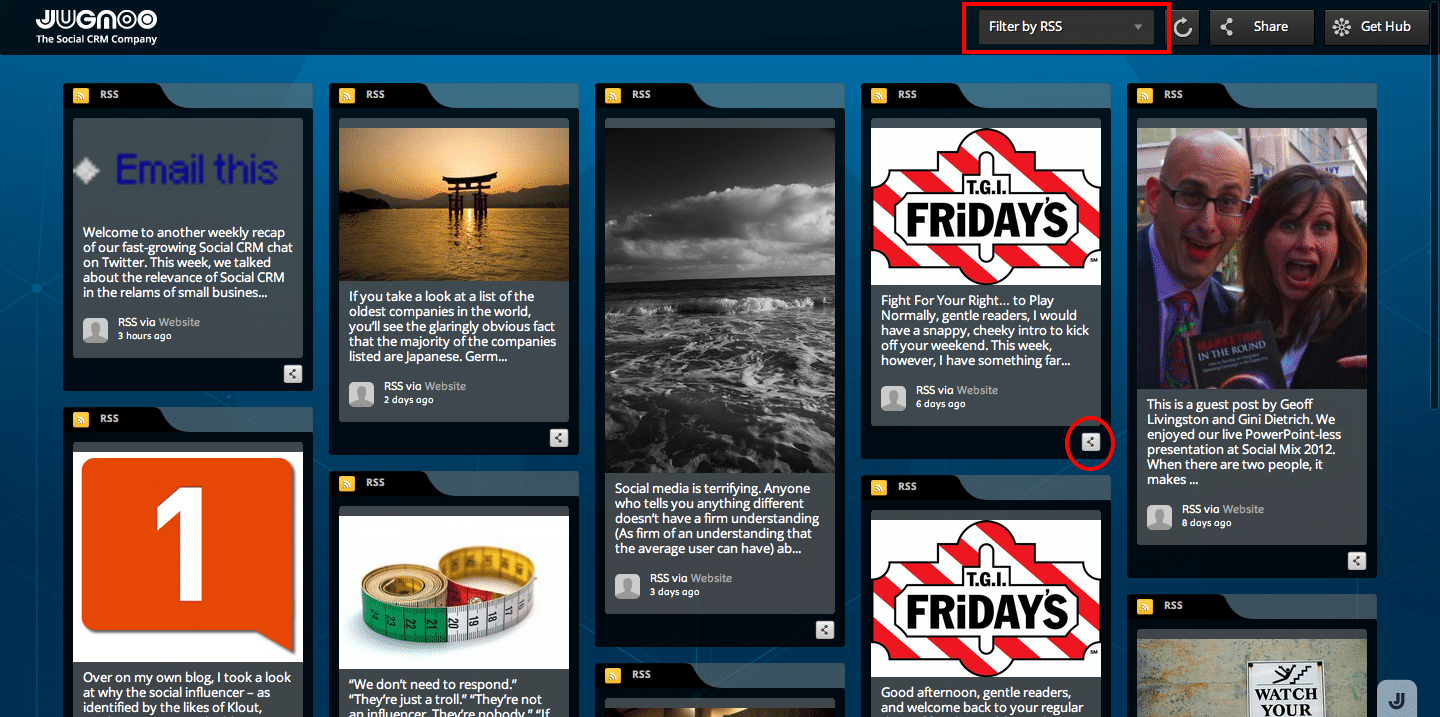
Kinda like a Pinterest board on steroids, our Social Hub? allows you to grab RSS feeds from various social networks and create a living, breathing hub where the most recent news around your choices can be displayed.
buzz RSS

Now, let’s say you want to connect more with the people talking about you from the Visualyzer results. You could set up a hub with feeds from their blogs, or Twitter account, or YouTube channel, etc, and use that to keep up-to-date with their latest updates or posts.

You can then reshare from the hub, send it as an email recommendation, tweet directly to the person, and more.

Let’s say @FeastInc, for example, tweeted that it was their pet’s birthday and you were a pet retailer. You could reply to them and wish them a Happy Pet Birthday, and then use the email function to send to your sales team and ask them to get in touch with @FeastInc to send them a goodie bag for their pet.

Or, you could see the URL for their most recent blog post, drop on over to leave a comment and mention the pet’s birthday in that comment too.

You’re building rapport; you’re showing you want to get to know them; and you’re rewarding for their support of you too.Who doesn’t like that?

These are just basic ideas using some cool tools that don’t even fall within the traditional social monitoring mix. When you partner them with the actual full social monitoring solution in the Jugnoo dashboard (released in the next 2-3 weeks) – well, the options become even more powerful.

And you still keep the fun factor of visuals, images and emotion, while making the connections that really count.

Works for me – you?

Sorry, Content Dudes, But It’s Just Plain Old Marketing

Empty blog

If you search “content marketing” on Google, you get about 560 million results.

There are events dedicated to content marketing, and folks like Brian Clark, Joe Pulizzi, Marcus Sheridan and others are huge proponents of the term.

So, big business then. And yet…

Is there really such a thing as content marketing? Or is it just marketing, plain and simple, and a facet of a bigger picture?

According to Wikipedia:

…content is information and experiences that may provide value for an end-user/audience in specific contexts.

So, by definition, content is information that may help in the decision-making process.

Marketing, on the other hand, is a different beast altogether. The core reason for marketing to exist, in no uncertain terms, is to make a buyer fall in love with something enough to purchase it.

This “something” can usually be categorized into three clear sections: product, service, expertise.

The Product and Service Angle

Product and service is straightforward. You make something, or provide something, and charge people for that. This could be footwear, a meal, cleaning services, or a million other things.

But it’s still the product or service that’s being marketed.

Sure, you might write a blog post about your industry and why your offering is better than anyone else’s.

Or you might create a video to showcase a design and embed on your website.

But that creation of content is simply a tactic in the bigger picture of marketing. The content is created to market the end product – you’re not marketing the actual content.

If you were, the message would be something like “See how cool this video / blog post is – buy the content now!”. Which wouldn’t make any kind of sense.

Switch to a marketing message, though – “The X1Z Thingymajig – Order Yours Today!” – and it’s back to using the content to drive sales of the product or service.

The Expertise Angle

One area where content marketing could be seen as a standalone solution is that of expertise (particularly on business blogs).

To show you’re someone a potential customer should do business with, you share your expertise and knowledge with your audience. You might provide white papers, or ebooks, or webinars, to help propagate that expertise and separate you as a thought leader (if that’s your goal).

The thinking here is, if the audience sees you know your stuff, they’re more likely to do business with you than your competitor.

But then, there’s that “do business with” phrase again. Because, as much as a business or consultant can say they’re offering expertise for the good of their readers, there’s always another end goal in sight – attracting business for your offering.

Sure, you’re offering free content as opposed to charging for it – but it’s with the goal of marketing your businesses through less in-your-face means. The end goal is still dollars in the cash register for whatever it is you’re selling (product, service, consultancy expertise).

Content is Still a Key Tactic

Now, I don’t want this post to come across as dismissing the importance of content when it comes to marketing your business. As someone who’s consulted clients over the years on the benefits of content, I know the value content brings to the table.

A successful blogger outreach, for example, can reap rewards at a far reduced cost to a business than traditional print or media ad buy can offer. A timely video can capture the hearts of your customers more than a radio ad ever could. And all the other pieces of content that get discussed when talking about content marketing all offer value too.

The thing is, though, it’s still just another tactic. The content is part of the overall strategy to get a customer to buy into your offering, and a solid part at that. But a standalone? I can’t see it.

Besides, when was the last time you ever saw a major news release and promotion for your latest blog post..? 😉

Read, Savour, Comment, Share ? Your Four Step Guide to Blogging Success

Blurred lines

Four steps to blogging success

You start blogging because you want to do something. Be someone. Be a part of something.

It doesn?t matter what your goals are ? thought leader, business leads, brand awareness, monetization, or even just a place to post thought ? you blog because of a particular reason.

The problem is, no matter how good the reason may seem to you, the traction isn?t coming fast enough for you. Which is okay, actually ? successful blogging is a marathon, not a sprint (damn these cheesy quotes!).

But for anyone that?s looking to try and speed up the success process, stop looking too deep into why you might be lagging, and instead think about adopting these four approaches that every blogger should aim toward, if they want to be successful.

1. Read

This might seem like common sense, but read other blog posts as much as you write you own. Look at the best writers in the literary world ? do you think they just read their own books and become great because of that?

No. Instead, they?re reading other authors in their niche, as well as up-and-coming authors in other niches but who have interesting approaches to storytelling. Mimic this.

Think about the blogs and bloggers you?d like to emulate, and see what sets them apart. It could be language, tone, formatting, etc. If you want to be the best, learn from who you feel are the best.

2. Savour

So many bloggers rush to get the next post ready to go. They feel that the more frequent their content, the more search engine value they?ll receive, and the more visitors they?ll get.

The thing is, though, your readers aren?t superhero ninja reading robots. Like the rest of us, they only have a finite amount of time every day to allocate to reading a blog.

So, instead of blasting out content left, right and centre and hoping the SEO benefits will come, take the time to sit back and let your readers savour your posts.

Let the content sink in, and the comments around the post end naturally. You can usually tell when a post has reached its zenith ? don?t force the issue, let it happen and then post the next update.

You don?t have to do this, especially if you have a schedule that works for you ? but wouldn?t it be nice to treat a blog post like a vintage wine instead of a tequila shot once in a while?

3. Comment

One of the most popular questions we get asked here is, ?How do I get more comments?? ? it?s easily in the top five questions for most bloggers.

And, unfortunately, there isn?t any real right or wrong answer, because every reader is different. Oftentimes, the most amazing blog posts get a few comments, while the most inane get hundreds. And vice versa, before you think, ?A-Ha! Let?s write an inane post!?

So, instead of telling you how to get more comments ? although that is covered here ? my piece of advice here is simple: make it easy to comment.

  • Use a friendly comment system. This can be your native option (the one that comes with your blog?s design), or a third-party option like Disqus, Livefyre or IntenseDebate (but allow guests to post when using third-party options).
  • Have an open comment policy. Unless your business dictates you absolutely must moderate all comments (which breaks up the flow), allow anything to be posted, as long as it adheres to your comment policy.
  • Encourage discussion. If someone leaves a comment, reply (where a reply makes sense). Make the reader feel welcome and they?ll come back (especially if you encourage discourse with respect and boot off comment bullies).
  • Kill the captchas. Seriously. Captchas used to be used as an excuse for stopping spam, but with the amount of anti-spam filters have now, this is a lame excuse. Captchas are the birth control of blog commenting ? if you want to propogate, drop the barrier to entry.

Make it easy to comment and guess what? People will generally comment.

4. Share

You?re the greatest blogger the world has ever seen and your content is amazing ? so why the heck are you making it so difficult to share with others?

The amount of times I?ve landed on a blog post, loved it, then went to share it with my networks only to find there were no social sharing options? GAH!

This isn?t 1999, folks ? we have hundreds (if not thousands) of ways to share a blog post without just relying on optimized copy for search engines (though, please, don?t forget that either).

You want your blog to grow? Make it easy for folks to help you in that goal.

It?s pretty easy to add sharing options to your blog, no matter what platform you?re on (though if you?re on self-hosted WordPress, even better with the amount of plugins available).

So why would you write the best stuff to keep hidden from the world? Your blog isn?t Rapunzel ? come out of your tower and let it be shared.

It?s pretty straightforward ? whatever your goal is in blogging, you?re not going to get there by making it hard to be found and interacted with.

The good news is, you don?t have to do a heck of a lot to get the cogs moving ? ready to get started?

This post originally appeared on our blog resource centre For Bloggers By Bloggers.

If @Klout is Fixed, Why Are They Profiling an 11-Year Old Kid?

Klout and minors

Klout and minors

Two days ago, social influence tool Klout published a blog post on how they had updated their algorithms to answer critics of their service.

From the post:

Today, we?re introducing some of the most significant product updates in Klout?s history. With these updates, we?ve concentrated on helping everyone to gain a clearer, more accurate understanding of how they influence other people through the ideas they share.

As part of the update, Klout promises “increased accuracy”. Which is great, as this is one of the core complaints about the service. They also promise more transparency, more data, real-world influence. And a shiny new site design…

However, one glaring omission from the post is the question of Klout and privacy.

There have been numerous posts written about Klout’s policy of creating profiles without the explicit permission of users, and the fact you have to opt out of the service if you don’t want profiled.

Worse still, though, was the discovery that minors under the age of 18 were being profiled by Klout, from something as innocuous as being connected to their parent on Facebook.

Due to the backlash against this practice from numerous bloggers, Klout CEO Joe Fernandez came out and stated “Klout has no interest in profiling minors”.

So, why does the Klout website have a profile for an 11 year old kid (click to expand)?

Klout Influence Report 11 year old

This is the son of a friend of mine, Jennifer, who brought it to my attention that both her kids were being profiled by Klout. Her son is the 11 year old pictured here, and her daughter is 14 later this year.

Both profiles are clearly there for all to see. Not only that, but her daughter’s profile on Klout shows who she influences. One is her brother, the other is her friend – also 14.

Klout Influence Report 14 year old

Jennifer spoke with both her kids, and neither of them even know what Klout is, never mind that they have a profile on there.

So, despite all the questions about privacy and minors, and despite Klout’s statements that this would be fixed, it’s clear the company is still adding profiles of children that fall under Klout’s own privacy terms.

Klout Privacy Policy

These terms have actually been updated, since it was previously under-18’s that weren’t “allowed” on Klout. Even so, is it really fair for any company to take a kid’s details and parade them on a site where numbers attract advertisers?

And while Klout advises parents to monitor their kids’ online activities, it’s hard to do this when you have to be logged into Klout to see your kids (if you opt out, you get redirected to a Facebook or Twitter sign-in page).

Now, it could be said that the kid shouldn’t be on Twitter (and thus, Klout) in the first place, since he’s under 13 years old. But as we move towards a more online world, kids are going to go online anyway – the best approach for many parents, and one that they’re taking, is to help guide them on the way.

With that in mind, isn’t it about time Klout quit adding profiles on an opt-out basis, and only has people on there who have voluntarily opted in? Maybe then parents wouldn’t have to worry about their kids being taken advantage of in this way.

Heck, there’s already enough online pitfalls to try and keep our kids safe from without a social score to worry about…

  • Update: The 11 year old also has a profile on Klout competitor Kred, despite their Terms of Service stating it’s for 13 years and older – more reasons for the opt-in process to be standard.
  • Update: Following an email from the 11 year old’s mother, Kred has made her kids’ pages on Kred inaccessible.

    Kred and minors

This Blog is Moving – How to Update Your RSS Subscription

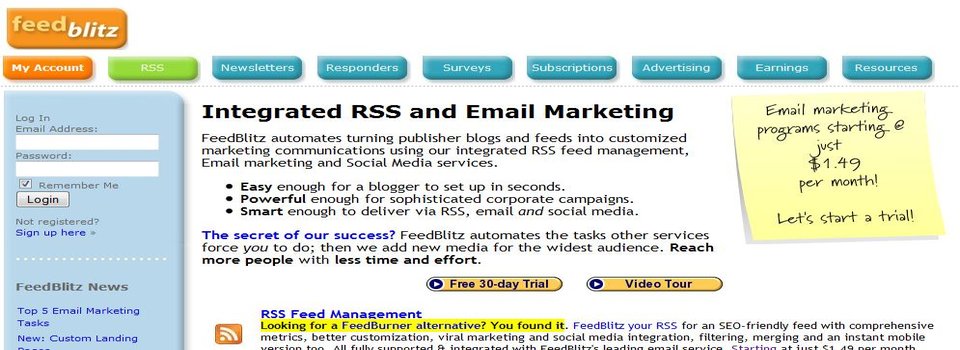
Feedblitz blog subscription service

Feedblitz blog subscription service

For the last four years, I’ve used the Feedburner service on this blog for folks that are kind enough to subscribe.

It was the simplest and – at the time – most effective way for bloggers to offer subscription options. Then Google bought it, and it went downhill.

Subscriber numbers were all over the place; often whole subscriber services disappeared; and the support for issues turned into something pretty non-existent. Although, in fairness, that’s true of pretty much any Google product…

However, I – like many other bloggers using Feedburner – persevered, in the hope it’d finally work out. Then I read this recent blog post over at The Way of The Web, which suggested Google may be about to close Feedburner down. From that post:

But today two things have happened. The Google Adsense for Feeds Blog has announced it has closed;

?After some consideration, we recognize that we?re just not generating enough content here to warrant your time, so we won?t be posting here any longer.?

Which is true, given the last prior post was in October, 2010.

But also the @Feedburner Twitter account is being closed from today as well. The Feedburner API was already deprecated and is due to close in October, 2012.

Now, while Google may keep Feedburner going, the signs aren’t good. So, time to move.

I’d looked at Feedblitz before as an alternative, but at the time it looked a little clunky as far as migrating feeds over. Let it be noted, however, that I am the world’s crappiest techy-type person, so that could have been down to me…

However, when I checked it out again earlier this week, it looked a lot smoother. Email subscription transfers for existing subscribers was pretty straightforward to do, and all new email subscribers should be going over to the new Feedblitz option.

RSS was even simpler – a straightforward feed redirect from Feedburner for the next 15 days, and then this blog should all be on the Feedblitz platform.

What I also like about Feedblitz are the social options – you can subscribe via a host of social networks too, so you’d get a Twitter mention once a post goes live, for example. There are also some pretty nifty analytics available, as well as newsletter options and more.

There is a cost involved, but that’s only for email subscriptions – if people subscribe to your blog by RSS feed, then that’s free for you to manage.

I don’t really do justice to the Feedblitz options here (especially the support from founder Phil Hollows) – so check them out for yourself and , if you’re currently on Feedburner, you might want to consider moving your own blog over.

  • Note: As of February 2 2015, I no longer use Feedblitz. Details can be found here.
  • « Go to Previous Page
  • Page 1
  • Interim pages omitted …
  • Page 108
  • Page 109
  • Page 110
  • Page 111
  • Page 112
  • Interim pages omitted …
  • Page 283
  • Go to Next Page »
© 2026 Danny Brown - Made with ♥ on Genesis