• Skip to primary navigation
  • Skip to main content
Danny Brown

Danny Brown

podcaster - author - creator

  • About
  • Podcasts
  • Journal

Latest posts from Danny Brown

Enjoy the latest posts from Danny Brown, and feel free to add your own thoughts in the comments after the post.

At Some Stage the Conversation Has to Advance

Over on Facebook, author and marketer Geoff Livingston posed the following question/statement:

Apart from the misplaced punctuation mark in CEO’s (*cough*, sorry Geoff, couldn’t resist!), it’s a great question, and one that solicited some great responses (mostly along the lines of CEOs don’t need to tweet).

Because, simply put, a CEO has one job and one job only – to meet the goals set for the company by the Board of Directors. In that role, he or she becomes responsible for four key tenets:

  • Communicator – ensuring the outside world and/or media are kept up-to-date with the current business.
  • Decision maker – responsible for the overall strategy and policy making.
  • Leader – advising the board of progress, motivating employees and driving change in the organization.
  • Manager – overseeing the day-to-day challenges and operations within the organization.

See any mandate for tweeting there, or being active on social media? No – because, as Geoff rightly points out, the role of a CEO is far more reaching than the occasional tweet.

So why are we still having this conversation about CEOs and the need for them to tweet? Simple – social media is stuck in a time-warp created by a number of “experts” severely lacking in true business acumen.

I Have a Klout Score of Eleventy Billion, Therefore I Am

Don’t worry, I’m not going to start one of my anti-Klout rants here. But the influencer model and social scoring metric has led to an epidemic of businesses looking to the wrong people to help them with their goals in social media.

Whereas previously consultants and agencies had to work their asses off to get to a level of expertise and trust before they began advising corporations and organizations, now you just have to appear to know what you’re on about and have that validated for you by your impressive social score.

It’s not really the fault of these platforms either – although they have exacerbated the problem with their “You’re no-one unless you’re a social someone” approach.

Social media in general has allowed people to rise from nowhere and become “the voice” that people should listen to when they speak.

Never mind the fact that their LinkedIn profile has no experience of actually running a multi-million dollar company; or shows any kind of success metrics or return except a high score on the latest influencer platform and a speaking slot at some non-descript conference.

And yet these are the folks that are advising CEOs should be stepping away from their daily duties and responsibilities to their employees, shareholders and customers, so they can impart 140 characters of wisdom that may have been vetted and scripted anyway.

It’s advice that seems to have been pumped for the last 5 years or so – as Doug Haslam put it on Geoff’s Facebook wall, “We’re still talking about this? <kicks time machine to make sure it hasn’t malfunctioned and sent me back 5 years>.”

It also shows the maturity this space still has to go through, and the nonsensical talk that “experts” need to advance from.

Customers Don’t Necessarily Care About the Tweet Owner

One of the main arguments put forward by these social media wonks (using Geoff’s description) is that by having the CEO tweet, the brand becomes more human and awesome.

Sorry, but you can’t pay the bills with awesome.

Can CEOs tweet and improve the brand perception with customers? For sure, and there are many examples of this – Zappos and Virgin are two that spring to mind.

But they also had an incredible culture within the company too, that the CEO mandated as part of his Leader role. The true success of these brands, and others in the social space, is not that the CEO is tweeting – it’s that the CEO empowered others to be truly human in their interactions with customers.

The majority of customers don’t care if the CEO tweets or not – what they do care about is an excellent product, a fair price, and a superb experience both during and after the sale.

That kind of return is what the CEO is employed to achieve – and he or she employs the right people to do that, whether it’s in sales, HR, or social media. Getting that part right is the role of a CEO – not hovering about on Twitter in the hope of “being awesome”.

Something those that are advising a CEO what to do had they ever had the actual experience of what that incurs behind them.

Otherwise, continuing the same kumbaya conversation will only hurt in the long run, and then everybody loses. Especially business.

Note: My friend Jeff Esposito has a great post today on the same topic.

Facebook Hacking and the Value of Social Currency

Bring it

Bring it

So this weekend just gone was an interesting one.

On Saturday afternoon, I went furniture shopping with my wife and kids, and then we went for dinner. When I got home, I came back to a whole bunch of emails and Facebook alerts, asking me what was up.

Because, while I had been with my family, my Facebook account was hacked into, and the person responsible had some fun acting as me while I wasn’t around.

When I say fun, though, I mean they acted like an asshole and said some very hurtful and potentially damaging things about me, my friends, and the company I work for.

Two of the public updates that brought the email questions were “Are you hiring?”, insinuating that I was disillusioned at Jugnoo – which couldn’t be further from the truth – and “What do you really think of me?” as a “marketing experiment”.

I deleted these posts – yes, I should have just hidden from Timeline and used them to work with Facebook on catching the person responsible – and then started going through the alerts to see what had been done.

But that was just the start.

The Cowardice of the Asshole

As I dug further into the mess this asshole had created, I found that he (or she, but I have my hunches) had not only said hurtful things publicly, but had initiated a few private messages between “me” and a few of my Facebook friends.

In these messages, the person had stated lie after lie after lie. Things about Jugnoo, my current personal life, and more. They had even gotten my friends to open up about some of their personal life as well.

Like I said on Facebook, this person is a completely immoral asshole. And a coward.

He (I’m going to continue to use “he” here, though it may be a “she”) played with my family, by saying my amazing wife Jacki had an affair with a colleague at Jugnoo, and this was leading to us getting divorced.

He was also concerned about my son, now that Jacki and I wouldn’t be together (another mistake – I have two beautiful children and my daughter is just as precious to me).

So, essentially, this asshole was calling out my wife – the term “whore” was actually used – as well as accusing her of not being a good mother? Game on, shitdiot.

As I mentioned on Facebook, I’m big and ugly enough to come after and say what you want about me when you want to try and damage me personally and professionally. But going after my family and using them to get my friends to open up on their emotions too?

That just makes you a pathetic loser and coward. Sadly for you, it didn’t work.

The Value of Social Currency

One of the things I’ve always said, both here on the blog and when I’ve either been consulting with or training folks on social media, is to be yourself. Truly be yourself.

It may not always win you the popularity vote, but it does make one thing crystal clear – you get known for who you are, what you believe in and how you say things.

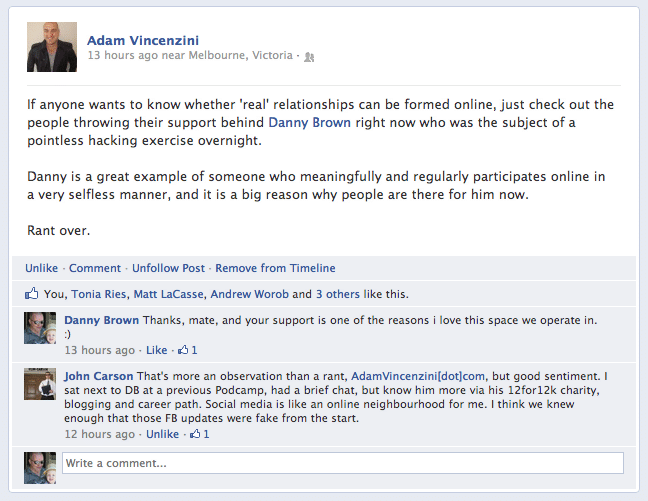
Never was this more true than when all this crap was going down last night.

My Facebook friends were railing around, with the vast majority saying they had doubts as soon as the crap started. Language uses, shorthand, letter cases, etc – none of them seemed to tally with how I normally speak, and in what tone.

Adam V on FB

Even if I had been drunk and was going on a rant – which some friends had asked, haha, cheers! – I’m sensible enough to not be online. Instead, you’d find me playing FIFA on Xbox and then falling asleep!

Being online is no different from being offline (with the exception of reach) – how you are and how you interact with people defines you, and paints a clear picture of you as a person.

I’m truly thankful and humbled that my friends realized the hacker was not me, and could see the difference between me and “not-me”.

It makes crap like this more bearable while going through the process of sorting it out, as well as helps combat the negativity that could have arose had these updates been believed.

If ever you need a reason to be you and your true self online, my experience this weekend should be a pointer.

Don’t Let The Bastard(s) Win

Of course, that still leaves the issue of the hacker in question. And what an idiot this person has turned out to be.

Going after me personally is one thing. The reason for the personal grudge, if that’s what it is, I don’t know. Like I said earlier, I have a hunch on who it may have been, given the people he spoke with and what was said.

But this idiot didn’t stop there – mistake.

He also tried to infer that the company I work for, Jugnoo, is having issues and that because of that, I wanted to leave (and, for the record, this is so far from the truth it made me laugh just typing it!).

When you state public things about a company, and these things could be damaging to that company’s public image? You’ve just opened yourself up to a whole new level of legal action.

While you might have thought it’d be fun to try and damage my personal and professional reputation, the game changes when you publicly involve a company. Something the hacker will no doubt find out soon…

My recommendation? Don’t take stuff like this lying down – fight back and work with the network or platform in question and make sure they don’t get away with it, where possible.

On that note, I’d just like to say I’m incredibly grateful for the support Jugnoo’s executive team gave me on Saturday night when I brought this to their attention (and are still giving me). That level of backing just adds to the hilarity of the “I’m unhappy at Jugnoo” statement made by the hacker.

Keep Yourself Safe

What this whole process has shown me is that we’re always vulnerable online. I consider myself to be a veteran in this space, and as such take a lot of measures to make my accounts secure.

But, as shown here, sometimes it may not be enough. The hacker seems to have known enough personal information about me to bypass my security levels, and that’s how they accessed Facebook (this is my guess, and not confirmed by Facebook yet).

So if someone who is very active in this space can be caught out, it shows the dangers for all of us.

To avoid this, make sure you have your accounts locked down as tight as they can be. On Facebook, for example, go into your Account Settings and make sure Secure Browsing is enabled; Login Notifications are enabled; and Login Approvals are enabled.

Security Settings

These steps will ensure you’re alerted when someone tries to access your account from a non-recognized source.

Changing your main email for alerts is also recommended, and don’t share that information with anyone. Do the same with any networks or public platforms you’re a part of – use their Help Desks if unsure of the process.

As this weekend has shown to me, we’re all at risk from idiots wanting our private information, or assholes trying to damage our reputation. Don’t make it easy for them.

As for the idiot that hacked me? I hope you’re reading this, since you left a pretty big trail to follow – watch your back, because the legal stuff will be starting soon…

And to my friends and colleagues that have supported me immensely in the 24 hours or so, I truly am grateful. Thank you.

How to Pitch This Blog

How to pitch a blog

How to pitch a blog

Before I start this post, i just want to give a heads up that it’s geared towards PR folks and advertisers.

If you’re more a “normal reader” of the blog, and don’t fall within these two industries, feel free to skip this post completely and come back on the next regularly scheduled updates. 🙂

So, with that heads up out the way, let’s get cracking.

How to Pitch Your Story or Partner On Your Product

I get a lot of pitches form either PR agencies or consultants on behalf of their clients, or from business people themselves wondering if I’d be interested in taking a look at their new product or service.

This is cool – after all, this blog looks to help you, the reader, in being more successful in whatever it is you want to succeed in, from your business and where social media fits to understanding blogging and everything in-between.

The problem is, the pitch needs to fit the audience here – and very often they come nowhere near that. In the last week alone, I’ve received pitches on vodka and fashion news.

Now, while I might like the odd vodka shot now and again, I’m anything but fashionable and single malt scotch is my tipple of choice (though Whyte & Mackay may change that!).

So, here are some ways for you to increase your chance of being shared here:

1. Know my readers

They’re a huge reason this blog exists so understand who they are. A really simple way to do this is use the Demographic feature on Alexa. You can also use tools like Quantcast to grab more information about this blog’s audience. If you’re looking for me to introduce you to them, at least give them the courtesy and respect they deserve by understanding whether or not they’re right for you.

2. Know my topics

I don’t think I’ve ever written about fashion. I know I haven’t written about healthcare. So why pitch these topics? I make it really easy to see what this blog is all about – you just need to check the black category navigation menu at the top of every page. Or, simpler still, check the About This Blog page. If you don’t take the time to see if there’s a fit, why should I take the time to make the fit?

3. Check the archives

A lot of the time when I’m pitched, it’s clear the person behind the outreach hasn’t carried out even the barest of research on this blog. If they had have done, they would have known I’d already talked about their topic before, often more than just the once. Save your time – use the Search This Blog option in my sidebar (or homepage), and use the keywords for your pitch/product/service. If the story angle has been covered, it’s not likely I’m going to do it again.

4. Know my style

I recently received a pitch where the PR agency wanted to control the editorial; only allow for positive praise; and moderate the comments for negative replies. I told them to go shit a porcupine (maybe not in these words, but you get the drift). The voice of a blogger is his or her currency when it comes to readers and their trust – don’t compromise that. Ever. If you don’t understand the tone here – upfront, no bullshit, honest and questioning – then don’t pitch me.

Save Time By Being Diligent

These are just some tips to help you have a better chance of sharing your news here. While the tips are mostly geared towards PR outreaches, they can also be applied to advertorial content and partners.

It’s pointless asking me if I’m interested in advertising skincare products or painting materials, when this blog is primarily about marketing, social media, business, digital/mobile trends and occasionally the odd blogging tip. So try and make the advertorial partnerships a relevant fit for that kind of audience.

If you want to interact with some of the smartest folks on the web, then I’m very fortunate to have them share their expertise in the comments regularly.

They’re probably also interested in hearing from you – as long as you do it right. Sound fair?

Note: While these tips are for this blog, you can pretty much transpose the basics to any blogger you’re looking to connect with.

Announcing the For Bloggers By Bloggers 30 Day WordPress Workout Program

WordPress training videos

WordPress training videos

This post originally appeared on the For Bloggers By Bloggers blog resource centre.

One of the things we?ve always tried to do at For Bloggers By Bloggers is offer you the most relevant and helpful information to help you grow your blog.

We?d like to think that our tips and posts are helpful, and have helped you get more results from your own blogging goals, whatever they may be.

However, going by emails we?ve received and comments left on various posts, it?s clear that we also have a lot of new bloggers in our audience, or people that are looking to start blogging ? the problem is, they don?t know how.

While there are many reasons shared, the biggest one is ?How do I start a blog and which platform do I choose??.

Taking that into consideration, and being that all our team are die-hard fans of the WordPress platform, we?ve created a special course to help you, the new or prospective blogger.

Introducing the For Bloggers by Bloggers 30 Day WordPress Workout Program?!

So How Does It Work?

While written blogs are great for sharing advice, more often than not people react better and learn more from visual aids. It?s why we?ve produced graphics and videos in the past to help get a certain point across.

With that in mind, we?ve created a comprehensive 20-part video series that will take you through the complete WordPress experience when starting your blog.

From choosing which version of WordPress to use, to understanding how custom menus operate, to working with themes, plugins, multiple users and more, the For Bloggers By Bloggers 30 Day WordPress Program? is designed with you in mind.

We?ll help you choose the right option, get set up, choose a theme, help decide the best plugins for your blog, and much, much more.

As well as the 20-part video series, we?ll be providing you with free ebooks to complement the videos, as well as set up a support area (optional membership) for ?What Next?? questions.

Who?s It For?

As I mentioned earlier, we have a lot of new bloggers, and bloggers-to-be, in our audience. We also have bloggers that are on other blog platforms, but are curious about making the switch to WordPress.

This video series is for you.

It will help you understand the benefits of WordPress, and all the bells and whistles behind the scenes of the WordPress dashboard.

Complemented by our ebooks and membership section, the video series will really help you become a fully fledged WordPress blogger in 30 days or less (of course, this depends on the time you can allocate).

And, we?ll still be posting all our usual blog tips here at For Bloggers By Bloggers for you to take advantage of, and use on your newly-created WordPress blog.

How Much Will It Cost?

The full 20-part video series and ebooks will have a price of $67. However, there will be a special introductory price of $37 at launch, and you can sign up using the form at the end of this post to be alerted to the release, and receive your FBBB discount code to get the $37 price.

Additionally, we may be releasing each video in the series individually, so you can pick and choose which modules are best for your needs. Pricing on this is still to be confirmed, but expect them to be around the $5 price per video.

Membership fees will be low, and we?re looking at how best to serve you ? and also how to make sure your membership (if you decide to join that area) is really valuable to you.

So, we?d be offering strategies, offers, partners and more that we?d normally charge consultancy fees for, but for our member area, these costs will be greatly reduced.

Again, we want to make sure we have this nailed down so you really get a valuable offering, so we?ll announce that pricing soon as well, but expect it to be low, around the $20 per month range.

And for those interested in making some money, we?ll also have an affiliate program with 40% shared revenue on any program sold!

Ready to Get Blogging?

With all that having been said, here?s a taster video of the course series. The full 20-part version follows this format and, as you can see, is very easy to follow and clearly laid out. We’ll be announcing the full line-up of topics soon!

We want to make sure you don?t get lost with a bunch of buzzwords and technical talk ? after all, that?s not why you?d be interested in this series!

We hope to see you there when we launch, and make sure you sign up below for updates on when the For Bloggers By Bloggers 30 Day WordPress Workout? is launched and to get your special discount code!

[youtube]http://www.youtube.com/watch?v=bMhIzy3Aipk[/youtube]

[gravityform id=”9″ name=”FBBB 30 Day WordPress Workout Pre-Launch Update”]

The Best Practice Guide for Blogger Outreach

best practices blogger outreach

Best practices for blogger outreachIf you’re a regular reader here, you’ll know one of my pet peeves is the (more often than not) crappy pitches that PR agencies and consultants send to bloggers.

It’s almost like there’s a bulletin board somewhere that says if you have a campaign or product to launch, and you want bloggers to write about you, you treat them like idiots.

You can send pitches that make absolutely no sense, or you can make it completely impersonal and almost meat-market in approach.

Of course, there are always great examples of how to do a blogger outreach well, and how to really engage a blogger in a way that truly encourages engagement and appreciation from the blogger.

Sadly, the good ones still seem to be outnumbered by the bad ones.

Which is why Forth Metrics’ new ebook, The Best Practice Guide for Blogger Outreach is such a well-timed and much-needed read.

Compiling best practices and examples of how PR and bloggers can get along better with each other, this ebook is literally the blueprint for all PR practitioners to follow if they want to successfully connect with a blogger and his or her audience.

It includes words of wisdom from the likes of respected professionals Shelly Kramer, Paul Sutton, Gini Dietrich, Tonia Ries and many more, all of whom understand the core principals of successful blogger outreach and relations.

Oh, and it includes some Scotsman as well, if that floats your boat…

The ebook includes:

  • How to set objectives for an outreach campaign
  • How to research a campaign properly
  • How to develop relationships with bloggers
  • How to approach a blogger and what you can offer them
  • How to optimise your approach
  • How to track and measure your performance
  • How to keep a ?win-win? relationship going
  • All supplemented with loads of tools and resources

It’s available for free, and really is your primer for your next blogger outreach campaign – and will probably stop curmudgeons like me writing about your latest bad pitch. Who can argue with that?

Get your copy by clicking the image below.

best practices blogger outreach

  • « Go to Previous Page
  • Page 1
  • Interim pages omitted …
  • Page 110
  • Page 111
  • Page 112
  • Page 113
  • Page 114
  • Interim pages omitted …
  • Page 283
  • Go to Next Page »
© 2026 Danny Brown - Made with ♥ on Genesis