• Skip to primary navigation
  • Skip to main content
Danny Brown

Danny Brown

podcaster - author - creator

  • About
  • Podcasts
  • Journal

Latest posts from Danny Brown

Enjoy the latest posts from Danny Brown, and feel free to add your own thoughts in the comments after the post.

Introducing Help Me Be Inspired

Hi guys,

First, I just want to say thank you for subscribing to my blog – I sincerely appreciate it, and always look forward to reading your thoughts and takeaways at the end of the posts.

Today, I’m kind of excited to share a new “project” that I’d love for you to check out –?Help Me Be Inspired.

Help Me Be Inspired

A complete break from the norm of social media, marketing, business, etc, Help Me Be Inspired looks to step back from the rush and madness of today’s always-on world, and remember to pause, breathe, and live.

A collection of inspiring quotes, stories, people and redemption, the goal is simple – to take back some of our time and stop and savour the world around us.

I’d love for you to check it out, and if you’re feeling inspired by what you find and what lies ahead, feel free to share with others.

I also want to hear about what inspires you – your story, or your inspiration (person, place, event, etc). You can find out more about inspiring us here.

Thanks for reading, and here’s to being inspired together!

How to Counter Fake Social Media Reviews

Fake social media reviews

According to leading business analysts Gartner, as many as 10-15% of social media reviews will be fake by 2014.

Instead of honest customer reviews, praise and feedback on sites like Yelp and Google Places, we’ll have professionally-paid for reviews, either from a company trying to damage a competitor, or raise their own profile by posting multiple glowing reviews.

The report does mention that this will probably be more in the Enterprise market, but what’s to stop smaller businesses hiring interns and specialist agencies to post a review for them?

Mind you, perhaps we shouldn’t be surprised at this analysis – as social business continues to take a stronger grip in the mainstream consumer business world, it’s perhaps stranger to ask why these percentages aren’t already in place now (maybe they are).

The good news is, there are steps that can be taken to protect your reputation as a business, as well as stay on the right side of the law when it comes to this newer form of peer and customer recommendation.

Make Social Media Reviews Socially Accountable

On this blog, you’ll see I use the Livefyre comment system. Now, currently I have it set to accept guest comments – however, by a flick of the switch in my admin area, I can change that up and only allow readers to comment after logging in via the likes of Twitter, Facebook, LinkedIn, etc.

So, when it comes to posting reviews on the likes of Yelp, Google Places and elsewhere, make it the same process.

If you want to leave a review, you have to log in with your Facebook profile, or LinkedIn account. This immediately adds accountability to the process – your name and business is inextricably tied to your review. This makes it far easier to see which is a valid review, and which belongs to a fake.

For instance, let’s say Joe Smith left a crappy review on Yelp for Acme Restaurant, Toronto. The owners of the restaurant can see the review, and then check Joe’s profile on Facebook.

If it’s a valid one, they can then ask Joe to come in with his receipt and they’ll refund the cost of the meal. What, Joe doesn’t have a receipt because he was never there?

Gotcha – that takes us on to the second part of the process.

Build a Digital Ethics Agreement

In the last couple of years, social media has attracted the interest of organizations like the FTC (Federal Trade Commission) in the U.S., the ASA (Advertising Standards Authority) in the U.K., and the Office of the Privacy Commissioner in Canada.

These organizations are forcing the hands of advertisers and marketers in social media to be above board when it comes to how they’re targeting consumers in the space and, in the case of the Privacy Commissioner, making Facebook change their privacy terms when it comes to sharing information about its users.

So, there are already governing procedures under way and ongoing when it comes to making sure the medium isn’t being used in questionable ways.

The problem is, they’re splintered. The FTC has no real jurisdiction outside of the U.S, and vice versa with the U.K. and Canadian equivalents (although they can work with each other in cross-border cases).

So, technically, a Canadian business could operate around U.S. consumers and (unless picked up) be outwith the legalities of that country. This is where the fake social media reviewers (solo or agency) would win.

However, the Internet is one big global community when it comes to e-commerce. I don’t care if I need to buy a British import CD from Japan to complete my Canadian music collection using Bitcoin – it’s a global market and I’ll use whatever means I need to.

Now, while this may be too simple in actuality over theory, if there was a global Digital Ethics Committee that handled stuff like online reviews, social marketing, etc, and created a governing law that applied to online transactions and subsequent reviews – well wouldn’t that help counter the fake reviews?

The businesses that are caught paying for fake reviews are banned from review sites for X amount of years, with a disclaimer on their Yelp or Places page that advises visitors why there’s no official presence.

By naming and shaming (as well as the obligatory fine and damages paid), consumers can see which companies live by their product and which live by their producing of lies.

As Consumers, We Need Protecting

It may be that these two suggestions are too simple for such a legal minefield. And, despite the Internet’s global reach, the arms of it at a country and cultural level are still too disparate for the simple approach to work.

For now, anyways.

But as we move into a more socially-led and active world, and the stakes continue to rise as to those businesses that will succeed versus those that will flounder, the playground needs to take a stand now.

While social sign-ins may not be the answer (although it’s a lot easier to spot a fake Facebook or LinkedIn account than it is to filter a bogus email), and cross-border integration into a single unit might be a ways off, it’s important we start to think of solutions today.

Otherwise, that tomorrow of 2014 will come a lot quicker than we think, and it’s more than just our reputations at stake – it’s our very future business success.

The 7 Phases of Twitter

Twitter noob

This is a guest post by Matt Andaloro.

Twitter, the never-ending story.

It’s a platform I find myself pitching to my friends and family more and more, as it has increasingly become a platform that the general public has become more open to using on a regular basis.

As a result of this, people I know have been gradually joining this social media snowball.

Which, truth be known, is pretty exciting because it means this social network is simultaneously becoming more powerful in general, and more personally pertinent for myself.

Along with this, If I look at who I follow, I am able to see a snapshot of different people I know in various stages of their journey through the Twitterverse.

This has caused me to think about my own trip through Twitter and what I considered the evolution of my Twitter experience. After putting some serious (but not too strenuous) thought into my Twitter milestones, I found that I was able to break my entire experience into 7 distinct phases.

Phase 1: The Beginning

The beginning is literally where it all started for me, from the initial set-up, the choosing of that first (sexy) avatar, following several celebrities, news sources, and friends who are already on the platform. Then came the daunting task of sending my first tweet, which I CLEARLY put so much thought into:

Matt Andaloro on Twitter

This tweet was followed by several weeks equally as insightful tweets, until some combination of the novelty of this new toy wearing off, and a lack of understanding of the platform induced a dormant and update-less Twitter-state.

Phase 2: The Second Push

After the 10 month dormancy came my second push into Twitter. For whatever reason, maybe another social media account has asked me to link up my various accounts, or I was simply harassed by some people in the social sphere, interest was sparked again.

This time I started discovering many more interesting people to follow, and my Twitter feed began to become much more interesting (and more tailored to my tastes), and it began to dawn on me why Twitter is so? Magical.

To quote a friend on his own dawning moment he said:

When I was on Twitter and I saw a David Bowie Official tweet right below a CBC News tweet, and I thought to myself: Oh? I see why people love this.

Suffice it to say, I was hooked like many of those before me had been.

Phase 3: Learning How To Tweet

The quality of my tweets didn?t see any remarkable improvement in the first little while, mostly because I was sitting in front of my computer trying to sound insightful or make meaningful observations.

It wasn?t until I got Twitter on my phone and started relaying actual observations that I received my first non-gratuitous re-tweet!

It was a big day. Tears may have been shed.

From that point on, my tweets became less angst-y, and my thoughts were those that more than one person could share, as I learned more Twitter-oriented ways of expressing myself.

Phase 4 ? 5: Searching and Engaging

Phase 3 was arguably the longest phase of my Twitter experience, as I spent month after month content with my micro-blogging and my information ingestion.

One fateful day, however, I was scrolling through my Twitter feed, and I wanted to talk to someone and I realized that the amount of people I was following who would actually message me back was very low, so phase 4 became finding and following real people.

I started with Hamilton, Ontario, then searched for people from my University, and then drilled down even further to people in my classes trying to find anyone to interact with. Phase 5 then became actually reaching out to these new connections I?d formed and starting ?actual- conversations.

The results led to phase 6.

Phase 6 ? Twitter IRL

The people I started connecting with online started connecting with me in real life!

(Note: Prior to this, being a very recent transfer into the Communication Studies program, I knew very few of my new classmates.)

I connected with a bunch of people and was afforded the opportunity to establish a common ground that I had been unable to do previously while a professor was lecturing. This then built into several relationships.

The power of this platform simply continued to grow.

Phase 7 ? The Present

Which brings me to my present phase. Although I recognize that it may be the seventh phase of my Twitter adventure, I still find myself plagued with nearly as many questions as I had in phase one.

  • How do I create valuable content?
  • What value do I bring to online interactions?
  • How do I interact successfully in a professional manner?

I even find myself re-facing some of the questions from the previous stages, if only at a greater stage.

  • How do I create messages that my audience will jive with?
  • Do I sound cool enough?
  • Is what I am talking about old news?
  • Am I too sensational?
  • How do I make sure my personality bleeds through?

Whether or not I?ll find answers to these questions in this phase, or in an unknown phase in the future (The 10,000th tweet? Building a Following? Becoming a Source?), remains to be seen.

All I can do right now is work at it while trying to enjoy the journey as much as possible.

If you made it to the end of this story, I would love to hear your story. Do your phases reflect any of mine? Or did you have an entirely different experience? Do you have any advice for someone entering phase 7?

Thanks for reading.

Matt AndaloroAbout the author: Matt Andaloro is currently a Marketing Analyst and an aspiring blog writer at Jugnoo. A lover of magic, learning, stories, and the intricacies of interpersonal communication, Matt is an avid rock climber, a part-time improviser, and a self-proclaimed outdoorsman. You can converse with Matt on Twitter, but be forewarned, he is exclamatory and excitable!

Blog Comments and Experimentation – Or Why @Livefyre Is Here to Stay

Community conversations

So, if you’re a regular reader of this blog (and thank you!), I think I owe you an apology for any dizziness I may have caused you in the last couple of months.

As a regular visitor, you’ll know that I’ve been experimenting with what comment system to go with – native WordPress (in use for the last couple of weeks), Disqus (in use for about 6 weeks prior to that), or Livefyre (in use again now, and a system I’ve raved about many a time).

The reason for this was simple – user experience here is key. You take the time out of your day to come and spend some time here, when you could be choose from a million other blogs at that given time.

For that, I thank you. And to extend that thanks, if you like, I want to try and make your stay here as enjoyable and user-friendly as I can.

That’s the reason behind choosing the Genesis framework and the Optimal child theme (affiliate links). Since activating them a few months back, folks have been kind enough to comment on the easy navigation, and the responsive design makes it very easy to read on mobile browsers.

That user experience extends into the comments – I want to encourage you to share your thoughts, and extend the conversation beyond the post and with each other.

This is kind of where native WordPress comments falls down, and leaves both Livefyre and Disqus ahead. All you need do is compare a post where there are a lot of comment threads, and you can soon get lost with native WordPress, wondering who’s replying to who.

Not so much Livefyre and Disqus, where you can clearly see the thread and who the conversation is aimed at.

And, for a while, I was thinking of sticking with Disqus as I experimented with the new 2012 version – it’s very slick. Community comments, popular conversations elsewhere and a beautiful interface make it a very tempting platform. And yet…

Here we are, back with Livefyre, and this time it’s for keeps, for a few simple reasons.

Livefyre Support is Awesome

If there’s one area that Livefyre excels at, it’s their customer support and community support team. It must be a culture they have over there – from Jenna Langer to Jeremy Hicks, and current Community Manager supreme Dhara Mistry, Livefyre clearly encourages interaction at a very high level.

While I was experimenting, I had some issues on switching Livefyre back on, due to a minor conflict with Disqus and some WordPress avatars. I also couldn’t fully sync comments over that have been left during my activation of Disqus.

Step up Livefyre, and Dhara and her team of engineers.

Dhara Mistry
Click image to enlarge

They worked way beyond what any support would normally offer and ensured all the glitches were fixed. Not only that, Dhara kept me up-to-date at every touchpoint, and even recommended I hold off until they locked down a fix for my specific needs.

All this while rolling out a brand new version of their commenting system, as well as fielding questions and support tickets from users with Livefyre currently installed on their sites.

This kind of service and constant communication is a huge factor for me when it comes to any business, and the fact Livefyre don’t even charge the majority of its users, yet still offer that kind of support? I’m sold.

Livefyre Is The Natural Evolution of Blog Commenting

As I mentioned earlier, I’ve been a rabid fan of Livefyre since it launched, and was one of the early users of the platform.

I love its real-time chat system as well as the social media integration of conversations from Twitter and Facebook, as well as the ability to share across multiple networks.

But that was Livefyre back then – the recently-released beta version of Livefyre 3 shows you exactly where this platform is heading, and I love it. You want your blog comments to be truly social and interactive? Check out what Livefyre has for you.

Social Comments Integrated

Livefyre social comments
Click image to enlarge

With the previous version of Livefyre, they already had a pretty cool way to bring conversations from Twitter and Facebook into your comments section. If someone tweeted about your post, and added extra commentary, or it was shared on specific Facebook Pages, these would be pulled into the post at the end of the comments.

Now, however, they fall neatly into the comment stream itself, based on timestamp. And, if you reply back via the comment, it goes back to Twitter automatically, to answer the person that shared. Further conversations continue to fall back into your comments – very cool.

Rich Text Editor

Livefyre rich text editor
Click image to enlarge

One of the biggest “gripes” of the previous version of Livefyre was the inability to make your comment more dynamic. While the likes of WordPress and Disqus allowed you to drop HTML in to add bold, italic or other font edits, Livefyre was stuck with its standard font.

Not any more. Now you have a rich text editor that allows you to choose bold font, italic, underscore, insert a hyeprlink, bulleted lists and numbered lists.

Additionally, and one that a lot of commenters and bloggers were asking for, is the ability to edit your comment if you make a mistake. However, this only works if the blogger with admin duties enables this feature on Livefyre.

It may be small changes, but these features make comments more dynamic and highlight the parts that need to be highlighted.

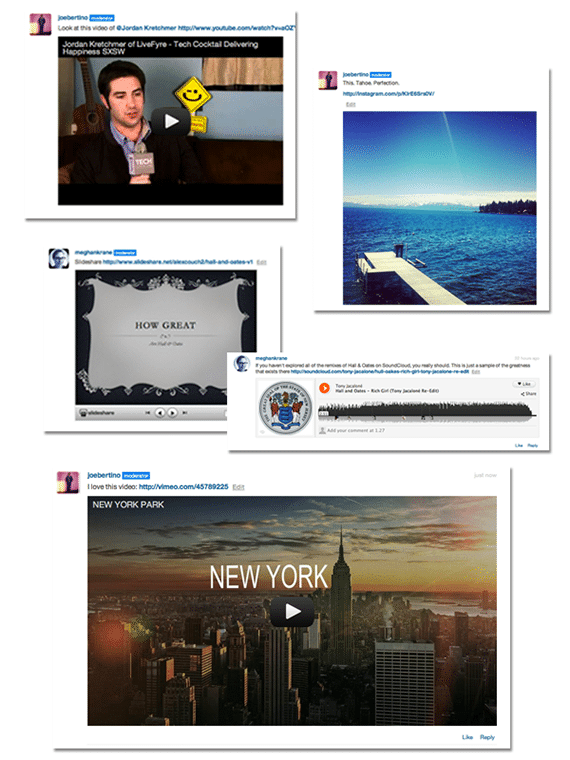
Livefyre Supports Rich Media

Probably one of my favourite new features is the way Livefyre 3 truly turns your comments into a fully-fledged multimedia experience.

Normally, when you leave a comment on other blogs that don’t have Livefyre, and you want to show a video or image, you have to grab the link to YouTube or Flickr, and then the reader of your comment has to click through to see what the video or image is.

Not with Livefyre.

Instead, they keep your readers engaged on your blog by embedding the rich media directly into the comments area.

Livefyre rich media embed
Click image to enlarge

Currently supported platforms include YouTube and Vimeo (video), Flickr and Instagram (images), Slideshare (presentations), SoundCloud and Spotify (music), animated GIFs from MySpace and Wikipedia (the articles appear in-stream).

To show this media content, simply grab the URL of its parent page and drop alongside your comments, and Livefyre does the rest. It’s pretty damn cool and can make for a very entertaining comments section.

Livefyre and Multi-Site Admin

One of the new features that came out before the current beta version of Livefyre 3 was the revamped admin area for bloggers.

Livefyre Site Moderation
Click image to enlarge

Now, instead of having to hunt through reams of comments to filter one out, you can search directly by username, IP address, if it was a user logged in via Twitter or Facebook, keywords, and much more.

You can choose to do this while having all your sites open, or just one domain at a time. You can also quickly check if any comments have been filtered into pending or spam, ensuring all comments you want approved are done so.

It’s a slicker version of the previous admin area and a very welcome addition to the product.

So Is Livefyre Perfect?

Is anything? Okay, I know, glib answer and I apologize, because we all know Jessica Alba is perfect… Moving on!

As I mentioned, Livefyre 3 is currently in beta, so the version being used on blogs currently is one that will experience some hiccups as the platform moves into a wider public release.

Some of the current glitches, from my own use and conversations I’ve seen online, include:

  • The SocialSync tagging doesn’t always work the way it should, meaning you can’t tag your friends on Facebook and Twitter (by using the “@” symbol and then typing their name until it appears). For a social commenting system, this is a core part of Livefyre’s appeal.
  • Sometimes it looks like there’s no comment box, whereas it’s just Livefyre rendering. The load time has been improved from the previous Livefyre, but could sill be optimized further.
  • Styling Livefyre to suit your blog design requires CSS, and not every blogger is comfortable with this. The advantage of Disqus in this respect is it inherits the font, style and design from your blog, so should match up every time.
  • It’d be great to see your commenters’ activity across the web without having to click on their profile. A lightbox when hovering over the username would be great, and encourage commenters to visit other blogs in the Livefyre family.

In fairness, the last two are personal choices as opposed to glitches, but I feel they’d make the platform even more complete than it is currently, and its current iteration is pretty damned impressive.

So, Livefyre Is Here to Stay Then?

As I mentioned at the start of the post, if you’ve felt a little dizzy recently with the comment system changes, I apologize. But it’s the last time it should happen.

I’ve been an early supporter of Livefyre and the platform has continued to grow way beyond its potential from its early days. That continues to be the case as new features and slicker processes get added, and it’s definitely my commenting platform of choice.

Mind you, I have to take my hat off to Disqus – they’ve really upped the game with Disqus 2012, and the interface and integration is very slick. Plus, they also sent out a very fun Welcome package of Disqus goodies – thanks, guys!

But, I have to say, Livefyre just feels what a comments system should be – live, interactive, media-rich, socially-enabled and much more. Simply put, it feels like home.

And, as a blogger, that’s all I can ever ask for from a comments system. Here’s to the conversation.

Creating Your Business Playlist

Creating a business playlist

Creating a business playlist

I was going through my iPod tunes over the weekend, adding some new ones and building some new playlists.

Looking at the tracks, I saw there?s no real genre that stands out as a favourite ? there?s everything on there from hard rock to R&B, Motown to 80?s pop, classical arias to hip hop. Quite the mix.

Instead of being fractured, it makes sense for me to have so many different styles on there ? I?m sure it does for you as well.

It all depends on how the mood takes us at any given time.

For instance, if I?m driving in the summer, it?s time for hard rock, windows down, full volume. But if I?m melancholy or introspective, it?s Marvin Gaye and Ella Fitzgerald time. Different sounds for the need at any given time.

And that should apply for us in business as well.

Building a Playlist

We shouldn?t be concentrating on just one area all the time. Sure, let?s be strong where our strengths are, but does that mean we need to limit our knowledge to these strengths?

People aren?t satisfied with the one-trick pony anymore, no matter how strong or sturdy that pony might be. Agencies and organizations are having to adapt to offer an umbrella service.

PR; Marketing; Creative; Customer Service; Sales; Design ? couldn?t they be available from one source (or at least have an option to offer more than one core strength)?

Think about what you offer at the minute, and what you don?t. Can you build on that? Can you learn what you need to know, so that you can offer multiple practices instead of just one? If not, how easy can you learn? It doesn?t matter if it?s online or offline, you can find the solution:

  • Webinars
  • Forums
  • User groups
  • Networking events
  • Workshops
  • Social learning
  • In-house or on-site training

Think about what you?d like to see as a customer. Are you happy with having to go to 5-6 different agencies to get core skill sets at each one, or would you prefer a solution where everything could be under one roof? Or at least half the current amount of solutions.

Sell Your Strengths, Buy Your Weakness

Even if you don?t have the time to take onboard the new skills you need, why not outsource but keep it under your banner?

Search for freelancers that you can call on for projects that need a specific expertise. Nurture relationships, build portfolios, treat as equals ? you never know what could come from it, and it opens your own business up to many more possibilities.

Having a favourite band is normal. Having a favourite type of music is normal. But just think of the amazing sounds you could be missing out on if you don?t mix up your iPod every now and again.

Is it time for you to freshen up your business playlist?

  • « Go to Previous Page
  • Page 1
  • Interim pages omitted …
  • Page 106
  • Page 107
  • Page 108
  • Page 109
  • Page 110
  • Interim pages omitted …
  • Page 283
  • Go to Next Page »
© 2026 Danny Brown - Made with ♥ on Genesis