• Skip to primary navigation
  • Skip to main content
Danny Brown

Danny Brown

podcaster - author - creator

  • About
  • Podcasts
  • Journal

Social Media

Making Homelessness Visible Through Social Media

Danny Brown, Mark Horvath, Troy Claus

Danny Brown, Mark Horvath, Troy Claus

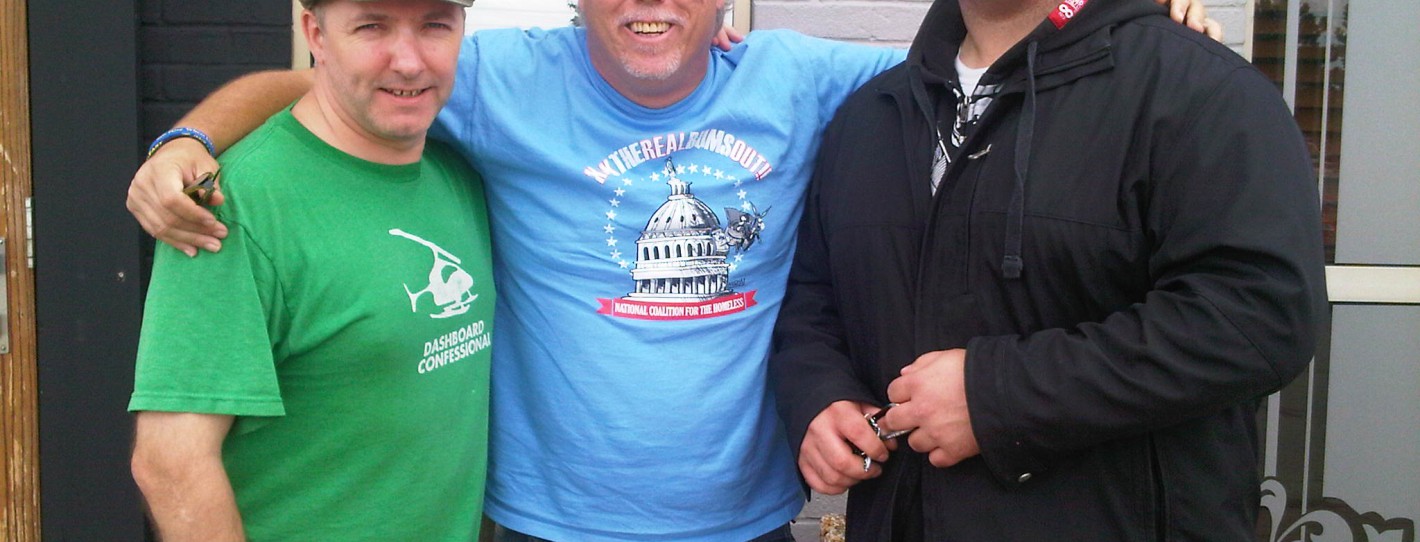
This weekend just gone, I was honoured to meet a guy I’ve admired for a long, long time, Mark Horvath (Mark’s in the centre, my business partner Troy Claus is on the right).

Based out of Los Angeles, Mark is someone with an incredible story. Fifteen years ago, Mark was homeless and sleeping on the streets of Hollywood.

But he managed to get back on his feet, and then some. He was at the top of his game – working in Hollywood, bringing some of the best-known shows on television to viewers across the world, a great future – Mark was living the American dream.

Then the economy collapsed. Mark fell into a mix of drug and alcohol abuse, lost his job, became homeless, and lost his way. He fought hard to get back on his feet again, and get his life in order. And he did. But he’s always just one step away from being homeless again.

From that time, Mark took the experience of being homeless, and the stories of the people he met on the street, and created Invisible People. A site full of video, it shares the stories of the homeless in L.A. and beyond, and lets you see the person behind the stereotypical image we let ourselves create when we see a homeless person.

It’s been a huge success and has opened a lot of eyes to what homelessness really is. Hint – it’s not all drug abuse and choice.

Now Mark has a new project, and one I really hope you’ll check out and offer your support to.

We Are Visible

We Are Visible is a simple idea – and simple ideas are often the best. Many homeless use their local library’s Internet-enabled computers to connect with others, and try and learn new skill sets that could help them get back on their feet.

They also can find medical help; companies and organizations that help the homeless; lost family and loved ones; and so much more. Yet often they only know the basic email and Internet access.

As Mark’s shown, social media offers an incredible platform to not only connect, but tell stories. And this is exactly what We Are Visible aims to do, by making social media simple for anyone homeless to understand, and use.

There are videos that show you how to set up a Gmail account, as well as a Twitter and Facebook profile. Additionally, We Are Visible shows you how to set up a free blog, and connect your profiles to it.

You can then share your story through the main We Are Visible social networks, as well as be put in touch with other homeless folks. And, where possible, be connected to companies that could help you get back on your feet and/or off the streets.

Last Christmas, 12for12k partnered with Mark to show people how they could help the homeless in their own towns and cities, and we’ll be doing something very similar this year again, starting in November.

In the meantime, however, We Are Visible is a brilliant concept, and one that I’m honoured to share with you. Please, check the program out, and if you feel you can help raise awareness of it, get in touch with Mark and see how you can help.

One way is to order promo cards (if you’re in the U.S.) and these can be ordered here. More information will be available via the networks below.

– We Are Visible website.
– We Are Visible on Twitter.
– We Are Visible on Facebook.

Facebook Loves Porn, Hates Health Advice

Facebook porn 1

Check Your Package testicular cancer campaign

Yep, hands up, that’s a bit of a link-bait title. But I make no bones about it, after reading an article in the Toronto Star today on how Facebook is saying no to a testicular cancer ad by Toronto Public Health for being too “threatening”.

The ad in question is the one at the top of this post (or a version of it).

Seems a great ad, no? It’s provocative in a fun way – always good for catching eyeballs. And it also shares an important message for a disease that can affect a large percentage of the male population, especially younger men. So, win-win all round.

Except Facebook doesn’t agree.

According to the story in the Toronto Star and HealthZone.ca, Facebook won’t approve the ad because it’s not deemed suitable for their audience. According to an email from Facebook ad employee Roger Lu:

The image must not focus on a specific body part, particularly a man?s crotch, and the ?Check Your Package? headline was unacceptable.

Facebook also called the use of the phrase “Men 18-35 are at risk” threatening, as well as being against Facebook’s ad policy of not calling out ages. Which seems kind of ironic, considering part of Facebook ad audience targeting is choosing which age demographic you want to reach.

So, cut a long story short, Facebook seems to be against the Toronto Public Health ad because it shows a guy’s groin and has some questionable wording.

This could probably be a bit more understandable if it was a sexual ad with provocative language. But it’s not – it’s a health ad with some startling but real statistics.

To gauge how idiotic the Facebook stance appears to be, I did a little searching on Facebook pages and profiles. Here are some profile pics and page images that popped up, according to the search terms.

Facebook porn 1

Facebook porn 2

These are a couple of the tamer ones, both from the profiles and the search results themselves.

So, it appears Facebook is pretty happy having full-on and open sex pictures, with some pretty funky descriptions, but not a health ad that could save a ton of lives amongst many of Facebook’s users.

My friend Christina Kingston shared a post about Facebook’s contradictory stance, but I can’t find the link unfortunately. It was another example of Facebook having an issue with something harmless while okaying – or seeming to okay – something that could be more “harmful”, depending on the viewer.

I don’t know about you, but seems they have a bit of a mixed up approach, no?

Caring Across Continents – The Next Phase of #12for12k

12for12k social media charity

12for12k social media charity

“As I see it, there are two great forces of human nature: self-interest, and caring for others.” Bill Gates.

Say what you will about Bill Gates, the man has a great point. It’s the kind of thinking that drives me, and is almost a mantra for the whole 12for12k project that I started with the help of friends back in December 2008.

Since then, a ton of folks have become great friends and supporters, and taken the initial idea to heights I couldn’t have imagined when coming up with the concept.

Through your support, offline events and kindness, you’ve helped raise more than $100,000 for thirteen charities since 12for12k was born. Not to mention untold awareness for these charities and the folks that are trying to do good with them.

As mentioned previously, 12for12k took a bit of a back seat recently, but now it’s ready for the next phase.

Caring Across Continents

Targeted for Summer 2011, Caring Across Continents is something I’ve been thinking about for a long time. And with the global support community that 12for12k has, it’s the perfect platform for Caring Across Continents.

A week-long celebration of hope, change and belief, Caring Across Continents will see live events, fund-raising activities, social media get-togethers and much more, in every continent.

There will be lead cities, but there will also be smaller cities, towns and villages involved too. Whoever wants to be part of Caring Across Continents will have the opportunity to create something where they live.

Additionally, the charities supported will be specific to the countries involved, so you know that whatever good you do will not only be global, but local.

There’s obviously a lot of work to be done between now and next year. This is where you come in again.

Your support – either personally, or as a sponsor – has been amazing so far. And we want you to be involved again.

If you’re interested in hosting something where you live, email 12for12k (or leave your details in the comments below). Additionally, if you’re interested in partnering as a sponsor and you have experience with large-scale live events, we’d love to hear from you.

The 12for12k team will be putting together an info package soon on the event(s). We’ll then be reaching out to companies about partnering with us, so if you’d like to be part of something amazing next year, get in touch.

Through your help, 12for12k has been a huge success so far, and helped shape how social media can be used to raise awareness and funds for charities across the globe.

Let’s keep the good fight going – you in?

Follow 12for12k on Twitter, or connect on Facebook.

Using Facebook Like to Market Your Business

Why fans like Facebook pages

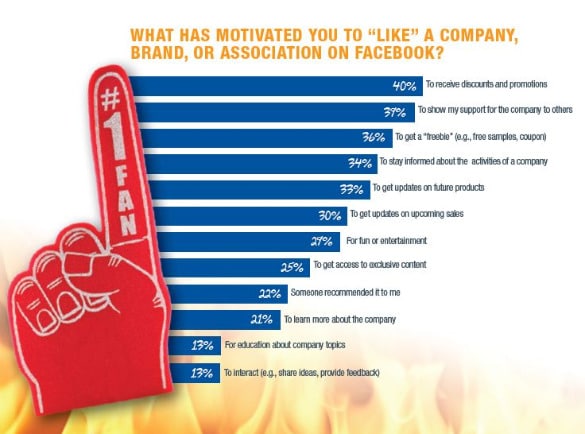
According to new figures released by a joint survey between Exact Target and CoTweet, Facebook users use the Like option for a brand for one overpowering reason – discounts and special offers.

Why fans like Facebook pages

Surveying 1,550 U.S. respondents aged 15 and older from March 2009 to April 2010, the results found that a whopping 40% of consumers like a brand or company on Facebook to “receive discounts and promotions.” When it comes to getting freebies, 36% would like a brand who offered giveaways.

Add to that 30% of those surveyed would like a brand to get updates on upcoming sales, and it’s clear that having a Facebook page offers a great opportunity for businesses to build loyalty with a willing customer base.

So how can you use this information for your business’s Facebook page?

Coupons and Customer Coding

The obvious way to market would be through coupons of your own. If you have flyers or discount coupons for your brick-and-mortar retail store, you can easily transfer that to your Facebook page.

Grab the artwork from your existing flyer (or make one unique to Facebook) and then transfer that to a tab on your page’s navigation menu. Currently this is created using the FBML application (and some HTML coding), though soon you’ll have to change to iFrame.

Call your tab something simple like Coupons or Discounts to grab attention. Then, to encourage folks to Like your page, only make the coupon or discount available to people after they like you. If you’re unsure how to do this, my friend John Haydon has a great guide on using Facebook HTML as well as hiding offers until people click your Like button.

I used this method when I offered a free Facebook Marketing ebook exclusively to folks that liked my Facebook page, and as you can see by this overview on the metrics, exclusive content definitely works.

Of course, getting folks to like your brand through coupons and discounts is just part of the process – keeping them is a whole other story.

Loyalty, Lists and Like Highlights

So now you have a bunch of folks that have liked your Facebook page because of your discount coupons or freebie offer. But how do you stop them from un-liking as soon as they have the coupon?

Simple – you market. But not just any old marketing – now you use the strengths of the Facebook page platform and make it a no-brainer for folks that like you to continue to do so.

  • Facebook Insights are available for admins of any Facebook page, and will give you information on demographics, content popularity, interaction on offers and other useful insights into how people are acting on your page. Use this to tailor audience offers and time-sensitive specials.
  • Facebook Updates are the equivalent of email lists, and will send a targeted message to people that like your page. The great thing with updates is that you can completely tailor them so that instead of everyone receiving a message, only those in a certain city, country, age range, demographic, etc, will receive the message. Perfect for gender-specific offers, or cultural events, or national holidays – anything you like, really.

On top of these two options, rotate your coupon and offers, and make sure they’re only available to people that like your page. Don’t settle into a routine – have an offer one week, then change two weeks later, then 2 days, etc. Mix it up so people will always have to be connected to your page to know when a new coupon is available.

Highlight your most valuable users as well.

Folks that interact the most; or use their coupon the most; or share your offer the most – give them special discounts and rewards to say thank you. It shows you value them, and also offers incentives to your other “fans” to become more involved.

These are just some of the ways you can be the brand that customers won’t just like, but be loyal to instead of being a fairweather friend.

And at the end of the day, isn’t that what you’re in business for?

Image: Exact Target and CoTweet

Social Media Bashing is Boring as Hell

Social media bashing

Social media bashingThere’s a fair few blog posts doing the rounds about social media.

How its practitioners are snake-oil salesmen.

Why everyone’s just out to make a quick buck.

How businesses are being ripped off by consultants who charge an arm and a leg for their time and deliver very little back in return.

One of the better headlines I spotted was Why Social Media Gurus Should Be Trampled by Elephants (check out the edited URL as well for extra emphasis). To be fair, that post makes some good points, while draped in a humorous link-bait title.

But here’s the thing.

While there are definitely crap merchants out there who wouldn’t know a tweet from a poke, there are also many more incredibly smart and business-savvy individuals and agencies that are bringing their clients huge success in social media.

You know why?

Because their clients actually had the common sense to do due diligence on who they were employing as their social media arm. Because the consultants/agencies had results and actionable strategies (with return predictions) to show. Because, simply put, the business owner acted like a business owner.

It doesn’t matter what industry you’re in. It doesn’t matter that “social media is new”, “social media is scary”, “we don’t understand social media”, or any other excuse or phrase you want to use.

If you do your job as a business owner and protect your investment, there wouldn’t be the need for any social media bashing (or any other industry bashing). You’d be asking questions that should be asked of any supplier.

  • What’s your experience?
  • Name some of the projects you’ve worked on.
  • What was the strategy used?
  • How did the results versus the projections go?
  • How will this really benefit my company?
  • What’s the time map?
  • How will you transfer your skills to my industry?

Forget how many Twitter followers someone has – that can be gamed and bought. Forget how sparkly their blog is – that can be paid for. Forget how they name drop players in the industry – is that relevant to you?

Instead, treat social media like you would any other part of your business. Carry out due diligence and don’t be sold on the first whiz-bang pitch you receive.

You’ve built your business to where it is now because you’ve been protective of your investment.

Why stop that now?

Image: What What

  • « Go to Previous Page
  • Page 1
  • Interim pages omitted …
  • Page 33
  • Page 34
  • Page 35
  • Page 36
  • Page 37
  • Page 38
  • Go to Next Page »
© 2026 Danny Brown - Made with ♥ on Genesis