• Skip to primary navigation
  • Skip to main content
Danny Brown

Danny Brown

podcaster - author - creator

  • About
  • Podcasts
  • Journal

Social Media

From Reach to Relationships – Chapter 7 of Greg Verdino’s microMARKETING Book

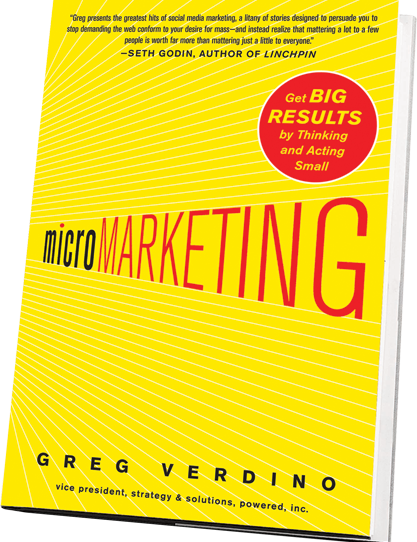
microMARKETING by Greg Verdino

microMARKETING by Greg VerdinoGreg Verdino’s new book, microMARKETING: Get Big Results by Acting and Thinking Small is already generating some great buzz because of one of the ways the book is being marketed.

Living up to the book’s premise, Greg and his partner at Powered, Inc., Aaron Strout, decided to forgo the usual blogger outreach program and target a select few based upon expertise in certain areas.

This was handled by Alexandra Kirsch, Social Media Coordinator for Planned Television Arts, and it’s an approach that’s been received favourably by those targeted by the outreach program.

As part of the limited outreach, I’m reviewing Chapter 7, From Reach to Relationships – Activating the Many by Resonating with the Right Few. These are my thoughts.

Reach is the Result

While there are a few examples of mass marketing throughout the chapter, the overarching viewpoint is simple and clear – while huge numbers can work, it’s the connections based around any figure that makes the real difference.

Opening with the much-maligned Suggested User List (visible when logged in) employed by Twitter to recommend potential follows to new Twitter users, Greg uses the example of blogging pioneer Anil Dash.

When Anil was placed on this list at the end of 2009, he went from having a few thousand followers to several hundred thousand (as of writing, he sits at 341,304). Great, right? Especially for a blogger – imagine the retweets and social shares of his posts!

But what Anil found was that, instead of getting more useful eyeballs, he really just got a larger amount of fairweather followers who didn’t really care about what he was saying – they just connected because Twitter had suggested him.

The reach was there, but it was a silent reach. In other words, there was no result from having the reach. And, as any good marketer will tell you, numbers are great but it’s the results that count. Heck, any marketer should be telling you this, never mind just good ones.

Relationship Marketing 2.0

From this starting point, the chapter opens up and discusses an oft-said mantra within social media – it’s the quality of the connection, not the quantity. However, where Greg differs is that he actually backs up this kumbaya mantra with quantifiable examples.

To quantify the examples he uses, Greg first shares a defining white paper that was published way back in 1999, but still rings true today.

Commissioned by the Institute for Public Relations and authored by Dr. James E. Grunig and Dr. Linda Childers (Hon.), the white paper looked at how organizations could relate better with the public. Their findings led to two distinct approaches: Exchange Relationship and Communal Relationship. To quote the white paper:

In an Exchange Relationship, one party gives benefits to the other only because the other has provided benefits in the past or is expected to do so in the future.

In a Communal Relationship, both parties provide benefits to the other because they are concerned for the welfare of the other – even when they get nothing in return.

As Greg points out, while both may appear similar – they’re about getting sales, at the end of the day – the approach is hugely different. While an exchange relationship might get you customers, a communal relationship will get you customers that have the potential to become evangelists. These customers can then result in new customers because of their love for the brand – the Holy Grail of any marketing campaign.

But it’s not just the relationship that’s important – it’s the right relationship.

Big Brands, Micro-Marketing

To enforce Greg’s view that it’s the small things that matter, he uses some great examples of how big brands have taken this communal relationship and thought smaller to get big results.

Panasonic’s Living in HD campaign, for instance, took 12 families in 2008 and made them part of a fully immersive program to test out their top-of-the-range consumer electronics equipment.

Panasonic Living in HD

They would have the latest gadgets as part of their everyday lives, and all they had to do was offer feedback on the experience, through their own blogs in the LiHD community.

The project has been a huge success, and seen the community grow from 12 families to 100. Indeed, Greg uses a letter to Panasonic from one such family to show their gratitude, and how the project has changed their lives (the previously tech-agnostic wife now has a job in social media and a thriving website).

Greg also uses examples from the Walmart ElevenMoms project (now Walmart Moms) as well as the to show how big companies are using relationships with the few to achieve results normally associated with the many.

Does microMARKETING Work for All?

It’s this attention to detail and statistics that sets Greg’s book apart from many other books that look at marketing in the social media era.

While other books may be a good read, and offer an “Isn’t social media great?” mindset because of buzzwords and sexy tales of the odd success story, few go into the Why behind the What. Greg Verdino offers the meat behind the cordon bleu appetisers. It’s an approach that I wish more social media authors would take (and a key reason I stopped reviewing these types of books last year).

If there’s any criticism, it’s that once again it’s the larger brands that are used as an example. Panasonic, Walmart, McDonald’s – would the same approaches have been successful with businesses that have a fraction of the budget available to these guys?

Would the bloggers attached to the ElevenMoms project have jumped to write about Joe’s Bakery instead of Walmart, for instance? (Note – I’m only speaking from the point of view of Chapter 7 – it may be that the rest of microMARKETING addresses smaller examples).

However, to be fair, this is something that social media as a whole needs to address better. We’ve all heard the big success stories – let’s hear about the small successes too.

So, is microMARKETING: Get Big Results by Acting and Thinking Small worth your time? From my point of view as a single chapter reader, I’m hungry to read the rest of the book. Its figures, stats and anecdotes offer an excellent reason why the new media landscape we find ourselves in is so important to businesses today.

From that angle, microMARKETING could well be one of the best social media books on the market today.

If you want to get a feel for the other chapters in the book, Greg is offering an updated list of all the reviews and they can be found here. You can also find out where you can buy microMARKETING.

Two Blog Posts You Should Read Today

PR and communications blog Spin Sucks

The great thing about blogs is they offer a great starting point for discussions. The blogger offers his or her take, and then the comments provide even more juice.

So I?d like to point you to two blog posts you should read today (both, handily enough, over at the awesome Spin Sucks blog).

PR and communications blog Spin Sucks

Five Signs that a Social Media Star?s Reputation is Spin is a great guest post by the very smart Liz Strauss, and looks at how many social media heavyweights are beginning to believe in their own importance. Or, were never really genuine to start with (I?m sure we all know a few of these).

PR Pros: Stop Treating Bloggers Like Second-Class Media is by Spin Sucks hostess Gini Dietrich, and is a continuation of the conversation started last night when she guested for the #sbt10 Start Blogging Today chat on Twitter. The title says it all, and there?s a great conversation in the comments from both sides.

Both of these are great posts with terrific points both in the post themselves and the comments that follow. Check them out when you have a minute, and leave your take.

And then pop back here tomorrow when I share an example of a PR agency that got it bang on the money for blogger outreach.

Cheers!

Why Seth Godin Misses the Mark on Facebook and Privacy

Tribes author Seth Godin

Tribes author Seth GodinSeth Godin?s a very smart guy.

He introduced the concept of permission marketing.

He?s also written a slew of business and marketing bestsellers, and has one of the foremost blogs on marketing today (also my favourite marketing blog).

Basically, Seth?s usually bang on the money and that?s why people listen when he speaks.

But for me, his blog post today about whether we care about privacy or not (and his example of Facebook to make the point) is off the mark, for one simple reason.

Facebook uses the practice of opt-out privacy, while every other reputable business offers the option of opt-in.

When you sign up for a newsletter, or a blog, or a marketing database, it?s because you?ve opted in. You ask to be informed of something.

You ask to be involved.

If your information is used by that resource, it?s because you allowed this in your privacy settings.

When Facebook makes changes to its platform, it invariably does so by resetting all the privacy settings back to the equivalent of you being visible to the whole world.

If you want to be private again, you have to go back into your settings and make the relevant changes.

Go to Google and search for ?Facebook privacy issues? and you get more than 300 million results. Wikipedia has a pretty good breakdown of the main concerns with Facebook since 2007.

Seth?s right in that often we don?t take enough care to look at what we?re signing up to. But that?s usually because we have to sign up to get into something.

Signing up to get out of something is a different thing altogether. And people do care about that, even when Facebook doesn?t seem to.

Image: think isb

Building Business Blocks From Your Homebase

Building a business blog

Building a business blog

Over at Start Blogging Today (disclosure ? I?m a partner in the program), we talk about how you can use your blog as a homebase to help you with your business.

We also show you how to get up and running with your blog and keep growing it from a personal angle ? it?s not just for business owners and entrepreneurs. However, there?s a lot of stuff there that can help you turn your blog into a business for you.

Why focus on blogs? Simple ? they?re your property (self-hosted blogs) and offer an excellent way to share your thoughts, ideas and offerings to not only your readers, but their readers. Which, in turn, can lead to potential leads.

And the great thing? You can do it one block at a time.

Preparing the Blocks

Ask any blogger, and they?ll pretty much say the same thing ? you need to love it to enjoy it. But then, that?s pretty much true for anything in life, and that?s what a lot of folks miss when they think about blogging.

True, you don?t need to blog daily to have a successful blog, but you do need to have some sort of rhythm, and that comes from loving what you?re doing.

Blogging can often be a lonely pastime (even for multi-author business blogs) and you don?t always see quick returns (financially or personally). So unless you love what you?re doing, it?ll become boring pretty quick.

  • Takeaway: The first block is built on love.

Blocks of Why and What

Before you start blogging, take stock of both the reasons why you want to, and what you?re going to offer.

I?m currently helping a friend take stock of her reasons for blogging, and she has a clear goal of both Why and What.

Her Why is because she has a great voice, and a mentor in a figure she looks up to from an opinion perspective. The What is she wants to offer a racier take of herself than her professional image normally allows.

By having a clear idea of her blogging goals, she?s already a few steps ahead of new bloggers that start without having a core idea. Yes, you can stumble your way into your eventual voice, but starting with a flourish will help you get there quicker.

  • Takeaway: The second block is built on goals.

Square Blocks, Round Holes

According to Technorati, one of the leading blog resources, there are more than 130 million blogs registered with them. Type ?how many blogs are there?? into Google and the answer ranges from 50 million to 220 million.

Whatever way you look at it, that?s a heck of a lot of blogs looking for the same readers in their topics. So how will yours stand out?

It won?t. At least, not at first. But that?s okay ? with so many blogs on so many topics, it?d be pretty difficult to have a completely unique voice anyway. What you can do, though, is be the square block to your readers? round holes.

  • Look at what others are blogging about and see what questions are left unanswered either by their post, or by comments left by their readers. Then offer your take and optimize it for search.
  • Question popular opinion and if you disagree, offer a post on why. But don?t just disagree ? offer actions to follow if you?re pointing to a different path.
  • Be creatively outlandish. With so many blogs on the same topics, a lot of repetition is natural. So combat that ? think of creative solutions and ideas to everyday topics. They might not always be realistic, but they?ll show a willingness to take a risk. And the best businesses are the risk takers.

Yes, there are millions of blogs with millions of thoughts. But you don?t need to join that thought process ? offer your own quirkiness and don?t accept the perceived right way of doing things.

  • Takeaway: The third block is built around YOU.

These are just three blocks in an ongoing process ? your blogging adventure never really stops. The other blocks are defined by how strongly you place the first three.

What about you ? how are you shaping your blocks?

PS ? Interested in learning how to build more blocks? Come visit us at Start Blogging Today ? we have a ton of them just waiting for you.

Image: Tom Haynes

10 Fun Twitter Apps You May Not Have Heard Of

Twitter Tussle and other fun apps

Twitter Tussle and other fun apps

As the new Twitter continues to role out across the network, it’s clear that the micro-blogging platform intends to be here for the long-term.

Its initial use as a short message system has evolved into a truly multi-faceted and game-changing platform. Business, cause marketing, non-profits, customer service, lead generation and more – Twitter really does have something for everyone.

A lot of blogs (mine included) often concentrate on the best ways to use Twitter for business, and there’s nothing wrong with that. But wouldn’t it be cool to mix it up with a bit of fun too?

With that in mind, here are 10 fun apps for Twitter that you might not have heard of but are definitely worth checking out.

  1. SecretTweet. Founded in April 2008, SecretTweet allows you to tweet your darkest secrets (or those of your friends) for Twitter to comment on. There’s? a mix of the funny and bizarre on the site, though there can also be sad ones as well.
  2. Twitter Tussle. A cute little cartoon site, Twitter Tussle answers which topics are more popular on Twitter by having two cartoon Twitter birds duke it out on-screen.
  3. ASKch. A great healthcare resource, ASKch (currently in beta) from Change:Healthcare allows you to send a question about healthcare costs and options in your neighbourhood, and receive an automated response and information link within 60 seconds.
  4. Mombo. A fun and useful service, Mombo collates tweets about movies and formulates them into a review and overview of how good (or bad) that movie is according to Twitter.
  5. BollyTweet. Like Bollywood movies? Got an iPhone? BollyTweet allows you to connect and chat with your favourite Bollywood stars. And in great Bollywood fashion, you can shake your iPhone to get the latest tweets.
  6. Twitter for Busy People. Need to know at a glance what your Twitter friends are up to? Twitter for Busy People collates their images into sections (Last Hour, Last Day, More Than a Day Ago) and lets you hover over them for the latest update.
  7. CheapTweet. Almost like a Digg for deals, CheapTweet collates all the best retail offers being tweeted, and allows folks to vote on the best ones so you can save the most.
  8. Twitgift. The idea behind Twitgift is simply awesome. Want to send a gift to a Twitter friend? Choose a gift and send a tweet to them, and if they accept it gets mailed out to them. You don’t even need to know their address, Twitgift takes care of this.
  9. Twistori. A very cool visualization project, Twistori gathers tweets about six main topics – Love, Hate, Think, Believe, Feel, Wish – and runs a colourful stream with tweets about that topic.
  10. HootCourse. An interesting idea, HootCourse takes educational tweets and builds online classes around them. Virtual classrooms are created and students and teaches can meet to hold informal classes, complete with teaching materials and formats.

So there you have it. These are ten Twitter apps that might add a bit of fun to your tweeting and help mix things up a little when you want to get away from the serious stuff.

How about you – any Twitter apps you’ve found worth sharing? The comments are yours.

Image: Twitter Tussle

  • « Go to Previous Page
  • Page 1
  • Interim pages omitted …
  • Page 31
  • Page 32
  • Page 33
  • Page 34
  • Page 35
  • Interim pages omitted …
  • Page 38
  • Go to Next Page »
© 2026 Danny Brown - Made with ♥ on Genesis