• Skip to primary navigation
  • Skip to main content
Danny Brown

Danny Brown

podcaster - author - creator

  • About
  • Podcasts
  • Journal

Social Media

Should Facebook Remove Holocaust Denial Groups?

Against Holocaust Denial Laws

Against Holocaust Denial Laws

When the Allied forces began to turn the tide of their conflict against Hitler’s Germany in 1944, one of history’s most disturbing events was about to be discovered.

Named the Final Solution by the Nazis, and subsequently known as the Holocaust around the world, concentration camps were found by Allied forces advancing toward Germany. The first major camp was Majdanek, which was found by the Russians in July 1944. This was followed by other camps in 1945.

The concentration camps were built for one reason – the extermination of the Jewish race by Hitler, in an attempt to breed the perfect Aryan race of blond hair and blue eyes.

While the exact number isn’t known, over six million Jews died in these camps – two thirds of the Jewish residents of Europe at that time. Of this number, one million children perished, along with two million women and three million men.

However, the numbers could be far more – many scholars feel the genocide of other ethnic groups by the Nazis, such as homosexuals, disabled people, Romani and other cultures, should be included. This would mean around 11 million people were murdered in the Holocaust, all because of one man’s twisted vision.

Over the years, there have been many claims by groups and individuals that the Holocaust never happened and that it was a myth created by Israel. Despite the public video footage; the images taken by Allied troops; the admittance of guilt by past Nazi generals – many still believe the Holocaust never happened.

It’s a viewpoint that’s raised questions on free speech and opinions and if, by denying the right to deny the Holocaust, people are having their own right to speak abused.

Now that debate and fight is involving Facebook.

Facebook and Free Speech

A caveat. I’m a huge believer in free speech and differing opinions, and often get shit on because of it – c’est la vie. I will admit I don’t agree on all speech being free – clear hate and sex crime/hate, for example, are some areas I feel opinions step over the line. But then does that make me against true free speech? Possibly.

That’s a personal opinion, though, and would affect very few people in the grand scheme of things (and only if I spoke out). A social network like Facebook, with over 700 million users, is a different kettle of fish. It’s a public platform that allows anyone and everyone to post (and access) status updates, thoughts, views and more.

Holocaust denial

Facebook’s policies look to encourage free speech and opinion, and rightly so. But is there a limit to which this should stop, and a different policy invoked?

That’s one of the questions currently being asked of Facebook by survivors of the Holocaust, in a plea to Facebook to remove groups that have been set up to deny the Holocaust ever happened.

In an open letter posted on the Simon Wiesenthal Center website, the survivors ask Facebook to re-evaluate their approach to what’s classed as free speech versus hate speech so that the atrocities of the past aren’t repeated.

In dialogue so far between the survivors group and Facebook, a Senior VP at Facebook has advised of the importance to “…maintain consistency in our policies, which don’t generally prohibit people from making statements about historical events, no matter how ignorant the statement or how awful the event.”

I’m not sure I can buy that.

Free Speech or Road to Conflict?

As I mentioned earlier, I’m a huge believer in free speech and opinion – yet should all speech be free? Opinion is different – you can keep that to yourself. But, by definition, speech is public and has the ability to change mindsets and start movements.

A speech by Hitler in 1938 led to a movement. It resulted in the deaths of at least six million people.

I’m not naive enough to believe that had the speech never happened, the Holocaust wouldn’t have. Hitler was determined in his path to the Final Solution, and if that speech hadn’t happened, others would have (some did). Nazism was much more than words from a balcony.

But if there’s one thing that history can teach us, it’s that words can be dangerous. When hate is powerful enough, it can see words become a powerful weapon. The world saw its results from Nazi Germany. It sees its results in countries where dictators rule by force, and people live in fear of their gender, sexuality, beliefs and religion being used against them.

Free speech is important – it differentiates true freedom from state-defined freedom. The question is, if free speech is silencing voices and historical fact – and has the potential to incite violence – should it still be free?

I don’t have the answers, just my opinion. You?

Debunking Popular Myths of Social Media

Social media myths

Social media myths

Social media is many things to many people. For some, it’s a core part of their overall business and marketing strategy. For others, it’s a key player in driving traffic to their blog. For others, it’s a new toy they’re just beginning to play with. And for some, it’s about as interesting as pond moss.

So, lots of uses and definitions, depending on who you speak to.

Yet there is one area where all the definitions can come together and agree on, and that’s the area of social media myths. The claims from people that should know better, either for a hidden agenda or a lack of foresight.

So, here are a few social media myths that we can probably all agree are out-of-date thinking at best, and dangerous advice at worst.

Social Media is Free

Bzzzzt (insert noisy buzzer sound here). This one’s been doing the rounds for a while now, and still seems to pop up, even though everything points to the complete opposite. So let’s make it simple – social media is not free.

Yes, the tools are free (unless you have the premium version of these platforms). And, no, not everyone will be looking at the cost investment from the example linked to above.

But even if you’re a small business user or solo entrepreneur using social media to help raise awareness of your brand through interaction, you have to invest a serious amount of time for any traction to begin. So take whatever salary you give yourself, deduct the man hours you put in by the financial cost of this, and that’s the bare minimum of how much social media is going to cost you.

Add to that any advertising on the likes of Facebook Ads and LinkedIn Advertising, and then how you’re going to integrate all your online stuff into your everyday marketing and promotion, and the costs start to add up.

Sure, you can bootstrap your way around social media – but free it ain’t.

Social Media Levels the Playing Field

One of the pros of social media, according to many of its most vocal proponents, is that it levels the playing field. This comes from the viewpoint that it allows the consumer – who never had much of a voice before – to air their grievances in a far more public forum, as well as have access to leading players at these brands.

The belief is that this now means the brand is no longer in control, and the little guy is now the giant. And it’s true – social media does allow the consumer to be a bigger part of the business decisions being made.

Yet there’s also the flip side for businesses. A lot of social media purists will say that small businesses and solo practitioners can compete with the huge corporations and the big agencies, because the tools are the same for everyone.

Except they’re not. A corporation with a $10 million budget for research, strategy, implementation and measuring is going to have a heck of a lot more at their disposal than a small business with $10,000 to play with. And then the scale factor comes into play – can a one-man band (or even a two or three-man band) monitor and respond to social interaction the same way a dedicated team of fifty can for the bigger guys?

The simple answer is no. So, yes, social media can level the field somewhat – but then it also means you have to get new machinery to keep it level, and that’s still beyond the capabilities of many businesses.

You Need the Voice of the Influencers

Like any eco-system, social media has many layers, and at the forefront of these layers are the Influencers. Usually these will be early adopters in the space, and they’ve become influential for identifying trends and looking at how these tools can be used for business.

The problem is, influence is based on relevance, yet many businesses still try and get the Influencers to talk about their products, regardless of whether they’re experienced in that brand’s niche or not. The mindset is that the Influencer has over 100,000 Twitter followers, or tens of thousands of blog subscribers, so it’s an easy “in” to that audience.

Except it’s not.

Because nine times out of ten (not a scientific figure), the Influencer will only share your brand or product for reward. Hard cash, or a large amount of swag. They’ll write about you once, and then move on to the next brand. Because they’re (usually) not invested in you.

But your brand advocates are.

The ones that write and talk about you every day, both online and offline. The ones that truly have your best interests at heart, so they’ll offer you honest feedback on how you can improve. Compare that to the Influencer who thinks your product is great, now just pony up the greenback.

The Influencer may get you a quick buzz, but longevity and success very rarely come from a fire sale. It does come from having an army of advocates and loyal customers, though – look after your advocates and they’ll look after you better than any Influencer can.

Conclusion

There’s no doubt that social media has changed much of the business landscape, and continues to do so. And with potentially game-changing products like Google+ entering the fray, the real fun could just be beginning.

We just need to make sure we’re keeping a level head at what social media can, and doesn’t, offer. If history has taught us anything, it’s that hyperbole is very often the precursor to, “Remember so-and-so?”…

image: Luminis Kanto

Make Yourself An Influencer By Playing The Klout +K Game

A lot of people continue to talk about Klout and whether it’s something to take note of, or simply another tool that’s fun to use but doesn’t offer real value.

Personally, I’m in the second camp. Probably because I don’t feel you can measure influence purely by what you do online, and most definitely because there are so many variations that make up a single decision that – to me – it’s impossible to say what influenced that decision the most.

But whether you think Klout has value or not, it’s now a lot of fun – because you can game the system and show its flaws, and this is all done by one of Klout’s own tools, the new +K option.

The +K option allows you to vote for people’s expertise on a certain topic. The idea is, the more votes someone gets on a topic, the more recognized they are by Klout as an expert in that field. Which, as the video below shows, can lead to completely ridiculous results .

So, yeah – well done, Klout, for showing your flaws better than any critic could. Now that deserves a +K!

http://www.youtube.com/watch?v=I387sH_9yMY

Note: Big props to Dino Dogan for the idea of this mock interview to highlight how to game Klout.

American Express and Foursquare – So What?

meh

meh

Over at Fast Company, there’s a post about the American Express partnership with Foursquare. While the announcement is interesting, the direction that Fast Company runs with the article is less so.

According to Fast Company, the AMEX/FourSquare deal?“…might finally give us some hard evidence as to whether social media is a worthwhile investment for merchants and marketers.”

Ummm… riiiiigghht.

I’m not sure where Fast Company has – or hasn’t – been looking, but agencies, consultants and business owners have been proving the ROI (return on investment) for a while now.

The Easy Social Media Management Example

Lauren McMullen is the owner of Easy Social Media Management, a consultancy that helps small businesses understand social media and how it can help their bottom line. Her agency was recently involved in a book launch for an anthology called Align, Expand and Succeed – Shifting the Paradigm of Entrepreneurial Success.

The book featured 40 authors, and over a six-month period Lauren used the social networks of the authors and the publisher to build awareness around the impending publication. This included blogs, YouTube interviews, and article directory promotions.

Because of this, the book became an Amazon bestseller on the morning of launch, and held the number one position in the four categories it was targeted to.

The Willis eTech Ltd. Example

John Willis is the founder and owner of Willis eTech Ltd., a small business offering photography, video and websites for other small businesses based in Okanagan, BC.

While flying over the newly-opened Sparkling Hills resort in Vernon, BC, John took some pictures of the resort and uploaded them to his TwitPic account. He tweeted the owner of the area where Sparkling Hills had opened their resort, and was invited to contact them.

That led to a bunch of photography and media projects for John’s company, and his use of other social media platforms saw him become recognized as the go-to guy in his area for social media and how it can be used to drive business. He speaks at local Chamber of Commerce events as well as seminars, and trains businesses on how they can effectively use social media.

Why the AMEX / Foursquare Deal Isn’t All That

These are just two examples. If you want others, just type in?“social media roi success stories” to Google and you’ll find just under 3,000 results. Now, that may not sound much in the grand scheme of things, especially when other Google searches often result in millions of examples.

But that’s more than likely to do with the fact that instead of writing about how the ROI of social media is real, most businesses and agencies are just getting on with proving it to their clients, as opposed to trying to show how great they are in public.

They’re making results happen every single day – which is why the Fast Company angle means less than they might have hoped for.

For instance, according to the article, one of the “big wins” with the deal is that Foursquare will “…help merchants foster customer loyalty.” By encouraging check-ins and rewards, and the ability to tie back into your AMEX card, it means more people will shop at your location.

Great stuff. Except for one major problem – you don’t have to be at a location to check in. You don’t have to physically be there to become a Mayor and reap the rewards for it (like a free meal, or a discount on your clothing, etc).

My house is about 5 miles away from my office. Yet, by not checking in anywhere when I leave the office, I can be at home and check into my office because of the way Foursquare caches my last check-in.

Think about that from the point of view of a restaurant owner. They decide to offer a free meal and drink to the Mayor of their restaurant. I see that, so start checking in, even though I’ve never been there before in my life. I become Mayor, get my free meal and drink, don’t pay a thing and leave.

I then get my friends to do the same, and between us we constantly force the restaurant owner to give us free meals and drinks. But we never go to that restaurant as paying customers.

So… where’s the loyalty building in that?

Until location-based services can actually lock you down somewhere and make it impossible for you to check in somewhere unless you’re there, you’re not going to build loyalty through offers. You will, however, lose the vendor money – and that doesn’t build loyalty or ROI.

image: Slightlynorth

The Difference Between Engaged and Engaging

Arment Dietrich Inc.

Companies love to share their successes with social media. How it’s allowing them to “engage with fans and customers”, and how they’re “being part of the conversation”.

Like it’s something new and wild and golly gee, aren’t we great?

Well, yes, it’s great that you’re doing something you should have been doing all along – talking with customers, and not just because of social media – and it’s great that you’re now part of the conversations around your brand.

But are you really engaging, or just being engaged? Because there’s quite the difference between the two.

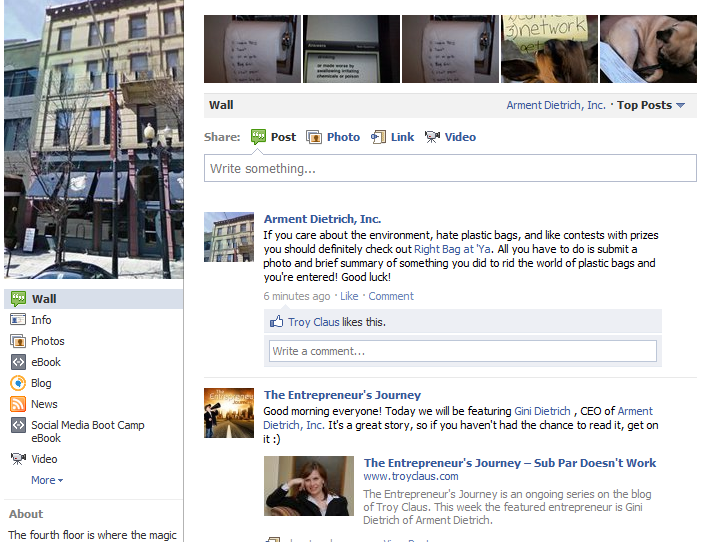
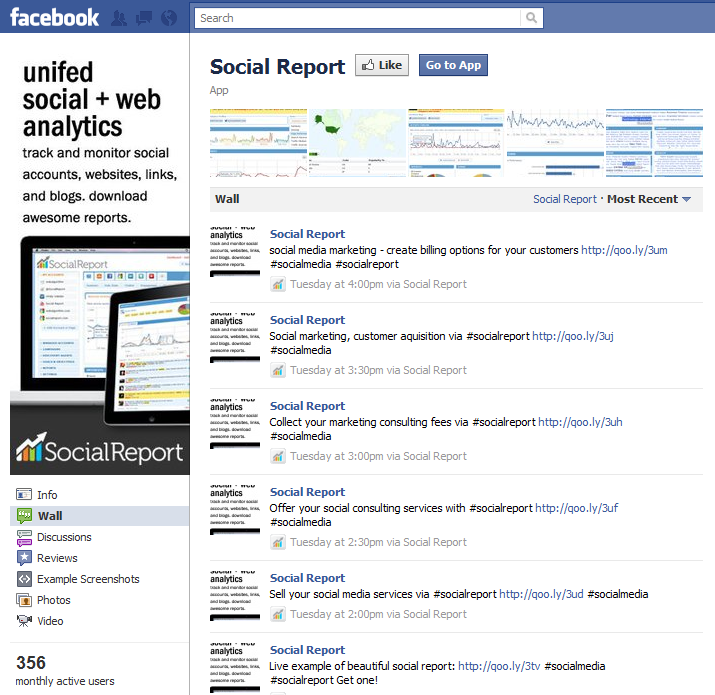
Check out these two Facebook Pages as an example.

Social Report

Arment Dietrich  Inc.

The first page is for Social Report, “a social network analytics solution that gives you rich insights into your social space and marketing effectiveness.” It’s a lively page – if lively equals automated updates every thirty minutes about what their service features are. Their Twitter stream is pretty much the same.

The second is for Arment Dietrich (a little disclosure – Gini Dietrich, the CEO of Arment Dietrich, is a friend, but this doesn’t bias my post). Their wall is a mix of company updates, social media and communication industry news, helping the environment, questions from “fans” and fun Facebook tips. And they have a lot of their connections sharing stuff on their wall too – always a great sign of full engagement.

If you were someone looking to hire a company – or see how a business understands – social media, which one would you choose (going by these two Facebook Pages)? One where it’s just update after update with no real depth, or one that shares a mix of useful advice and tips, and allows their customers (fans) to do the same?

So. Are you engaging with social media, or are you just engaged?

  • « Go to Previous Page
  • Page 1
  • Interim pages omitted …
  • Page 20
  • Page 21
  • Page 22
  • Page 23
  • Page 24
  • Interim pages omitted …
  • Page 38
  • Go to Next Page »
© 2026 Danny Brown - Made with ♥ on Genesis