• Skip to primary navigation
  • Skip to main content
Danny Brown

Danny Brown

podcaster - author - creator

  • About
  • Podcasts
  • Journal

Social Media

The Great Twitter Unfollow of 2011 – Leaked Email

This post is inspired by this awesome article from Daniel Newman.

There’s been a bit of conversation in recent months about mass unfollows on Twitter. These have been carried out by folks with large followings, with the biggest complaints being the numbers were unmanageable; spam was an issue; etc.

Some onlookers have questioned how genuine these unfollows were; and if it wasn’t just an attention-seeking ploy. Discussions have being started, with folks from both sides of the unfollow coin sharing their reasons for support / disdain. Theories arose; and more questions were asked as opposed to answered.

Until now.

In this leaked email between two social media gurus, their reasoning can finally be shared as to what The Big Twitter Unfollow Purge of 2011 (as it has become known) was all about. The reasons might surprise you. Then again, probably not…

Anyhoo – here’s the email. Names have been changed for no reason other than it seems the fashionable thing to do when sharing a leaked email.

Project Unfollow Email

Social Media Guru A: “Okay, people aren’t talking about us as much any more – we’ve been found out for lack of real business acumen, and our blogs are empty shells of what they used to be. It sucks.”

Social Media Guru B: “I know. Remember when everyone was talking about us, thinking we were awesome? But now they see through us and think we’re less than average. If only we could get people talking about us again, so we feel as important as our egos tell us we should be.”

Social Media Guru A: “I know – let’s completely ignore all the advice we doled out while building our false reputations, and UnFollow everyone on Twitter, and blame it on spam. They don’t do anything for us, anyway – they don’t buy our affiliate programs any more. Who needs them?”

Social Media Guru B: “Great idea! We’ll make big announcements, make it sound like we’re the wronged party and everyone should feel sorry for us, even though there are a host of ways we can manage and filter all the stuff we’ll blame for the UnFollow.”

Social Media Guru A: “And to keep it buzzing along, we’ll do it at spaces apart from each other, and then promote each other’s words of angst.”

Social Media Guru B: “Love it! But won’t people see through it as nothing but an ego stroke and a desperate last throw of the dice to seem relevant?”

Social Media Guru A: “Not at all. I’ll make up some webinar and charge for it, describe it as something it isn’t, and the heat generated around that decision will make our UnFollows seem genuine. Then people will actually believe we cared about the feelings of those we strung along all these years, with our advice of reciprocal follows.”

Social Media Guru B: “Genius. Absolutely genius.”

Social Media Guru A: “Yeah, some suckers will trust anything we tell them, hehe. Okay – let’s start stroking those egos!”

End of email

Of course, the mass unfollows of 2011 are nothing new – this “experiment/event” already happened two years earlier with unfollows in 2009. So maybe not such a new trend after all.

Ah well, there’s always the Great Facebook Desertion Exercise. Oh – wait a minute…

image: Neil Crosby

Lessons From An Asshole

Robert Scoble and Aimee Giese

Over on Facebook yesterday, technology blogger Robert Scoble opened a discussion about Twitter versus Facebook versus Google+, based on an observation by Digg founder Kevin Rose and how these platforms offered different engagement.

One of the commenters, Aimee Giese, left her take, and offered a counter to Robert’s view that Twitter was basically a dead zone now, and all the social media interaction is happening on Google+ and Facebook. To which Robert offered the reply as seen in the image below:

Robert Scoble and Aimee Giese

If you think Robert’s reply to Aimee, and his claim that she can’t have many friends or family members, is over the top, you wouldn’t be alone.

As well as people that continued to have a debate about the merits of Twitter, Facebook and Google+, many offered their take on Robert’s jibe (intentional or otherwise):

Stephanie Quilao

As you can see, the responses ranged from disbelief to anger and disappointment. Yes, we all get riled up, and yes, we say things we probably regret – but that used to be to a limited crowd. Friends down the pub, or work colleagues, for example.

With social media, though, that local crowd has become millions-strong, and everything we say is up for grabs. And if you’re in a position of “influence”, as Robert Scoble is to many, then that amplification becomes even louder (as of writing, the image Aimee uploaded to TwitPic has had just over 16,500 views).

In fairness to Robert, he did apologize to Aimee on Google+, and admitted he had been an asshole and stepped over the mark (although an apology on the original Facebook thread would perhaps have made more sense).

So can we learn anything from what happened yesterday? After all, it’s a prime case of what many brands are afraid of when it comes to social media – a negative interaction. There are a few things.

We Are Always On Display

You might think that a comment or notification is flippant, or not as important as others might see it. The problem is, people have very different views when it comes to what they see as acceptable and what they see as insulting.

Before we (or brands) make a statement, we need to think a little bit more to see if it will be misconstrued. Many of the people that commented on Robert’s apology feel Aimee took it too personally, and Robert wasn’t in any way to blame. Personally, I disagree with this – I think it’s exactly what Robert said it was in his apology (“way over the line”).

But others obviously disagree.

So just consider if the tone of response is appropriate, and even needed. Brands especially have detractors (customers hate to be let down), so it’s even more important to be on your game when making public statements.

Apologies Are Better When Immediate

When the Facebook wall lit up last night with support for Aimee, it was clear that many felt she was owed an apology from Robert. And, as I mentioned, he quickly apologized over on Google+, and made sure to tag Aimee too, so she knew he had mentioned her.

Too many people and brands leave their apologies until long after the event – this doesn’t help their cause. The belief then is that it’s just a carefully orchestrated corporate PR ?response, and the intent isn’t really there.

Sure, for some cases an apology and how it’s worded may have to go through legal channels for approval, to ensure more damage isn’t done. But for something like Robert’s gaffe, a speedy (and honest) apology not only helps douse more flames, but shows people you actually have the balls to admit when you’re wrong, and take ownership.

That goes a long way in reputation management.

Fanboys Wear Shit Goggles

One of the interesting/sad aspects of the whole thread was how many people “Liked” Robert’s reply to Aimee (17 at current count). Does this mean 17 people think it’s okay to insult someone, and raise questions about that person’s ability to make friends?

Then on Robert’s Google+ apology, more people are chipping in and saying Aimee (and those that felt Robert’s comment was out of place) are over-reacting, and need to grow up. A couple of examples:

At least DeWayne Lehman admits to being a professional asshole…

Yes, healthy debate is good, and that’s the beauty of the web – we’re offered far more open options to have a debate, as opposed to just having the views of one with no option to disagree.

Unfortunately, you’ll always have the fanboys that seem to wear shit goggles, as it feels like anything others say is just shit (unless it’s from the object of their affection).

We just need to accept that some people’s opinion will more than likely always be skewed, and no amount of debate is going to change that view. So don’t waste your energy there, and move on to where you can have a healthy debate.

We all make mistakes. Or we all say something that can be viewed as a mistake.

Some people handle it better than others. Kudos to Robert for rectifying his. If only more would step up to the plate in the same way…

How to Use Social Media for Your HR Needs

Searching

Searching

According to the LinkedIn press centre, 1-in-20 of all LinkedIn profiles are held by recruiters.

Additionally, Oracle’s Chief Finance Officer Jeff Epstein was headhunted for the position via his LinkedIn profile.

And with 80% of companies using LinkedIn as a recruitment tool, it’s clear to see that social media (at least from LinkedIn’s side) is a great tool for any recruiter or human resources department to find their next employee (or for employees to find their next position).

But what about the other main networks and platforms? How could you use them as part of your employee needs, current and potential?

Twitter

Because of its instant conversations and weekly chats, there are a ton of ways that Twitter could be used as a recruitment tool. Think of some of the ways you operate your HR team or recruitment agency offline:

  • You check resumes.
  • You make phone calls.
  • You place job ads.
  • You interview.
  • You cold-call potential clients (more from a recruitment agency point-of-view).

Now, flip these around and see how Twitter could replace them (or work alongside them).

  • You see how people act online and what they’re discussing (resume checking).
  • You have conversations with folks you’re interested in (phone calls).
  • You share a link to your latest offerings (job ad placement).
  • You talk and get a feel for people directly (interview).
  • You use Twitter Search to look for keywords of company hiring needs then make contact through your tweets (cold calls).

Same needs, different approach. You also have a ton of weekly chats that you can participate in – there’s a great and ever-growing resource on Google Docs if you need to find one in particular.

Facebook

A different platform with a frequently different mindset, Facebook is still a great outlet for your HR needs. And as the platform continues to evolve into a business-friendly one, it’s a platform that offers a lot from a recruiting angle.

  • Build a company Facebook Page and have a dedicated tab for your latest positions.
  • Use your page to show the culture of the company and why people would want to work there.
  • Set up a dedicated Facebook group purely for job-hunters. Make it a resource on best practices for interviews, career progression, etc.
  • Go to Facebook Search and type in “jobs” – you’ll find a huge amount of companies and people on various pages, groups, etc, sharing and looking for work. Use these existing resources to find your next superstar.
  • Build a Facebook widget that can be added to a user’s profile and shared with others. Update this with your latest jobs, news, careers, etc, and update interested parties as soon as your position goes live.

There are also a bunch of other ways you can use Facebook as both job hunters and employee seekers – these are just some of the immediate ones.

Website/Blog

This should be a given, but you’d be surprised how many companies don’t advertise their latest positions on the company website. Instead, they’d rather rely on external ads and agencies to do the hard work for them.

Fair enough – but wouldn’t it be better to be the source of information about your company to a job seeker as opposed to them getting third-party reviews? Again, there are a few ways you can start to use your site now.

  • Like your Facebook Page, have a dedicated tab or area that not only has all your latest positions, but also positions recently filled. This shows interested parties that, while they may have missed out this time, at least you’re occasionally looking for their skill sets.
  • Add an HR blog and have your employees tell their stories. We all love stories – it’s how we connect best. Having your people share why you’re great to work for is a huge way to humanize your business.
  • Offer an HR newsletter sign-up to alert folks when you have a position coming up. By giving them “first refusal”, you’re immediately building rapport because you’re looking out for those that are really interested.
  • Have a client services section, that shows what roles and what companies your new employees would be part of. Seeing the scope of project can help make someone’s mind up if they’re unsure of career growth and fulfillment.

Again, these are just some of the ways your site (or blog) can be adapted to be more beneficial to potential employees.

You don’t need to stop there, either. These are just the main outlets you can use.

Think of other ways to share your HR needs. It might be a YouTube channel where you give insights to the company. Or it could be a niche community or network you sponsor that’s tied into your current and future needs. And with Google+ about to set business accounts live, candidates finding you through social search could be about to step up to another level.

The main point is, you want the best. So are you making sure you’re presenting yourself as the best?

image: mhartford

How to REALLY Measure the ROI of Social Media

Social media ROI

Social media ROI

This is a guest post by Eugene Farber.

“How do you measure the ROI of your social media efforts?”

It’s a question being discussed ad nauseum of late, and rightfully so. Social media investment is a legitimate issue that businesses have to face, now more than ever. So, being the problem solver that I am, I decided to figure out how to measure the ROI of social media once and for all.

The quick answer is there is no answer!

If you want a long-winded explanation, read on.

Enough “Whys” Already!

For my first stop on the way to figuring out how to complete this elusive calculation I went to all of the usual suspects.

What I discovered actually got on my nerves a little bit. There were no concrete answers. For all of the promises of “how-to” in the titles, all I got was “why.”

Why you need a strategy before entering the realm of social media.

Why you should use social media to begin with.

Why you should measure the ROI of your social media campaigns!

…OK great! But how?

Some Actual Value…

Luckily my next stop resulted in some actual numbers. This was it! I was finally going to figure it out!

To prove that social media provides a great return on investment (if used properly) The Next Web published 10 case studies on the ROI of social media. These are gleaming examples of social media done right. Case studies which every company should take as an example and follow suit.

Social media management firm Syncapse took it one step further. They recently conducted a study and concluded that the average Facebook fan is worth $136.38.

Now I just have to figure out how to get a lot of Facebook fans and I’m ready to retire!

The Caveats

The Syncapse study is utterly useless. To perform the study they used a selection of companies that are not representative of the average small business. Even Syncapse, within the study, states that no two fans are the same. Well no two companies are the same either. There are too many variables to make the $136.38 figure mean anything significant.

Plus, that takes care of the return part. What about the investment?

Facebook costs

Sure Facebook is free, but someone has to run the page and the campaigns on there. How many man-hours does it take to keep those campaigns working. How many man-hours does it take for large companies like Starbucks to keep the customer engagement going?!

The “ROI from Facebook Ads” case study mentioned on TNW (originally published on Search Engine Journal) begins to explore the actual investment part of the calculation. But they still fall short.

The dollar cost of Facebook ads still doesn’t tell me what the REAL investment was. Hours of research to figure out how Facebook ads work? Keyword research? Ad design? Maybe even hiring a consultant to do the work for you?!

Strictly measuring ROI in terms of dollars spent on ads doesn’t really give you a true representation.

Attempting an Actual Measurement…

A recent post written by Jay Baer of Convince&Convert is probably the best summary of actual ROI measurement I’ve seen. The post focuses on the ROI of blogging but can be extended to any social media activity (and really any activity in general).

The first step is to identify what activities you (or your company) is performing and what it costs. Consider all costs including salaries, direct expenses and overhead. If you want to get really fancy (and I know you do) you may want to take into account the opportunity cost of time spent on these activities and what you could be accomplishing with those resources.

Once you have an idea of what your costs are you need to figure out what the return on those activities is. To do this you need to figure out what your revenue-producing actions are (what behaviors your customers can exhibit to drive revenue). Is it blog subscriptions? Is it opt-in subscriptions? Are you just focusing on sales?

As you can see the actual calculation is simple, but not easy. There are many variables to consider and the outcome of your ROI test greatly depends on which factors you focus on.

For larger companies the ROI becomes even more of an estimate because overhead allocations are often subjective. This also means that departments have to get together and interact (i.e. marketing and accounting departments). And how often does that go smoothly?

But even if you do get of that straightened out, it may be impossible (or at least very inaccurate) to measure true ROI in a short-term time frame.

Are We Asking the Right Question?

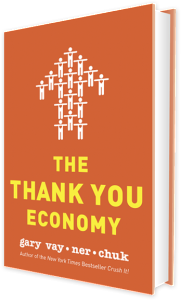
Thank You EconomyGary Vaynerchuk has made a hugely successful business through social media engagement. He has made an even bigger business by promoting the idea of social media engagement.

As he points out in his book?The Thank You Economy, it is the businesses that don’t begin to engage with their customers on a personal level that will fall to the wayside.

People born today are born in to a world that is connected more than ever before. By the time they are consumers they will expect connecting and interacting with businesses to be easy.

This may sound ludicrous, but Gary V believes it to be true. And who am I to argue with Gary V?

My grandmother never had a computer.

My parents are now using the internet for purchasing, yet they tend to stay away from the social network scene as much as possible.

I am in my mid-20s, on the cusp where the social media outbreak occurred.

My kids will be born into a world where the President of the United States having a town-hall meeting over Twitter would be a thing of the past (the effectiveness and legitimacy of said meeting is a debate for another day).

The evolution is clear. And in a world that is evolving faster than ever before, maybe our questions should be evolving as well.

Are We Measuring the Right Metrics?

Maybe the answer to the question is no. Maybe the ROI on social media engagement doesn’t even matter at this point.

Perhaps it isn’t the ROI of social media we should be measuring, but rather the LOLOI – the loss on lack of investment (yeah…I just made that up).

How many potential customers might you be losing if you aren’t engaging in conversation with them? What if your competitors are engaging them? People would rather buy from people they like and can relate to. With social media even the biggest corporations can become more personable.

So at this point the wiser question might not be “what is the cost of implementing a social media strategy?” but rather “what is the cost of not implementing one?”.

A Learning Curve

In truth the investment, and the return, does matter. It doesn’t make sense to pump resources into social media if you can’t afford it. If all of your resources are getting sucked up by social media and not enough are being put into actual business operations then you have a serious problem on your hands.

But it is important to note that social media tools are just that…tools. And the magic isn’t in the tool, but rather how you use it. It doesn’t have to cost an arm and a leg, but it does take some practice.

There are certainly learning curves when it comes to using social media. And each individual and business has its own.

But it may be a good idea to get in now, while it is still early, to perfect the craft before it becomes an absolute necessity.

The Conclusion

There may not be a simple answer to measuring the ROI of social media because there are too many variables. And each individual and company needs to figure out which of those variables they need to focus on.

There is definitely no blanket one-size-fits-all answer. But just because it may not be easy to measure the ROI of social media, doesn’t mean you shouldn’t attempt it.

Go for it. Play around. Test different variables. Finagle some numbers.

And remember…the ROI of social media might not even be the right thing to measure.

Eugene FarberAbout the author:?Eugene Farber is an accountant turned internet entrepreneur. He blogs about internet marketing, business and life at?Reality Burst. Visit his site today for a free?Social Media ROI checklist, and connect with Eugene on Twitter?@EugeneFarber.

image: Leads United
image: Debs

You Make The Choices

Meh to social media complainers

Meh to social media complainers

There’s a lot of hand-wringing and woe is me in social media.

At times, it’s like watching a therapy group from the sidelines, except the therapy group shouldn’t really be called that – it’s more like a “woe is me, how unfair this social media thing is to me” group.

Thing is, it’s not. When something’s unfair, or annoying, or any other emotion that doesn’t fill you with unicorn-flavoured Kool Aid, much of it can be attributed back to the person doing the hand-wringing.

For example, making a public song and dance about unfollowing everyone on Twitter because of all the spam you get in your Direct Message box. Hint – maybe following over 130,000 people in the first place had something to do with it.

But seriously?

Are we really missing the point that, in social especially, we make all the choices that come back and upset the apple cart later on?

No, we don’t deliberately ask for spam – but every single person we take “onboard” has the potential to be a spammer. So, it makes sense that the more we connect, the more the potential.

There are also options available for countering spam.

For example, I’ve seen Twitter profiles that clearly state, “I don’t answer DM’s anymore, but feel free to @ me or email me instead.” Then simply adjust your email settings to stop DM alerts coming into your email Inbox.

Or – less ideally – set your Twitter profile to private. That way only the chosen few will be able to DM you, and you can soon see who the spammers are that way.

Or, simply click Delete and Report Spam – Hootsuite is great for this approach.

Note – all of the above options also mean you don’t flaunt Twitter’s Terms of Service by running a script to mass unfollow.

But the same goes for offline.

We see ads on TV that we don’t want to see. We hear radio ads we don’t care about. We receive flyers in the mail that we have no interest in. But instead of telling all our friends about it, we just change channel or throw in the bin and move on. No big deal.

The point is, all of this is our choice to make.?We can all follow hundreds of thousands of people and deal with the inevitable bad eggs; or we follow less and be less visible.

We can’t have it both ways, as much as we’d like to think we can.

  • « Go to Previous Page
  • Page 1
  • Interim pages omitted …
  • Page 18
  • Page 19
  • Page 20
  • Page 21
  • Page 22
  • Interim pages omitted …
  • Page 38
  • Go to Next Page »
© 2026 Danny Brown - Made with ♥ on Genesis