• Skip to primary navigation
  • Skip to main content
Danny Brown

Danny Brown

podcaster - author - creator

  • About
  • Podcasts
  • Journal

Social Media

The Google Plus Apathy Malaise

Danny Brown Google Plus FB Question

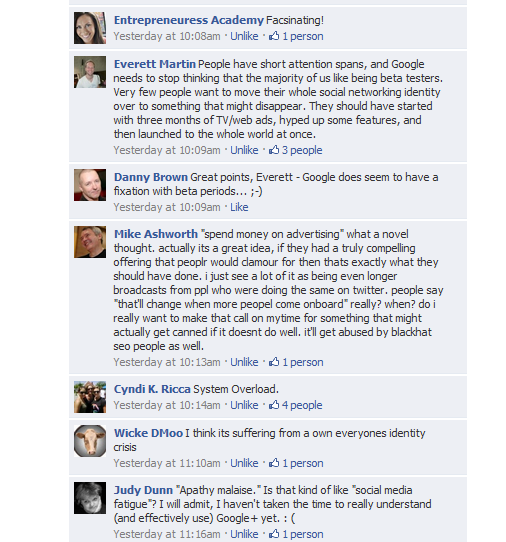
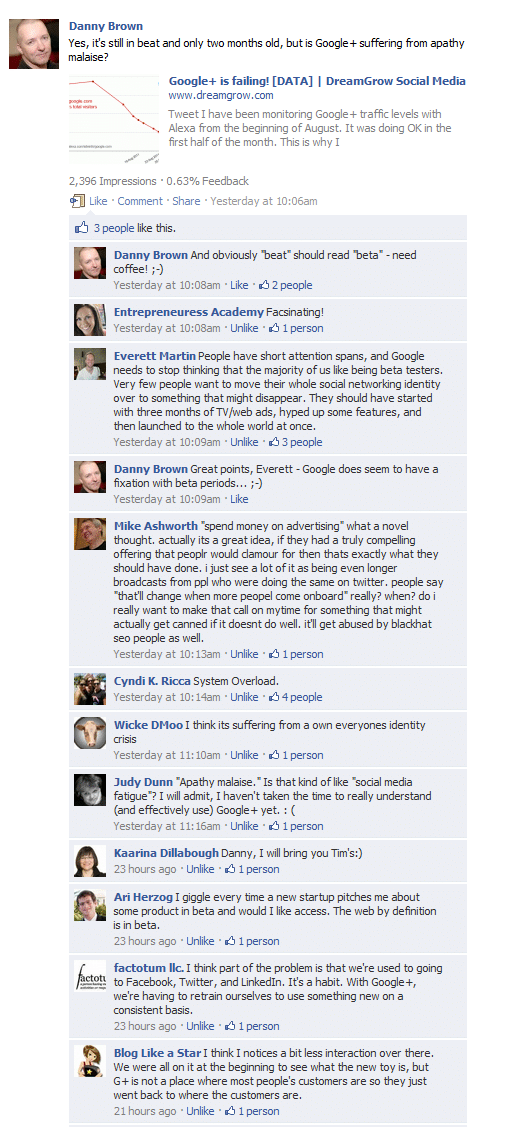
Yes, Google+ is just two months old, and yes, they’ve had a great uptake in numbers using the service (currently 25 million and counting). But there’s a growing amount of talk about how it’s not majorly different from what’s currently out there.
Danny Brown Google Plus FB Question

Additionally, the majority of users fall within limited categories – early adopters, tech geeks, social media “power users” and marketers/agencies trying to decide on its potential business value.

For Joe Public, though, Google+ remains an anomaly, and one that has a big question to answer – mainly, “Why should I leave Facebook when everyone I know is on there?”.

Personally, I’m enjoying Google+, but I’ll admit the early novelty has worn off and I use it less than Facebook. I’m hoping that the various tools and apps Google has at its disposal will make an appearance soon and integrate smoothly, as I feel that could be where the real Wow factor comes into play.

We’ll see. For now, from a lot of the people I’m connected with, it’s okay but could be better.

How about you?

Enough With The Opt-Out BS, Klout

Prisoner of Klout

Prisoner of Klout

Klout sucks. Not because of what they’re trying to do, in measuring your online influence (although I’ll be the first to admit I’m not a fan of that approach for a number of reasons).

Nor do they suck because they’ve engendered a mindset among people to try and grab Klout Perks, based on that perception of influence. Heck, you’ll always have folks that do nothing but want everything for free, so may as well have somewhere for them to spend their time and energy.

No, they suck because they’re stuck in the mindset that opt-out is better than opt-in.

Meaning, they don’t give you a choice when it comes to having a “profile” of you. It doesn’t matter if you sign up to the service or not, or whether you connect your accounts to grow your Klout score.

Because Klout automatically gives you a basic profile anyway.

No permission – there you are, as bright as day online, with whatever score they deem you fit to have based on their perception of you.

Note: I understand that by accepting the Terms of Service on the likes of Twitter, etc, your information can be shared. I’m not sold on that being turned into a full-on profile on another site, though.

I’ll admit, when Klout first came out, I was curious as to how it worked. As someone who needs to connect clients with perceived influencers for outreach and promotional programs, it seemed an interesting way to find those that could help.

Then the flaws appeared.

Just using my account as an example, I recently disconnected all my accounts from Klout, with the exception of Twitter as it wouldn’t let me disconnect that.?As a result, my Klout “score” (or influence) dropped from 75 to 63.

So, even though I was still active on the networks I’d disconnected; even though I was sharing the same amount of information, and interacting just as much – if not more – on blogs, Klout felt I was less “influential”.

What they were really saying, though, is that because I wasn’t participating by their rules, I was less influential. Never mind the fact I was still getting “reactions”, if you like, for my interactions online – if Klout didn’t see them, they never happened.

Because I’ve written a fair few times about my lack of “trust” in how Klout perceives influence online, I thought it’d be hypocritical to keep an account there. So I went to delete, which is where the fun began.

I followed the instructions on their site to delete my account, and received an email from Lan at their contact centre advising my account had been removed. This was almost a week ago, and I was advised it could take a day to clear their system.

A week later, and I’m still there, even though I have no desire to be part of the Klout game anymore, nor do I wish to be “on display” on their site, since I (initially) never gave permission.

This is where the opt-out bullshit needs to stop.

It’s more than 10 years since Seth Godin wrote about Permission Marketing, and yet here we are, still being added to things we didn’t have a say in. Fair enough, I added details to Klout, but the initial permission wasn’t there. As it isn’t for anyone.

The Standard for Online and Internet Influence Klout

And to remove yourself, you have to go through hoops to get it done? That’s crap.

It’s not just Klout. Facebook is as bad, as are many other social networks. I had the same issue with Hashable, and got into a debate on Twitter with that service’s founder, who decreed, “Hashable’s not the kind of service people leave, hence there’s no need for an option to delete your account.” (This option was later added.)

Yes. There. Is.

You don’t add people to something and not ask them their permission (unless there’s some legal reason to do so). Especially when that information is there for anyone to see, and make a snap judgement on.

For example, some companies are using Klout scores in the hiring process. If someone has a low score because they don’t know they’re on Klout, and get passed by for a job even though they’re the best qualified, that makes your system screwy (it also doesn’t say much for the research angle of the company in question).

So, please, Klout, and anyone else that puts people onto their platform then makes it almost impossible to get off – be smart. Make it easy to leave. I was able to delete my Empire Avenue account with a single mouse click – why should it be any more difficult than that?

After all, it’s not like you’re just looking to have numbers to show off about your platform to possible investors. That wouldn’t be a reason to keep people on there that want to leave.

Right?

Update 26.10.2011: Seems the link to remove yourself from Klout is now showing an “invalid request”. You can try this one instead.?

Note: This post is about Klout and its practices. I have nothing but good words for its CEO Joe Fernandez, who’s always responded to criticism about the service and looked at ways to improve.

~ Update: As of November 1st 2011, you can now?delete your Klout account.?

image: remuz

Great Customer Service or Great PR?

Promo

Promo

So, Morton’s Steakhouse is making waves online at the minute, due to them delivering a steak to HARO founder and social media guy Peter Shankman.

If you’ve not heard it, the story in a nutshell is this – Peter faces a long flight home and is hungry, so tweets to Morton’s that he’d love a steak delivered and waiting for him at Newark Airport. Lo and behold, when he arrives and goes to his car, the steak and a tuxedo-wearing waiter are there waiting for him.

Cue Peter’s post “The Greatest Customer Service Story Ever Told”, and his belief in the awesome way Morton’s looks after their customers.

This would all be great, if it was a simple customer service story. But I’m not sold on that – it feels a great PR opportunity for Morton’s (and nothing wrong with that), but a customer service example? Sorry, not for me.

Average Joe vs. Peter Shankman

In his post, Peter says he believes it’s because he’s a good customer, and that he wasn’t treated any differently because he has over 100,000 Twitter followers. And looking at Morton’s social media stream, it’s clear they do a great job of engaging people, both on Twitter and Facebook. And that’s great to see.

But would they deliver a steak to anyone that tweeted them to, to show great customer service? I’m not so sure. Especially if it’s not paid for (which Peter doesn’t mention in his post, so not sure if it was free or not).

Had Joe Invisible with 10 followers tweeted the same, would he have received the same service? Acknowledgement? Options to have delivery to an airport? Perhaps, though the cynic in me is doubtful (always happy to be proven wrong!).

Great Service Is Consistent

One of the overall takeaways from Peter’s post is that Morton’s is always known for being on the ball. Which is quite a thing to live up to, for any company. While Morton’s no doubt offers a great experience, they’re also guilty of poor ones.?For every positive review, there are a fair few negative experiences.

Of course, this is to be expected for any business, and restaurants in particular will usually have an above average list of complaints compared to many other industries – we people like our food, after all.

But the litmus test for any business is how they respond to their critics as much as how they respond to their fans. Does Morton’s respond – publicly or privately – to each online complaint? Does their customer service team pro-actively engage their critics on forums and review sites as much as they do on Twitter and Facebook, which are far more public platforms to the majority of social media users?

Perhaps, and if so, great, because that would be the sign of “the greatest customer service”, as opposed to a steak to an influencer.

There’s Nothing Wrong With PR for Customers

As mentioned, Peter counters claims in his post that it had anything to do with his Twitter followers, and more to do with Morton’s offering awesome customer service.

But so what if it is down to his follower numbers? Or the fact that his HARO newsletter offers more than 130,000 people to get a story in front of? Or that his site, where Peter posts about his experience, is in the Top 50,000 online according to Alexa?

It’s smart business to see an opportunity like a tweet from Peter, and know that you’re probably going to get a shitload of traffic and positive press for the price of a steak meal.

But, again, that’s great PR, not great customer service.

So, by all means, let’s congratulate Morton’s for a job well done – more companies should take a look at how a relatively small act can result in a fairly big reaction. But let’s also keep in mind who the recipient of the action was, and the reach and eyeballs that recipient has, before we say it’s the norm and not a well-seized opportunity.

Unless, of course, Morton’s wants to spend over $4.5 million and send their lowest-priced steak to all of Peter’s 100,000+ followers, to show everyone gets treated the same…

image: suttonhoo

A Special Livefyre Q&A with Geoff Livingston

Geoff Livingston

Geoff LivingstonThis coming Thursday, August 11, at 12.00 noon Eastern / 11.00am Central / 9.00am Pacific / 5.00pm GMT, there’s going to be a special interactive Question and Answer session here on the blog.
Using the interactive features of the Livefyre comment system, my special guest will be Geoff Livingston, author of the new book .?Geoff is one of the smartest writers around today, and brings both organizational and non-profit smarts to the business world.

His new book has been praised as one of the best on sale today, and helps businesses and organizations build long-term and sustainable success using social and new media channels, alongside traditional ones.

Instead of me writing “just another book review” (although the book is that good, I’ll be breaking my “no book reviews” rule here soon), Geoff has agreed to be a “live guest” on this blog on Thursday.

So how’s it going to work?

Watch the video below, and let Geoff give you a small overview of what Thursday will be about. Then, start thinking of questions you would like Geoff to answer – on social media, new media, what channels are best for your business, how to measure and track goals, what part bloggers play in the new business landscape, and more. Seriously – if you have a question about social media and its ramifications for your business, Geoff is the guy to ask, and now’s your chance.

And to make you really get your thinking caps on, Geoff will kindly be giving away two signed copies – one for the best question about challenges business face, and one for the best question on social media and business sustainability (use your own examples, if you like). I also have a little surprise for anyone buying Geoff’s book on the day – details Thursday!

Then come back here at 12.00 noon EST on Thursday, where Geoff will be here to answer your questions about the book, social media and business, online channels and more.

The difference is, this will all happen in the comments section.

Because Livefyre offers real-time live updates, it’s more like a chat system than your normal blog commenting system. The cool thing is, when a new comment has been posted and you’re on the page, a little alert box pops up to say there’s a new comment (or several, if more than one new comment has been posted as you read).

You can then click on each alert, and it takes you directly to the new comment, so you can see what questions and views are being shared as soon as they’re posted.

So all you need to do is ask your question for Geoff via the comments, and he’ll be spinning his fingers all over the place to respond. You can then reply to Geoff, or anyone else’s comments, and really make it an interactive book overview and discussion like no other.

To take part, all you need to do is the following:

  • Choose your profile. Because Livefyre is a profile comment system, you need to either have a Livefyre account (which you can create here by using the Get Livefyre Now option), or sign in to comment using your Twitter, Facebook, LinkedIn, Google or OpenID profile. You’ll see these options under the Comment As option to the right of the comment box.
  • Set yourself a reminder (I’ll be tweeting and using Facebook to send out occasional reminders) to be here between 5-10 minutes before noon on Thursday August 11 to watch the video again as a reminder for the chat.
  • Get your questions ready, and fire away from noon onwards.
  • Be interactive – if you use the little “@” function when commenting, you can bring your friends from Facebook or Twitter into the conversation too. So if you think someone specific could be a great addition to the chat, invite away!

Like any live chat, there could be some technical gremlins, but hopefully not. The Livefyre guys are working behind the scenes to try and make it as smooth an experience for you as possible. And Geoff has his gremlin-slapping gloves ready, just in case.

Hopefully you’ll join us on Thursday and have a bunch of great questions for Geoff. I think this could be a lot of fun, and something to show how blog comments can really come alive.

Look forward to seeing you here – cheers!

Update Thursday, August 11: Anyone who between now and 11.59pm EST on Sunday, August 14, will receive a free copy of The Parables of Business too. Simply email me a copy of your Amazon receipt and I’ll send you the book – simple!

[youtube]http://www.youtube.com/watch?v=Tj2xlzSt0Rw[/youtube]

Ford, Red Tape and Social Media Roadblocks

Ford F-series recalls social media

Ford F-series recalls social media

News came out this week that Ford are recalling more than 1 million F-series trucks, due to a defect in the straps that secure the truck’s fuel tanks to the vehicle. The defect could see the straps corrode, causing the tanks to fail. So far, there have been 8 incidents, three of which included a fire, and one injury.

The news came to the fore after an investigation by the U.S. auto safety regulator, and affects older versions of the truck. In response, Ford has targeted mid-September to notify owners about what to do if their truck is affected.

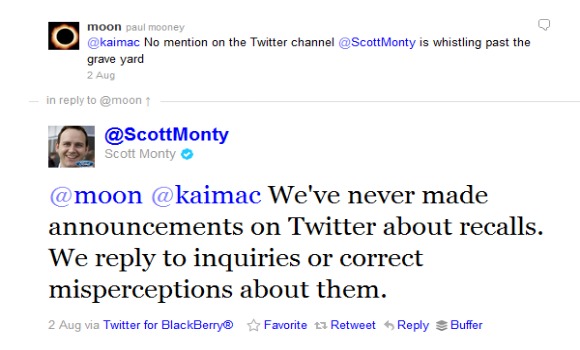
What’s interesting is how a company that’s noted for its use of social media isn’t using social platforms to pro-actively share news about the recalls. Instead, as the image at the start of this post shows, they’re using it reactively when asked about the recall situation, and to correct any non-factual statements. There’s also nothing about the recalls in the Ford newsroom.

Is this a sign of choice or legal red tape?

The Pros of Being Pro-Active

Head of social media at Ford, Scott Monty, says the reasoning behind the “silence” is to avoid inciting panic and unsubstantiated rumours. This is understandable, since we all know the consequences of fake stories and rumours online, and how that can affect brands.

Yet as a way to share news to a wider audience, and quell rumours at the start, social media has continuously proven to be a very strong tool. While Scott may allude to the legal constraints he and the Ford communcations team are under, does being silent unless questioned help?

Wouldn’t it be useful to have an official update in the Ford newsroom, as opposed to having to put out fires by false rumours due to the reactive approach? And a single tweet, or a Facebook page update, that shows a link to where F-series drivers can get the latest and official updates, would help alleviate the very concerns Ford wants to meet.

Additionally, if you’re pro-active, it can also help deflect the view that you have something else to hide (this isn’t just Ford, this is any company online). In a post from 2010, Scott praises SeaWorld on how they were being pro-active at quelling fears, by releasing an official statement from the SeaWorld President and linking to it from their Twitter account.

The Social Media Marketing Blog  When Crisis Attacks

The Cons of Being Pro-Active

As Scott mentions in his answers over at Google+, the reason nothing is mentioned on social media platforms or the Ford newsroom is down to necessity. Ford is handling this recall situation the same way they handle all recalls, and don’t feel the need to say anything “unless the recall rises to a level that is relevant to the wider public.”

Additionally, Ford needs to adhere to regulatory and legal issues and this is tying their hands (at least, that’s how it reads).

Christian Adams, in his response to the question on Google+, advises how he was involved in testing tires after the Firestone fiasco, and that having to wait until the auto safety regulator gave the green light on a problem was very constrictive.

I know the constricted feeling well. When I was contracted at an organization last year, they handled a prize promotion for Canada’s largest airline. Due to some prizes not being delivered in time for the holiday season (a bit attraction to the promotion), there were some negative comments posted on a forum. They asked how it should be handled (as they blamed the couriers and the couriers blamed them), and I advised to let them know that we were looking into it, and that we would reply directly and publicly once an answer had been found.

Due to crappy red tape, it took eight days for someone to come back and tell the person that the case was being looked at. And this was just an update to say the company was aware and would investigate. Eight days is a long time for any answer – on social media, it’s a lifetime.

So I completely get the need to do things right. But couldn’t there be at least one update from Ford, and others like them, to alleviate the questions that will be asked due to silence? Especially if it becomes a wider issue, and the questions become accusations of trying to cover a problem up.

Then again, with the news that Ford has been accused of fraudulent tactics and destroying documents in a lawsuit by a woman paralyzed when her van accelerated out of control, Ford may be feeling the heat and doesn’t want to add to it any more.

Obviously there are pros and cons to any choices made, both by people and businesses. The right one can be difficult to gauge, and perhaps it’ll be in the next couple of months if we see whether the Ford reactive one is the better over the pro-active.

  • « Go to Previous Page
  • Page 1
  • Interim pages omitted …
  • Page 19
  • Page 20
  • Page 21
  • Page 22
  • Page 23
  • Interim pages omitted …
  • Page 38
  • Go to Next Page »
© 2026 Danny Brown - Made with ♥ on Genesis