• Skip to primary navigation
  • Skip to main content
Danny Brown

Danny Brown

podcaster - author - creator

  • About
  • Podcasts
  • Journal

Insights

The Great Friends and Relationships Myth

Friends in business

Friends in business

There’s a lot of talk about relationships in business, and how to make business more human.

There’s also a lot of talk about how businesses need to be more like friends, and treat people the way you would your friends if you want to succeed.

Add in the view that businesses and their clients should be friends as well, and you could be forgiven for thinking you need to be either Ross or Rachel and sipping coffee in Central Perk to get anything done.

But here’s the thing – that viewpoint is a myth. Not only that, it can also be a dangerous myth.

Here’s why.

Friends Don’t Always Come With Benefits

Let’s look at the friends angle first. Can you have friends in business, or be friends with clients? For sure – you can be friends with anyone. But here’s why you shouldn’t be.

With friends, we let our guard down. If they’re going through a tough time, we support them. If they need to borrow money, we help, and let them pay it back when they can. If they need to pick our brains, we’re there for them.

But because we let our guard down, we very often don’t put it back up.

Transfer that to business, where either a client, or a supplier, or a customer, uses your service but doesn’t pay when they’re meant to. Or a supplier skims money off you left, right and centre without you knowing it. Or they talk with your competitors behind your back while you’re working on getting them airtime.

Business don’t have friendships. Businesses do what’s right for them at that given time, and rightly so – it’s why it’s called business and not high school.

If you’re friends with a business, you can put your own success and longevity at risk because you don’t want to ask too much of your friends. Unpaid invoices go unchallenged, and soon your business is struggling to pay an invoice. Once you start down that path…

Relationships Never End Well or They Wouldn’t End

The relationship angle is an interesting one, because obviously we can (and should) foster relationships in our business lives at every turn.

Relationships are the key to a long client/vendor arrangement over a one-hit-never-work-together-again one. Relationships are also the key to promoting relevant skilled resources to those that need them – say, you recommend one client to another, or an outsourcer to a client, etc.

But the key to remember is that, just like many personal examples, relationships come to an end. Girlfriends split with boyfriends, friends split with each other, families grow apart. The closer the relationship, often the harder the split is. It can turn nasty as sides are picked and grievances aired, and that’s no fun at all.

We’re currently working with a client whose previous agency always talked of their “special relationship”. Yet once the agency’s work and results were questioned, the owner went postal and demanded more money (even though they’d already skimmed the client of more than $12,000 for a project in limbo). So much for the “special relationship”.

So is it impossible to combine friendship and business relationships? No – if approached right.

Buddy Boundaries

In an ideal world, we’d all be friends together – people, businesses, ex-lovers, enemies, etc. The world would be an easier place for all if we lived on clouds and blew bubbles at each other.

But we know that life isn’t ideal.

Instead, we just need to realize that sometimes, it’s okay to not be friends. That doesn’t mean we can’t be friendly, though – similar word but a world of difference.

  • Respect boundaries. Appreciate that while tone and interaction can be friendly, at the end of the day you’re still in business to both make your clients and customers successful, and be successful too.
  • Maintain professionalism. I’ve seen some classic emails because of a “friendship” – because of the perception, professionalism goes out the window from the sender. Keep in mind that businesses are professional ventures, and don’t send a CEO an email better suited to pub talk.
  • Understand subtleties. While we look out for our friends unreservedly, often we can’t offer the same support to our clients, vendors, customers. Know where the cut-off point is and you know where the help can begin and end.

We all want to be friends. We all want to have the most amazing relationships. And, often, that can be the case (or a close resemblance to it).

But we also want to be successful – for our clients, our customers, ourselves and our families who depend on us to keep a roof over their head. If we confuse friendship and relationships with friendliness and professional relationships in that order, we run the danger of losing sight of crucial decisions that need to be made.

And none of us can afford to do that.

image: marie-II

Help Me Choose a Name?

Beginning on Sunday January 30, I’ll be running an ongoing series on the blog that answers a new question each week from you, the readers. It might be on strategy; marketing; building loyalty; business; blogging; social media; and more.

Originally I was going to call it Sunday School, since it’ll be posted on a Sunday and it will have an educational slant (yeah, I know, not very original).

But then I was thinking some folks might think it’s a religious thing, and I wouldn’t want to confuse or upset anyone. So… any ideas?

Leave your suggestion(s) in the comments below. My favourite will be the name of the series, and will get a special little something mailed out to them.

Thanks, guys, and look forward to seeing your suggestions!

Update: Thanks to Phil McDonnell and his suggestion – the name for the new series will be Sunday Brunch – details here.

Is Your Marketing Message Being Diluted by Automated Advertising?

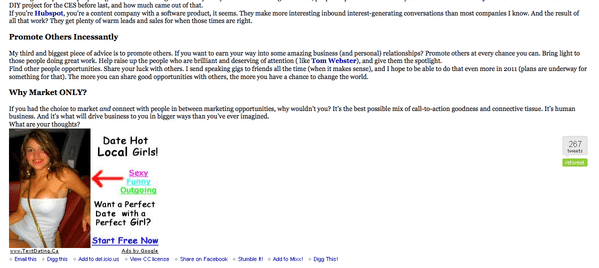
Chris Brogan dating ad

Chris Brogan dating ad

This morning, I received the latest post from a popular blogger via the blog’s email subscription service, which runs on Feedburner.

The post talks about marketing and how relationships and connections are a key part of the marketing mix (and can often be the starting point for any marketing campaign).

It’s a good post with a sensible message. What caught my attention, though, was a Google Ad at the bottom of the post, which is the image at the top of this post (and, yes, I’m a man and, no, the scantily clad young girl wasn’t why the picture caught my attention).

It’s a prime example of why you need to be careful of how your message is being shared, and why automated monetizing can (potentially) backfire.

Adventures in Keywords

A lot of bloggers look at ways they can monetize their blogs. One way is through affiliate marketing; another is through products; another is through running related ads via Google, which is what’s happened here.

The way this works is you set up a Google Ads account and set them to run automatically with your content. This could be your blog’s sidebar, the blog post itself, or (in this case) the subscription feed. Google looks at the keywords in the blog, and automatically inserts what it thinks are relevant ads.

In the post used here, a lot of the talk is about “connections” and “relationships”, so they’re seen as keywords. Throw in the odd “touchpoints” and “love”, and Google probably thought the blogger was talking about dating – hence the accompanying image and ad.

And that’s where the problem of automation can rear its ugly (or scantily-clad) head.

Your Readers Are Listening

When you subscribe to a blog by email, it’s because you’re really interested in what a blogger has to say. You’re investing in them, and giving over real estate in your Inbox as opposed to just catching up now and again via an RSS feed. It’s showing your trust in that blogger’s voice.

Because of this, you might think that an ad like the one in this example is something the blogger has attached to that post by choice. And that can cause problems.

A lot of people could be offended by the image and the message it portrays. Others could be receiving the email at their workplace, and potentially break any rules about adult images on-screen. Or you could be the girl’s parents opening the email…

It’s not (directly) the blogger’s fault – the choice was made by Google, not the blogger. But it’s an image that’s gone out from a highly-respected blog, with more than 60,000 subscribers, and it’s attached to a marketing message on how to do business right.

Yet through a simple error on keywords, the message of the post could potentially be diluted. Additionally, if the ad was worse, it could also lead to some readers unsubcribing (depending on the trust built up for the blog in question).

Something you might want to keep in mind when considering automating your readers’ content…

Stop Playing the Sympathy Card

Boo hoo life sucks

Boo hoo life sucks

Being in business for yourself is difficult.

Sure, you don’t have to answer to a domineering boss. Nor do you have to venture to a drab office on a biting cold day to be bitch-slapped by that same domineering boss. You’re also in the fortunate position of choosing the people you work with, as opposed to having them forced on you.

But it can also be difficult.

You lose the guaranteed paycheck. The company healthcare plan. You have to fend for yourself and not have someone else bring work to you. You have to have buy-in from your loved ones, because they suffer too if you don’t bring the food money to the table.

But here’s the thing – you chose this environment.

When you decided that you wanted to exchange payroll for pay dirt (as in work/life ratio and more freedom of choice), you signed up for the rollercoaster ride and the tough times.

You signed up for the projects that could go awry; the late hours; the blood, sweat and tears that often go hand-in-hand with risk-taking. Simply put, you signed up being responsible for what you do.

So why play the sympathy card when things don’t go your way?

Why blame the client because you missed deadlines? Why complain about not making enough money when you’re the one that billed the project in the first place and didn’t scope the work out properly? Why use the “single parent coping alone” cry when there are many other single parents in the same boat, but are just getting on with it?

Blame is easy to deflect onto others, because we can use it to cover up where we went wrong and failed.

But we all have failings. We all have mistakes we make. We all have issues with clients, with suppliers, with outsourcers. As they, no doubt, have with us.

But we make it work.

We make the trials part of our ongoing education, and grow stronger because of it. We use setbacks to strengthen our resolve and make sure we don’t follow the same paths the next time. Simply put, we use all the good and the bad of being in business ourselves to make us a better business.

If that’s not something that’s for you, then maybe an employed position is a better fit. And there’s nothing wrong with that – business is a tough nut to crack, and sometimes it makes sense to let others do it for you.

But let’s leave the sympathy card for hospital patients, eh?

image: Fran Simo

Stepping Outside Social Media and All That Jazz

So this post has absolutely nothing to do with marketing. Nothing to do with social media. Nothing to do with PR, or communications, business or blogging tips (unless you count the stats about spam emails when you click the “More” tab on the side navigation menu).

But that doesn’t matter. Sometimes you need to step away from all of that stuff and take a look at the world around us. Learn about the people, facts and figures that make up this planet.

Which is exactly what this World Clock from Poodwaddle does.

With real-time statistics (based on projections) on the state of the world today (collated from various world organizations), it’s a very cool visual representation on the make-up of our home.

Enjoy.

For more cool applications, check out the Poodwaddle website.

  • « Go to Previous Page
  • Page 1
  • Interim pages omitted …
  • Page 72
  • Page 73
  • Page 74
  • Page 75
  • Page 76
  • Interim pages omitted …
  • Page 174
  • Go to Next Page »
© 2026 Danny Brown - Made with ♥ on Genesis