• Skip to primary navigation
  • Skip to main content
Danny Brown

Danny Brown

podcaster - author - creator

  • About
  • Podcasts
  • Journal

Insights

Two Awesome Examples of Promotional Campaigns Done Right

Sometimes, you just have to take your hat off to excellent examples of promotional campaigns done right.

With many folks saying advertising is dead, it’s nice to see examples like the two below and say, “Uh, really?”. Especially since both show a mix of cool and (where Audi and BMW are concerned) outright cheek.

The Audi and BMW Billboard Chess Match

This is probably one of my favourite examples of corporate fisticuffs I’ve seen. Below on the left is a billboard ad from German auto manufacturer Audi, and the response from fellow German competitor BMW (click to expand):

Audi versus BMW

Audi’s ad shows their new A4 saloon, with the challenge to BMW of, “Your move”. It’s classic advertising at its best, with a gentle poke at a direct competitor. A competitor that was clearly up for the challenge.

Up steps BMW with their response, a picture of their sporty M3 and the words, “Checkmate.” Brilliantly simple, and one that would end any “mine is bigger than yours” game.

Except Audi have their own sports car heritage, as was quickly evident in the response below (click to expand):

Audi versus BMW sports car battle

In a wonderfully cheeky piece of advertising sass, Audi put up a new billboard with their R8 supercar and the statement, “Your pawn is no match for our king.” Game over, right? not quite.

BMW has a long history in race cars, especially when it comes to Formula 1 racing. And they were more than happy to show this when they brought out a blimp with their F1 race car emblazoned on it along with the words, “Game over.”

Epic. Simply epic.

Note: Audi reached out to advise that the blimp was photoshopped into a screengrab of the billboards. Bugger. Still epic response though. 😉

The Monsters University

Scheduled for release next summer, Monsters University is the sequel to the massive hit, Monsters Inc. A prequel to the original movie, it looks at the two characters from the original movie and how they met at the titular Monsters University.

Now, normally, movies are pretty good at coming out with cool promotional campaigns, with studios trying to outdo each other on the viral effect. But Pixar and Walt Disney have really come up with something pretty cool for this one.
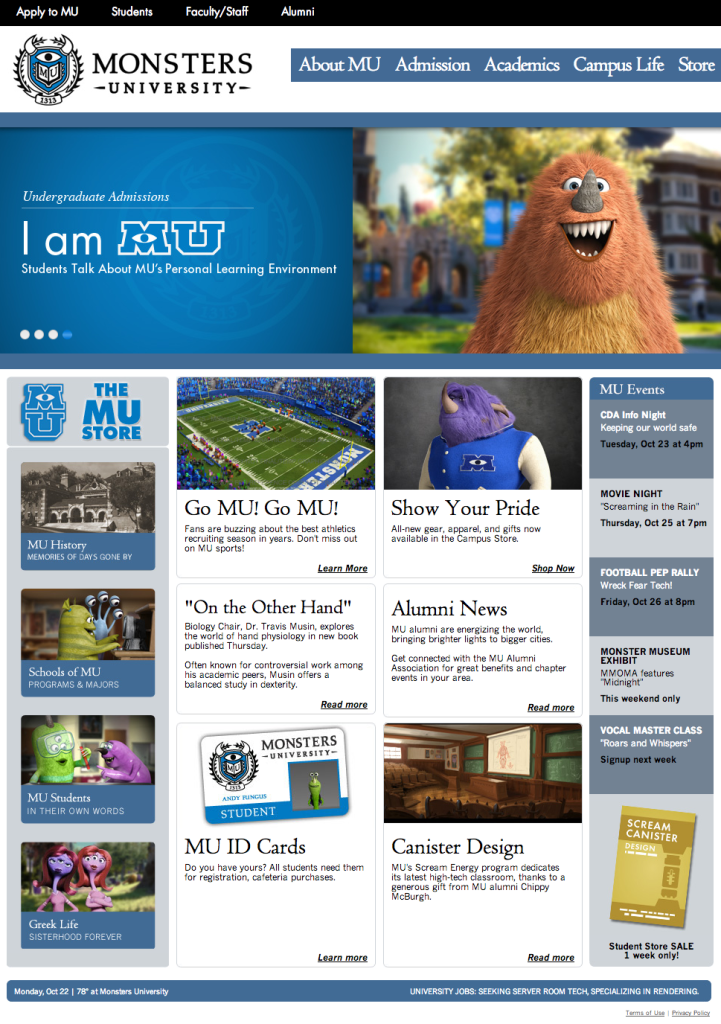
Monsters University

Instead of the normal movie site, Pixar has gone all out and created a fully functional University website (hat tip to Matt Andaloro for the heads-up on this).

Not only can you explore the School of Scaring, where the Monsters learn their trade, but you can check out the MU sports and athletics teams; get alumni news; check out MU events; and much, much more.

It looks and feels exactly like a University website would, adding to the realism and authenticity of actually spending time with fellow students. Which is exactly what the new movie will be about – result.

The Moral of the Story

As I mentioned at the start, many folks have decreed advertising to be dead, as social media and new media platforms look to share messages differently.

Yet, as these two examples above show, advertising is alive and well, and more creative than many of their social media equivalents.

To the naysayers of advertising and “traditional marketing”, perhaps it’s less the medium that’s dead as much as it’s just crappy advertisers and marketers that are killing creativity.

Then again, that’s true of all mediums, including social media. Here’s to creativity, especially when it’s integrated and not silo’d.

A Lack of Real Vision is Stalling the PR Industry

First, a caveat – I don’t know the folks whose quotes I’m about to use as examples of why the PR industry is struggling.

They could be (and probably are) very smart and accomplished business people.

So, this isn’t a “go” at them.

With that being said, however, this recent report/white paper does seem to highlight exactly why the PR industry is continuously seen as one that’s been slow to adapt to the new business landscape and, as such, is holding agencies and consultants back.

First, let’s take a look at the piece.

The PR Firm of the Future

As a precursor to the PRWeek Conference on November 14, Michael Lasky – senior partner and head of PR at law firm Davis & Gilbert LLP – asked this question:

What is the most important way in which the PR agency of 2017 will be different from the PR agency of today?

Michael asked 8 leaders of independent agencies. The responses included:

– Ken Eudy, CEO, Capstrat: “The PR firm of 2017 will increasingly help is clients become publishers and broadcasters… communicating directly with stakeholders without having their messages filtered through traditional media.”

– Maril MacDonald, CEO, Gagen MacDonald: “The successful firm of 2017… will be interested in relationships, not transactions. It will think about the long-term strategy, not short-term tactics. It will add value through a technology-driven collaborative dialogue…”

– Elise Mitchell, CEO, Mitchell Communications Group: “The firm of the future will be known as a business strategist with communications expertise. It will offer integrated services that create solutions… leveraging earned, owned, paid, shared and promoted media in all channels including digital.”

– Jennifer Prosek, CEO, Prosek Partners: “Practitioners in 2017 will be required to think across the marketing mix and successfully drive campaigns versus simply owning the traditional earned media channels. Firms will need to articulate the value of results that engage their audience versus simply offering impressions.

These are just four quotes I pulled from eight agency leaders. Others include:

  • “Providing value at this level is not only the key to establishing lasting partnerships, but also creates a desire… to partner with this organization”;
  • “Multidisciplinary expertise will be the firm’s leading competitive asset”;
  • “THE PR firm of the future… will deploy a mix of paid, earned, owned and shared media that can be monitored and measured directly in real time.”

All good stuff. All good advice. If this weren’t already happening today in 2012, versus what should happen in 2017.

The PR Firm of Today and Yesterday

While there are some good quotes from the assembled eight agency folks, the “problem”, if you like, is that they were asked what the PR firm of the future would look like.

So, you’d kind of hope/expect to hear stuff that no-one’s really doing at the minute, or ideas that are really pushing the industry forward.

Unfortunately, the majority of the soundbites would be futuristic if they were answers from circa 2008/2009.

Suggestions that brands become publishers and broadcasters, for example, miss how well blogs and social networks have been used by brands and agencies for the last 3-4 years.

You only need to look at programs like Sony’s Digital Dads, or Ford’s blogger outreach campaigns, to see how well this has been done in the last few years. And smaller businesses are increasingly using blogs to educate their audience and grow their customer audience and loyalty.

Then there’s the prediction that the PR firm of the future will deploy a mix of paid, earned, owned and shared media while being able to monitor and measure in real time.

When I was working on a RIM account back in 2009 to launch the Bold 9700 in the U.S., we used a collaborative strategy that saw us involve Facebook, Twitter and YouTube to create a fully interactive experience for you and your friends. This was supplemented by paid media ads as well as partnerships with BlackBerry communities.

We measured and identified where the campaign was working, where it needed help, and which communities were driving real value and worth around the promotion.

The result was millions of impressions, thousands of handsets pre-ordered and sold, and an industry award for the campaign itself.

That was in 2009 – and I know we weren’t the first to use true integration in campaigns.

The Future is Now

And this is exactly why this “prediction paper” just adds to the view that PR is being left behind, versus countering that belief.

There’s no doubt that there are great agencies doing great things. Companies like Arment Dietrich, RKPR, Mullen, Voce, V3 and more. And the reason they’re leading the way today is because they’re already practicing what’s being predicted for 2017.

They’re integrating channels and expertise now. They’re not silo’ing PR from marketing from digital from strategy from creative and more – they’re running these as fully integrated ideas from the start, and have been for years.

My friend Rick Rice, a 35-year industry veteran, sums it up best with this quote:

The PR business is in need of disruptive change and none of this generation are even willing to try.

There’s no doubt the PR industry has a perception problem, and it’s great to see it trying to move forward. I just wonder how far it can move when it still seems to be behind the curve on so many things…

From #HungerToHope – Supporting World Food Day

World Food Day

World Food Day

As bloggers, we talk a lot about the world around us.

We talk of the things that matter to us and our readers – marketing, knitting, Pinterest, motorbikes, etc. Anything and everything. And, for the most part, these blog posts do matter and is why we have readers.

Yet sometimes, we need to take a step back and really look at the things that matter. Like world hunger.

Consider these numbers:

  • 1 in 4 children in the developing world are underweight.
  • 1 in 6 people worldwide don’t get the amount of food needed to live a healthy life.
  • Hunger is #1 on the world’s top 10 health risks, killing more people than AIDS, malaria and tuberculosis combined.
  • 10.9 million children under five die in developing countries every single year.

Scary stuff, and while we know there’s a hunger and poverty problem, we often don’t know how bad a problem it truly is. And it’s not just in developing countries, either – hunger is a very real problem in first world countries, too.

While we won’t change this situation overnight, we can combat it through initiatives like From Hunger to Hope from Razoo. Even if you’re struggling financially yourself in these tough times, you can help raise awareness of the program.

  • Follow the official Twitter account @WldHungerRelief and tweet support messages using the #hungertohope hashtag.
  • Hop on over to the blogger resource centre and see how you can support across various social networks.
  • Change your profile pictures to support the official gravatar.

If you can donate financially, as little as $10 will provide a meal for 40 children, while $100 provides supplementary food to a child under 2 years old for 18 months of their life.

While we might disagree with each other’s political views, or religious views, one thing we should all be agreeing on is hunger chooses no political or religious sides. For that, we can all take a stand together and help end this tragedy in our lifetimes.

You in?

The Art of Great Service and When We Stopped Listening

Greatv local service

Offering great customer serviceYears ago, I led a customer service team for a well-known telecommunications company in the UK.

Despite its size, one thing that was always drummed into us was that no matter what the problem, have empathy with the customer and acknowledge that any verbal attacks are aimed at the company, not us.

It did the trick.

We knew that our company wasn?t perfect ? which one is? We also knew that some of our company?s practices wouldn?t go over well with our customers, and that would lead to unhappy customers calling in to complain.

Though they sometimes got vociferous in their argument, we would always listen, offer empathy and look for a way that we could both work together to resolve the issue.

Again, it worked.

At the end of the call, the customer would apologize and say they were really sorry that they came over as argumentative ? they were just frustrated and felt as if they had no-one to talk to about it. All they wanted was for someone to listen and show that their problems were being heard.

Even if nothing could be done about them, just knowing someone cared made a huge difference.

So when did we stop listening?

I come across businesses every day that seem to have forgotten what customer service is. Public transport that?s always late with no apology or explanation; banks raising charges on credit cards with little warning and no alternatives; restaurants changing menus without any kind of customer survey (and often losing the best food in the process).

Even social media isn?t immune to this malaise ? look at the thousands of unhappy Facebook users when the company changes its front-end without asking users what they thought first? Even worse, when users complain, Facebook pretty much sticks its head in the sand and says,??Take it or leave it.?

What amazes me more about this apathy toward customers is that businesses can?t afford to have this attitude. All around us, businesses are folding, communities are suffering and families struggling to keep their heads above water.

New business will be almost impossible to come across with any great success, which is why it?s more important than ever to look after your existing customers.

Business is tough enough as it is. We all want to attract new clients and build our brand, but we can?t afford to do so at the expense of our existing customers. Along with employees, they?re the soul of any company and the ones that can offer you the best kind of new client attraction ? word-of-mouth advertising.

Something for businesses to keep in mind the next time they review their customer service policy.

image: gumption

Social Influence and the Shift of the Carnegie Principle

Meet the social instigators

Meet the social instigators

When Dale Carnegie wrote the book on influence more than 75 years ago, he probably didn’t realize the impact he was about to make on society. Just ask the 15 million people that have bought the book since 1936.

But, more than just sharing some evergreen ideas on how people and ideas can really connect with each other, Carnegie also pioneered how we – as individuals – are perceived by others.

Swap that to social influence today, and brands are now looking to highlight those they perceive as influential, to market their services and products for them.

Whereas Carnegie looked to show you ways on how you could make friends quickly, get you out of a rut, and make you more effective all round, today’s influence is finding uptake with brands looking to (often) bypass the legwork that Carnegie advocated, and utilizing shortcuts instead.

These shortcuts mean quicker access to the many; identification of who can spread a message; and more cost-effective approaches to outreach programs and brand advocate partnerships.

This has led to the popularity of companies like Klout, Kred and PeerIndex, as well as niche offshoots like Reppify, Connect.me and Tawkify, to name but three. Each have their benefits, and proponents of these platforms highlight the importance of their place in today’s social media-led marketplace.

However, critics of the services point to today’s influence measurement being nothing more than activity based – the more you are online, the more you’ll be measured as influential, whether you encourage people to act on your activity or not (the dictionary standard of influence).

Perhaps the middle ground offers an insight into where Carnegie’s vision and that of social scoring metrics need to be.

Context

One of the most-discussed areas of influence in the current iteration of social scoring is that of context. As mentioned earlier, proponents of social scoring platforms point to activity being a valid metric – if you’re online a lot, you understand the nuances of the space and how it can be influenced.

Critics point to automated social feeds with little to zero engagement that – while enjoying a high influence score – would be rendered useless when it came to being an influencer to partner with in a social media campaign.

This is where the context argument plays its hand. By definition, context is:

… the interrelated conditions in which something exists or occurs.

By that definition, it’s the very thing that influence looks to do. By connecting the right people with the right brand, and sharing the right message to the right audience, the results should be favourable every time.

If the context of the message is right, and the relationship between the person and the product the message is promoting fits, then there is an immediate “belief” in the message being more than just a sales promotion.

Find the context, and the pieces of the influence bubble begin to come together.

Relevance and Readiness

If context is important, relevance is equally so (if not more so). You may trust the person/influencer sharing a brand’s message with you; you may even be the perfect audience (based on demographics and research) for that message and that product at that given time.

Until you hit the relevance angle.

  • Are you really in the market for this new product right now?
  • Are you financially available to be the customer?
  • Has your situation or taste changed since you last bought a product from this brand?
  • Are there external issues at play here?

The relevance to how ripe you are as customer is something that no influencer can bypass, no matter how much you trust them, or trust the message.

It’s why the social influence market is only just beginning to grow and mature. Activity may be an early barometer of someone’s potential to a brand and its audience – but there are far more pieces of the jigsaw puzzle to add.

Context, relevance and readiness are three – but even they’re just the start.

To truly mature the social influence – and, by association, the influencer – market, we need to remember how many aspects there were to Dale Carnegie’s seminal book and how they all had to be aligned to work their magic.

Then we can really start to move the social influence needle.

  • « Go to Previous Page
  • Page 1
  • Interim pages omitted …
  • Page 41
  • Page 42
  • Page 43
  • Page 44
  • Page 45
  • Interim pages omitted …
  • Page 174
  • Go to Next Page »
© 2026 Danny Brown - Made with ♥ on Genesis