• Skip to primary navigation
  • Skip to main content
Danny Brown

Danny Brown

podcaster - author - creator

  • About
  • Podcasts
  • Journal

Insights

Are We In Danger of Losing the Right to an Opinion?

Back in 2009, I published a post about online watch sales company Melrose Jeweler’s. The post dissected a press release Melrose had put out, suggesting how the actor Owen Wilson had been saved from suicide by seeing his wonderful Rolex watch, and realizing life was worth living.

Ridiculous, right? Not to Melrose, who positioned themselves as resellers of authentic Rolex watches, and used the news release to show just how awesome Rolex is, and why people should buy from their online store.

(Note: Rolex was never affiliated with Melrose, as has since been publicized by a recent lawsuit and the closure of Melrose.)

My original post was an opinion piece, and pretty scathing, questioning the ethics of Melrose and their publicity team. Shortly after the post went live, I received a Cease and Desist letter from Melrose’s lawyer, requesting I take the post down as it was harming his client.

I refused, and instead published a rebuttal post that took apart each of the lawyer’s “statements”, and advised that the post would remain online, as is, as an opinion piece backed by facts. I never heard from either Melrose or the lawyer again.

For me, that experience with Melrose showed the growing “allure” of blogging and social media – the ability for businesses to be challenged?on questionable practices, and be held to a higher standard.

It also showed the growing gap between bloggers and journalists, and why content consumers turned to blogs as opposed to print journalism. While journalism was often red-taped by editorial decisions and boardroom approvals (based on what political party had the bigger sway with the owner of the paper), blogs could offer stronger opinion pieces that could go straight for the jugular, if you like.

A recent decision by French courts, however, could see the future of opinion pieces, and holding businesses to better standards, become redundant. Or worse.

Opinion Is Great – As Long As It’s Positive

French fashion and literature blogger Caroline Doudet wrote a scathing review of her experience with the Il Giardino restaurant in the south west of France. Much like any blogger worth their salt, Doudet optimized the post title and content to rank in Google’s search algorithm.

Indeed, her post – entitled “The Place to Avoid in Cap-Ferret: Il Giardino” – ranked so well it came up fourth in search results when Google users searched for that particular restaurant. It was this placement – and the accompanying review published by Doudet – that upset the owner of the restaurant, who promptly sued and took Doudet to court.

In the ruling over the case, the judge ordered Doudet to amend the title of the post, so that it was less inflammatory, as well as pay the restaurant owner $2,000 in damages. Following this ruling, Doudet actually deleted the post completely, but warns of the precedent this decision sets.

This decision creates a new crime of being too highly ranked on a search engine, or having too great an influence. What is perverse, is that we look for bloggers who are influential, but only if they are nice about people. Source.

That last sentence is particularly telling, both for bloggers and brands alike.

The Neutrality of the Web and the Betterment of Brands

The last few years has seen the rise of bloggers as a prominent feature in any brand’s marketing strategy. This can range from promotional or sponsored posts to working with influential bloggers in a certain field to work through crisis or emergencies.

The trust that bloggers have built with their audiences is hugely attractive to brands looking to reach those audiences – it’s essentially one of the warmest “leads” you (the brand) will have with your demographic. Get the relationship with the blogger right, get the approach to the audience right.

Much of this trust in the blogger stems from the fact the audience knows the blogger has their best interests at heart, and won’t shill for the sake of a few bucks. Trust, after all, is the currency of any successful blogger.

If we get to the stage where that neutrality and power of opinion is removed because a restaurant owner didn’t like a review, or a brand didn’t like the fact a blogger only gave their product a mediocre review, then we’re taking a major step into losing any kind of protective layer between brands and questionable practices.

While the case of Doudet isn’t expected to set a legal precedent currently (it’s classed as an emergency order that’s causing harm to another party), that’s not to say it won’t be used as a weapon in the battle between brands controlling what’s said about them, and the content creators that are determined to hold these brands to a better modus operandi.

The signs are already there. Review site Yelp is currently seeing test cases of reviewers being sued for their postings, while a bishop recently sued a blogger for an article where the victim claimed defamation, while the defendant claimed it was satire.

The latter example may be a more clear-cut one: after all, if you break the law, expect the consequences. However, the examples of brands suing against reviews and opinions that don’t offer a rainbows and unicorns view of their service or product is a troubling one.

If we lose the right to opine based on fact and experience, and instead are forced to remain silent or face the consequences, we lose more than just a few page views and comments – we lose the very fabric of what makes the web what it is today.

The only winners when that happens are the brands that have something to hide – the good brands already use negative opinion to improve their service and product.

Surely that’s something we all want, brands and consumers alike?

image: Rebecca Barray

Three Mobile Social Networks to Keep an Eye On

Teens and technology

This April, technology and digital news site?ReadWrite?published an article titled?“The Future Of Social Media Is Mobile Tribes.”

Written by journalist and advertising strategist Matthew Bryan Beck, the piece looked at how digital users were moving away from bloated social networks like Facebook and Google+, and spending more time on networks that offered a more intimate and personal experience.

Specifically, Beck pointed to the increase in smartphone usage and the ubiquity of mobile consumption when it came to content and networking.

Beck called this movement “mobile tribes,” even noting Facebook founder and CEO Mark Zuckerberg’s goal of?“unbundling the big blue app”?and offering multiple versions of Facebook and the other apps the company owns (Instagram, WhatsApp, Messenger, etc.) so people could choose what to use based on their personal preference and needs.

If the mega-networks like Facebook are becoming a dying trend and mobile tribes are indeed leading the future state of social media, then the following three networking and communications platforms may not only affect the state of social media but your business as well.

Nextt: Merging Your Online and Offline Private Networks

Since their inception, social networks have primarily been criticized for the way they encourage “antisocial” behavior by encouraging usage that “rewards” frequency online with?the perception of being someone important.

Meanwhile, Facebook itself has been cited as being the?primary cause in at least one-third of failed marriages in which “unreasonable behavior” is a factor. Spouses have discovered “flirty” messages, photos of their partner with someone they weren’t supposed to be with or photos of them attending parties or events they never told their spouse about.

Into this sometimes-hazardous arena comes?Nextt, which looks to mix online friendships with offline socializing. Initially launched as an iPhone app but now also available on Android, Nextt describes itself as “a private network for close friends to connect online so they can do more together offline.”

Nextt

Primarily built to counter FOMO (the “fear of missing out” syndrome, which has become increasingly prevalent online), Nextt allows friends to use calendar templates and tools to arrange private get-togethers and make plans, without worrying about multiple email chains, lost messages, mistaken dates and more.

Nextt’s main distinction from similar networks is that it keeps activities between small groups of in-person friends versus the likes of Meet-Up that suggest get-togethers with online connections. Nextt allows for much more privacy, while making it easier to arrange date nights for couples or city getaways while minimizing who gets access to which activities. Once activities have been ironed out, an “It’s On!” notification is sent to all parties and calendars are updated and confirmed.

For users of online networks who are becoming increasingly disengaged because of the noise factor, Nextt offers an opportunity to take the social part back from social media and actually have experiences to remember with friends that really matter.

Nextt is available for both iPhone and Android.

Spayce: Making Better Use of the Space You’re In

There are a lot of similarities between Spayce?and Facebook. Both started as a student project at Harvard, both look to connect people, and both see mobile as the future of social networking. However, unlike Zuckerberg and Facebook, Spayce founder Patrick Colangelo is taking a very different approach to connecting people.

While Facebook sees its platform as a way to connect the world, Spayce wants to connect like-minded people who are within 100 meters of each other physically.

Making Use of Space with Spayce

These small spaces can range from classrooms to business meetings to local bars and more. The idea is simple: Users create a profile that’s separated into personal and professional personas, then use the appropriate persona with whatever social situation they’re in?personal for a bar, professional for a business meeting, for instance.

A personal profile shares pictures of the user, friends and three adjectives describing their interests. A professional profile simply includes a user’s occupation and the industries related to that user.

Spayce then uses facial recognition and hyper-location tools to highlight users within a specific vicinity, allowing people to connect with others who enjoy similar interests, tastes, discussions and more. Once connected, Spayce users can save these events and participants for future get-togethers or similar meetings.

Spayce has already enjoyed a successful trial run at Harvard, with one senior praising its ability to enable non-awkward ways to meet someone they haven’t previously met.

Pheed: Optimizing Your Feeds

It seems like only yesterday that all the buzz was centered on Vine, the popular short video app that Twitter bought for $30 million in October 2012. That buzz, however, has died down a bit, as?Pheed?started generating the latest chatter.

Optimizing Feeds with Pheed

Essentially a mish-mash of the best features of Twitter, Vine, Tumblr and SoundCloud, Pheed allows users to share text, images, videos, voice notes and audio tracks, as well as live events. These features form a user’s channel, and other Pheed users can subscribe to and connect with the owners of these channels.

Where Pheed gets interesting is its user monetization option. When they upload content, users can watermark their creations, tying copyright back to that user. Users can then charge for access or usage of that content?anywhere from $1.99 to $34.99?on a per-view or per-month basis. Pheed then takes a cut of the fees, with the user keeping the rest.

It’s a clever mix of premium and “freemium” that’s seen the platform explode in popularity over the past six to 12 months, with the Apple app consistently placing high in the iTunes store for both social apps and free apps overall.

Pheed is available for both iPhone?and Android.

Where Does Your Business Fit In?

Of course, much like Instagram and Vine before it (and now WhatsApp and SnapChat), mobile-led social networks are notorious for being non-business friendly. It’s part of the attraction of these networks?the pureness of friendships and networking without the push interruptions of marketers.

Looking ahead to more organic ways to connect with these services, however, businesses should be considering how they can offer real solutions and benefits for the users and not just thinking of ways to take advantage of the three networks highlighted here, and others like them that will surely follow.

For example, could a restaurant or bar sponsor a Nextt meetup? Or could a theater offer a VIP screening for a Nextt group of movie-loving friends? Additionally, could the likes of?Airbnb?partner with Spayce to offer collaborative work areas for like-minded users in the same vicinity? Or could Pheed see creative studios provide power users with access to high-end creative tools and editing studios to create licensed products?

These are just a few, simple ideas to spark thinking?depending on the goals of the networks and their users, they may or may not be ideas that could come to fruition.

But one thing remains clear: The social media landscape is changing ever more into a mobile-led arena, and businesses need to be thinking ahead in order to keep pace.

A version of this post originally appeared on my monthly American Express OPENforum column.

The Future of Content Part 2: with Lisa Gerber

The future of content

As content continues to become an ever-important staple for businesses of all shapes and sizes, I thought it?d be interesting to share some thoughts on what the future of content might look like.

However, instead of?sharing just my own thoughts, I wanted to bring you what the future of content looks like for some of the folks I look up to and respect in this space.

This mini-series will bring you some of the web?s most critical thinkers when it comes to content ? hopefully you?ll enjoy reading as much as I did, and these thoughts will spark ideas of your own on what the future of this thing we call content looks like.

Today?s thoughts come from?Lisa Gerber, founder of Big Leap Creative Integrated Communications.

Content and the Lack of Originality

I don’t know I can predict what will happen in the future when it comes to content but I’d love to share my hopes. I can share what will differentiate those who succeed from those who fail.

There will always be brands who are late to the game, and try to take the shortcut to get to the finish line by copying and/or stealing ideas.

This will never change.

Lisa Gerber on the Future of Content

Matt Cutts, head of Google’s web spam team, said,

Ultimately… we can’t have nice things in the SEO space: a trend starts out as authentic, then more and more people pile on until only the barest trace of legitimate behaviour remains.

He was referencing SEO tactics but it applies to anything that happens in marketing. Look at what happened after Oreo made the famous tweet in the dark. The following year, every brand was poised at the Superbowl waiting for their big moment in the Twitter spotlight.

We are out of original ideas.

Content and?Creating from the Heart

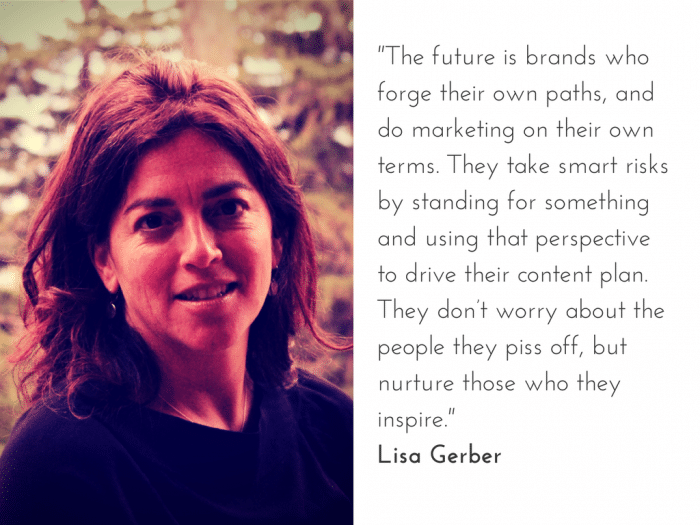
What I hope for the future is brands who forge their own paths, and do marketing on their own terms.

They take smart risks by standing for something and using that perspective to drive their content plan. They don’t worry about the people they piss off, but nurture those who they inspire.

Because when they take take that stance, they come from a place where they are creating from the heart; and it shows. In quality and substance.

Lisa Gerber on the Future of Content

As technology improves, our consumers expect a more personalized experience. Search engines are lagging when it comes to this because we’re still getting results based on who is best at SEO, not what is best for me, as a searcher.

So we’ll start to see better curated content sites – much like public radio programs that work hard to bring out indie musicians; we’ll see curators cherry picking better, deeper, content that doesn’t have the following and backlinks that allow them to compete with those early adopters who have too much track record to be able to compete with.

Content and the Fundamentals

The bottom line is, as always, the fundamentals remain the same. We need to continue to create helpful and relevant content.

Lisa Gerber on the Future of Content (1)

The difference is we’ll have to rely on other channels outside of search engines to get in front of audiences by building relationships with influencers and networks.

Which isn’t much different from present day.

Lisa GerberAbout Lisa Gerber: Lisa Gerber is the founder of Big Leap Creative Inc., an integrated marketing and communications company in Sandpoint, Idaho. Lisa is on the perpetual search to balance happiness with ambition. Read more from Lisa on the Big Leap Creative blog, or connect with her on Twitter @LisaGerber.

image: Emerson

Other posts in this series:

  • The Future of Content Part 1: with Clay Morgan
  • The Future of Content Part 3: with Richard Becker
  • The Future of Content Part 4: The Return to Pure Blogging

The Future of Content Part 1: with Clay Morgan

Content

As content continues to become an ever-important staple for businesses of all shapes and sizes, I thought it’d be interesting to share some thoughts on what the future of content might look like.

However, instead of?sharing just my own thoughts, I wanted to bring you what the future of content looks like for some of the folks I look up to and respect in this space.

Starting today, this series will bring you some of the web’s most critical thinkers when it comes to content – hopefully you’ll enjoy reading as much as I did, and these thoughts will spark ideas of your own on what the future of this thing we call content looks like.

Today’s thoughts come from Clay Morgan, Vice President of Operations at Arment Dietrich.

Content and Standing Out from the Crowd

In one of her recent speeches, Gini Dietrich said there are about 152 million blogs.

That?s just blogs.

It doesn?t include news sites that are generating tons of content or the millions (billions?) of websites that have some type of content on them. That means standing out from the crowd is going to be more and more difficult.

Clay Morgan on the Future of Content

I think there will be increased focus on how the content is presented, and I?m talking beyond design.

  • Is it written, and if so, long form or short form?
  • Is it video or audio?
  • A slideshow?
  • Infographics?

Something I think about is songs. I can?t sing, but children?s television has successfully delivered good content via songs for decades.

Should people look at packaging their content as other forms of art? Photography? Illustration? What about fiction writing? After all, children?s authors have used fiction to teach children for decades.

The point is, whether we see it or not, I think we should really get creative in our approaches when it comes to presenting our content.

Content and Distribution Channels

Right now as I write this, the girls are in Vacation Bible School.

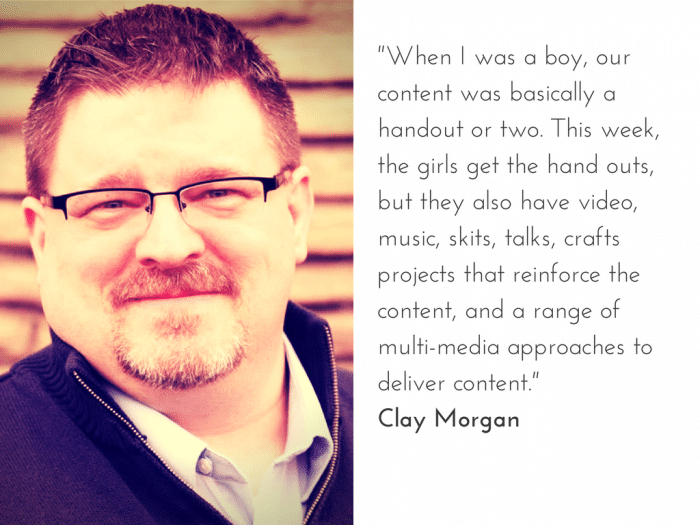
When I was a boy, our content was basically a handout or two. This week, the girls get the hand outs, but they also have video, music, skits, talks, crafts projects that reinforce the content, and a range of multi-media approaches to deliver content.

The content is being delivered in many different ways, and they are ways to which the children respond. Just something to think about.

Clay Morgan on the Future of Content Approach

The second thing I think (or hope) we?ll see is an increased focus and an increased sophistication in terms of distribution. There are large companies telling people that if they create a landing page or a blog, and post x amount of content each week, they will organically gain more sales leads than they know what to deal with.

Funny how ?organically? and ?magically? sound very much alike.

Organic growth is the result of strategy, planning, implementation – in other words hard work. There are no magic bullets and if you want your content to get to the right people, you have to hand it to those people.

I think we will see more people realize they need more sophistication and more strategy when it comes to distribution, if for no other reason there is so much content being developed.

Content and the “Smaller” Blogger

It is going to be critical for small bloggers to think about distribution.

Clay Morgan on the Future of Content Distribution

They will need to be very strategic in the use of SEO, email marketing, RSS feeds, social media, and other tactics in order to break through the domination of content offered by major bloggers and companies with deep resources.

The idea of organic growth through this type of strategic approach always reminds me of my aunt.

She?s quite a successful romance novelist. She works with a major publisher and has a real following. She?s one of the ?hot new stars? in romance fiction and an ?overnight success.? What she tells people is it took her 10 years of hard work before she became an ?overnight success.?

Organic growth always has hard work behind it. Always.

Clay MorganAbout Clay Morgan:?Clay Morgan is the vice president of operations for Arment Dietrich and is based in Nashville.

He believes if you can?t deliver content to the right people, and if you can?t make money off it, content will never be king…or queen.

He?s a husband, foster father, and has two cats and an unexpected fish. You can read more from Clay on Spin Sucks, or connect with him on Twitter and/or Google+.

image: Emerson

Other posts in this series:

  • The Future of Content Part 2: with Lisa Gerber
  • The Future of Content Part 3: with Richard Becker
  • The Future of Content Part 4: The Return to Pure Blogging

Endemic Cultures and Why We Need More Logical Indians

Culture of ignorance

If you keep up with world news, you can’t help but have read (and hopefully been horrified by) the heartbreaking and anger-inducing stories coming out of India with regards the recent rapes and hangings of Indian women.

Last month, news broke (with accompanying graphic images) of two teenage cousins who were gang-raped and then hung from a nearby mango tree. Five men were arrested for the crime – but only after relatives of the girls refused to let their bodies be cut down until police investigated.

Where the crime was exacerbated (if that’s even possible) is that two of the five arrested were police officers, who refused to help the families when they reported the girls as missing.

Even as the horrors of this crime were still fresh in the minds of those in the village of Uttar Pradesh where the rapes and murders happened, two more reports came out of identical crimes involving a woman in her 40’s and a 19-year old girl.

Tragically, these stories are nothing new. The world was outraged in 2012 when a 23-year old woman was gang-raped on a bus for almost an hour, beaten and then thrown to the side of the road to die. She later died of her injuries in hospital.

In 2013, three young sisters – aged only 7, 9 and 11 – were raped and murdered after disappearing from their school. Much like the other rapes, family members speak about the lack of gravity given to the cases by the police, who initially dismissed the deaths as accidental.

These are just the stories that make the news – external sources believe the numbers are in their thousands, if not more, with the perpetuators (and those that should be protecting the women of India) truly believing nothing wrong has been done. At least, not by the men…

Endemic Cultures and the Power of Belief

Much like many ancient cultures, India has a complicated history of women often being seen as second class to their male counterparts.

While the Hindu faith places women on an equal status?(and blames Muslim and western intervention for the change in mindsets),??the crimes committed in Uttar Pradesh and other parts of India highlight how some parts of India view women.

Some of this stems from the Dowry. Originally a transactional gift when the daughter of an Indian family was married, a dowry (or “street dhan”, its original Indian name that was replaced by the European-born dowry) could be cash, real estate or something else that had financial value. This enabled the women to enter the marriage as an equal, and able to support herself.

As the economic structure of India changed, so did the value of the dowry. Instead of giving equality to the bride, the dowry became something the husband used for his own personal gain.

  • If the woman gave birth to children, the husband could demand more money from his wife’s family;
  • If land taxes were raised, the husband could demand more money to pay for those hikes, in order to keep his wife housed.

If the wife’s family could not meet these new financial demands (and many couldn’t), this would often lead to abuse by the husband, leading to countless suicides. If the wife didn’t commit suicide, many husbands “simply” murdered them, often by dousing them in petrol and setting them alight (known as “dowry burnings”).

This culture of male empowerment led to the introduction of the Dowry Prohibition Act in 1961. Sadly, despite amendments to the act, the practices of dowry killings and abuse are still common and widespread throughout India, with more than 8,200 reported in 2012.

The culture of men being superior and having more rights than women isn’t restricted to “honour killings” and abuse such as those inflicted through dowry arrangements. Forced marriages are common even when not in India – the culture and mindset transcends the locale.

When a cultural mindset is so endemic, how can we change it? Can we?

The Logical Indian and the Road Forward

One way is to understand that cultures are not defined by the endemism of some of that culture’s subsets. A perfect example in the case of India and the recent outrages is The Logical Indian.

While the recent atrocities committed in Uttar Pradesh and elsewhere highlight much of what is wrong with a culture that holds women and female children in such disregard, The Logical Indian shows that this is not a universally-held mindset.

Their Facebook page is an educational (and eye-opening) resource for stories that may otherwise be missed by the mass media. These are strengthened by powerful images that stop you in your tracks – like this one about labeling women.

Women labels

Or this one, that highlights exactly why the battle to change mindsets and cultural upbringing is such a long one. After all, when your elected leaders and officials think there’s nothing wrong, what hope is there for the common voice to be heard?

Indian leaders rape beliefs

This is why The Logical Indian is so important. If you visit their Facebook page, you’ll see that it’s not only the page owner(s) that are pushing thinking beyond that which is widely accepted today.

Commenters, too, are sharing outrage, and frustration, and anger, as well as their own stories. Take a look at the comments from the image above, many of which come from men appalled and disgusted by not only the views of the politicians, but those of their “fellow men”.

The Logical Indian tackles many issues that, often, are left unreported or – worse – viewed as the acceptable dangers of making a profit. Like the 25 children, aged between 6 and 13-years old, that were rescued from dangerous working conditions in a residential building.

Kids India rescue

What’s equally empowering about this story, in addition to the highlighting of the rescue and the bigger story of economics and profits behind it, are the words that The Logical Indian posted beside the picture.

This is something which one can emulate all over the country where a vigilant citizen, a group of dedicated volunteers, administration and the government together rescue 25 children from a hazardous factory.?Our dream of freeing India from the clutches of social evils can be fast tracked when we take up responsibilities into our own hands.

It’s this belief that we still can change and – more importantly, have the power to make that change – that gives hope that this can happen not only in one culture, but others that are becoming “the norm”.

Culture is Not Defined by Religion

I’m wary, for want of a better word, of concentrating on the example of India and the stories and atrocities shared in this article. India is a beautiful, historical country with much to admire.

My goal with writing this is not to demonize a country, or faith, or culture, but hopefully encourage conversation around endemic mindsets and how we can change. This is equally true of other “cultures” that are becoming more pervasive and common-place around the world.

Take gun culture, for example. Using Tumblr to answer questions from young Americans about the seemingly-daily news of yet another shooting in everyday America, President Obama shared his shame and fear of what his country has become. From that address,

No developed nation on earth would put up with mass shootings that happen now once a week and disappear from the news within a day ? no nation except America.

When asked about the recent tragedy near the campus of the University of California, and the painful ?image of the father of one of the victims talking about his son’s death, Obama stated,

As a father myself I just ? I couldn’t understand the pain he must be going through and just the primal scream that he gave out. Why? Why aren’t we doing something about this?

Why indeed.

The growing fears around rapes at universities and campuses also highlights why endemic thinking offers excuses for the guilty and little protection and comfort for the victims.

High profile stories about Stanford and Cornell?(and the inaction and lack of severity initially afforded to the cases by officials) are cited as being just the tip of the iceberg for young women attending college or University in America.

Rape culture

When TIME Magazine published a piece suggesting “rape culture is hysteria”, it was quickly countered (also in TIME) by political analyst and speaker Zerlina Maxwell.

In her piece, Maxwell shares examples from a Twitter hashtag she created, #RapeCultureIsWhen, that offer powerful rebuttals to the earlier TIME piece.

  • Rape culture is when women who come forward are questioned about what they were wearing.
  • Rape culture is when survivors who come forward are asked, ?Were you drinking??
  • Rape culture is when people say, ?she was asking for it.?
  • Rape culture is when we teach women how to not get raped, instead of?teaching men not to rape.

It’s not just America, either. Canada – that friendliest of countries – is also finding itself in the kind of spotlight no-one should ever want to be in, including?a high profile case surrounding the University of Ottawa hockey team.

Rape culture a result of media hysteria? Clearly…

Where Do We Go From Here?

As I mentioned in the previous section, my goal in writing this particular post isn’t to demonize a culture, at least not from a religious point of view. Nor do I want to suggest that the actions shared in this piece are systematic across the various cultures and countries.

But there’s clearly a cultural problem when actions that would normally create instant outrage are in danger of being shrugged aside as “just another day or example of what’s gone before”.

I’m not a politician. I’m not smart enough to be a cultural analyst or behavioural scientist. I don’t profess to know what the answers are to the various topics discussed in the words on this page.

But, much like folks behind The Logical Indian, I am a human being that wonders just where we’re taking our planet and those souls that inhabit it. Have we truly set ourselves on a path that’s too late to recover from? Have our mindsets – and, by association, culture – already been irrevocably damaged beyond repair?

Or can we still effect change?

The Logical Indian thinks we can. So do amazing people like Debbi Morello, Amy Vernon and?Amanda Quraishi, who highlight the news that we’d otherwise miss and work tirelessly to educate and share the bigger stories and pictures.

What about you? Where do we go from here? How do we truly effect change? Can we?

The comments are yours – let’s have an honest discussion.

image: Alain Bachellier

  • « Go to Previous Page
  • Page 1
  • Interim pages omitted …
  • Page 20
  • Page 21
  • Page 22
  • Page 23
  • Page 24
  • Interim pages omitted …
  • Page 174
  • Go to Next Page »
© 2026 Danny Brown - Made with ♥ on Genesis