• Skip to primary navigation
  • Skip to main content
Danny Brown

Danny Brown

podcaster - author - creator

  • About
  • Podcasts
  • Journal

Insights

Changing Lives Can Be As Easy As A… B… Tweet

Recently I wrote a blog post against poverty for Blog Action Day 2008. At the time I wrote that I would be continuing to raise the issue of poverty via social media in whatever ways I could. The wonderful people at One Home Many Hopes have given me the perfect opportunity.

Founded by Boston newspaper columnist Thomas Keown, One Home Many Hopes – OHMH – is a non-profit organization that offers orphaned former street girls in Mtwapa, Kenya a safe environment to try and reclaim their childhood. Simple things we take for granted like education and family support are sorely missing from these girls’ lives – OHMH offers them a lifeline to enjoy these things.

One of the many challenges facing OHMH is funding, like any non-profit organization. However, thanks to Twitter users Vanessa Leong and Shelley Greenberg, as well as Boston-based social media blogger Graddon Tripp, OHMH could be $20,000 better off within 30 days. Together they have come up with the following challenge.

Dubbed Race to 20k, OHMH is hoping to raise the afore-mentioned $20,000 in 30 days. And with social media, that should be pretty easy. Think about it – if just 1,000 Twitter users pledged $20, the figure would be met in no time at all. Even just donating $10 would only take 2,000 Twitter users. With the popularity of this medium, $20,000 has to be a realistic target.

If you want to make a difference, here’s what to do. Visit the OHMH donation page and pledge your $20. Then send out a Tweet to your Twitter friends, or write a blog post about the event – with the widespread scale of social media, making people aware of this great cause should be pretty easy. Become friends with both Vanessa and Shelley on Twitter to keep updated.

It only takes a minute to make a difference – but that small difference can last a lifetime.
If you enjoyed this post, please consider leaving a comment and subscribe to my RSS feed or via email to ensure you can enjoy the latest post(s).

So What, I’m Still a Rock Star

I got my rock moves, and I don’t need you… Yes, I’ve fallen victim to quite possibly the catchiest pop song this year, Pink’s “So What”. Laugh away, but at least it’s not the Jonas Brothers, right?

However, apart from being one of the best party songs of the year, Pink’s song could also be looked at as a poster child for surviving today’s economic mire. After all, in a year when corporate America finally screwed over everyone to bursting point, a song about taking the hits and coming out fighting is strangely karmic.

Yet perhaps there’s more to this than my questionable connection between Pink and greedy suits? For years the music industry has shown how to take an extremely competitive business model and stay relevant. While it’s true that the labels are suffering just like every other business at the moment, again that’s down to greed – charging exorbitant prices for CD’s, tour tickets, etc.

No, when I mention the music industry being successful, I mean the artists in it – specifically the ones that have adapted and changed to suit current trends. Look at the most successful artists of the last 40 years – the Beatles, the Stones, Madonna, David Bowie. They all continued having hits in different decades because they moved with the times and searched out new audiences.

This is where businesses need to do the same thing. There is so much doom and gloom being spouted by so many negative business owners – but this needn’t be the case. Yes, the Government and the city slickers royally screwed everyone – but is there anything new there?

Instead of complaining about the why’s, perhaps we should be looking at the what’s – what can we do, what changes can we make, what technologies do I need to adapt to in order to continue my business? Ed Lee of Internet communications consultancy iStudio wrote a great blog post about this very topic, and offered suggestions on the three areas that businesses should be looking at to be more “recession proofed” (one of which is social media, unsurprisingly).

It’s a theory I’ve subscribed to for all of my professional life. Before I started my own business I worked under some static bosses in this respect – sadly many of these businesses are no longer around, although unfortunately I can’t say I’m surprised.

The business world has been changing for a long time – the Internet and the explosion of online trading has seen to that. Although we’re looking down the barrel of a very scary economic gun, it doesn’t mean we have to be held hostage. The businesses that realize this and adapt will be the ones that survive.

For the rest? They’ll be the equivalent of Pink’s ex in her song – hung out to dry while everyone else moves on.

If you enjoyed this post, please consider leaving a comment and subscribe to my RSS feed or via email to ensure you can enjoy the latest post(s).

Using Social Media to Inspire

There are many different ways that social media can be used. For some people, it’s simply a way of connecting with others. For other people, it’s an effective business tool. On top of that, it can also be a great educational tool for newcomers to the Internet. Personally, I also feel that social media can be used to inspire greatness and knowledge.

A prime example of this was Blog Action Day earlier this month, when thousands of bloggers worldwide wrote about poverty. Not only did this show a combined voice on the desperation of poverty itself, it also proved how social media – when used cohesively – can open up a line of discussion on topics that are so often ignored or swept under the carpet.

Also this month, it’s been National Breast Cancer Awareness Month. While millions of people offline have been wearing pink ribbons to signify support, social media users have been showing support in their own ways. Twitter users have turned their profile pictures pink, while MySpace members have pink ribbon themes to offer their support.

Next month sees the annual Movember charity event, which highlights the importance of men’s health and getting regular check-ups. Of particular importance is looking for early signs, and prevention, of prostate cancer.

To support the event, men everywhere are being encouraged to grow moustaches – hence the name Movember (moustaches in November). I’m already getting my Twitter profile picture readied for the month, as are countless other men and women worldwide.

This is where social media is so inspiring to me.

Just making the small effort to change a Twitter profile pic (or any online profile), encouraging people to ask what it’s about, which in turn gets them involved. Strangers blogging about the same topic, offering a unified voice often more powerful than any newspaper or traditional media source.

Social media often gets cynical looks from people who don’t understand it, or who see it as a passing fad that will soon be replaced with the next big thing. While that may indeed happen, until then it offers a unique way for millions of voices to be heard and make a stand. Surely that’s something to applaud?

Harness the Power of Stumbleupon with a Social Media Group

One of the social media tools growing in popularity and use is Stumbleupon. A simple yet effective application, Stumbleupon allows users to find random sites on the Internet either by recommendation from other Stumblers, or by happening across it by accident – all with the click of the Stumble button on your web browser.

It’s also one the most effective tools for web traffic in social media – yet Stumbleupon is still being underused by many, despite having the power to increase your web traffic by several hundred per cent. However, there are ways to make sure you’re utilizing all that Stumbleupon has to offer.

Start a Social Media Group for Stumblers

I can’t take credit for this idea – it was suggested by an online friend of mine and I was invited to participate. Yet the idea is so simple I’m surprised no-one else has picked up on it yet. Simply, gather a group of friends and create a social media group (not to be confused with the excellent social media clubs you can find online).

By gathering a number of online friends that use Stumbleupon as a social media tool and emailing each other a couple of blog posts or links each week to Stumble and recommend, you’re instantly getting new traffic to your recommended link. It also means you’re reaching new Stumblers through your friends, who can help you grow both your Stumbleupon and social media network.

To make sure it works to its maximum, keep the email requests to just a couple a week, and have your social media group at no more than 50 members. That means you only have to Stumble a maximum of 100 recommendations per week (including your own) which takes no time at all.

Use a Stumbleupon Widget

Although all blogs should really have some form of Share This or Add This widget at the bottom of each post – which allows readers to recommend the post to their friends – not all of them do. This is missing out on a great opportunity for your blog to reach a far wider audience – the Share This button allows the post to be shared on Digg, Technorati, Facebook and much more.

However, if you simply don’t like having too much clutter on your blog post, at least have the option to Stumble the post. This will see it being recommended to that reader’s Stumbleupon subscribers, which again will see you enjoy an immediate traffic spike.

(As an example, whenever one of my posts is Stumbled, I usually receive anywhere between a couple of hundred to over a thousand new reads. The more popular blogs receive several thousand new hits, so you can see the potential for business marketing as well).

The great thing about Stumbleupon is that once your blog has been stumbled the once, it offers a passive traffic flow for as long as your blog or post is live. Any time someone online hits their Stumble button, they could be taken to your original post. That’s just as good as any Pay-per-Click or AdWords campaign that I can think off – best of all, it’s free.

If you’re truly interested in all social media offers, Stumbleupon is one of the tools that you really should have a look at. Its potential for business is also only just beginning to be realized – be there when it happens.

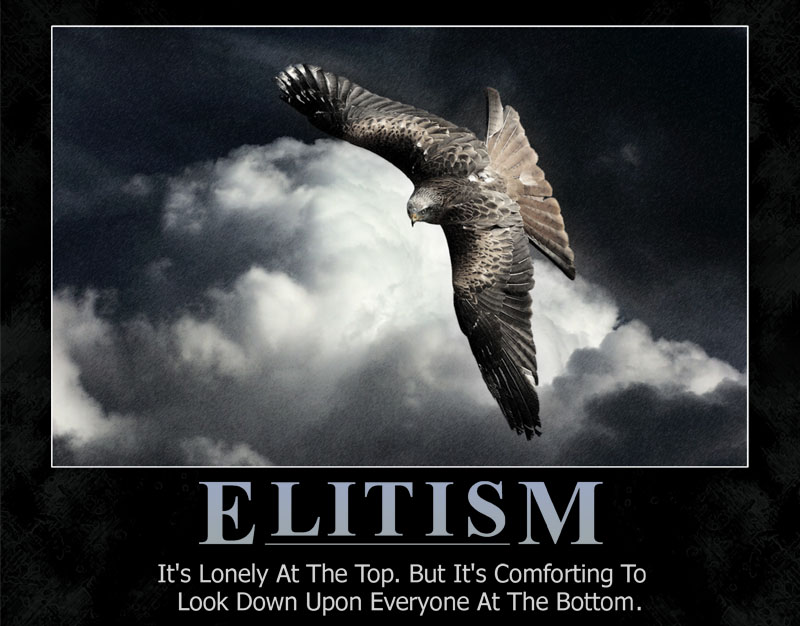
The Growing Elitism of Social Media

Recently I questioned whether we were turning into social media snobs. This wasn’t an attack on social media per se – more a valid look at whether certain people in the social media arena were beginning to try and wield a little too much (and possibly unwanted) influence over the medium.

However, perhaps even more disappointing than snobbery is the elitism that seems to be creeping into social media as well. While they may share certain characteristics, they are two different beasts.

Instead of the “do as I do” approach I discussed in my snobbery post, there’s a growing trend of “I want to feel more important than you” elitism that’s becoming more apparent.

A good example is the Twitter phenomenon. At its heart, it’s an excellent tool to not only make new friends and potential business contacts – it’s also a great way to see a microscopic snapshot of someone’s life in nibble-sized chunks. The fact that Twitter only allows you 140 characters to say your piece means you have to use that space wisely. This can lead to some very inventive and humorous comments.

Yet lately Twitter has become nothing more than a virtual brothel for people to either whore themselves out or to come across as a “look at me, I’m great” type of person. As a fan of social media and all it can offer, I find that sad and a little disappointing.

I’ll be the first to admit that I’ll notify my fellow Twitter users/followers of a new blog post – but then, that’s fairly standard for pretty much everyone on Twitter.

Where the application is losing its appeal (for me) is the amount of people that shout out about how many followers they have, or how many more they need to reach 500, or 1,000, or something similar. When did Twitter become a popularity contest? Isn’t that what MySpace is for (and one of the reasons Facebook is starting to take over from the Fox-backed networking site as the most popular)?

Maybe it’s just me, but I can see from your Twitter profile how many followers you have, or how many people you are following. That doesn’t interest me – and judging by the reaction of some of my friends who have stopped following certain Twitter accounts, it doesn’t impress them either.

Instead, tell people about excellent sites or blogs they should be checking out. Tell them about tools they can use to make them more effective in either their online brand building or improving their social media awareness.

Constantly mentioning you have so many followers often emits an air of superiority that no-one really enjoys and can lead to them unsubscribing from your updates. Which kind of goes against all that social media stands for, no?

  • « Go to Previous Page
  • Page 1
  • Interim pages omitted …
  • Page 168
  • Page 169
  • Page 170
  • Page 171
  • Page 172
  • Interim pages omitted …
  • Page 174
  • Go to Next Page »
© 2026 Danny Brown - Made with ♥ on Genesis