• Skip to primary navigation
  • Skip to main content
Danny Brown

Danny Brown

podcaster - author - creator

  • About
  • Podcasts
  • Journal

Insights

Mashable Open Web Awards 2008 Finalists Announced – Last Round of Voting Begins

The Mashable Open Web Awards 2008 have reached that all-important time: the finalists have just been announced for this year?s last round of voting. After thousands of nominations and voting, it boils down to three finalists in each category.

The full list of the finalists in each category can be viewed now at the Mashable Open Web Awards website. Voting ends 11:59 EST on Sunday, December 14th. Your votes can also be cast via the voting form below.

Congratulations to the finalists and good luck in the voting rounds.

Reblog this post [with Zemanta]

The REAL Social Media ROI – Risk of Ignoring

It seems everyone’s been talking lately about the Return on Investment – ROI – of social media. On the one hand, we have businesses trying to see where they’ll make a profit; on the other we have social media proponents explaining you shouldn’t try to measure social media ROI the same way you would in normal business practices.
But maybe we’re looking at the wrong ROI to start with – instead of return on investment, perhaps we should be more worried about the Risk of Ignoring.

This can work on both levels, personal and business-led, but for the sake of this post, I’m going to stay with businesses.

(If only from the viewpoint that it seems to be businesses more than individuals that are using social media less effectively).

Say the CEO of Company X brings in his sales or marketing director to the boardroom, and tells them he’s heard wonderful things about this “social media craze”. He’s heard that millions of people are using it, and he wants his company to have a bite of the money that these millions of social media users have, just waiting to be spent.

So the sales or marketing director decides to have a look at social media. Perhaps he’s even on Facebook, so he knows what social media is all about. He’s told his CEO not to worry, Company X will soon be rolling in extra cash from all the wonderful sales to be made through social media marketing.

So the director sets up a Twitter account – after all, just look at the conversation going on there. That’s a surefire sales arena if ever there was one! He starts following people left, right and centre and pretty soon he has a sizable following back. Time to start selling Company X to the masses, thinks the director, and starts sending out Tweets and direct messages about how great Company X is and why people should buy from them NOW.

The director has carried out the legwork and now has his message in front of hundreds, if not thousands, of people. Time to sit back and wait for that Holy Grail of ROI to start. Which it will – just not the one that was expected.

This is where the Risk of Ignoring plays its hand.

By ignoring the simple fact that social media is about conversation, the director has completely missed the point. Instead of building up a loyal and quality-led following, all he’s done is build the equivalent of a non-optional email list for a sales pitch.

Now he’s wondering why so many people are un-following him on Twitter. He’s also wondering why no-one has rushed to Company X’s website and bought anything from their online store. Most of all, he’s wondering what he’s going to tell the CEO at the next progress report meeting.

I see this happening all too often with businesses. While originally there may be good intentions for using social media, trying to use traditional sales or marketing tactics will usually backfire. Whereas CEO’s and sales or marketing directors may be used to success with the heavy-handed “shout at everyone” approach, it’s just not going to work when it comes to social media.

You want your business to enjoy success with social media users? Be social with us. Get to know us, and what interests us, and in return I can pretty much guarantee you’ll have the interest you want in you and your product. Because we are actually interested in what you have to say.

Just don’t ignore us.

Have You Been Tweetbombed on Twitter Yet?

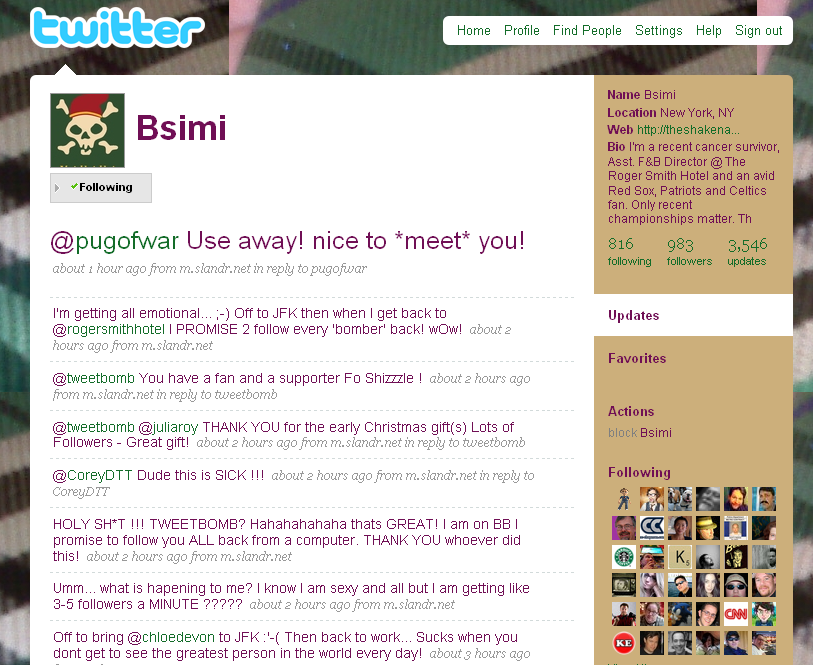
For an off-the-wall way to use Twitter, new craze Tweetbombing may just take the award for the most fun. Like the best crazes, Tweetbombing keeps it simple and open to everyone and so far the formula is working, with the Twitter profile for Tweetbomb already enjoying over 1,000 followers.

So what is Tweetbomb and why is it so much fun?

At its simplest, Tweetbomb is nothing more than a harmless way for Twitter users to play a game almost junior school-like in its approach. Twitter users follow Tweetbomb, and at exactly 3.33pm Eastern time (EST), a message is sent out to all followers with the name of the Twitter user to be Tweetbombed that day.

Everyone then sends out a blank Tweet – the Tweetbomb in question – to that user. No message, no hello, nothing – simply a blank Tweet and that’s it. Live results of how many Tweets are sent are provided via the Twitter search tool, while the user in question has no idea what’s going on until informed later.

As a way of encouraging new connections, Tweetbomb delivers (Tweetbombers often befriend the person that’s just been targeted). As a fun way and harmless way to use Twitter, Tweetbomb also delivers.

And isn’t having fun and meeting new people what makes Twitter so popular in the first place?

  • UPDATE 30 NOVEMBER 2008: The Tweetbomb account has been suspended by Twitter pending investigation into misuse. While the idea behind Tweetbomb seems to be innocent fun, as Lucretia Pruitt points out in the comments it could perhaps be costly for someone receiving cell phone updates from Twitter. Until a way of voluntary and non-cost Tweetbombing is found, perhaps it needs to go back to the drawing board?

Why The Black Friday Madness Has To Stop

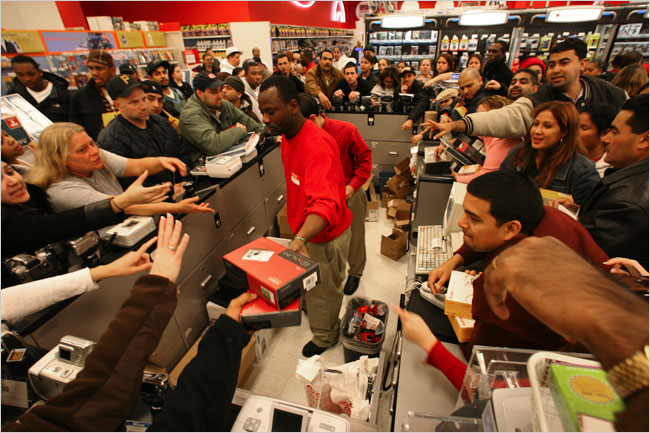
I’ve never been a fan of one day rush sales like the Black Friday ones. Having been in retail many years ago, sales time was always a hectic and stressful time.

For those working the shop floor, it meant a long day of shoving and pushing and often bruised bodies at the end of the shift. The stories making the news from this year’s Black Friday are testament to why this craziness needs to stop.

What sales push could possibly be worth the death of a shopworker and the miscarriage of a woman’s baby? What does it say about both humanity and the greed of retailers?

The defining message in social media is that of sharing and helping others to better themselves. How many of the people that continued to barge by the dying shopworker are Twitter users, or Facebook members? Does the message of sharing and making ourselves better stop at social media? Doesn’t it have a place in the real world?

Many people have said that Barack Obama is “the social media President”. Not only did he use the medium to great effect during his campaign, he also offers a parallel to social media through his “Vote for Change” policies. Empower everyone, make the world around us a better place through caring and sharing.

If this is the case, he needs to make one of his promises more widespread. Instead of just focusing on corporate greed, he needs to look at why retailers hold back on prices until sales days like Black Fridays. If retailers can afford to offload so much stock at crazy prices one day a year, there’s nothing to stop them having these prices throughout the year.

I know it’s a tough market – as a business owner myself, I know profit is becoming even tighter as the economic bite kicks in.

But is any profit worth the death and injury we saw yesterday? People scramble for Black Friday sales because the retailers (and, to a degree, the manufacturers) fix prices throughout the year and offer less reasons to buy. Shoppers therefore wait until sales time, whether it’s Black Friday, Boxing Day or other sales periods.

We need to stop this process now, before anyone else gets hurt. Is that too much to ask?

Drop The Retainer If You Want to Retain

View of Wall Street, Manhattan.
Image via Wikipedia

The day of the large retainer fee is over. Upfront and ongoing fees charged by PR, advertising and marketing agencies used to be the normal way to conduct business, but this is no longer the case. Truth be told, it hasn’t been the case for a while and more agencies need to realize this.

The massive stock crash and financial mire the economy finds itself in has affected everyone, from huge corporations to micro-businesses and everyone in-between. This has resulted in many companies either reigning in their agency spend or cutting ties altogether. The main reason for this has been the exorbitant retainer fees charged by many.

Smart agencies stopped this practice a long time ago, and changed over to value-based pricing. Instead of expensive monthly retainers and high hourly rates, value-based pricing charges on delivered results. This could be number of new customers, amount of new revenue, amount of press received, etc.

The benefit to the client is obvious – they aren’t shelling out for a monthly cost that may return very little. They also know that their agency is working properly for them – no results, no huge project fee regardless of success.

Many agencies decry value-based pricing, saying that it isn’t manageable and there are too many variants to take into account. I disagree – this is where getting to know your client comes in. You know, the role you’re being paid for?

As more businesses realize that high-cost retainers are becoming a thing of the past, the more they’ll look for agencies offering value-based alternatives. Will your agency be one?

  • « Go to Previous Page
  • Page 1
  • Interim pages omitted …
  • Page 160
  • Page 161
  • Page 162
  • Page 163
  • Page 164
  • Interim pages omitted …
  • Page 174
  • Go to Next Page »
© 2026 Danny Brown - Made with ♥ on Genesis