• Skip to primary navigation
  • Skip to main content
Danny Brown

Danny Brown

podcaster - author - creator

  • About
  • Podcasts
  • Journal

Insights

The 12 for 12,000 Challenge in 2009

for a good cause
Image by krystynana via Flickr

I’ve been thinking a lot lately about the world around me, around us. When the economy is so bad and much of the future is uncertain, it’s easy to forget that as bad as we have it, there will always be someone worse off. Illness; poverty; hunger; abuse; these and more happen every day to people breathing the same air as us. Which is why I’m setting up the 12 for 12,000 Challenge in 2009.

There have been many examples of how social media can help charitable causes, and I’m hoping that that same power can make a difference in so many lives. The best part – it will take very little effort from you.

You’ll notice that I’ve called this the 12 for 12,000 Challenge in 2009, and with good reason. They’re easy numbers to remember, and with a little bit of luck and goodwill they’ll also be the numbers we meet in this challenge. So, how does it work?

  • In 2009, I will offer 12 different charities to support, one for each month of the year.
  • Everyone that signs up for the challenge donates $10 to the chosen charity.
  • Our aim: to involve 1200 people minimum (if there are more, even better).
  • If we reach our target number of 1200 people, and we each donate $10, that’s a figure of $12,000 to every single charity each month in 2009. You can imagine the difference this will make to these charities and the people they help.

The beauty of this challenge is that the decision is entirely down to you and how you participate. If you feel that a particular charity doesn’t fit you, simple – don’t donate that month. (If you wish to donate double to a preferred featured charity, that’s entirely up to you again).

I know that looking at the figures, it’s a high amount to aim for – raising $144,000 in the space of 12 months for 12 different charities. But is it really that difficult if we put social media to its most effective use? I think it’s doable.

For instance, if all the people or brands that followed me on Twitter donated $10 each month, that would be over $16,000 every month and almost $200,000 by the end of the year. That’s just one person. Imagine if we could encourage our followers to join us, as well as ask the help of some of the big guys on Twitter that have several thousand followers? Just one or two extra people each could make all the difference.

I’m currently in talks with various charities to arrange promotion as well as direct sponsorship and donation options. You can view some of the charities that might be chosen here. There’s still some groundwork to be done but I wanted to start the ball rolling now and see who’s interested in supporting this challenge.

If you’re interested, or you wish to suggest a charity, please feel free to leave your details in the comments section, or simply email me and put “Charity Project” in the header. I want to make this work, and I feel that if we have a collection of charities that everyone feels affinity to, we’ll raise even more money.

It’s a tough world, and it often gets a bad reputation as an uncaring one. Help me make it better. It won’t take much, but it will mean a lot. Are you with me?

  • Update. You can now join the 12 for 12,000 Challenge Facebook Group. Look forward to seeing you there. Additionally, if you are on Twitter, we will be using #12for12k to identify specific Challenge messages. Thanks guys!
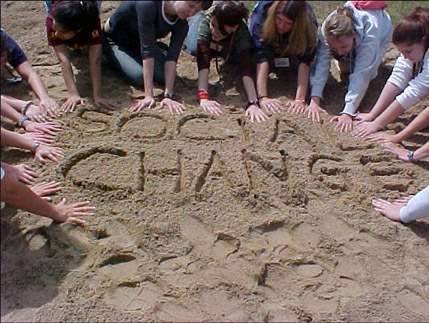

Using Social Media for Change

Description unavailable
Image by danish. via Flickr

Talk about social media and many people automatically think of its business uses. While it’s as good a tool for individuals as it is for business, most social media talk at the moment is how it can benefit businesses. I’m as guilty as the next person for this, as it’s an area I always recommend clients both new and existing take a serious look at.

Yet there’s another area of social media that’s often overlooked, even though it’s quite possibly the most important use of all – using social media for social change.

There’s no end of advice around the web on how to use social media for business change, yet try and find information on how it’s being used for society and the results are less impressive.

Thankfully, there are some great organizations and influential blogs that are using social media to encourage change worldwide.

Social Media for Social Change, for example, is the brainchild of Michelle Riggen-Ransom, co-founder and Communications Director of BatchBlue Software. Michelle and guest writer T.J. Sondermann use the blog to show how technology can change the world for the better. Topics include Education, Non-Profit and Family Action Plans. There’s some great information on there and is well worth your time.

Change.org is also making headway since its inception in 2005. Its core message is about effecting change both social and environmental. Excellent use of their blog and interaction with their readers and visitors, as well as various projects using social media outlets, has seen Change.org become a leading light in social change.

One company that I have a lot of time for is Kiva, whose aim is to eradicate poverty through micro-lending. Individuals or groups can offer micro-loans to entrepreneurs in developing countries, offering a more viable way to escape poverty than charity handouts that may never get past the ruling Government. Kiva uses the Internet and social networking to great effect and is making a difference to those that really need it.

With these companies and the likes of Max Gladwell, Pop! Tech and more, social media is maturing into a medium that is much more than a business marketing tool. If we really want to encourage the “social” part of social media, then these sites and others like them are leading the way.

How will you make change?

Starbucks – A Lesson in Social Media Branding

Venti Mocha!Ask anyone what one of the biggest stumbling blocks for businesses and social media is and the over-riding answer will probably be understanding. Or lack of it.
With so many businesses questioning why they would enter a medium that doesn’t offer the same kind of return on investment (ROI) than traditional marketing, why bother?

One look at Starbucks could offer some answers. The Seattle-based coffee giant has embraced social media with some great initiatives that any business could learn from.

For instance, while other brands are deciding whether micro-blogging site Twitter is for them, Starbucks has tackled it head on. Better still, they’re actually engaging their customers into the bargain. Instead of simply using Twitter as a broadcasting tool, Starbucks is actively conversing with its 17,000 followers (although weekends seem strangely quiet).

By helping people buy Starbucks-related products to sharing information on various charity projects the company is involved in, the Starbucks Twitter account is the perfect example of great brand usage.

On top of that, Starbucks has also set up an interesting project over at My Starbucks Idea. Here customers of the company are invited to share their ideas on how Starbucks can improve. An open forum approach sees users post their ideas and other members vote for the best. These are then looked at by Starbucks for viability.

As an idea in improving a company through the people that matter – the customers – it’s brilliant common sense. As an example of interactive social media at work, it’s perfect.

Perhaps it shouldn’t be surprising that Starbucks is embracing social media as well as it is. After all, the company has long been an advocate of social responsibility with their eco-friendly projects. With My Starbucks Idea and their Twitter account, they’re merely transferring their offline ethos into the social media world. And a fine job they’re doing too.

How does your brand compare?

Creative Commons License photo credit:?betsyjean79

It’s Nice To Be Nice

The world can be a tough place to live in at times. We try our hardest to make it work, but things don’t always work out to plan. It’s a fast-paced environment where people get left behind or ignored, or simply forgotten about. If you don’t fit into a stereotype, you’re not one of the “in-crowd”.

(And you thought that stopped at high school.)

But you know, as fast as the world is and as unfair as it can be, we can still make it better in our own little ways. Nothing mind-breaking; nothing rocket science in nature. For example, this morning on Twitter I suggested this:

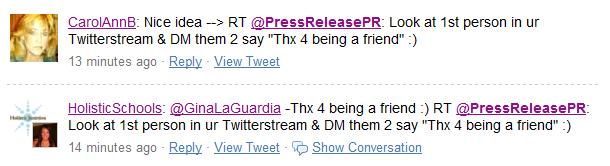
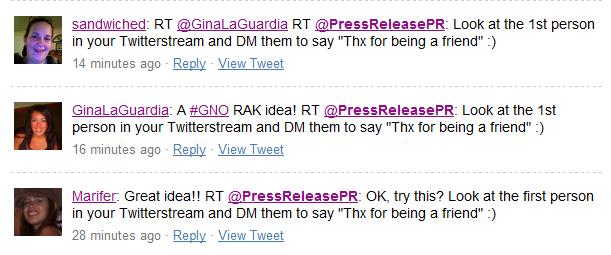
“Look at the first person in your Twitter stream and Direct Message them to say thank you for being a friend.”

Simple, easy and maybe just offering a little fun into our lives and the people around us. What was really nice to see was that people picked up on it.

If we can pick up on something as simple as this with people we may never have met physically, shouldn’t it be just as easy to do so with those we know? So let’s try it.

Look at the last “proper” email you received, reply to that person and say, “Thank you for being a friend.”

Look at the first name in your phonebook and call them to say, “Thank you for being a friend.”

Look at the first person on your Facebook friend list and say, “Thank you for being a friend.”

It’s easy to do. It doesn’t take much. Yet in a world that does its best to put us down at times, it can brighten up a whole day. And just so you know?

Thank YOU for being a friend.

Taking the Social Out of Social Media

I’m one of social media’s biggest fans. The byline of this blog says “social media PR”. I probably have more accounts on social media sites than I need, although I am weeding out the non-essential ones. I like reading social media blogs (amongst many other niches).

So, I’ll raise my hands and say yes, I’m guilty of being a big proponent of social media.

One thing I would hope I don’t do is evangelize about it to the point of boredom and “Who cares?” responses. I know it’s not for everyone, or every business. I feel it could be, but if it’s not to be, it’s not to be.

The reason I like social media so much is because it offers a realistic alternative to the “me, me, me” mentality that is so prevalent in the world around us.

Instead, it encourages discussion, openness and a willingness to listen and engage in discussion. What it doesn’t (shouldn’t?) do is encourage forced views, hostility and closed mindsets.

Which is why, today, I was stunned to be called a “racist” and someone with “aggressions” towards China and her people when I was trying to get across various points on social media, and Twitter in particular.

The conversation that this accusation comes from can be found in the comments thread in this post from Social Media Today. While I encourage you to read the full text to ensure that I don’t offer a simplified and biased view of the exchange, the basic gist of it is as follows.

Social Media Today member Jerry Bowles wrote a piece that inferred 99% of Twitter conversation was “self-serving drivel”. I questioned this, and it seemed that a good discussion about Twitter’s value was about to start. Another member, Larry Choi, proposed that Twitter’s numbers were no more than small potatoes, and that the service isn’t used in China.

I suggested to Larry that perhaps the reason Twitter hadn’t taken off in China was because of the well-documented problem with the Chinese government and their Internet censorship policy. If websites were being closed down and monitored for any anti-government beliefs, then it would be very hard to monitor a medium as instant and as interactive as Twitter.

My response to Larry is what caused the accusation that I’m a racist with aggressions towards Chinese people and the country as a whole.

Cameron Soong replied to my suggestion with the following: “Danny Brown seems to have a racist problem vis a vis the Chinese people. A pity. His aggressions could be more useful to the stakeholders in Twitter.?And leave China to the Chinese, please.”

Now I’ll admit to being many things (and having been called them a few times as well!) but one thing I am not and never have been is racist. Anyone that knows me personally will know that I am one of the least racist people you could meet.

(And my sincere thanks to Jason Tryfon for his support with his comment).

I’m not sure why Cameron thought this way – further in the comments I ask Cameron why, but as of writing there’s been no response. And again, I recommend you read the post and comments in question so it’s not just my version of “the story” that you’re reading.

The whole episode left me disappointed. Apart from the unwarranted accusations that Cameron made against me, it also made me question how we can try and increase awareness and respect for social media, when even members of a social media website can be so negative and vitriolic.

It seems ironic that in a discussion about social media tools, Cameron effectively went into broadcast mode and ignored the conversation – everything that social media is not. Is it any wonder that social media continues to be looked at as a novelty rather than a genuine personal and business tool when those inside it are practising the opposite of what it’s trying to be?

Perhaps Cameron can answer that.

In the meantime, Jerry’s point about Twitter is a valid one that certainly makes for a good discussion, and it’s that type of conversation that makes social media the medium that I support so much.

If you enjoyed this post, please consider leaving a comment and subscribe to my RSS feed or via email to ensure you can enjoy the latest post(s).

Reblog this post [with Zemanta]
  • « Go to Previous Page
  • Page 1
  • Interim pages omitted …
  • Page 159
  • Page 160
  • Page 161
  • Page 162
  • Page 163
  • Interim pages omitted …
  • Page 174
  • Go to Next Page »
© 2026 Danny Brown - Made with ♥ on Genesis