• Skip to primary navigation
  • Skip to main content
Danny Brown

Danny Brown

podcaster - author - creator

  • About
  • Podcasts
  • Journal

Insights

Gosh

One of the people I connect with online, and whose blog I read regularly, is communications whiz Arik Hanson. Arik has a very savvy mind on him and has actually guest posted here before.

A couple of weeks ago, Arik opened up the first Annual PR Readers Choice Awards for blogs.

After the initial nomination round, I’m more than happy (and pleasantly surprised) to say that yours truly is in the running for the Most Thought Provoking Blog. As the title of this post says – “Gosh!”.

If you want to vote for me, or check out the great blogs that have made the final checklist, head on over to the awards voting page or click the badge in the sidebar or at the top of this post. Voting closes at midnight on Wednesday June 3 2009.

Sincere thanks to Arik for looking out for bloggers and putting this together, and everyone that thought this blog was worth talking about to begin with. And good luck and well done to all the nominations – you guys are leading the way in so many areas.

Cheers!

Is #Journchat Losing Its Fizz?

Just Full Of IdeasBack in November last year, #Journchat was launched by PR maven Sarah Evans.

Its aim was simple – use Twitter to bring journalists, PR professionals and bloggers together on Twitter in a weekly chat format.

Since then, #Journchat has gone from strength to strength and brought in special guests from CNN as well as regularly topped the Twitter trends every Monday night.

Lately, however, it seems to have lost its way and some of its sparkle. That’s not to say that #Journchat doesn’t offer any value – it does, and an incredible amount at that. And it’s done a great job of bringing together industries that otherwise tend to just criticize each other.

But maybe #Journchat is a victim of its own success?

Too Much, Too Little?

The way that #Journchat works is simple, yet it can also be frustrating. Because it uses Twitter as the chat medium, each question and answer needs to be within the 140 character limit of Twitter.

This is good for keeping answers short and punchy, but it’s also frustrating when an answer needs so much more and you have to go to multiple messages. By the time a longer answer is out, often it’s the next question. So in that respect, Twitter as a format isn’t ideal.

Bigger Isn’t Always Better

#Journchat runs for three hours officially, every Monday night from 7.00pm until 10.00pm CST. The length normally means that around eight questions are asked, with about 20 minutes allocated to each topic. Then there’s a wrap up and pitch session to close the discussion. You can continue to discuss topics but it’s not part of the moderated session.

Is three hours too long, though? Are there too many topics being discussed that it’s easy to become lost?

Some people can be on Q6. while others can still be chatting about Q3. This then leads to potential confusion throughout the #Journchat stream as three or four topics are being discussed at once. Which can then lead to missed questions and answers.

Invisible People

One thing that #Journchat is immensely successful at is encouraging probing questions and discussions on topics that are often avoided.

The introduction of special guests has also helped get an insider look at larger corporations like CNN, with questions being asked about inner workings and how the various forms of media are co-existing.

Yet too often, important questions based on a previous answer are being missed. Guest speakers are (obviously) being inundated with questions that they may have already answered, therefore missing the really juicy ones that everyone wants to hear a view on. Which is a shame.

Where Next for #Journchat?

As I said at the beginning, I’m a huge fan of #Journchat and what Sarah Evans is both currently achieving, and also trying to achieve. I just think the current format is stifling and maybe taking away some of its sparkle.

Perhaps the very format that made it successful is now holding #Journchat back? 140 characters on Twitter is great for little info bursts but for an in-depth discussion panel it obviously has limitations.

How about swapping to something like the new WordPress template P2? It’s similar to the Twitter stream but with two key differences – no character limit and threaded replies. This makes it far more effective to keep up with conversations.

Additionally, how about changing the format a little? It’s great that so many people want to be involved in #Journchat but perhaps it’s time to scale it back?

Have a registration where 100 people across the three mediums – journalism, blogging and PR – are the “live chatters” each week, with questions being provided by everyone else. You keep mixing up the 100 people so everyone that registers is involved in the debate at some point, and there’s less on-screen confusion.

Or, go to UStream TV and have a live feed from there with special guest, and have a similar approach to the debate. Questions can be asked in the chat room and the most relevant or topical can be asked.

These are just some ideas. I’m sure there are countless others.

I love #Journchat. I love the reason for its inception and I support what Sarah’s trying to do 100%. I just feel there could be a more effective way of hosting it.

Then again, maybe it is perfectly fine as it is. After all, it’s been going strong for more than six months now, so that must say something.

How about you? Do you participate in #Journchat? What’s your take – is it good as is or does it need freshened up a little? I’d love to hear your suggestions.

Creative Commons License photo credit: Cayusa

Better Twitter (and ROI) with Topify, Seesmic Desktop and bit.ly

People talk about Twitter and ROI (return on investment) and how there’s no real definable way to measure success or use the tools to your best advantage. At least, not unless you put a whole load of time into it.

While that can be true depending on your needs, there are also plenty of ways to use Twitter more effectively as well as offer measurable ROI. Here are three of the tools I use – hopefully they’re as useful to you as they are to me.

Topify

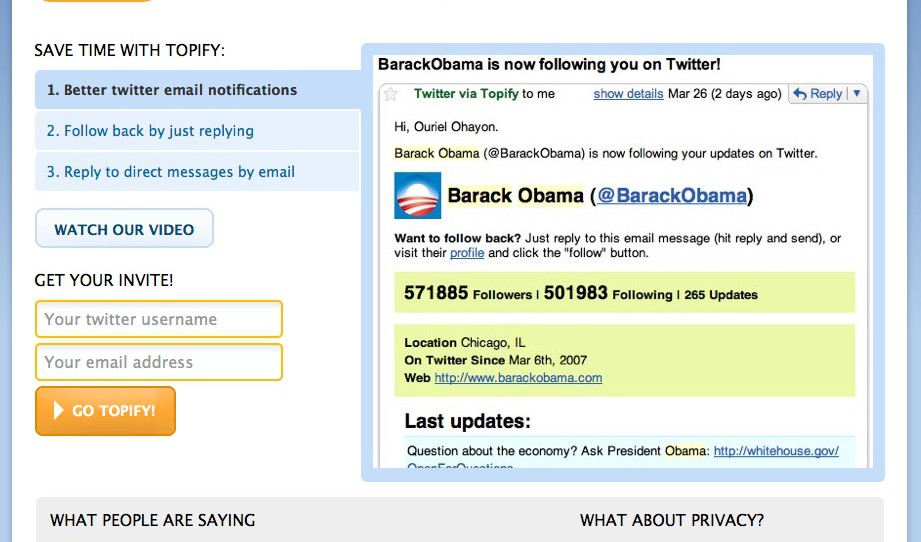
Topify Email NotificationThe way Topify works is pretty simple – it takes over your email account from Twitter. It doesn’t hack into your existing email to do so. Instead, you set up your account at Topify and they provide you with a personal email address.

You then go into your Twitter account settings and replace your normal email address with the Topify one.

Once you’ve amended your settings, Topify starts to send you the same alerts from Twitter that you used to get, but to the power of ten. Now, you get to see the user’s bio, their followers/following ratio, when they joined Twitter, their five most recent updates, their website – basically everything you’d see on their Twitter homepage.

Topify then gives you the option of following that user by simply replying to the Topify email. No message needed – just hit reply. You can also send direct messages by replying with your message, or block unwanted users by forwarding that user to Topify.

By giving you all the options via one single email that it could take you several minutes to check out via Twitter itself, you can see why Topify is gaining popularity with Twitter users.

Seesmic Desktop

Seesmic Desktop PreviewUp until now, the reigning champion of third-party applications to help run your Twitter account has been Tweetdeck.
Its use of columns, groups and account management has been hugely popular. Now, its time as undisputed champ might be near an end, thanks to Seesmic Desktop.

From the same guys that gave us Twhirl, Seesmic Desktop is more than just a possible alternative to Tweetdeck – it’s better (to me, anyhoo). Here’s why:

  • Cleaner layout with fresh neutral colours as opposed to the dark Tweetdeck (although Tweetdeck’s colour options can be changed in the settings)
  • Multiple accounts, ideal for users who want separate personal and business accounts
  • Excellent Facebook integration
  • Better API usage – Tweetdeck limits how many updates you can have per hour, Seesmic seems to avoid this (so far)
  • Less memory suck on your system compared to Tweetdeck
  • Easier navigation between columns and searches
  • Remembers your preferences for URL shortening services and image uploaders

There are numerous other little tweaks – suffice to say, as an alternative to Tweetdeck, Seesmic Desktop comes up trumps. And then some. I love it.

bit.ly

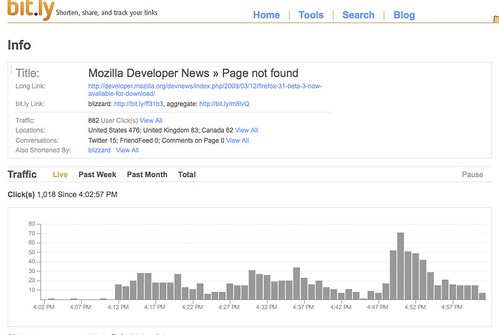
Watching Firefox 3.1 Beta 3 on TwitterSince Twitter only allows 140 characters per message, you need to optimize your space and make sure you’re not wasting any real estate.

To help with this, there have been a host of URL shorteners that allow you to share a website link without having to post the complete URL. My favourite is bit.ly.

While you can use bit.ly straight from the box, the really good stuff happens when you sign up for an account. Once you’re logged in, you can tweet your link and message straight to Twitter.

You can then track how many times your link was clicked, who by, what’s being said about your link and more. There are also a host of additional tools, including support for Firefox, Gmail, email, Facebook, mobile use and much more.

A really cool feature is bit.ly’s support for Google Documents – you can create a Google Spreadsheet template and convert your links into an Excel report. Of all the URL shortening systems, bit.ly is definitely my favourite.

So these are three great tools – but where does the ROI come into play? There are a few ways:

  • Better time management, allowing you to interact with more people, more effectively, building the relationships that could lead to customers/clients
  • Keep tracks on the searches that matter most to you, your brand and your customers/clients
  • See who’s discussing your links, helping you target warm leads for promotional or sales campaigns

Of course, you don’t need to worry about ROI if it doesn’t affect you.

But, if you’re trying to convince your boss (or client) why they should get on Twitter from a business point of view, and need to convince them it’s not a waste of time and does offer ROI, you could do a lot worse than the three examples here.

How about you? What are you using to better manage your time on Twitter and how are you measuring success?

  • Update Friday May 22 – Topify have very kindly released 100 beta invites to readers of this blog. You can get your invitation to try Topify by clicking .

Creative Commons License photo credit: arikfr
Creative Commons License photo credit: adamjackson1984
Creative Commons License photo credit: Christopher Blizzard

I Want to Fall in Love With You

SweetheartsI’m a romantic. I think that love is the one constant that we all want to be in.

We want to love and be loved; being in love is infinitely more preferable than being alone and unloved.

You, as a business, want me to love you. Or you should. You should be wooing me big time. Singing me sonnets, delivering me flowers, buying me dinner, taking me to a movie. I’m a pretty straightforward guy – I know when I’m in love. And I’ve already told you I believe in love, so it makes your advances easier, no?

I’m not a material guy, either. You don’t have to spend millions on me to make me love you. In fact, as long as you just take the time to let me know you care once in a while, I’m pretty much good to go.

Customers are great because every single one of us wants to love your business. It’s pretty easy for you to love us, too. We can even seal it with a KISS.

Keep us at the top of your mind all the time.

Initiate contact with us before we have to contact you.

Sell us just the good stuff. Don’t fake it with us.

Save the technobabble for your internal meetings. Just give us the simple version of what you have and why we need it.

Falling in love is easy. Staying in love takes work and commitment. Thing is, if you work on loving us, you can be sure we’ll share our love for you with others that we love.

Love really does make the world go round. So, are you ready to love the world and go round with us?

Creative Commons License photo credit: adwriter

In Case You’re Interested…

… I was recently interviewed by David Holliday for his Totally Incorrect Media series. It’s an audio interview, and you can either download the mp3 file or catch the recording over at David’s blog.

We discuss social media, blogging, 12for12k and a whole load more good stuff. David was a very genial host and I had a blast chatting with him. He’s also a very interesting character with a pretty cool background – check him out.

I also spoke with Billy Nab over at his Twitter-specific blog PleaseRetweet.me about Twitter, community, marketing, 12for12k, ROI in social media and more. Billy has been one of the biggest supporters of 12for12k from the beginning and always has something interesting to say, and it was really cool to chat with him.

Hopefully you enjoy the interviews as much as I did, and make sure you check out both David and Billy – they’re great guys to know.

  • « Go to Previous Page
  • Page 1
  • Interim pages omitted …
  • Page 136
  • Page 137
  • Page 138
  • Page 139
  • Page 140
  • Interim pages omitted …
  • Page 174
  • Go to Next Page »
© 2026 Danny Brown - Made with ♥ on Genesis