• Skip to primary navigation
  • Skip to main content
Danny Brown

Danny Brown

podcaster - author - creator

  • About
  • Podcasts
  • Journal

Marketing

Webfluenz Brings Social Media and Influence Analysis to the Masses

When it comes to social media analysis and influence marketing, and the ability to use software to identify and track potential influencers for your brand, one thing that always comes up as a stumbling block is the cost usually associated with it.

Because of the data required to filter and rationalize the findings of platform-specific algorithms, costs usually range from the $700 per month mark to anywhere between $3,000-$5,000 per month. So far, this has meant the benefits of social analysis, as well as true influence marketing, has been limited to mid-to-Enterprise-level businesses and organizations.

One company aiming to change this is Singapore-based Webfluenz.

Addressing the Cost of Social Data

The pricing model makes Webfluenz an attractive solution for businesses of all sizes, but especially smaller-to-medium ones that don’t have the financial muscle a mid-to-large Enterprise-type business has.

Webfluenz pricing

For a solo entrepreneur or professional, the free account is a great starting place, with a lot of features that you’d expect to find in a premium solution: sentiment tagging, demographic locale and ad-hoc filtering.

However, when you move up a scale, either to the $299 per month option or the $499 one, this is where Webfluenz really starts to show its benefits, not to mention advantages over similarly priced competitive solutions.

Meeting Multi-Level Business Needs

Let’s say you run with the $299 per month option – ?this is much lower than industry leaders like Radian6 or Sysomos. Heck, even the $499 per month option is. So what are you getting for that, and are you losing features because of the lower cost? Short answer to the features question – no.
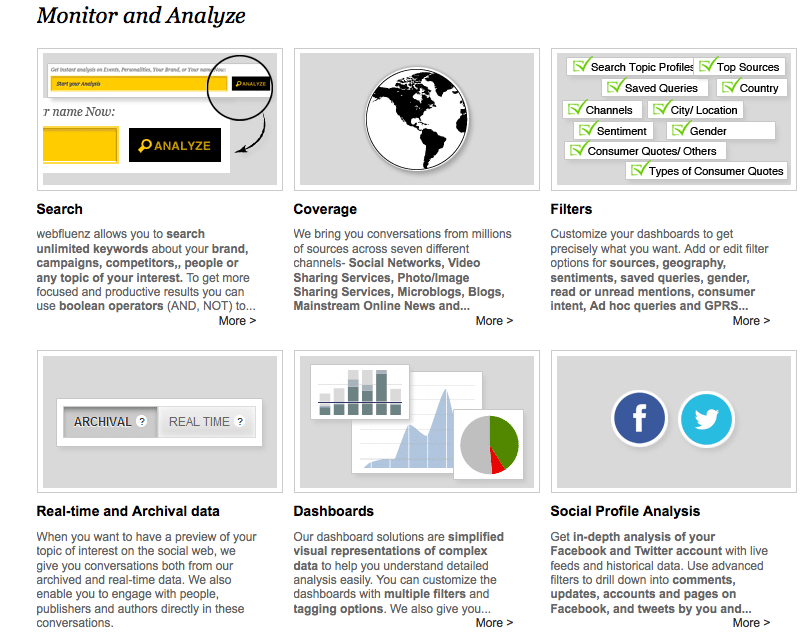
Webfluenz monitor and analyze

Multi-lingual sentiment tagging

Supporting 24 languages of the world’s Internet population, Webfluenz allows you to track around 90% of global languages and allocate sentiment tracking to these conversations. Its proprietary technology breaks common language down into real meaning, as opposed to generic mentions and word definitions.

Qualitative analysis for influencer campaigns

I’m not a fan of judging influence by the amount of amplification an online user can generate. Bots and scripts can inflate numbers. Instead, I’m more impressed by business actions taken based on content shared – sales, leads, downloads, etc. Webfluenz tracks these actions, and the impact on your business, as well as identifies the intent of your target customer (research, compare, buy), enabling a far more effective influencer message can be crafted.

Engagement history

The key to building any kind of business loyalty – online or offline – is the amount you invest in the core relationships that matter. Customer, employee, colleague, stakeholders, etc. Webfluenz tracks all of your enagegements, their levels, frequency, etc., and makes sure you don’t let the most important connections disappear.

Webfluenz Engagement WorkFlow?

Just these three features alone would make an already-attractive price point worthwhile, but the additional features Webfluenz provides takes it up yet another notch.

The Complete Digital Business Suite

One of the biggest complaints around any of the social tools available today is that none of the offer an all-in-one solution.

If you want social monitoring, you need a dedicated monitoring platform. If you want social engagement, you need a good conversation dashboard like a Hootsuite. If you want influence tools, you need ?a Traackr or an InNetwork. If you want a CRM platform, you need a Nimble. And so on.

And this makes sense – it’s rare for any platform to offer an in-depth solution to multiple business needs the way the platforms mentioned above can, in their individual categories.

I’ll give Webfluenz credit here, though – they make a great attempt at answering this criticism.

Competitive analysis

Knowing what works for your competitor, and how they’re driving traffic and sales from their digital efforts, can help you refocus yours and adapt on the fly. Webfluenz shows comparison reports on competitor buzz and growth, while giving you current performance data on your campaigns.

webfluenz - Competitive Benchmarking Analysis? 2013-08-29 15-34-21

Team collaboration and workspaces

Using a simple workflow process, you can assign team roles and duties within the Webfluenz dashboard, as well as follow up on assignments and use this information across internal teams to improve your internal set-ups.

Dashboard reports

If there’s one thing that any business needs, it’s easy-to-understand reports that deliver the kind of data you can act upon. From Deep Dive Reports to Competitive Benchmarking, as well as Comparative Benchmarking and results, Webfluenz has you covered here.

Webfluenz and You

That’s just a sampling of what’s on offer – the full suite of tools, and the ease in which almost any level of user can start diving in, is what helps Webfluenz stand out in an already crowded marketplace.

Add in a detailed user guide, as well as a hands-on support team and account management guide, and you’re going to be pretty hard pushed to find as cohesive a platform at the price Webfluenz is currently being offered for.

If you’re already using a social analysis platform and you’re happy with its performance and features, then you’re probably not going to change anytime soon.?If you’re currently looking for a new suite of tools, though, and you don’t want to break the bank while doing so, I’d definitely recommend checking Webfluenz out.

If they’d create an open API to connect with other tools, it’d be an even better solution that it currently is. The UI could also be a bit slicker when it comes to the engagement dashboard. But?I’ve mostly been impressed so far and, as a demanding grumpy Scotsman, that’s never an easy thing to do.

Nice work, guys.

Edit, August 30: Just heard from Rachana Khanzode, head of social marketing at Webfluenz, and seems the platform does offer an open API, so integration with other platforms should be good to go.

Where Does Online Video Sit in Social Media for Marketers?

Video and social media

Video and social media

With the recent implementation of video posts for popular photo app Instagram, and the swift uptake of the Vine platform when it was released on iPhone and later Android, video has continued to make bigger inroads into the marketing tactics for brands and agencies alike.

Whereas previously marketing budgets would allocate a certain amount for professionally-filmed video for promotion and media ad spots, the rise of YouTube as a content-rich medium for brands saw tactics change.

Videos could be more “real”, with less focus on polish and more on the brand: its story, its products use cases and, most importantly, what its customers felt.

Big Things Can Come in Small Packages

This richer interaction has led the way for Vine’s short, snappy videos, which – despite early criticism of the six second limitations of the format – saw successes for brands that adapted to its style.

  • Nascar gave racing fans an idea of what it was like to be behind the wheel of a race car;
  • Fashion retailer Nordstrom created a funky video of a shoe being passed between Vine apps;
  • Child non-profit Barnardos ran a very powerful Vine short highlighting child abuse for their “Believe in Children” campaign.

Instagram’s new video feature isn’t slouching when it comes to brand usage, either. Despite being later to the market , their longer videos – 15 seconds, compared to Vine’s six – has seen a variety of ways to showcase a brand’s message and culture.

  • Ice cream retailer Ben & Jerry’s use it to show how they make fan favourites;
  • Computer technology manufacturer Dell shows how to create a laptop sleeve using a ?sweatshirt;
  • Women’s lingerie and clothing manufacturer Victoria’s Secret offer a stop-motion gallery on changeable summer accessories.

These are just some examples of how brands are not only using video effectively for promotion, but using short-form video and making it count.

So how does this impact where marketers focus when it comes to integrating different tactics when it comes to social media?

The State of Video for Social Media 2013

A new mini-report from digital publishing company Uberflip shares some statistics regarding video’s continued ubiquity when it comes to online and social media crossover.

Using data from reports by Google, Forrester, ComScore, The Guardian and The Globe and Mail, they’ve compiled this overview into a short video that shows just how much we’re using video, both from a creation and curation standpoint.

Some of the key stats that stand out include:

  • 40 billion videos are streamed in the U.S. every month;
  • 75 million people watch video in the U.S. every month – a quarter of the population;
  • 87% of marketers use some form of video for their content marketing campaigns;
  • $6.3 billion – that’s how much the video ad market is projected to be worth by 2015;

Search Google for “online video marketing statistics” and you’ll get about 97 million results, with stats, figures, predictions and more around this ever-growing medium. Simply put, it’s about to be very big.

How this impacts your brand marketing is up to you – but as both the Vine and Instagram examples linked to in this post show, as well as the more traditional marketing videos, it’s an impact that is growing.

Are you ready for it?

[youtube]http://youtu.be/VyqD0Vzo_K8[/youtube]

image: Daniel Proulx

The Changing Face of Social Media for Business in the B2C and B2B Space

Changing face of social media

Changing face of social media

With the shorter buy-in cycle of consumer customers versus business clients, and the natural usage of social media by “everyday consumers”, the ratio of B2C (business-to-consumer) versus B2B (business-to-business) has traditionally been in B2C’s favour when it came to how companies could benefit from social media as part of their business arsenal. Not any more.

Two recent surveys not only highlight the diminishing notion that social media is better suited to B2C companies, but also how well B2B companies are adapting and competing with their B2C counterparts.

The B2B Integration of Digital and Traditional

The first report is from New York-based abm, or the Association of Business Information and Media Companies. The report – a whopping 425 pages long – was carried out between March and April of this year, with more than 6,600 respondents covering 11 markets, including agriculture, marketing, engineering, healthcare and more.

The goal of the report was simple – to identify what resources B2B companies use to identify/encourage buying signals in their market. The three main questions of the report were:

  1. Marketers, advertisers and sellers: How well do trade media help you reach customers?

  2. Users, readers, media consumers and event attendees: How much do trade media influence your buying decisions?

  3. B2B media professionals: How effective are you at bringing buyers and sellers together?

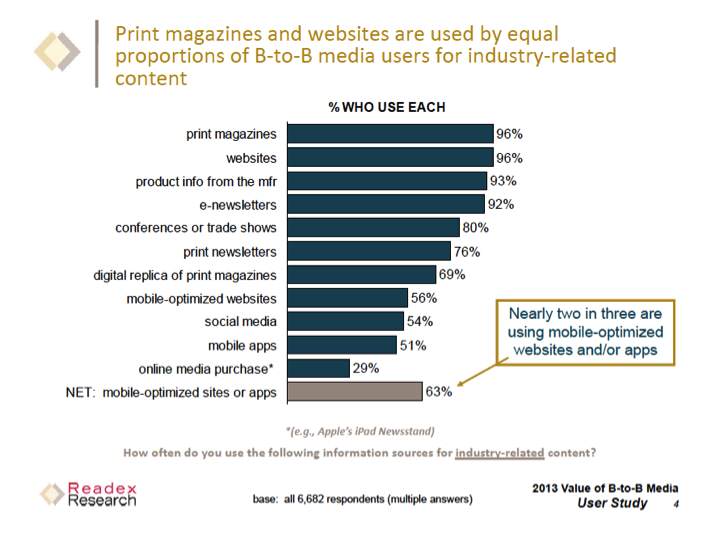
The results were illuminating. While traditional methods like print magazines, product info from the manufacturer and print newsletters were still leading the way, digital resources were equally important.

B2B resources for media

While websites play a huge role, and are equal in usage to the more traditional print magazine approach, it’s the implementation of digital or social media-led resources that catch the eye.

  • Digital magazines – 69%;
  • Mobile-optimized websites – 56%;
  • Social media – 54%;
  • Mobile apps – 51%.

For consultants and agencies pushing the line “social media doesn’t work in the B2B space”, this should act as a bit of a wake-up call.

Not only that, but when you look beyond just the current business use of social media and dig into how B2B sees resource use in the next 3-4 years, the picture becomes even clearer with regards the changing landscape.

Future of B2B media resources

The difference in where the B2B industry sees the market going from where it currently is now is striking.

  • Only 39% see print magazine usage as important, compared to today’s 96%;
  • Just 61% rate product information from the manufacturer, compared to 93% today;
  • Conferences and trade shows drop to 46%, compared to 80% today.

Meanwhile, social media, mobile-optimized websites and mobile apps remain steady in their importance. It’s a clear signal that the B2B space is moving beyond traditional thinking and into more integrated and agile solutions.

However, if the B2B space is showing an interesting trend upward, the B2C space is starting to show some serious wear and tear.

Senior B2C Marketers Know Less Than They Did Before

Marketing used to be so easy. Create a campaign, allocate a budget, blast a message out, (hopefully) see some traction, call it a success, rinse and repeat.

Deeper strategies and tactics weren’t needed, because the channels to view marketing messages were limited – print, TV, radio, billboards, and maybe some emails and telephone calls.

Of course, today it’s completely different. Not only do you still have all these channels, but now you have social networks, review sites, forums, game sites and more competing for your customer’s attention. Combine that with the reduced attention span of today’s connected consumer and the need for much better targeted marketing “just got real”.

The problem is, it doesn’t appear that marketers are keeping up, according to a new study from Yesmail Interactive and Gleanster. Also carried out between March and April this year, the two companies surveyed 100 senior B2C marketers representing brands with revenue between $10 million and $1 billion.

The results were just a little bit scary, although not too surprising.

B2C effective use of data

The main takeaways from the image show that while marketers believe they’re doing a good job of understanding their customers, the reality is a little further from the truth.

  • Marketers are still using reactive data to define customer knowledge – purchase history (67%), customer feedback (59%), and transactional/campaign response data (56% and 54% respectively);

  • Proactive data, such as likelihood to purchase (41%), online behaviour patterns (41%), social data (38%) and customer value scores (36%) is being severely underutilized, despite the fact it paints a far deeper picture of a brand’s customer base, existing and potentional.

By not using this data, the results are two-fold: the false belief that the business is meeting its customers’ needs, and resources being allocated to projects, products and services that are more likely to fail, due to non-relevance and non-market need.

Dig further into the report, and you can see this disparity become even more transparent.

B2C disparity of audience

As per the previous image, the senior marketers surveyed believe they’re doing a great job at understanding their customers based on historic purchases and interactions with the brand.

The problem is, this is just a small part of the bigger B2C picture, and that picture shows a much smaller understanding of the customer than the marketer believes.

  • Transactional data is still viewed as key, despite offering limited and dated insights;
  • A customer’s preferred channels to interact on are unknown;
  • There is no underlying understanding of when a customer is ready to buy;
  • The customer’s use of social media for decisions and actions is unknown;
  • How profitable offline customers are compared to offline ones.

These are just the basics – important basics, but basics nonetheless. If marketers are getting these wrong, then it’s disconcerting to picture what else they’re missing out on.

The blame for this lack of understanding? ?Limitations in marketing tools, poor data quality, and fragmented marketing systems. Sorry, but that’s bullshit.

No-One Said Success Was Easy

These excuses are the same ones that marketers used 10, 20, 50 years ago and more.

“We only have radio to market with”, “we only have TV and radio to market with”, “we don’t have audience insights from TV viewers”, “we have audience insights but they just represent a median percentage”.

And on, and on, and on. While there might have been some validation to that argument a few years back, today it’s anything but valid.

Today, technology – or Big Data, if we want to use the current buzz term – allows us to understand the minutest detail about our target audience.

  • We can understand the emotional triggers that make them take a specific action;
  • We can understand the emotions they feel when viewing a certain product;
  • We can target geolocated offers based on propensity to buy when in a certain neighbourhood;
  • We can identify who influences them to move along the purchase life cycle path at any given time;
  • We can identify cross-cultural opportunities and best practices to implement them;
  • And much, much more.

By using this data and more like it, and having the right people in place to both analyze and deconstruct, we can now target very small and specific buyer communities, allowing for more focused marketing and subsequent performance. This enables a richer understanding of success and failure, and future methods and relationship paths.

Simply put, it’s smarter marketing and where businesses need to start being now, as opposed to 12 months down the line. Does it take a lot of work? Yes, with a capital Y.

It takes employing people that understand the data beyond the data – emotions, human psyches, emotive terminology like sarcasm, and more. It means moving beyond the algorithms and blast radius marketing, and beginning with the customer at the heart of all you do, and working back from there.

It’s not easy, but it does deliver, and much more effectively than current transactional mindsets.

The B2B space is realizing this and catching up on the previously dominant B2C space. Who would have thought..?

The full B2B report from can be downloaded here. A shorter, PDF version can be downloaded here.

The B2C report from Yesmail Interactive and Gleanster can be downloaded here.

image: jbhalper

Social Media Intelligence, The UK / North America Digital Divide, and Social’s Impact on Influence

Social media measurement

Social media and HR

With a long weekend coming up here in this part of Canada, I’m about to take some downtime with my family and switch off for a few days. So, to end the week, I thought instead of a normal post here, I’d point you in the direction of three recent guest posts / Q&A’s elsewhere around the web.

I was grateful to be asked to contribute to three very different blogs in recent weeks – Canyon Communications, Salesforce and The Social Penguin – and the results can be found below. They cover different yet connected topics, so hopefully you’ll find use in at least one of them!

Cheers, and see you next week!

How Social Media Impacts Influencer Marketing

My guest post for the Salesforce.com blog takes a look at how influence is being skewed by the ever-growing noise and ambiguity of the social web.

By creating systems where noise and amplification is rewarded, and social impressions are currencies versus dollar return, are we creating an ecosystem where brands can no longer pinpoint who can help them reach, and meet the needs of, their target customer base?

Read the full article here.

Social Media Intelligence Isn’t Exclusive to Interaction and Participation

Over at Canyon Communications, the topic of discussion is determining business value and the return on investment for your social media efforts.

Often business are out off from entering the social space because of the “engage or die” mindset that often pervades their participation. This fear of scale, interaction, negative feedback, etc., stops many businesses from enjoying social’s benefits across multiple verticals.

This post shares three ways to overcome that fear and use social media intelligently – Social Research, Social Listening, and Social Influence. But more than just marketing examples, it shares how to optimize data insights, company culture, customer retention, crisis communications and much more.

Read the full article here.

Social Media, Digital, and the UK / North America Digital Divide

The last, but not least, post can be found at UK-based The Social Penguin, and is part one of a two-part Q&A.

While many companies are using social media as an integral part of their bigger business strategy, others are lagging behind or struggling to adapt. This can be for many reasons, all of which may have some validity but more often than not are simply used as a fallback.

In part one of the Q&A, I discuss why conflicting information and the fear of selling is social media’s biggest detractor; an example of a great social media campaign that delivered results; the differences between the UK and North America when it comes to digital and social; and why we need to break the silos of PR, social, SEO and content.

Read the full article here.

And with that, I bid you adios!

The Problem with Marketing is It’s Full of Marketers

Marketing dilemma

I’m a marketer. In marketing, our mission, if you like, is to instill desire.

You may see a product you like, but don’t necessarily need. Marketing’s job is to instill enough desire around that product to make you need, or want, it.

While there are several facets to marketing – including the afore-mentioned desire, as well as awareness and promotion – the ultimate goal of any marketing strategy is to increase growth of a brand.

Primarily, this growth is in lead generation and in sales. But it can also be:

  • Customer acquisition;
  • Customer value;
  • Customer loyalty;
  • Share of voice;
  • Competitive advantage;
  • Brand perception.

At its simplest, marketing is the hub that holds much of sales, service, PR and more together. And while that’s part of marketing’s biggest strength, it’s also increasingly becoming its biggest weakness.

The Hyperbole Factor

Because marketing’s role is to instill desire, often it sounds like too many marketers are loving the sound of their own voices, and the niche area that they concentrate on becomes the next big thing to save businesses.

Take a look around the social web, and see what’s being said on Twitter, Facebook, LinkedIn, Google+ and blogs, just as a starting point.

Some of the choicest comments, posts, updates, etc, go a little something like this:

  • Why content marketing is the future of marketing;
  • It’s time for something bigger than social media marketing;
  • Social influence marketing is about to change your business;
  • Mobile marketing is the most powerful media ever invented.

And on, and on, and on. There are literally thousands of different takes on the four highlighted above, but they all share the same malaise of hyperbole where common sense is needed instead.

And that’s the biggest issue with many marketers today – everything is “the next big thing”, and brands need to engage or die, or similarly worded sensationalism.

The truth of the matter, as it’s always been, is that nothing is really the future of anything – it’s simply the evolution of the current.

Marketing is Knowledge

Although his expertise was based in advertising, David Ogilvy nailed it when it comes to successful marketing:

Advertising people who ignore research are as dangerous as generals who ignore decodes of enemy signals.

Good marketers have always used research to base their strategies on.

When I gained my marketing degree way back in the day, it took me four years to attain. During that four years, we were taught everything about the importance of research – the data we needed, the filtering it required, the insights it gave us, and the implementation that would lead to.

That research allowed us, as marketers, to understand our consumers, or those that the brands we worked with were looking to target, from existing customers to potential ones.

The Four A's

It enabled us to create targeted campaigns and content long before content marketing was even a buzzword, and track these campaigns and see what worked and what didn’t.

Simply put, knowledge truly was, and remains, power. Except today, it’s not.

Lazy Marketing Syndrome

Today, marketers have an abundance of ready-made solutions at their fingertips that bypass the need for knowledge.

Instead of doing the legwork that real marketing involves, you have the lazy marketing solutions:

  • Social scoring platforms that promote non-relevant influence;
  • Content marketing platforms that spit out content in classic spray-and-hope promotional tactics;
  • Invasive software that allows mass direct messaging or mobile texts to unsuspecting, non-targeted consumers;
  • Social media “marketing” automation that blasts messages out regardless of goal, platform, relevance of content and more;
  • The pulpits of the gurus and their message that “everything non-social is dead”.

And the sad part is, people and brands are buying into this.

The reason? Marketers, in their ultimate wisdom, have created this fallacy that there’s this amazing golden goose that will deliver results without the legwork needed to make these results happen.

Marketers saw an opportunity to instill the desire we spoke about at the beginning of this post and run with it in a new way. Instead of the desire to buy a product or service, now the desire was “Don’t be the company that dies because you’re not on Platform X!”

Even though Platform X may have been the most ineffective platform for the brand to be on, because there was little research carried out as to whether that was the right move for the brand, based on what their goals and long-term objectives were.

The Folly of Marketers Today

The ironic thing at play here is that the marketers who think this is beneficial, because it makes their jobs easier and brings in easy money, are the ones that are closing the doors on not only their future success but marketing in general.

With the amount of data available to marketers today, there has never been a better time to be a research-led marketer.

  • Big data offers us the insights on purchase life cycles and consumer behaviour that we could only have dreamt of when I started my career;
  • Consumers are helping us shape increasingly targeted solutions that meet their needs, leading to warmer purchase intentions;
  • Metrics and debrief data show us immediately where a marketing message is failing, and how we can fix it;
  • Emotions around a message can be identified, measured and shape future interactions, promotions and sales.

Lymbix ? Sentiment Analysis Reinvented

We have the opportunity to positively impact both the customer’s life and the brand’s success with these tools and data-points we have access to.

Instead, we push the strength of marketing – research, strategy, implementation – aside, and offer diluted versions that have little chance of providing the same level of solutions.

Worse yet, we remove the desire factor and replace it with the push, push, push factor of crappy content and supposed marketing that, while impressions may tell us we’re successful, the real story is how much has been invested and how little that’s yielded.

That’s not marketing – that’s taking the easy path of bullshit metrics and making them sound worthwhile. It nixes real marketing that meets the needs of the customer, the kind of marketing that increases the brand’s bottom line while improving the top line because resources haven’t been wasted on non-effective tactics.

And that’s unforgivable for any real marketer.

The sad thing is, this lazy marketing isn’t just harming an industry – it’s harming other facets of that industry.

When Marketing Sucks, Everyone Suffers

While marketing is primarily around the art of promotion and desire, its footprint touches many more areas of a brand that can mean a major impact if lazy marketing is left unchecked.

  • Future products and innovation suffer, since the brand is unwilling to put more resources into something the customer would welcome with open arms, because real data and insights weren’t forthcoming;
  • Customer service bears the brunt of consumer anger at poor products that don’t live up to the marketing hype;
  • The brand takes a hit, reputation-wise;
  • Competitors are handed sales on a plate as they react to your poor efforts and attract any potential customers you may have swayed.

These are just the basics.

Internally, the damage can be even worse, as marketing teams are fired, morale takes a hit, budgets are cut and stagnation replaces drive and future plans, with brands playing it safe and sticking with what they know, even if all that does is prolong their eventual failure.

While that might seem a drastic scenario, I’ve seen it happen before and will no doubt see it happen again, as we continue to be sucked into the lazy marketer’s pitch and grasp.

But it doesn’t need to be this way.

Marketing should be hard work. It should see brands demand more. It should see marketers deliver more. It should see consumers benefit overall.

Anything else isn’t really marketing – don’t be fooled into thinking otherwise.

image: Joel Abroad

  • « Go to Previous Page
  • Page 1
  • Page 2
  • Page 3
  • Page 4
  • Page 5
  • Page 6
  • Interim pages omitted …
  • Page 19
  • Go to Next Page »
© 2026 Danny Brown - Made with ♥ on Genesis