• Skip to primary navigation
  • Skip to main content
Danny Brown

Danny Brown

podcaster - author - creator

  • About
  • Podcasts
  • Journal

Marketing

The State of Social Media Marketing 2012

Social media measurement

State of Social Media Marketing 2012

Social marketing software company Awareness has just released the second part of its bi-annual State of Social Media Marketing report for 2012, and it makes for some pretty interesting reading.

Surveying 469 marketers from a variety of industries, expertise and verticals, the report looks at how businesses are using social media (or not), the key pain points, and where businesses are heading in 2013.

Some of the key findings include:

  • 44% of companies with social marketing budgets of $100,000 or more are using social CRM software, compared to 16% in general.
  • 68% are interested in expanding their social footprint.
  • 50% see the need to tighten integration between social and more traditional marketing.
  • Social marketing ROI, a larger social presence and reach, and increased content creation and publishing are three areas executives are looking to concentrate on in 2013.

What’s interesting from these points alone is that social is definitely seen as a core strategy for many businesses to take on in the next 12 months and beyond. Yet, clearly, there’s still some ambiguity around social – the ROI question continues, as does building a strong presence where results can be actionable and measured.

The good news is, despite the ambiguity, when you look at the top business objectives for social media it’s clear that the customer experience is key (click to expand):
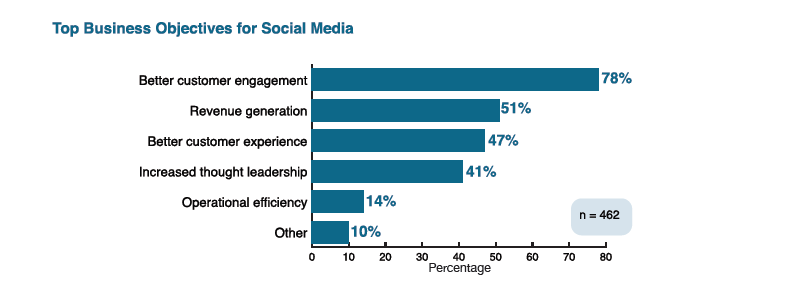
Top business objectives in social media

Seeing two of the top three objectives geared towards the customer is encouraging – it would seem that brands are finally realizing the amplification social offers consumers, so they’d better improve and tailor the experience while continuing to foster the initial touch-point.

So what else does the Awareness report tell us?

Social Media is Still a Challenge

It’s sad to say, but social media continues to be a challenge for many businesses in 2012. This, despite many seeing the tipping point of social media as 2010, when the ROI question and the business benefits of social media were really taken into the mainstream.

So what are the challenges that businesses continue to face when it comes to social media?

Top social media marketing challenges

While the lead challenge is still that of ROI, what’s interesting is the percentage that are struggling to integrate with the rest of the marketing vertical.

This accounts for almost a third, and is a clear indication that businesses are finally starting to realize that social isn’t a standalone strategy, but a core part of the bigger marketing picture. While it’s a struggle at the minute, the recognition it needs to be integrated bodes well for the future of these businesses.

Social Media and Measurement

For any business, knowing how successful a campaign is – whether that’s external or internal – is key to understanding where that business needs to grow and improve, and where it’s already doing a good job.

When it comes to social media, measurement is just as key – and brands are definitely keeping score when it comes to how effective their business is on social media:
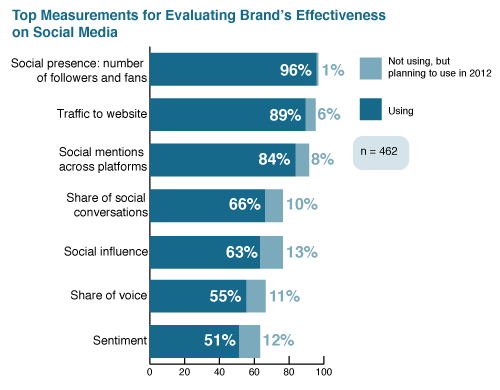
Top social media measurements for brand effectiveness

What’s interesting about this particular section of the report is that almost every single respondent chose number of fans and followers as the #1 barometer of social media success.

This, despite the fact fans and followers can be bought for as little as $5 for 10,100 Twitter “followers”. While it’s great to have a large following, it’s how engaged and involved with your brand that really matters. Numbers mean squat unless they add to your business overall.

Social influence is truly becoming a mainstay of the business landscape when it comes to social media, with almost 2/3 of businesses looking to increase their influence in the space. As Kred, Klout and others look to grab this slice of the action, expect that number to rise in 2013.

Social Media and Revenue

Perhaps one of the biggest questions around social media is that of revenue and lead generation. With ROI still being the leading business question around social media channels and campaigns, it’s no surprise that revenue is a core part of the equation.

What is surprising are two of the answers to the revenue question:
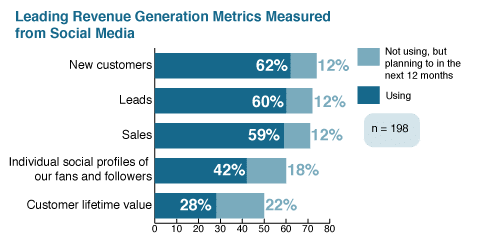
Social media and revenue

While the top three responses make perfect sense, the next two are a little worrying. If, as a marketer, you don’t know where your customers are online, you’re immediately at a disadvantage to your competitors who’re actively profiling their customers.

Even more concerning, perhaps, is the percentage that uses social media when it comes to the lifetime value of a customer. To these businesses, there’s a simple question in return: if you’re not using the simplest way to track a customer’s satisfaction, what exactly are you using?

By knowing your customer’s social footprint and combining that with monitoring and profiling, you can get an untainted and unbiased overview of what they think about you, your brand, your product and/or your service.

Social media continues to be the greatest focus group out there, because it’s tuning in on natural conversations – so why are just over a quarter of marketers understanding this? Scary stuff.

The Future of Social Media

As you can see, there are still some major challenges in the adoption of social media when it comes to business, regardless of size and resources.

As well as the points above, other challenges include tracking multiple channels, choosing the right tools, delegating the right people and tying social media results to actual business results.

The social CRM issue continues to be one that’s lacking in uptake, with only 16% of businesses currently using a social CRM system. While 21% are planning to, 17% don’t know what a social CRM system is and why businesses need it.

It’s perhaps this last stat that’s the most concerning since, without a CRM platform in place, how do you expect to truly measure activity and results, and allocate the right resources and team members, to ensure the customer experience is everything it can be?

The good news is, companies are beginning to notice where they’re lacking and what needs to be done to improve:

  • 53% of businesses are now using more than two Facebook accounts, to offer a more targeted experience (13% have more than five profiles).
  • 45% of businesses have two or more Twitter accounts, with 11% having more than five profiles.
  • 80% of marketers are creating teams of up to three people to manage social media.
  • 65% are using community platforms to engage with their customer base, while collaboration platforms like Basecamp and Huddle are expected to be used more in 2013.

There’s no doubt that social media is here to stay. Consumers continue to be the driving force behind its growth and businesses are clearly realizing they need to catch up.

The State of Social Media Marketing report offers hope that they’re doing just that.

To receive the full State of Social Media Marketing 2012 report, click here.

Related articles
  • Is Social Media a Waste of Time? (dannybrown.me)
  • How Much Listening Does Social Media Listening Really Offer? (dannybrown.me)
  • A Special @JugnooMe Invite to @Seesmic Users #Seesmic (dannybrown.me)

Sorry, Content Dudes, But It’s Just Plain Old Marketing

Empty blog

If you search “content marketing” on Google, you get about 560 million results.

There are events dedicated to content marketing, and folks like Brian Clark, Joe Pulizzi, Marcus Sheridan and others are huge proponents of the term.

So, big business then. And yet…

Is there really such a thing as content marketing? Or is it just marketing, plain and simple, and a facet of a bigger picture?

According to Wikipedia:

…content is information and experiences that may provide value for an end-user/audience in specific contexts.

So, by definition, content is information that may help in the decision-making process.

Marketing, on the other hand, is a different beast altogether. The core reason for marketing to exist, in no uncertain terms, is to make a buyer fall in love with something enough to purchase it.

This “something” can usually be categorized into three clear sections: product, service, expertise.

The Product and Service Angle

Product and service is straightforward. You make something, or provide something, and charge people for that. This could be footwear, a meal, cleaning services, or a million other things.

But it’s still the product or service that’s being marketed.

Sure, you might write a blog post about your industry and why your offering is better than anyone else’s.

Or you might create a video to showcase a design and embed on your website.

But that creation of content is simply a tactic in the bigger picture of marketing. The content is created to market the end product – you’re not marketing the actual content.

If you were, the message would be something like “See how cool this video / blog post is – buy the content now!”. Which wouldn’t make any kind of sense.

Switch to a marketing message, though – “The X1Z Thingymajig – Order Yours Today!” – and it’s back to using the content to drive sales of the product or service.

The Expertise Angle

One area where content marketing could be seen as a standalone solution is that of expertise (particularly on business blogs).

To show you’re someone a potential customer should do business with, you share your expertise and knowledge with your audience. You might provide white papers, or ebooks, or webinars, to help propagate that expertise and separate you as a thought leader (if that’s your goal).

The thinking here is, if the audience sees you know your stuff, they’re more likely to do business with you than your competitor.

But then, there’s that “do business with” phrase again. Because, as much as a business or consultant can say they’re offering expertise for the good of their readers, there’s always another end goal in sight – attracting business for your offering.

Sure, you’re offering free content as opposed to charging for it – but it’s with the goal of marketing your businesses through less in-your-face means. The end goal is still dollars in the cash register for whatever it is you’re selling (product, service, consultancy expertise).

Content is Still a Key Tactic

Now, I don’t want this post to come across as dismissing the importance of content when it comes to marketing your business. As someone who’s consulted clients over the years on the benefits of content, I know the value content brings to the table.

A successful blogger outreach, for example, can reap rewards at a far reduced cost to a business than traditional print or media ad buy can offer. A timely video can capture the hearts of your customers more than a radio ad ever could. And all the other pieces of content that get discussed when talking about content marketing all offer value too.

The thing is, though, it’s still just another tactic. The content is part of the overall strategy to get a customer to buy into your offering, and a solid part at that. But a standalone? I can’t see it.

Besides, when was the last time you ever saw a major news release and promotion for your latest blog post..? 😉

If @Klout is Fixed, Why Are They Profiling an 11-Year Old Kid?

Klout and minors

Klout and minors

Two days ago, social influence tool Klout published a blog post on how they had updated their algorithms to answer critics of their service.

From the post:

Today, we?re introducing some of the most significant product updates in Klout?s history. With these updates, we?ve concentrated on helping everyone to gain a clearer, more accurate understanding of how they influence other people through the ideas they share.

As part of the update, Klout promises “increased accuracy”. Which is great, as this is one of the core complaints about the service. They also promise more transparency, more data, real-world influence. And a shiny new site design…

However, one glaring omission from the post is the question of Klout and privacy.

There have been numerous posts written about Klout’s policy of creating profiles without the explicit permission of users, and the fact you have to opt out of the service if you don’t want profiled.

Worse still, though, was the discovery that minors under the age of 18 were being profiled by Klout, from something as innocuous as being connected to their parent on Facebook.

Due to the backlash against this practice from numerous bloggers, Klout CEO Joe Fernandez came out and stated “Klout has no interest in profiling minors”.

So, why does the Klout website have a profile for an 11 year old kid (click to expand)?

Klout Influence Report 11 year old

This is the son of a friend of mine, Jennifer, who brought it to my attention that both her kids were being profiled by Klout. Her son is the 11 year old pictured here, and her daughter is 14 later this year.

Both profiles are clearly there for all to see. Not only that, but her daughter’s profile on Klout shows who she influences. One is her brother, the other is her friend – also 14.

Klout Influence Report 14 year old

Jennifer spoke with both her kids, and neither of them even know what Klout is, never mind that they have a profile on there.

So, despite all the questions about privacy and minors, and despite Klout’s statements that this would be fixed, it’s clear the company is still adding profiles of children that fall under Klout’s own privacy terms.

Klout Privacy Policy

These terms have actually been updated, since it was previously under-18’s that weren’t “allowed” on Klout. Even so, is it really fair for any company to take a kid’s details and parade them on a site where numbers attract advertisers?

And while Klout advises parents to monitor their kids’ online activities, it’s hard to do this when you have to be logged into Klout to see your kids (if you opt out, you get redirected to a Facebook or Twitter sign-in page).

Now, it could be said that the kid shouldn’t be on Twitter (and thus, Klout) in the first place, since he’s under 13 years old. But as we move towards a more online world, kids are going to go online anyway – the best approach for many parents, and one that they’re taking, is to help guide them on the way.

With that in mind, isn’t it about time Klout quit adding profiles on an opt-out basis, and only has people on there who have voluntarily opted in? Maybe then parents wouldn’t have to worry about their kids being taken advantage of in this way.

Heck, there’s already enough online pitfalls to try and keep our kids safe from without a social score to worry about…

  • Update: The 11 year old also has a profile on Klout competitor Kred, despite their Terms of Service stating it’s for 13 years and older – more reasons for the opt-in process to be standard.
  • Update: Following an email from the 11 year old’s mother, Kred has made her kids’ pages on Kred inaccessible.

    Kred and minors

At Some Stage the Conversation Has to Advance

Over on Facebook, author and marketer Geoff Livingston posed the following question/statement:

Apart from the misplaced punctuation mark in CEO’s (*cough*, sorry Geoff, couldn’t resist!), it’s a great question, and one that solicited some great responses (mostly along the lines of CEOs don’t need to tweet).

Because, simply put, a CEO has one job and one job only – to meet the goals set for the company by the Board of Directors. In that role, he or she becomes responsible for four key tenets:

  • Communicator – ensuring the outside world and/or media are kept up-to-date with the current business.
  • Decision maker – responsible for the overall strategy and policy making.
  • Leader – advising the board of progress, motivating employees and driving change in the organization.
  • Manager – overseeing the day-to-day challenges and operations within the organization.

See any mandate for tweeting there, or being active on social media? No – because, as Geoff rightly points out, the role of a CEO is far more reaching than the occasional tweet.

So why are we still having this conversation about CEOs and the need for them to tweet? Simple – social media is stuck in a time-warp created by a number of “experts” severely lacking in true business acumen.

I Have a Klout Score of Eleventy Billion, Therefore I Am

Don’t worry, I’m not going to start one of my anti-Klout rants here. But the influencer model and social scoring metric has led to an epidemic of businesses looking to the wrong people to help them with their goals in social media.

Whereas previously consultants and agencies had to work their asses off to get to a level of expertise and trust before they began advising corporations and organizations, now you just have to appear to know what you’re on about and have that validated for you by your impressive social score.

It’s not really the fault of these platforms either – although they have exacerbated the problem with their “You’re no-one unless you’re a social someone” approach.

Social media in general has allowed people to rise from nowhere and become “the voice” that people should listen to when they speak.

Never mind the fact that their LinkedIn profile has no experience of actually running a multi-million dollar company; or shows any kind of success metrics or return except a high score on the latest influencer platform and a speaking slot at some non-descript conference.

And yet these are the folks that are advising CEOs should be stepping away from their daily duties and responsibilities to their employees, shareholders and customers, so they can impart 140 characters of wisdom that may have been vetted and scripted anyway.

It’s advice that seems to have been pumped for the last 5 years or so – as Doug Haslam put it on Geoff’s Facebook wall, “We’re still talking about this? <kicks time machine to make sure it hasn’t malfunctioned and sent me back 5 years>.”

It also shows the maturity this space still has to go through, and the nonsensical talk that “experts” need to advance from.

Customers Don’t Necessarily Care About the Tweet Owner

One of the main arguments put forward by these social media wonks (using Geoff’s description) is that by having the CEO tweet, the brand becomes more human and awesome.

Sorry, but you can’t pay the bills with awesome.

Can CEOs tweet and improve the brand perception with customers? For sure, and there are many examples of this – Zappos and Virgin are two that spring to mind.

But they also had an incredible culture within the company too, that the CEO mandated as part of his Leader role. The true success of these brands, and others in the social space, is not that the CEO is tweeting – it’s that the CEO empowered others to be truly human in their interactions with customers.

The majority of customers don’t care if the CEO tweets or not – what they do care about is an excellent product, a fair price, and a superb experience both during and after the sale.

That kind of return is what the CEO is employed to achieve – and he or she employs the right people to do that, whether it’s in sales, HR, or social media. Getting that part right is the role of a CEO – not hovering about on Twitter in the hope of “being awesome”.

Something those that are advising a CEO what to do had they ever had the actual experience of what that incurs behind them.

Otherwise, continuing the same kumbaya conversation will only hurt in the long run, and then everybody loses. Especially business.

Note: My friend Jeff Esposito has a great post today on the same topic.

The Psychology of Being Memorable

Being memorable

Consumers love simplicity.

We don?t want to be confused with multiple messages and options. We just want to buy the product or service that we need at that time and have it work, or improve our lives. Make our lives simpler.

Simple works. Simple means we can concentrate on other things. So when I?m shopping with you, why not make my experience the same whether I?m buying from you online or offline?

Direct the Traffic

I?ve been on some fantastic e-commerce websites that make shopping a cinch. Clean, well laid out and simple breadcrumb directions to the deals I?m interested in. I?ve then gone to other retailers that would make excellent poster boys for double servings of spaghetti ? they?re just all over the place and falling out the bowl.

Do customers really like this scattergun approach?

I?m not a huge fan of IKEA ? I think a lot of their stuff is chintzy, and just wouldn?t look right in my home.

BUT? I am a huge fan of the layouts in their retail stores. You go in the front entrance, and you simply follow a path until you reach the checkouts. You never feel lost, or cluttered ? everything is relaxing.

The Psychology of Being Memorable

It?s not surprising ? IKEA have mastered the psychology of shopping. They theme areas and direct you to where you?re most likely to purchase at a given time, all by simple layout structure.

Their websites follow this simplicity, with each country following the same design, and this has turned the Swedish furniture giant into one of the most successful retailers around. You have to respect that whether you like them or not.

It?s not just retail where IKEA?s mindset can be used. Think about everywhere you offer something to your visitors; customers; potential clients; new and existing employees; media enquiries; blog readers. Think about how you?re guiding them to where you want to be and how you can help them return.

You don?t need the psychology of shopping to help make you memorable; but you do want to be remembered, especially for the right reason.

Right?

image: taking leave

  • « Go to Previous Page
  • Page 1
  • Interim pages omitted …
  • Page 8
  • Page 9
  • Page 10
  • Page 11
  • Page 12
  • Interim pages omitted …
  • Page 19
  • Go to Next Page »
© 2026 Danny Brown - Made with ♥ on Genesis